বইগুলো এখনো বাংলা ভাষায় পাওয়া যায় না — ইংরেজি সংস্করণ দেখানো হচ্ছে।
Primary & Middle School Earth and Space Sciences · শ্রেণি 1–9
13The Earth, a Planet of the Solar System
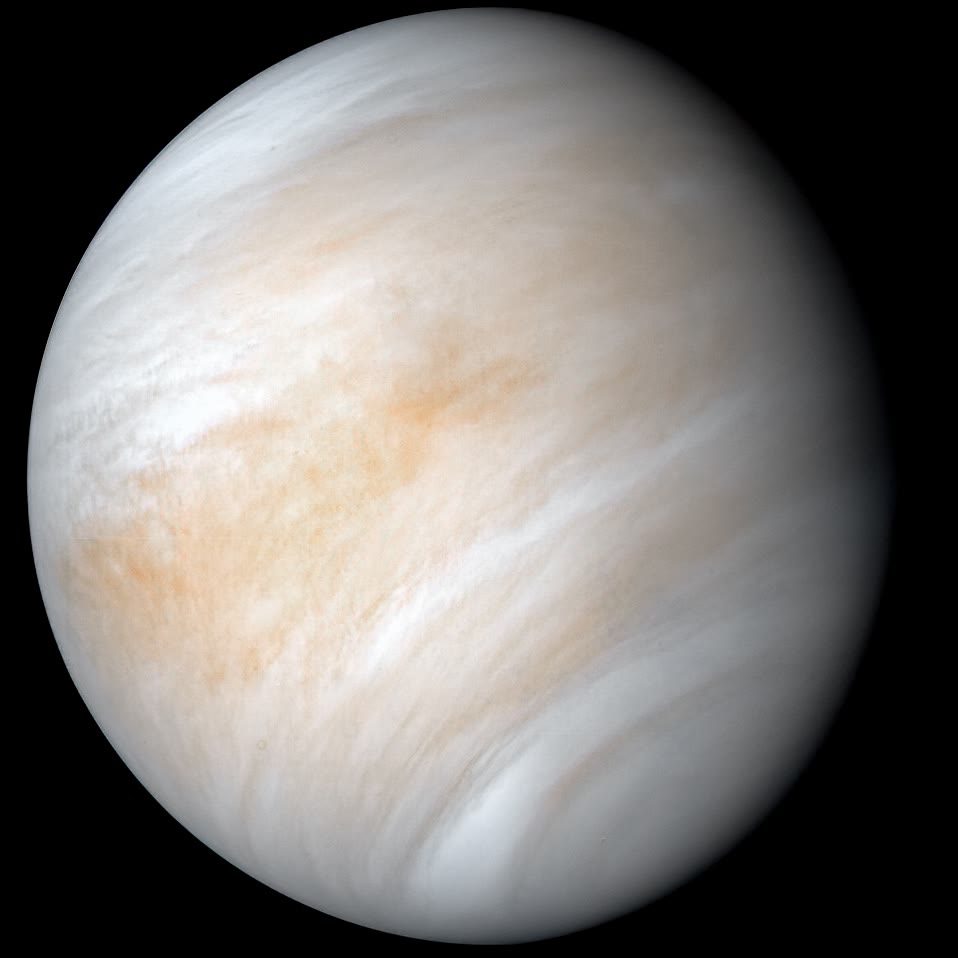
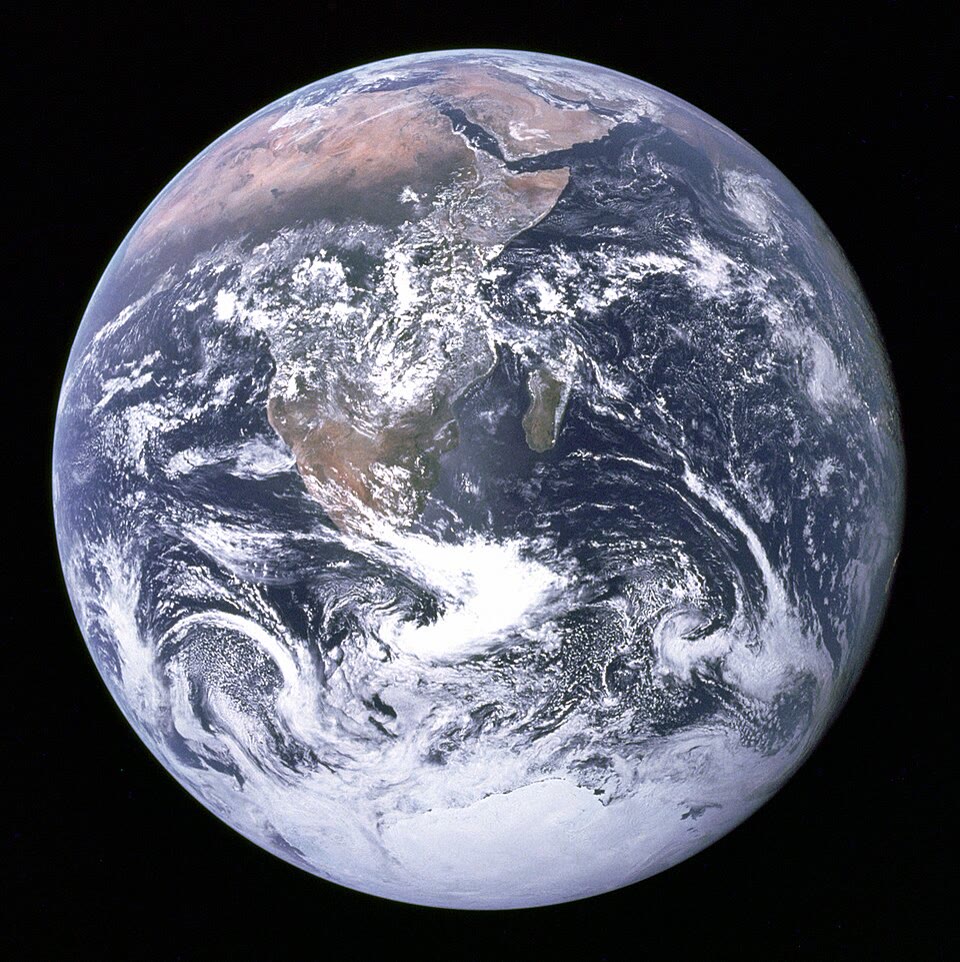
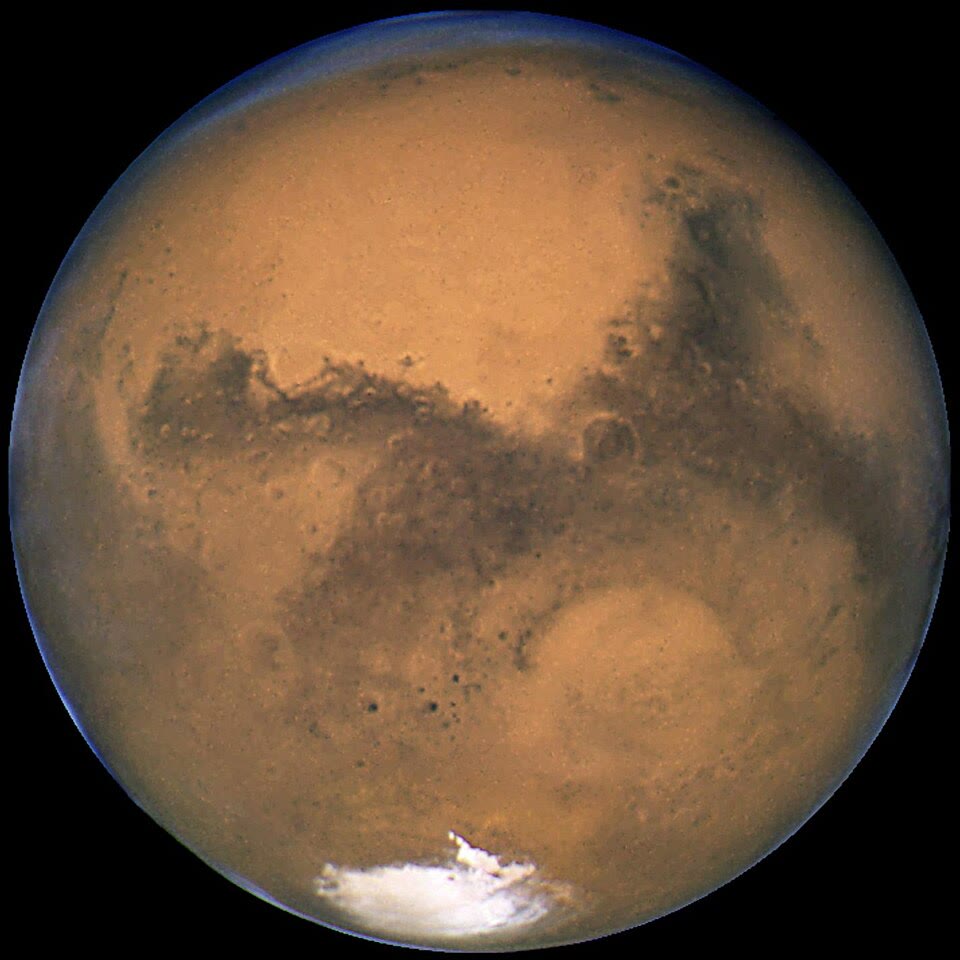
Three robot probes have been sent out into space. One by one, they send home a picture, like a postcard. The first comes from Venus: a pale ball wrapped in thick clouds, where it is hot enough to melt lead and the air presses on the ground with a crushing weight. The second comes from Mars: a red, cold, dusty desert under a thin sky. The third probe has turned its camera back towards home: a blue and white ball, with oceans, clouds and ice. Three planets, neighbours around the same Sun. Why is only one of them blue?
You already know
The physics books showed that the Sun is a star, a huge ball of hot gas that shines by itself, and that a planet is a large round body that turns around a star and does not shine by itself: we see it because it reflects the light of its star. The Sun and everything that turns around it form the Solar System. Each planet travels round the Sun along a path called its orbit, and spins on itself around an axis. The air around us presses on everything it touches: this is air pressure. The density of a material tells how heavy a given volume of it is: one cubic centimetre of water weighs 1 gram, so its density is 1 gram per cubic centimetre; a material denser than water sinks in it, a material less dense floats. Finally, about seven tenths of the Earth’s surface is covered by the ocean (Chapter 3).
13.1 Eight planets around the Sun
Eight planets travel around the Sun. In order, from the closest to the farthest, they are Mercury, Venus, the Earth, Mars, Jupiter, Saturn, Uranus and Neptune. A sentence can help to remember the order: My Very Easy Method Just Speeds Up Naming (Mercury, Venus, Earth, Mars, Jupiter, Saturn, Uranus, Neptune).
The drawing below shows the eight planets side by side, drawn to the same scale: if a planet is twice as wide as another, its circle is twice as wide too.
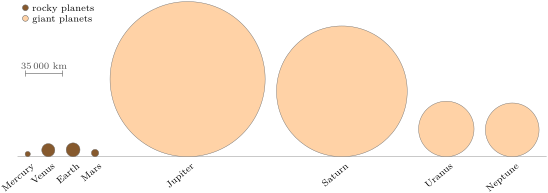
The four planets closest to the Sun are small. The next four are giants: Jupiter is about 11 times as wide as the Earth. And the Sun? Drawn to the same scale as the planets above, it would be a disc about 40 centimetres across — wider than this page.
Size is not the only difference. The table below gives, for each planet, its diameter, its density (in grams per cubic centimetre), and its distance from the Sun.
| planet | diameter (km) | density (g/cm) | distance from the Sun (million km) |
|---|---|---|---|
| Mercury | 4 879 | 5.4 | 58 |
| Venus | 12 104 | 5.2 | 108 |
| Earth | 12 756 | 5.5 | 150 |
| Mars | 6 792 | 3.9 | 228 |
| Jupiter | 142 984 | 1.3 | 779 |
| Saturn | 120 536 | 0.7 | 1 432 |
| Uranus | 51 118 | 1.3 | 2 867 |
| Neptune | 49 528 | 1.6 | 4 515 |
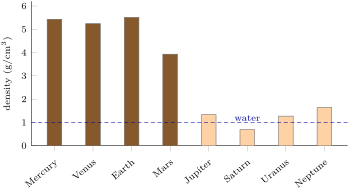
The densities split the planets into two families, with nothing in between: the first four are dense, more than 3.9 grams per cubic centimetre, like rock and metal; the last four are light, less than 1.7 grams per cubic centimetre.
Definition 13.1 (Rocky planets and giant planets)
A rocky planet is a small, dense planet made of rock and metal, with a solid surface on which a probe can land: Mercury, Venus, the Earth and Mars. A giant planet is a very large planet of low density, made mostly of gases and liquids, with no solid surface to land on: Jupiter, Saturn, Uranus and Neptune.
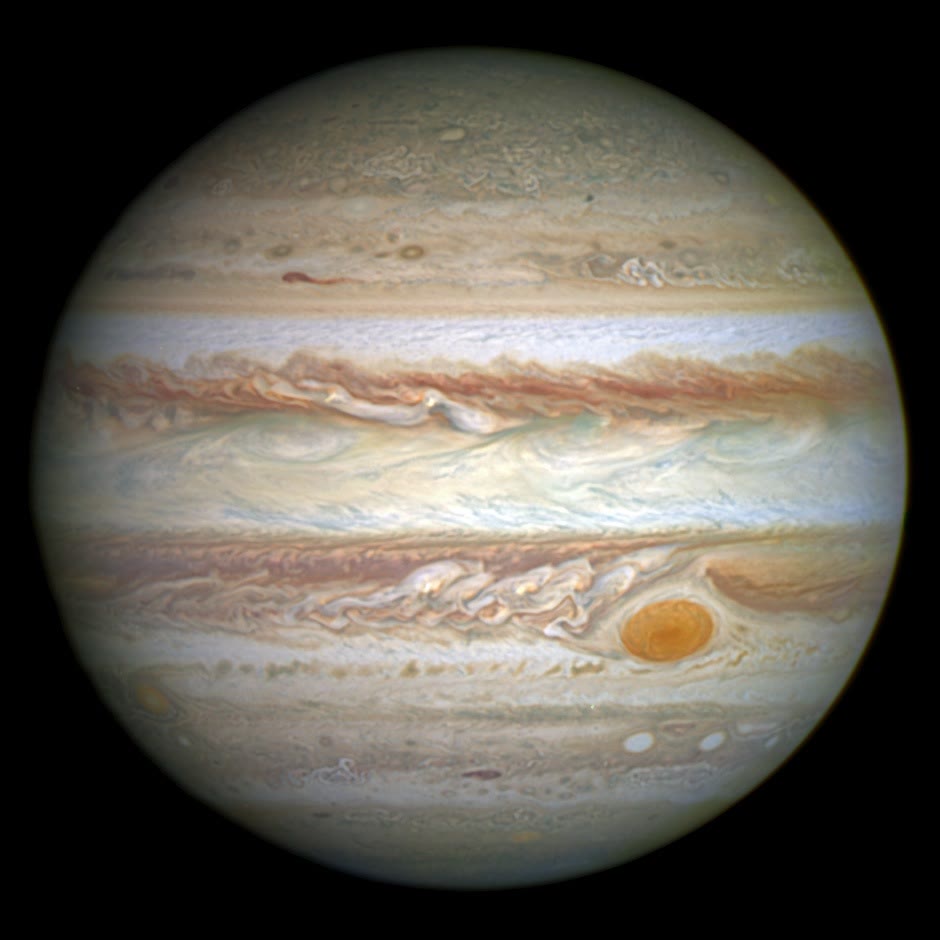
The photograph of Jupiter shows bands of clouds, light and dark, and a red oval: the Great Red Spot, a giant storm larger than the whole Earth, which has been blowing for hundreds of years. Below the clouds there is no ground: only gases, mostly hydrogen and helium, which get denser and denser deeper down.
Remark 13.2 (A planet lighter than water)
Saturn is the only planet whose density is less than that of water: about 0.7 gram per cubic centimetre. If there were a bathtub large enough to hold it, Saturn would float!
13.2 How far apart are the planets?
The planets are not only very different in size; they are also very far from one another. The Earth is about 150 million kilometres from the Sun. Neptune, the farthest planet, is 30 times farther: about 4500 million kilometres. The drawing below puts the eight planets on one line, at their distances from the Sun, to scale.
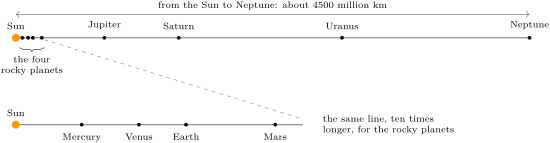
The four rocky planets are all close to the Sun; the four giant planets are far out, with huge gaps between them. The gap between Mars and Jupiter alone, about 550 million kilometres, is more than twice the distance from the Sun to Mars.
It is hard to draw sizes and distances on the same scale: the planets become invisible dots. A scale model helps to imagine both at once.
Method 13.3 (Building a scale model of the Solar System)
- Choose the size of the Earth in the model, for example 1 cm.
- Find how many real kilometres 1 cm of the model stands for: divide the real diameter of the Earth (12 756 km) by its size in the model.
- Divide every real size and every real distance by this number. Then change the units to something easy to picture (centimetres, metres, kilometres).
Example 13.4 (A marble for the Earth)
If the Earth is a marble 1 cm wide, 1 cm stands for 12 756 km. The Sun, 1 391 400 km across, becomes a ball cm wide: a ball taller than a small child. The Earth is 150 million km from the Sun: cm, that is about 117 metres, the length of a football pitch.
| body | size in the model (cm) | distance from the Sun (m) |
|---|---|---|
| the Sun | 109 | — |
| Mercury | 0.38 | 45 |
| Venus | 0.95 | 85 |
| the Earth | 1.00 | 117 |
| Mars | 0.53 | 179 |
| Jupiter | 11.21 | 610 |
| Saturn | 9.45 | 1123 |
| Uranus | 4.01 | 2248 |
| Neptune | 3.88 | 3540 |
In this model, the whole Solar System as far as Neptune spreads over a circle 7 km across, with a big ball in the middle and eight marbles and balls, the largest the size of a grapefruit, scattered across it. The Solar System is mostly empty space.
13.3 Venus, the Earth and Mars
Venus, the Earth and Mars are neighbours, all three rocky planets. Venus is almost the same size as the Earth: its diameter is 95 % of the Earth’s. Mars is smaller: its diameter is about half of the Earth’s. Yet these three planets could hardly be more different.
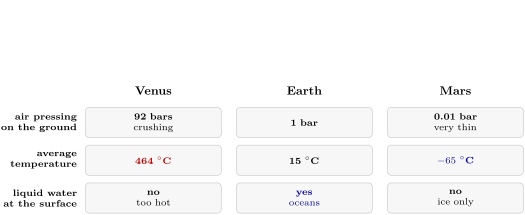
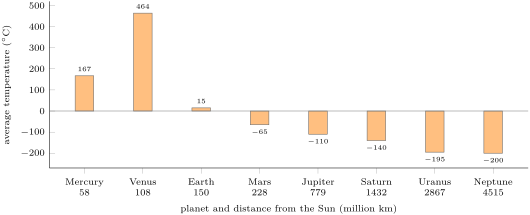
Venus. Venus is wrapped in a thick layer of air, made mostly of carbon dioxide, with dense clouds of sulfuric acid, a burning acid. Its air is so thick that it presses on the ground 92 times as hard as the air of the Earth presses on ours. At the surface, the temperature is about 464 C: hot enough to melt lead. No water can stay liquid there.
Mars. Mars is a cold, dry, dusty desert. Its air is also made mostly of carbon dioxide, but it is very thin: it presses on the ground about a hundred times less than the Earth’s air. The average temperature is C. Water is found there today, but frozen: as ice in the polar caps and under the ground near the poles. Yet Mars has not always been like this: billions of years ago, rivers flowed on Mars, lakes formed and floods swept across it.
The Earth. Between the two, the Earth has air that presses on the ground with about 1 bar (the unit used to compare the pressure of the air on the planets), an average temperature of 15 C, and oceans of liquid water.
Hot and cold. Close to the Sun, a planet receives a lot of its light and heat; far from it, very little. So the farther a planet is from the Sun, the colder it should be. The chart below shows that this is true from the Earth outwards: the giant planets, far away, are frozen worlds. But look at Venus: it is almost twice as far from the Sun as Mercury, and yet it is hotter! Its thick air of carbon dioxide traps the Sun’s heat like a heavy blanket and does not let it escape. Mercury, with almost no air, cannot keep its heat.
13.4 What makes life possible on the Earth
The Earth is the only planet where we know that life exists. Living things need several conditions together, and the Earth has them all.
- Liquid water. All living things need liquid water: the Earth has oceans, rivers and lakes.
- Mild temperatures. At the Earth’s surface, water freezes at 0 C and boils at 100 C (physics). With an average of 15 C, the Earth’s temperatures stay mostly between the two, so its water stays liquid.
- The right distance from the Sun. Closer to the Sun, like Venus, a planet risks becoming too hot; farther, like Mars, too cold. The Earth is at the right distance for liquid water.
- An atmosphere. The layer of air around the Earth keeps its surface warm at night, gives living things the gases they need, and presses enough on the oceans for their water to stay liquid. On Mars, the air is so thin that liquid water cannot last long at the surface: it freezes or turns into vapour.
Remark 13.5 (Was there life on Mars?)
Since Mars once had rivers and lakes, scientists wonder whether tiny living things could have lived there, long ago, when Mars was warmer and wet. Scientists do not expect to find living things on Mars today; with robot rovers, they look in its rocks for signs of life that existed long ago.
13.5 The Earth seen from space
For thousands of years, people could only imagine what their planet looked like from outside. On 24 December 1968, the astronauts of Apollo 8, in orbit around the Moon, saw the Earth rise above the grey horizon of the Moon, and one of them, Bill Anders, took the photograph below.
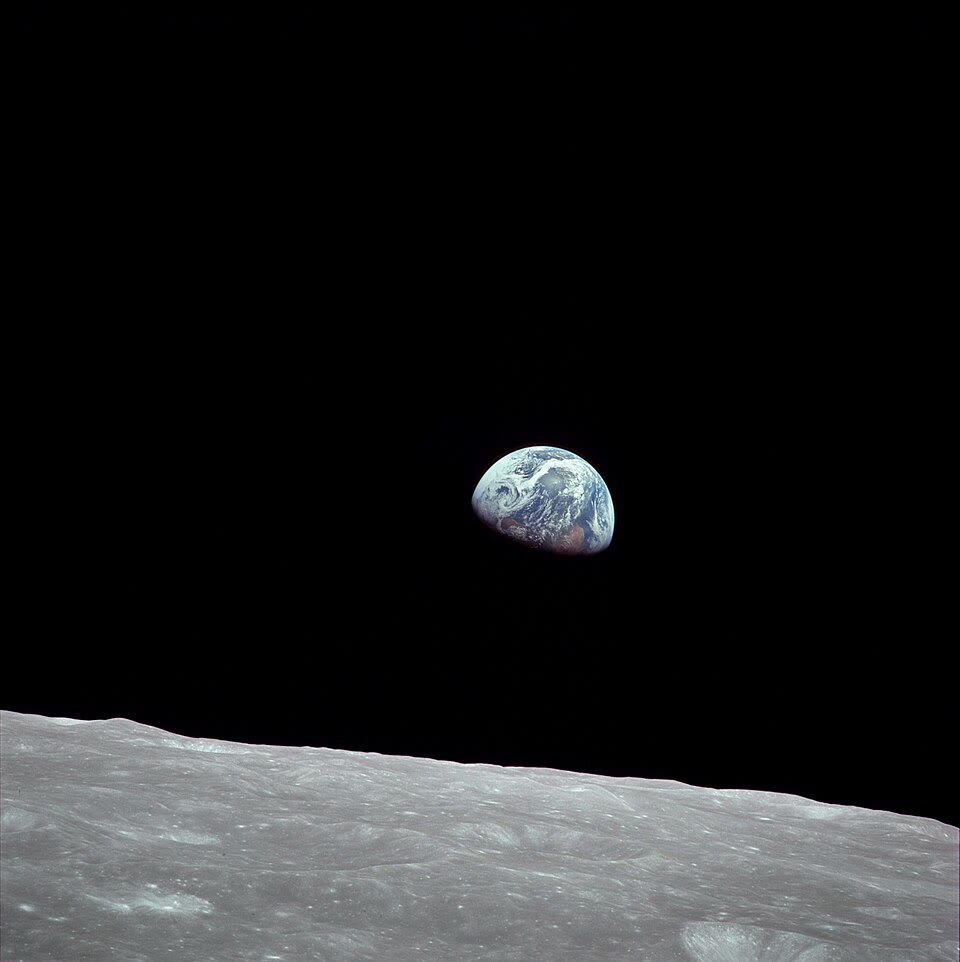
Seen from space, the Earth is mostly blue: the ocean covers about seven tenths of its surface. White clouds of water droplets swirl above it, and white ice covers the poles. The land is brown where it is dry, green where plants grow. The air itself cannot be seen, but the clouds floating in it show that it is there. Of all the planets of the Solar System, only the Earth shows these colours together: liquid water, clouds and living plants.
History — The pale blue dot
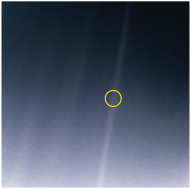
On 14 February 1990, the space probe Voyager 1 was about 6 billion kilometres from the Sun, farther out than Neptune. Before leaving the Solar System behind, it turned its camera back and took a picture of the Earth. In the photograph, our planet is a single bright speck, smaller than a grain of dust, caught in a ray of sunlight. The astronomer Carl Sagan wrote about it: “Look again at that dot. That’s here. That’s home. That’s us.”
13.6 Exercises
Exercise 13.1 ★
List the eight planets of the Solar System in order, from the closest to the Sun to the farthest. Underline the rocky planets.
Solution
Solution of Exercise 13.1.
Mercury, Venus, the Earth, Mars, Jupiter, Saturn, Uranus, Neptune. The rocky planets are the first four.
Exercise 13.2 ★
Copy and complete: “A rocky planet is small and …, with a solid … A giant planet is very large, of low …, made mostly of … and …”
Solution
Solution of Exercise 13.2.
“A rocky planet is small and dense, with a solid surface. A giant planet is very large, of low density, made mostly of gases and liquids.”
Exercise 13.3 ★
Using the table of this chapter, which planet has the diameter closest to the Earth’s? Which is the largest planet? Which is the smallest?
Solution
Solution of Exercise 13.3.
Venus (12 104 km, against 12 756 km for the Earth). The largest is Jupiter (142 984 km); the smallest is Mercury (4 879 km).
Exercise 13.4 ★
True or false? Correct the false sentences. (a) Venus is covered with oceans. (b) Mars is colder than the Earth. (c) The giant planets are the four planets closest to the Sun. (d) Saturn is less dense than water.
Solution
Solution of Exercise 13.4.
(a) False: Venus has no liquid water; it is far too hot. (b) True ( C on average, against 15 C). (c) False: the four planets closest to the Sun are the rocky planets; the giant planets are the four farthest. (d) True: about 0.7 gram per cubic centimetre.
Exercise 13.5 ★★
The diameter of Mercury is 4 879 km, the diameter of the Earth 12 756 km. Work out the diameter of Mercury as a percentage of the Earth’s, rounded to the nearest whole number.
Solution
Solution of Exercise 13.5.
, that is 38 %: Mercury is a little more than a third as wide as the Earth.
Exercise 13.6 ★★
How many Earths, side by side, would fit across the diameter of Saturn (120 536 km)? Round to the nearest whole number. Is Saturn a rocky planet or a giant planet?
Exercise 13.7 ★★
Astronomers have found planets around other stars. Planet A has a density of 1.1 grams per cubic centimetre and is 9 times as wide as the Earth. Planet B has a density of 5.0 grams per cubic centimetre and is a little smaller than the Earth. Which one is a rocky planet and which one a giant planet? Explain.
Solution
Solution of Exercise 13.7.
Planet A is a giant planet: it is very large and its density, 1.1 grams per cubic centimetre, is low, like that of the giant planets of the Solar System (between 0.7 and 1.7). Planet B is a rocky planet: it is small and its density, 5.0, is high, like that of the rocky planets (between 3.9 and 5.5).
Exercise 13.8 ★★
Using the chart of the temperatures of the planets: (a) how many degrees hotter is Venus than the Earth? (b) How many degrees colder is Mars than the Earth?
Solution
Solution of Exercise 13.8.
(a) degrees hotter. (b) degrees colder.
Exercise 13.9 ★★
Mercury is the closest planet to the Sun, but Venus is the hottest. Explain why.
Solution
Solution of Exercise 13.9.
Venus has a very thick atmosphere of carbon dioxide, which traps the Sun’s heat like a heavy blanket and does not let it escape. Mercury, closer to the Sun, has almost no air, so it cannot keep its heat.
Exercise 13.10 ★★
The Earth is 150 million kilometres from the Sun and Mars 228 million kilometres. How many million kilometres farther from the Sun is Mars? By what percentage is Mars’s distance larger than the Earth’s (round to the nearest whole number)?
Solution
Solution of Exercise 13.10.
million kilometres farther. : Mars’s distance is 52 % larger than the Earth’s.
Exercise 13.11 ★★★
A friend says: “Mars has always been a dry desert; there has never been any water there.” Using this chapter, answer him: what did Mars have billions of years ago, where is its water today, and why can liquid water not last at its surface now?
Solution
Solution of Exercise 13.11.
Billions of years ago, Mars had rivers, lakes and floods: it was warmer and wetter. Today its water is frozen, in the ice of the polar caps and under the ground near the poles. Liquid water cannot last at its surface now because Mars is very cold ( C on average) and because its air is so thin that water quickly freezes or turns into vapour.
Exercise 13.12 ★★★
Venus is sometimes called the Earth’s twin. Its diameter is 95 % of the Earth’s, and the pull of gravity at its surface is 8.9 on a scale where the Earth’s is 9.8. (a) Work out Venus’s pull of gravity as a percentage of the Earth’s, rounded to the nearest whole number. (b) Give two ways in which Venus is like a twin of the Earth, and two ways in which it is not.
Solution
Solution of Exercise 13.12.
(a) , that is 91 %. (b) Like a twin: almost the same size (95 % of the Earth’s diameter), almost the same pull of gravity, and it is a rocky planet too. Not like a twin: it is much hotter (464 C against 15 C), its air is far thicker and made of carbon dioxide with clouds of acid, and it has no liquid water.
13.7 Problem: Postcards from three planets
Problem 13.1
Weekend problem — three postcards from space, and how hard the air of Venus presses on its ground
Three robot probes each send home a postcard, with a few numbers written on the back.
| From Venus | From the Earth | From Mars |
|---|---|---|
| Distance from the Sun: 108 million km. | Distance from the Sun: 150 million km. | Distance from the Sun: 228 million km. |
| Diameter: 12 104 km. | Diameter: 12 756 km. | Diameter: 6 792 km. |
| Density: 5.2 g/cm. | Density: 5.5 g/cm. | Density: 3.9 g/cm. |
| Average temperature: 464 C. | Average temperature: 15 C. | Average temperature: C. |
| The air presses on the ground with 92 bars. Thick clouds of acid. | The air presses on the ground with 1 bar. Oceans and clouds. | The air presses on the ground with 0.01 bar. Ice at the poles. |
Part I — The planets compared.
- Put the three planets in order of distance from the Sun.
- How many million kilometres closer to the Sun than the Earth is Venus? How many million kilometres farther is Mars?
- Work out the diameter of Mars as a percentage of the Earth’s, rounded to the nearest whole number. Is Mars about a quarter, a half or three quarters of the Earth’s width?
- Are the three planets rocky planets or giant planets? Which numbers on the postcards tell you so?
Part II — The air.
- On which planet is the air the thickest? On which is it the thinnest?
- How many times less does the air of Mars press on its ground than the air of the Earth on ours?
- Venus is closer to the Sun than the Earth, but that alone does not explain a temperature of 464 C. What does the air of Venus do to the Sun’s heat?
- How many times as hard as on the Earth does the air press on the ground of Venus? Why must a probe that lands on Venus have very strong walls?
Part III — Water and life.
- At the Earth’s surface, water freezes at 0 C and boils at 100 C. Using the average temperatures, explain why water is liquid on the Earth.
- What would happen to a glass of water placed on the ground of Venus? On the ground of Mars?
- Mars had rivers and lakes billions of years ago. What does this tell us about the climate of Mars long ago, compared with today?
- Write the back of the Earth’s postcard: in a few sentences, give four reasons why life is possible on the Earth.
Solution
Solution of Problem 13.1.
1. Venus (108 million km), the Earth (150), Mars (228).
2. : Venus is 42 million kilometres closer. : Mars is 78 million kilometres farther.
3. , that is 53 %: Mars is about half as wide as the Earth.
4. All three are rocky planets: their densities (5.2, 5.5 and 3.9 grams per cubic centimetre) are high, and their diameters are small compared with those of the giant planets.
5. The thickest air is on Venus (92 bars); the thinnest on Mars (0.01 bar).
6. : the air of Mars presses a hundred times less than the air of the Earth.
7. Its thick air of carbon dioxide traps the Sun’s heat and does not let it escape, like a heavy blanket.
8. : on the ground of Venus, the air presses 92 times as hard as on the ground of the Earth. A probe must have very strong walls so as not to be crushed (and must also resist the heat and the acid clouds).
9. The Earth’s average temperature, 15 C, is between 0 C and 100 C: water is neither frozen nor boiling, so it stays liquid.
10. On Venus, at 464 C, far above 100 C, the water would boil away at once and turn into vapour. On Mars, at C, far below 0 C, it would freeze into ice (and slowly turn into vapour, because the air is so thin).
11. Long ago, Mars was warmer and wetter than today: liquid water could flow at its surface. Its climate has changed a great deal: it is now a cold, dry desert.
12. For example: “Dear probes, here on the Earth we have liquid water, in oceans, rivers and lakes. Our temperatures are mild, 15 C on average, between the freezing and the boiling of water. We are at the right distance from the Sun, neither too close nor too far. And our atmosphere keeps us warm, gives living things the gases they need, and lets water stay liquid. That is why life is possible here.”