University Chemistry — Year 2 · Bachelor Year 2
14Molecular Orbitals of Diatomic Molecules
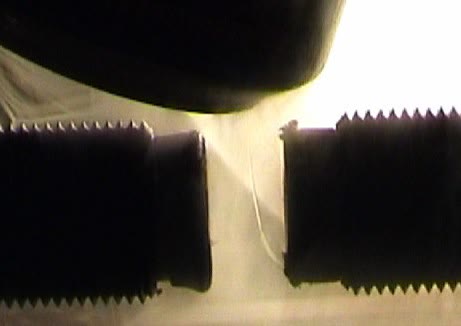
Pour liquid oxygen between the poles of a strong magnet and it is pulled aside; liquid nitrogen falls straight through. The oxygen molecule carries unpaired electrons, which a magnetic field attracts. Its Lewis structure, with every electron paired, cannot say so. Molecular orbitals, built from the atomic orbitals of the previous chapter, place each electron of a molecule in a level of its own: they account for the magnetism of oxygen, for the strength and length of bonds, and for the energies needed to ionise molecules — and they lay the ground for the reactivity of the chapters that follow.
You already know
Chapter 13: atomic orbitals, their shapes, signs and energies. The Year 1 volume: Lewis structures, and bonds as descriptive notions, hybridisation and its limits, unpaired electrons and radicals.
14.1 The LCAO method
Definition 14.1 (Molecular orbital)
A molecular orbital is the wavefunction of one electron in a molecule, spread over all its nuclei. In the LCAO method (linear combination of atomic orbitals) it is written as a sum of atomic orbitals of the atoms, , with coefficients chosen to make the energy lowest.
For two atoms A and B, each bringing one orbital, . The energy of an electron in , minimised with respect to the coefficients, brings in three numbers.
Definition 14.2 (The integrals of the LCAO method)
For two real atomic orbitals , and the energy operator of an electron in the molecule:
- the overlap integral measures how much the two orbitals occupy the same region ( for identical, superimposed orbitals);
- the Coulomb integral is the energy of an electron in within the molecule, close to the atomic orbital energy;
- the resonance integral , negative, measures the coupling of the two orbitals.
The energies of the molecular orbitals are the roots of the secular determinant
The determinant comes from minimising with respect to and : the two conditions form a homogeneous linear system, which has a non-zero solution only when its determinant vanishes. That variational step is admitted here.
Theorem 14.3 (Two identical orbitals)
For , the two molecular orbitals are
Proof. The determinant gives , so . With the plus sign, ; with the minus sign, . Back in the linear system, gives for and for . Normalisation: . ∎
Definition 14.4 (Bonding and antibonding orbitals)
A bonding orbital lies below the atomic orbitals it is made of: its electron density accumulates between the nuclei. An antibonding orbital lies above them and has a nodal plane between the nuclei. A nonbonding orbital keeps the energy of the atomic orbital, which finds no partner to combine with.
Proposition 14.5 (The antibonding orbital rises more)
For , the antibonding level is raised above by more than the bonding level is lowered below it.
Proof. and . The numerator is negative (the coupling dominates), and : the second shift is larger in magnitude. ∎
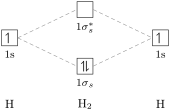
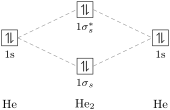
With two electrons, as in , both enter and the molecule is more stable than the separate atoms. With four, as in , two must enter , which costs more than gains: is not bound.
14.2 Overlap and symmetry
Definition 14.6 ( and orbitals)
A orbital of a linear molecule is unchanged by any rotation about the molecular axis: it has no nodal plane containing the axis. A orbital changes sign under a rotation of about the axis: it has one nodal plane containing the axis. An asterisk marks antibonding orbitals (, ).
Proposition 14.7 (Zero overlap by symmetry)
Two orbitals of which one is symmetric and the other antisymmetric with respect to a plane containing the molecular axis have zero overlap and zero resonance integral: they do not combine.
Proof. Reflection in the plane leaves the space unchanged but turns the product into its opposite at the mirror point: the contributions of the two halves of space to cancel. The same holds for , since has the symmetry of the molecule. ∎
Two orbitals interact strongly when they have the same symmetry (non-zero overlap), overlap well, and lie at close energies. A 1s orbital of one atom and a of the other ( perpendicular to the axis) never combine; orbitals (along the axis) give orbitals; and give two pairs of orbitals of equal energies.

14.3 Homonuclear diatomics of period 2
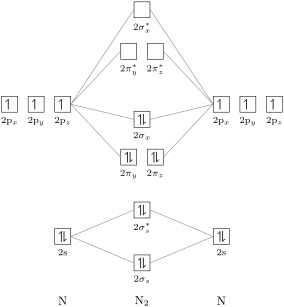
With the 2s and 2p orbitals of two atoms of period 2, eight molecular orbitals form: , , , two , two , .
Proposition 14.8 (s–p mixing)
For and the order is . For to , whose 2s and 2p levels are close, the orbitals made from 2s and mix: is pushed up above .
Argument. The and orbitals have the same symmetry and can combine with each other. Two levels of the same symmetry repel (Theorem 14.14 below): goes down, goes up, the more so as they are close. The 2s–2p gap grows along the period, so the effect is large on the left and small for oxygen and fluorine. The crossing between nitrogen and oxygen is admitted from the measured photoelectron spectra. ∎
Definition 14.9 (Bond order)
The bond order of a diatomic molecule is , where and are the numbers of electrons in bonding and antibonding orbitals.
Proposition 14.10 (Bond order and bond)
Between atoms of the same pair of elements, a higher bond order goes with a shorter and stronger bond; a bond order of zero means no bond.
Argument. Each bonding electron adds density between the nuclei and lowers the energy; each antibonding electron removes it and raises the energy by at least as much (Proposition 14.5). The net number of bonding pairs measures the binding. The comparison is meaningful only for similar atoms: has bond order 1 like , but its 2s orbitals are far larger. ∎
Definition 14.11 (Paramagnetic and diamagnetic)
A substance is paramagnetic if its molecules have unpaired electrons: it is drawn into a magnetic field. It is diamagnetic if all its electrons are paired: it is weakly pushed out of the field.
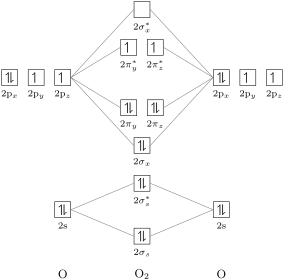
Method 14.12 (Building and filling an MO diagram)
- Place the valence atomic orbitals of each atom at their energies, the more electronegative atom lower.
- Combine orbitals of the same symmetry: each pair gives one bonding orbital below and one antibonding orbital above; an orbital without a partner stays nonbonding.
- For period 2 homonuclear molecules, use the order with above up to nitrogen, below it from oxygen on.
Method 14.13 (Reading a filled diagram)
- Count the valence electrons (add one for each negative charge, remove one for each positive charge).
- Fill from the bottom, two per orbital, with Hund’s rule for degenerate levels.
- Bond order ; unpaired electrons give paramagnetism.
- The highest occupied level is the one ionised first.
| valence electrons | 2 | 8 | 10 | 12 | 14 | 11 |
| bond order | 1 | 2 | 3 | 2 | 1 | 2.5 |
| unpaired electrons | 0 | 0 | 0 | 2 | 0 | 1 |
| bond length (pm) | 267.3 | 124.3 | 109.8 | 120.8 | 141.2 | 115.1 |
| () | 1.04 | 6.15 | 9.76 | 5.12 | 1.60 | 6.51 |
14.4 Heteronuclear diatomics
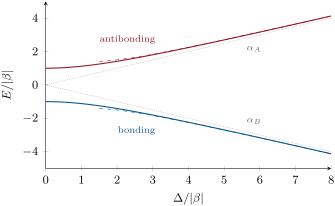
Theorem 14.14 (Two orbitals of different energies)
For (B more electronegative), neglected, and :
The bonding orbital (lower) has its larger coefficient on B, the antibonding orbital on A; when , and .
Proof. With the energies are the eigenvalues of : , whose roots are . For the lower root, ; is smaller than , so . For , . ∎
In hydrogen fluoride, the 1s orbital of hydrogen meets the far lower 2p orbitals of fluorine. Only , along the axis, has the right symmetry: it forms a bonding orbital weighted on fluorine, and a weighted on hydrogen. The and orbitals of fluorine stay nonbonding: they are its lone pairs. The bond is polarised towards fluorine.
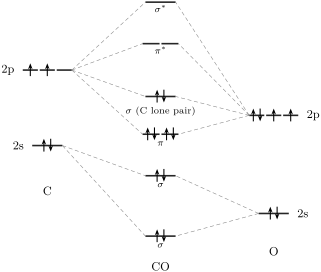
Carbon monoxide has the ten valence electrons of and a similar diagram, but the oxygen orbitals lie lower. Its bonding orbitals are weighted on oxygen; its highest occupied orbital, a orbital weighted on carbon, is a lone pair on carbon. Carbon monoxide therefore binds metals through carbon (Chapter 18).
History — Hund and Mulliken
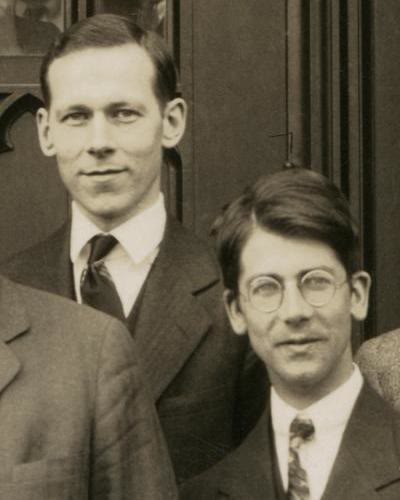
Between 1926 and 1932 Friedrich Hund and Robert Mulliken interpreted the spectra of diatomic molecules by assigning each electron to an orbital of the whole molecule, classified by its symmetry about the axis. The words , , bonding and antibonding, and the orbital diagrams of this chapter come from their work; Mulliken received the Nobel Prize in Chemistry in 1966. The photograph shows Mulliken (left) and Hund in Chicago in 1929. (Photograph: GFHund, CC BY 3.0, Wikimedia Commons.)
14.5 Ionisation and bond strength
Removing an electron from a bonding orbital weakens the bond; removing it from an antibonding orbital strengthens it. The dissociation energies of the ions follow from a thermochemical cycle: for ,
B being the atom of lower ionisation energy.
Example 14.15 (Nitrogen and oxygen ions)
() loses a bonding electron: , weaker than . () loses a electron: , stronger than , in line with bond orders 2.5 and 2.5 against 3 and 2.
14.6 Exercises
Exercise 14.1 ★
For two hydrogen 1s orbitals take , and (exercise data). Compute and , then the energy of the two electrons of compared with two separate atoms.
Solution
Solution of Exercise 14.1.
; . Two electrons in : against , bound by in this crude model.
Exercise 14.2 ★
Give the bond orders of , , and (with s–p mixing).
Exercise 14.3 ★
Which of , , , , are paramagnetic?
Solution
Solution of Exercise 14.3.
(two unpaired electrons in the two orbitals, with s–p mixing) and (two in ). , , are diamagnetic.
Exercise 14.4 ★
The molecular axis is . Which pairs among (1s, ), (1s, ), (, ), (, ), (2s, ) have non-zero overlap?
Solution
Solution of Exercise 14.4.
Non-zero: (1s, ), (, ), (2s, ). Zero by symmetry: (1s, ) and (, ).
Exercise 14.5 ★★
Predict whether has a longer or shorter bond than , and check with its dissociation energy computed in the chapter.
Solution
Solution of Exercise 14.5.
Ionisation removes a bonding electron: bond order 2.5 instead of 3, so a longer and weaker bond, as shows.
Exercise 14.6 ★★
Carbon monoxide and are isoelectronic. Explain why the bonding orbitals of CO are weighted on oxygen and why its highest occupied orbital is a lone pair on carbon.
Solution
Solution of Exercise 14.6.
The oxygen orbitals lie lower (oxygen is more electronegative): by Theorem 14.14, the bonding orbitals are weighted on the lower atom, oxygen, and the higher-lying orbitals on carbon. The highest occupied orbital, a orbital of mostly carbon character pointing away from oxygen, is the lone pair on carbon.
Exercise 14.7 ★★
In HF, which orbitals of fluorine interact with the 1s of hydrogen, and which stay nonbonding? Draw the diagram.
Solution
Solution of Exercise 14.7.
Only fluorine’s (along the axis) has the symmetry of hydrogen’s 1s: they form a orbital weighted on F and a weighted on H. Fluorine’s , (zero overlap) and its low 2s (too far in energy) remain nonbonding: three lone pairs. The eight valence electrons fill 2s, and the two nonbonding p.
Exercise 14.8 ★★
With , and (exercise data, neglected), compute the two energies and the weight of the bonding orbital on B.
Solution
Solution of Exercise 14.8.
, , : and . For the lower level : , , .
Exercise 14.9 ★★
With s–p mixing, show that has bond order 2 made of two bonds and no bond.
Solution
Solution of Exercise 14.9.
Eight valence electrons: , the orbital (pushed above by mixing) being empty. Bond order , from the two filled orbitals.
Exercise 14.10 ★★★
Give the bond orders of NO and . From , and , compute for , and comment.
Solution
Solution of Exercise 14.10.
NO, eleven valence electrons, one in : bond order 2.5. , ten: bond order 3. : much stronger than NO, since the electron removed was antibonding.
Exercise 14.11 ★★★
Show that , and that it exceeds when . Deduce why two filled orbitals repel (four-electron destabilisation).
Solution
Solution of Exercise 14.11.
. It exceeds when , that is (dividing by ). With four electrons, two in each orbital, the total energy is above that of the separated orbitals: two filled orbitals repel.
Exercise 14.12 ★★★
Order , , , by bond order, bond length and bond strength. Which ion is found in hydrogen peroxide, and which in the yellow compound ?
Solution
Solution of Exercise 14.12.
Bond orders 2.5, 2, 1.5, 1: in this order the bonds lengthen and weaken. Hydrogen peroxide contains the peroxide O–O single bond ( unit); contains the superoxide ion , paramagnetic.
14.7 Problem: Oxygen and Its Ions
Problem 14.1
Weekend problem — the molecular orbital diagram of dioxygen, the bond orders and magnetism of its ions, ionisation and the strength of the bond, and the two ways of pairing the electrons
Data: , , , ; at (): 246.79, 470.82; : , ; .
Part I — Dioxygen.
- How many valence electrons does have?
- Draw its valence MO diagram (no s–p mixing) and fill it.
- Compute its bond order.
- How many unpaired electrons? Is paramagnetic?
- Why does the Lewis structure fail here?
- Compute in .
Part II — The ions.
- Give the configuration and bond order of .
- Same for the superoxide ion .
- Same for the peroxide ion .
- Give the number of unpaired electrons of each ion.
- Order , , , by predicted bond length.
- Which ion has an O–O single bond, like hydrogen peroxide?
- Which of the four species are paramagnetic?
Part III — Ionisation.
- From which orbital does the electron leave when is ionised?
- Why is lower than ?
- Show that and compute it.
- Compare with and explain.
- Compute and in the same way.
- Why is higher than ?
- Summarise: when does ionisation strengthen a bond?
Part IV — The electrons.
- In the ground state the two electrons occupy two different orbitals with parallel spins. Which rule says so?
- Describe a state in which both occupy the same orbital.
- Why is that state higher in energy?
- What are its bond order and its magnetism?
- State the bond order of and its dissociation energy.
Solution
Solution of Problem 14.1.
1. Twelve. 2. , the two electrons in different orbitals. 3. . 4. Two: is paramagnetic. 5. It pairs all electrons, whereas two of them sit alone in two degenerate orbitals. 6. , . 7. : , bond order 2.5. 8. : , bond order 1.5. 9. : , bond order 1. 10. one, one, none. 11. . 12. The peroxide ion. 13. , and . 14. From a orbital. 15. The orbital, antibonding, lies above the 2p level of the atom: its electron is less bound. 16. Two paths from to : dissociate then ionise an atom, ; or ionise the molecule then dissociate the ion, . Equal: . 17. Larger than : removing an antibonding electron strengthens the bond (order 2.5). 18. ; . 19. The highest occupied orbital of is bonding, below the 2p level of the atom. 20. When the electron removed comes from an antibonding orbital. 21. Hund’s rule (maximum number of parallel spins in degenerate orbitals). 22. Both electrons in the same orbital, spins paired. 23. Two electrons in the same orbital repel each other more, and lose the exchange stabilisation of parallel spins. 24. Bond order still 2; all electrons paired: diamagnetic. 25. has bond order and a dissociation energy of , against 2 and for .