University Chemistry — Year 2 · Bachelor Year 2
16Hückel Theory and Conjugated Systems
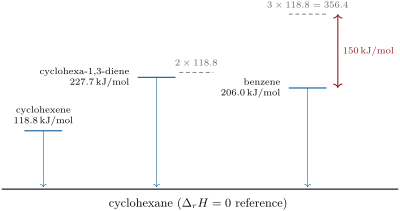
Add hydrogen to cyclohexene and are released per mole. Benzene, with three double bonds in a ring of six carbons, should release three times as much on its way to cyclohexane; it releases less. That missing energy is the stability of an aromatic ring, the reason why benzene resists the additions that alkenes undergo. In 1931 Erich Hückel computed it with a determinant, after reducing the molecule to its electrons and their neighbours. His method is crude, but it explains why rings of six electrons are special, why long conjugated chains absorb visible light, and where a conjugated molecule carries its charges.
You already know
Chapter 14: Coulomb integral , resonance integral , secular determinant. Chapter 15: orbitals of ethene and allyl. The Year 1 volume: conjugated systems, resonance, chromophores and absorption maxima.
16.1 The Hückel method
In a planar conjugated molecule, the orbitals are symmetric and the p orbitals perpendicular to the plane antisymmetric with respect to that plane: they do not mix (Proposition 14.7), and the electrons can be treated on their own.
Definition 16.1 (Hückel method)
The Hückel method computes the orbitals of a planar conjugated system as combinations of one p orbital per atom, with the approximations: overlaps for (and 1 for ); Coulomb integrals all equal to ; resonance integrals equal to between bonded neighbours and zero otherwise.
With , the secular equations become, for each atom , , and the energies are the roots of a determinant with on the diagonal and 1 between bonded atoms. Equivalently, where the are the eigenvalues of the adjacency matrix of the molecule’s carbon skeleton; since , a positive is a bonding level.
Method 16.2 (A Hückel calculation)
- Number the conjugated atoms; write the matrix with 0 on the diagonal and 1 for each bonded pair.
- Find its eigenvalues (by the closed forms below, or numerically): .
- Fill the levels from the most bonding, two electrons each: .
- From the normalised coefficients, compute charges and bond indices.
Proposition 16.3 (Trace)
The energies of the orbitals of a Hückel system add up to .
Proof. The sum of the eigenvalues of a matrix is its trace; the Hückel matrix has on each of its diagonal entries. ∎
16.2 Linear polyenes
Theorem 16.4 (Levels of a linear chain)
A linear conjugated chain of atoms has the levels and coefficients
Proof. The secular equations are for , with . Try : , so the equations hold with , and automatically. The end condition gives . Then . The normalisation uses . ∎
Example 16.5 (Butadiene)
For : , . Four electrons fill the two bonding levels: . The lowest orbital has coefficients 0.372, 0.602, 0.602, 0.372, the next 0.602, 0.372, , .
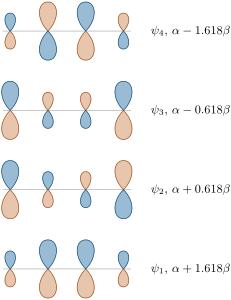
Definition 16.6 ( charges and bond indices)
With electrons in orbital (0, 1 or 2) and real coefficients , the charge on atom is (the number of electrons it carries), and the bond index of the bond is .
For butadiene, and : the end bonds carry most of the bonding and are the shorter, the central bond has partial double-bond character. All the charges are 1.
Proposition 16.7 (Alternant hydrocarbons)
In a neutral hydrocarbon whose conjugated atoms can be coloured in two sets with no two neighbours of the same set (no odd ring), every charge equals 1.
Proof. Admitted at this level. ∎
The result (Coulson and Rushbrooke) is checked on butadiene above and on benzene by symmetry; it is the reason why such hydrocarbons have no permanent dipole from their electrons.
Definition 16.8 (Delocalisation energy)
The delocalisation energy of a conjugated system is the difference between its energy and that of the same number of isolated double bonds, each with .
For butadiene it is ; for hexatriene, .
16.3 Rings and aromaticity
Theorem 16.9 (Levels of a ring)
A planar ring of conjugated atoms has the levels , : one lowest level , then pairs of degenerate levels, and for even one highest level .
Proof. In a ring every atom has two neighbours, with indices taken modulo : for all and . Try : the equation gives , and periodicity requires . The levels and have the same energy; their sum and difference are real orbitals. Only (and for even ) is single. ∎
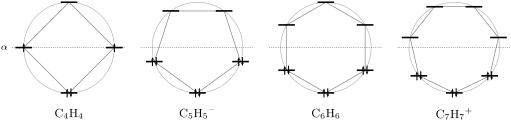
Corollary 16.10 (Frost’s circle)
The levels of a ring are read on a circle of radius centred at , in which a regular -gon is inscribed with one vertex at the bottom: each vertex is at the height of a level.
Proof. The vertex of the polygon is at angle , at height relative to the centre. ∎
Definition 16.11 (Aromaticity)
A cyclic, planar, fully conjugated system is aromatic when its electrons form a closed shell with a large delocalisation energy, and antiaromatic when its electrons half-fill a degenerate pair, which makes it less stable than the corresponding open chain.
Theorem 16.12 (Hückel’s rule)
A planar monocyclic conjugated system has a closed shell of electrons if and only if it holds of them (); with it has two electrons in a half-filled degenerate pair. This is Hückel’s rule.
Proof. By Theorem 16.9, the levels from the bottom are one single level and then degenerate pairs (for the occupied part). A closed shell fills the single level (2 electrons) and a whole number of pairs (4 electrons each): . With electrons, the last pair holds only two, one in each of its orbitals (Hund’s rule). ∎
Method 16.13 (Is it aromatic?)
- Is the system a ring with a p orbital on every atom (counting carbocation and carbanion centres and lone pairs of heteroatoms)?
- Can it be planar?
- Count the electrons: aromatic, antiaromatic if planar.
- An antiaromatic ring avoids planarity or conjugation when it can (cyclo-octatetraene is tub-shaped and behaves as a polyene).
Example 16.14 (Benzene)
Six electrons fill and the pair : . Three isolated double bonds give : the delocalisation energy is , about twice that of the open chain of six carbons, hexatriene (): closing the ring is worth as much again. By symmetry all bond indices are equal (), and so are the six bond lengths, , between those of ethene () and ethane ().
History — Kekulé’s ring
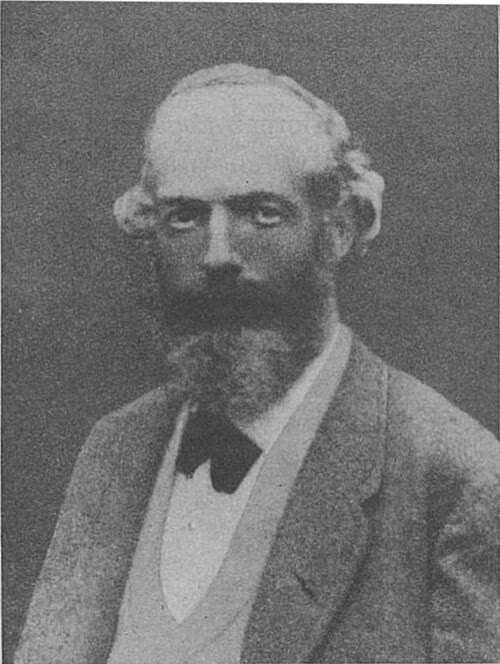
In 1865 August Kekulé proposed that the six carbon atoms of benzene form a ring with alternating single and double bonds, and soon after that the two alternations exchange so fast that every bond is the same. The equal bonds found by X-ray diffraction, and the orbitals spread over the whole ring, gave his intuition its modern form; Hückel’s rule, in 1931, explained why six electrons, and not four or eight, make a ring special. (Portrait, 1873, unknown author, public domain, Wikimedia Commons.)
16.4 Conjugation and light
Proposition 16.15 (The gap of a polyene)
In a linear polyene of carbons ( even), the gap between the highest occupied and the lowest empty level is : it decreases as the chain lengthens.
Proof. The highest occupied level is , the lowest empty . With , , and the first sine is . It decreases with since increases on . ∎
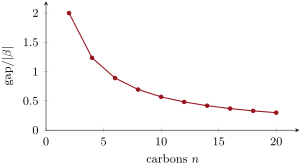
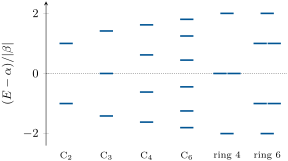
A heteroatom is brought in by changing its Coulomb integral, , and the resonance integrals of its bonds: a model with adjustable parameters, which keeps the qualitative results (an electronegative atom, , draws the density towards itself) but whose numbers are fitted, not derived.
16.5 Exercises
Exercise 16.1 ★
Give for the allyl cation, radical and anion.
Solution
Solution of Exercise 16.1.
Allyl levels (): , , . Cation (2 electrons): ; radical (3): ; anion (4): . The extra electrons go into the nonbonding level and change only the part.
Exercise 16.2 ★
Compute of butadiene from the levels , .
Solution
Solution of Exercise 16.2.
.
Exercise 16.3 ★
Aromatic, antiaromatic or neither (if planar): benzene, cyclopentadienyl anion, cyclopentadienyl cation, tropylium cation , cyclobutadiene, planar cyclo-octatetraene.
Solution
Solution of Exercise 16.3.
Benzene (6), cyclopentadienyl anion (6), tropylium (6): aromatic. Cyclopentadienyl cation (4), cyclobutadiene (4), planar cyclo-octatetraene (8): antiaromatic if planar (real cyclo-octatetraene is tub-shaped and non-aromatic).
Exercise 16.4 ★
Draw Frost’s circle for planar cyclo-octatetraene and place its eight electrons.
Solution
Solution of Exercise 16.4.
An octagon in the circle: levels , (twice), (twice), (twice), . Eight electrons: two in the lowest, four in the first pair, one in each orbital of the nonbonding pair.
Exercise 16.5 ★★
Compute the delocalisation energy of butadiene and give it in with . Compare with the of the hydrogenation data for cyclohexa-1,3-diene.
Solution
Solution of Exercise 16.5.
, that is , against about from the hydrogenation data: Hückel’s model, with fitted to benzene, overestimates the conjugation of open chains.
Exercise 16.6 ★★
Compute the bond indices of butadiene and predict which of its C–C bonds is the shortest.
Solution
Solution of Exercise 16.6.
, : the end bonds C1–C2 and C3–C4 are the shortest, the central bond longer but shorter than a single bond.
Exercise 16.7 ★★
The levels of a five-membered ring are , (twice), (twice). Fill them for the cyclopentadienyl anion and cation and compare.
Solution
Solution of Exercise 16.7.
Anion, six electrons: , , a closed shell: aromatic. Cation, four: , , with one electron in each orbital of the degenerate pair: antiaromatic, very unstable.
Exercise 16.8 ★★
Using the levels of a seven-membered ring, explain why cycloheptatrienyl bromide behaves as a salt, tropylium bromide.
Solution
Solution of Exercise 16.8.
Seven-membered ring: , (twice), then antibonding levels. Six electrons, as in the cation , fill the bonding levels exactly: an aromatic cation. The compound ionises readily into tropylium and bromide.
Exercise 16.9 ★★
Check the trace rule on hexatriene, whose levels are , , .
Solution
Solution of Exercise 16.9.
: the sum of the energies is .
Exercise 16.10 ★★★
Derive the levels of hexatriene from the closed form, and its delocalisation energy.
Solution
Solution of Exercise 16.10.
: , , , , , . Six electrons: ; delocalisation .
Exercise 16.11 ★★★
Square cyclobutadiene would have two unpaired electrons. Explain why the real molecule is rectangular, with two short and two long bonds.
Solution
Solution of Exercise 16.11.
In the square, the two electrons of highest energy sit one in each orbital of a degenerate nonbonding pair. Stretching two opposite bonds lifts the degeneracy: one orbital goes down, the other up, and both electrons pair in the lower one, which lowers the energy. The molecule settles as a rectangle with two localised double bonds; it remains antiaromatic and extremely reactive.
Exercise 16.12 ★★★
In a two-atom system with (model value, ) and , find the two levels and the charges on C and X for two electrons.
Solution
Solution of Exercise 16.12.
Matrix (in units of , with as origin) : and , (bonding) and . For the bonding orbital , so , ; with two electrons, , : the density is drawn to X.
16.6 Problem: Benzene’s Missing Energy
Problem 16.1
Weekend problem — the aromatic stabilisation of benzene from enthalpies of hydrogenation, the Hückel levels of benzene and its delocalisation energy, the value of , and the comparison with hexatriene and cyclo-octatetraene
Data: enthalpies of formation of the gases (): benzene 82.9, cyclohexa-1,3-diene 104.6, cyclohexene , cyclohexane . Bond lengths (pm): benzene 139.7, ethene 133.9, ethane 153.6.
Part I — Hydrogenation.
- Compute of the hydrogenation of cyclohexene to cyclohexane.
- Same for cyclohexa-1,3-diene.
- Same for benzene.
- What would three independent double bonds release?
- Deduce the stabilisation of benzene.
- Compare with that of the conjugated diene, and comment.
Part II — Hückel benzene.
- Write the Hückel matrix of benzene.
- Give its levels from the ring formula.
- Fill them with six electrons.
- Compute .
- Compute of three isolated double bonds.
- Deduce the delocalisation energy.
- Check the trace rule.
Part III — The value of .
- Equate the delocalisation energy with the stabilisation of Part I and find .
- With that value, predict the delocalisation energy of butadiene, and compare with Part I.
- Compute the bond indices of benzene.
- Compare them with those of butadiene.
- Explain why the bond lengths of benzene are equal and where they fall.
Part IV — Other rings and chains.
- Compute the delocalisation energy of hexatriene and compare with benzene.
- Give the levels of planar cyclo-octatetraene.
- Fill them with eight electrons: what is wrong?
- How does the real molecule escape?
- What is the situation of cyclobutadiene?
- State Hückel’s rule.
- State the value of obtained by matching benzene’s delocalisation energy to its measured stabilisation.
Solution
Solution of Problem 16.1.
1. . 2. . 3. . 4. . 5. . 6. The diene releases less than two isolated double bonds: conjugation of an open chain gives a small gain, the closed ring of benzene fifteen times more. 7. A matrix with 1 between each atom and its two neighbours (1–2, 2–3, …, 6–1) and 0 elsewhere. 8. : , , , , , : , (twice), (twice), . 9. Two electrons in , four in the pair . 10. . 11. . 12. , that is of stabilisation. 13. : the six levels add up to . 14. : . 15. , against : the model fitted on benzene overestimates the open chain. 16. The occupied orbitals can be taken as , and . For the bond 1–2: ; by symmetry every bond has . 17. Between the end (0.894) and central (0.447) bonds of butadiene. 18. The six bonds are equivalent by symmetry; their length, , lies between the double bond of ethene () and the single bond of ethane (). 19. , half of benzene’s: closing the ring doubles the delocalisation energy. 20. , (twice), (twice), (twice), . 21. The last two electrons go one in each orbital of the nonbonding pair: an open shell, antiaromatic. 22. It folds into a tub: the p orbitals of neighbouring double bonds are no longer parallel, the bonds alternate, and the molecule behaves as a polyene. 23. Four electrons: the same half-filled pair, worse because the molecule cannot avoid planarity; it distorts into a rectangle and is extremely reactive. 24. A planar monocyclic conjugated system is aromatic with electrons, antiaromatic with . 25. .