University Chemistry — Year 2 · Bachelor Year 2
22Aromaticity and Electrophilic Aromatic Substitution
Bromine water loses its colour within seconds when shaken with an alkene, and not at all with benzene. Yet benzene does react with bromine once a little iron(III) bromide is added — and the product, bromobenzene, still has its six-membered aromatic ring: one hydrogen has been replaced, nothing has been added. Aromatic rings substitute rather than add, because addition would throw away the stabilisation computed in Chapter 16. The same mechanism nitrates, sulfonates, alkylates and acylates benzene rings, and the groups already on a ring decide, with surprising regularity, where the next one goes.
You already know
Chapter 16: aromaticity and the delocalisation energy of benzene. The Year 1 volume: electrophilic additions to alkenes, inductive and mesomeric effects, donor and acceptor groups, carbocations and their rearrangements, the Hammond postulate, Lewis acids, energy profiles.
22.1 Substitution, not addition
Definition 22.1 (Arene)
An arene is a hydrocarbon containing at least one aromatic ring, such as benzene, toluene (methylbenzene) or naphthalene; an aryl group () is an arene less one hydrogen.
Proposition 22.2 (Why benzene does not add)
An addition to benzene would turn the aromatic ring into a non-aromatic cyclohexadiene and lose most of the of aromatic stabilisation; substitution keeps it.
Argument. In Chapter 16, the hydrogenation of benzene to cyclohexa-1,3-diene was found endothermic (, from and ), while that of an ordinary double bond releases : the first addition is the costly step. After the first electrophilic step, the cation formed can either add a nucleophile, which leaves a non-aromatic diene, or lose a proton, which restores the aromatic ring. The second path is far more favourable. ∎
22.2 The mechanism
Definition 22.3 (Electrophilic aromatic substitution)
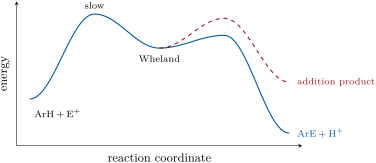
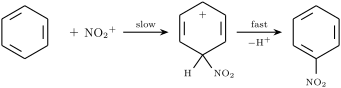
An electrophilic aromatic substitution replaces a hydrogen of an aromatic ring by an electrophile . The electrophile first bonds to one ring carbon, giving a cation in which that carbon is tetrahedral and the positive charge is spread over the other five: the Wheland intermediate (an arenium ion). A base then removes the proton from the tetrahedral carbon.
Proposition 22.4 (Two steps)
The first step, which destroys the aromaticity, is the slow one; the loss of the proton, which restores it, is fast.
Argument. The Wheland intermediate is a carbocation stabilised by delocalisation over three carbons but not aromatic: it lies high above the reactants, and by the Hammond postulate the transition state leading to it is close to it in structure and energy. The second step leads down to an aromatic product: its barrier is low. ∎

22.3 The reactions
Halogenation. Bromine or chlorine alone is too weak an electrophile; a Lewis acid (, ) polarises the halogen by binding one of its atoms, and the outer bromine attacks the ring.
Nitration. A mixture of concentrated nitric and sulfuric acids (above) gives the nitronium ion.
Sulfonation. Fuming sulfuric acid ( in ) gives benzenesulfonic acid. The reaction is reversible: heating the sulfonic acid in dilute aqueous acid removes the group again, which makes it a useful temporary blocking group.
Definition 22.5 (Friedel–Crafts reactions)
A Friedel–Crafts alkylation attaches an alkyl group to an aromatic ring from a halogenoalkane and a Lewis acid (). A Friedel–Crafts acylation attaches an acyl group from an acyl chloride and , through the acylium ion , giving an aryl ketone.
Proposition 22.6 (Limits of the Friedel–Crafts reactions)
Friedel–Crafts alkylation suffers from rearrangements of the carbocation and from polyalkylation; acylation stops after one substitution, gives no rearrangement, and needs at least one equivalent of . Neither works on a ring bearing a strongly deactivating group.
Argument. The alkylating electrophile is a carbocation (or a polarised complex that behaves like one), which rearranges to a more stable one by hydride or alkyl shifts: 1-chloropropane gives mostly isopropylbenzene. An alkyl group activates the ring (next section), so the product reacts faster than benzene and is alkylated again. The acylium ion is stabilised by resonance ( ) and does not rearrange; the acyl group deactivates the ring, so the product does not react further; and the ketone formed binds through its oxygen, removing the catalyst from the reaction: one equivalent is consumed. A strongly deactivated ring is too poor a nucleophile for these weak electrophiles. ∎
22.4 Substituent effects
Definition 22.7 (Directing groups)
A substituent on a benzene ring is an activating group if the ring reacts faster than benzene, a deactivating group if it reacts more slowly. It is an ortho/para director if the new group enters mainly at the positions next to it and opposite to it, a meta director if it enters mainly at the positions once removed.
Proposition 22.8 (Donors and acceptors)
Groups donating electrons to the ring by mesomeric effect (, , , ) or by inductive effect and hyperconjugation (alkyls) activate the ring and direct ortho/para. Groups withdrawing electrons by mesomeric effect (, , , , ) deactivate it and direct meta.
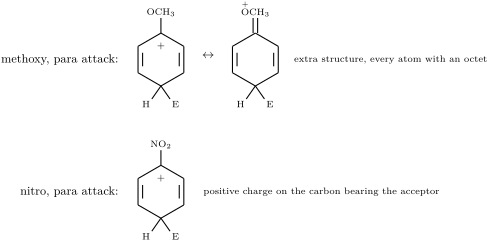
Proof. Compare the Wheland intermediates. For attack ortho or para to a substituent G, one of the three resonance structures puts the positive charge on the carbon bearing G; for attack meta, none does. A donor G (a lone pair on O or N) stabilises a positive charge on the carbon it is attached to, adding a fourth resonance structure in which every atom has an octet: the ortho and para intermediates are lowered, and by the Hammond postulate so are the transition states leading to them. An acceptor G destabilises a positive charge on its carbon: the ortho and para intermediates are raised, and attack meta, which avoids that structure, is the least disfavoured, though slower than on benzene. ∎
Proposition 22.9 (Halogens)
Halogen substituents deactivate the ring but direct ortho/para.
Argument. Their inductive withdrawal (electronegativity) lowers the electron density of the whole ring and slows every attack: deactivating. But a lone pair of the halogen can still share the positive charge of the ortho and para Wheland intermediates, which the meta intermediate cannot use: among the slower attacks, ortho and para remain the least slow. ∎
22.5 Polysubstituted benzenes
Method 22.10 (Predicting the position of substitution)
- For each substituent, mark the positions it favours (ortho/para or meta).
- If they agree, that position wins. If they disagree, the stronger activator decides (, alkyl halogen).
- Avoid the position between two substituents in a 1,3-relationship (hindered), and expect para over ortho when the groups are bulky.
Method 22.11 (Planning an aromatic synthesis)
- Choose the order of the steps so that each group already present directs the next one where it is wanted: to make 3-bromonitrobenzene, nitrate first (meta director), then brominate; to make 4-bromonitrobenzene, brominate first.
- Use convertible groups: an acyl group (meta) can be reduced to an alkyl (ortho/para); a nitro group (meta) reduced to an amine (ortho/para); an alkyl oxidised to (meta).
- Block a position with and remove it at the end.
- Tame a strong activator: an amine is acylated () before nitration or halogenation, then freed again.
History — Friedel and Crafts
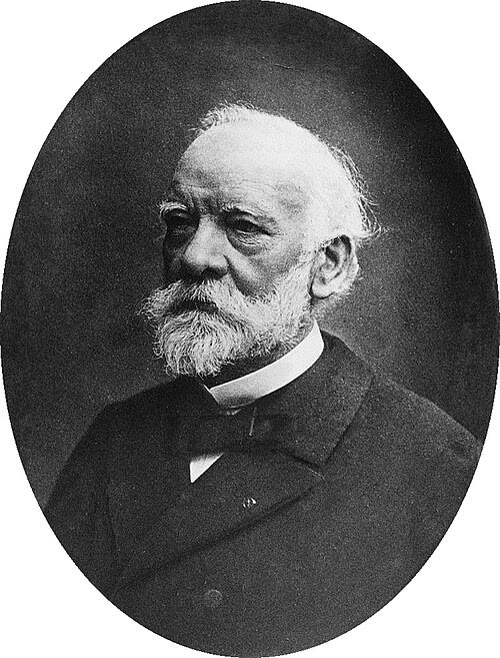
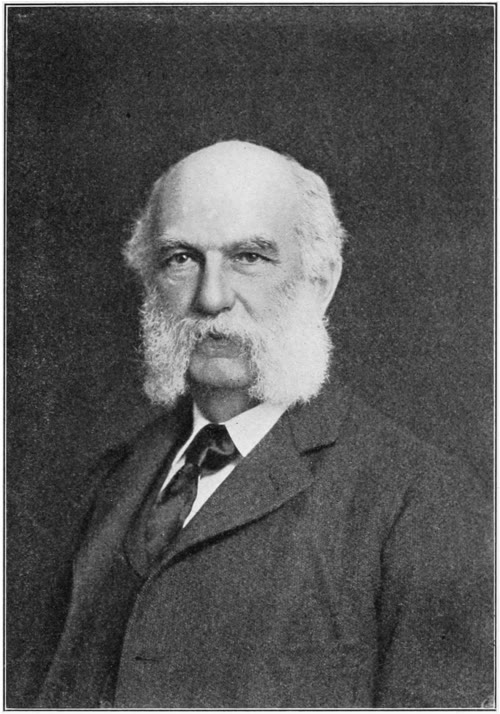
In 1877 Charles Friedel and James Mason Crafts, working together in Paris, found that aluminium chloride makes halogenoalkanes and acyl chlorides react with benzene. Their reactions became the standard way to attach carbon groups to aromatic rings, and the Lewis acid catalysis they discovered reached far beyond it. (Portraits: Friedel, 1890s; Crafts, from Popular Science Monthly, 1900; public domain, Wikimedia Commons.)
Safety


Benzene is a carcinogen and is replaced by toluene or other arenes wherever possible. Concentrated nitric and sulfuric acids are corrosive and the nitrating mixture is strongly oxidising; it is cooled and the arene added slowly, since nitrations are exothermic. Bromine is very toxic and corrosive; aluminium chloride reacts violently with water. Nitroarenes are toxic.
22.6 Exercises
Exercise 22.1 ★
Write the formation of the nitronium ion from nitric acid and sulfuric acid.
Solution
Solution of Exercise 22.1.
: nitric acid is protonated, then loses water.
Exercise 22.2 ★
Give the main products of the bromination (, ) of toluene and of nitrobenzene.
Solution
Solution of Exercise 22.2.
Toluene gives 2-bromotoluene and 4-bromotoluene: the methyl directs to the ortho and para positions. Nitrobenzene gives 3-bromonitrobenzene, more slowly: the nitro group directs meta.
Exercise 22.3 ★
Classify as activating or deactivating, ortho/para or meta: , , , , , .
Solution
Solution of Exercise 22.3.
: activating, o/p. : strongly activating, o/p. : deactivating, o/p. : strongly deactivating, meta. : deactivating, meta. : activating (moderately), o/p.
Exercise 22.4 ★
Give the product of benzene with ethanoyl chloride and aluminium chloride.
Exercise 22.5 ★★
Benzene and 1-chloropropane with give mainly isopropylbenzene. Explain, and give a two-step route to propylbenzene.
Solution
Solution of Exercise 22.5.
The primary carbocation (or its complex) rearranges by a hydride shift to the secondary isopropyl cation, which alkylates the ring. Propylbenzene: Friedel–Crafts acylation with propanoyl chloride (no rearrangement), then reduction of the ketone to .
Exercise 22.6 ★★
Phenol decolourises bromine water at once, without a catalyst, giving 2,4,6-tribromophenol. Explain.
Solution
Solution of Exercise 22.6.
The group is a strong mesomeric donor: the ring is so activated that molecular bromine is a sufficient electrophile, and all three ortho and para positions are substituted.
Exercise 22.7 ★★
Give syntheses of 3-bromonitrobenzene and 4-bromonitrobenzene from benzene.
Solution
Solution of Exercise 22.7.
3-Bromonitrobenzene: nitrate, then brominate (nitro directs meta). 4-Bromonitrobenzene: brominate, then nitrate (bromine directs ortho/para), and separate the para isomer from the ortho one.
Exercise 22.8 ★★
Aniline is nitrated poorly (oxidation, and meta product), but acetanilide gives mainly 4-nitroacetanilide. Explain both facts.
Solution
Solution of Exercise 22.8.
The nitrating mixture oxidises the very electron-rich aniline, and protonates its nitrogen: is a meta-directing, deactivating group. In acetanilide the nitrogen lone pair is shared with the carbonyl: less basic and less activating, it is not protonated or oxidised, and still directs ortho/para, mainly para for steric reasons.
Exercise 22.9 ★★
Show how a sulfonic acid group can be used to prepare 2-bromotoluene free of its para isomer.
Solution
Solution of Exercise 22.9.
Sulfonate toluene (mainly para, the bulky group avoids ortho); brominate: the bromine enters ortho to the methyl (the para position is blocked, and both groups favour that position); remove the group by heating in dilute acid.
Exercise 22.10 ★★★
Where does 4-methylanisole (4-methoxytoluene) undergo nitration? Explain with the two directing groups.
Solution
Solution of Exercise 22.10.
Both groups direct ortho/para; their para positions are occupied by each other. Methoxy, the stronger activator, wins: nitration ortho to (position 2), giving 4-methyl-2-nitroanisole.
Exercise 22.11 ★★★
2,4,6-Trinitrotoluene is made by three successive nitrations of toluene, each under harsher conditions. Explain why.
Solution
Solution of Exercise 22.11.
Each nitro group strongly deactivates the ring: the second nitration needs stronger conditions than the first, the third (on a ring bearing two nitro groups and only the weakly activating methyl) much stronger still.
Exercise 22.12 ★★★
Propose a synthesis of 4-nitrobenzoic acid from toluene, and of 3-nitrobenzoic acid.
Solution
Solution of Exercise 22.12.
4-Nitrobenzoic acid: nitrate toluene, separate the para isomer, oxidise the methyl to (hot permanganate). 3-Nitrobenzoic acid: oxidise toluene to benzoic acid first, then nitrate ( directs meta).
22.7 Problem: Nitrating Toluene
Problem 22.1
Weekend problem — the nitronium ion and the mechanism of nitration, the ortho, meta and para positions of toluene against the statistical ratio, the separation of the isomers, and a mass balance
Data: melting points: 2-nitrotoluene , 3-nitrotoluene , 4-nitrotoluene . Exercise data for a run: of toluene, conversion 90 %, isomer distribution 58 % ortho, 4 % meta, 38 % para. Molar masses (): C 12.011, H 1.008, N 14.007, O 15.999.
Part I — The electrophile and the mechanism.
- Write the formation of the nitronium ion.
- Draw its Lewis structure and give its shape.
- Write the attack of on toluene para to the methyl.
- Draw the three resonance structures of the para Wheland intermediate.
- Which step is rate-determining?
- What removes the proton in the second step?
Part II — The three positions.
- How many ortho, meta and para positions has toluene?
- What ratio would a random attack give?
- Draw the meta Wheland intermediate and explain why it is the least stabilised.
- How does the methyl group stabilise the ortho and para intermediates?
- Compare the observed ratio with the statistical one: which positions are favoured?
- Compare the yield per position at ortho (half of the ortho percentage) and at para. Suggest a reason for the difference.
- Is toluene nitrated faster or more slowly than benzene?
Part III — Separation.
- Which isomer is solid at room temperature?
- Suggest how to isolate it from the mixture by cooling.
- Why does symmetry favour a high melting point?
- How could the ortho and meta isomers be separated afterwards?
- Why are these isomers hard to separate by simple distillation?
Part IV — Mass balance.
- Compute the molar mass of toluene and of nitrotoluene.
- Compute the amount of toluene and of nitrotoluene formed.
- Compute the masses of the three isomers.
- What further reaction must be avoided by cooling and by not using excess acid?
- How would you make 4-nitrobenzoic acid from the para isomer?
- State the mass of 4-nitrotoluene obtained from of toluene in this run.
Solution
Solution of Problem 22.1.
1. . 2. : linear, isoelectronic with . 3. The nitrogen bonds to the ring carbon para to , which becomes tetrahedral (bearing H and ). 4. The positive charge on the two carbons ortho to the attacked carbon and on the carbon para to it, which bears the methyl. 5. The first, formation of the Wheland intermediate. 6. A base of the medium: or water. 7. Two ortho, two meta, one para. 8. 2 : 2 : 1, that is 40 % ortho, 40 % meta, 20 % para. 9. For meta attack, the positive charge is never on the carbon bearing the methyl; no structure is helped by the methyl. 10. One resonance structure has the charge on the carbon bearing : a tertiary carbocation, stabilised by the inductive effect and hyperconjugation of the methyl. 11. Ortho and para are favoured (96 % against 60 % at random); meta is almost absent. 12. Per position: ortho , para 38 %: para is the more reactive position, the ortho positions being slightly hindered by the methyl. 13. Faster: the methyl activates the ring. 14. 4-Nitrotoluene (melts at ). 15. Cool the crude mixture: the para isomer crystallises and is filtered off; the liquid keeps the ortho and meta isomers. 16. A symmetric molecule packs better in a crystal: more interactions per volume, a higher melting point. 17. By fractional distillation under reduced pressure, or by chromatography; or by further cooling (the meta isomer melts at ). 18. The isomers have close boiling points (same formula, similar polarity). 19. : ; : . 20. of toluene; of nitrotoluenes. 21. Total : ortho , meta , para . 22. A second nitration (dinitrotoluenes), and oxidation of the methyl group. 23. Oxidise the methyl to with hot alkaline permanganate, then acidify. 24. The run gives of 4-nitrotoluene.