University Chemistry — Year 2 · Bachelor Year 2
5Continuous Reactors and Industrial Processes
In the laboratory a reaction is run in a flask: the reagents go in, the mixture is stirred for an hour, the reaction is stopped and the product isolated. A plant that makes the same product by the thousand tonnes works differently. Its reactor never empties: reactants flow in at one end, products flow out at the other, day and night, and the composition inside does not change with time. Two questions then replace “how long?”: how large must the reactor be for a given conversion, and how is the heat of the reaction taken away before it heats the reactor out of control? This chapter writes the balances of matter and energy for the two ideal continuous reactors, the stirred tank and the tube, compares them, and shows how a reactor can have several possible states, one of them a runaway.
You already know
The Year 1 volume: rate of reaction, rate laws and orders, integrated laws of a closed reactor (now called a batch reactor), half-life, the Arrhenius law , consecutive reactions. Chapter 1: heat released at constant pressure; Chapter 4: single-pass conversion, recycle. From physics: the balance of an open system in steady flow (what enters minus what leaves equals what accumulates).
5.1 From batch to continuous
Definition 5.1 (Reactor types)
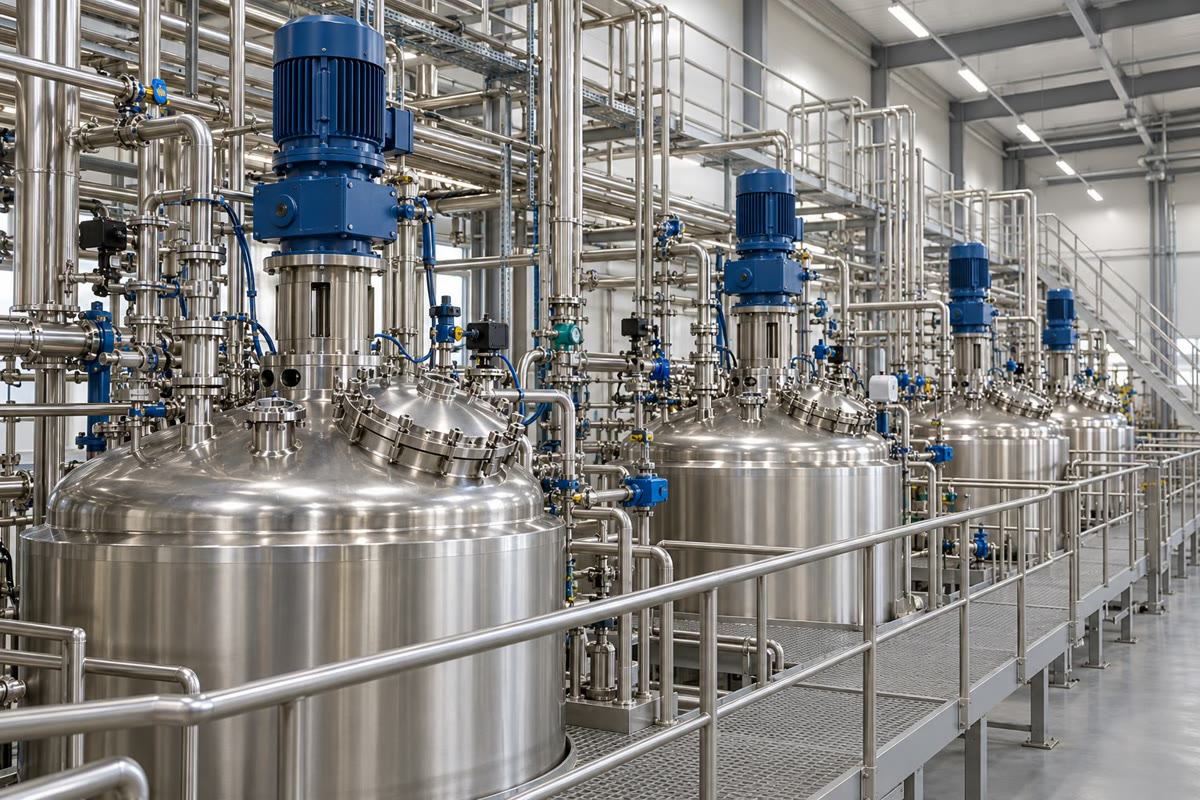
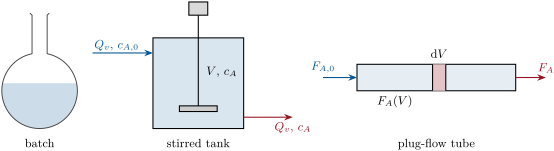
A batch reactor is a closed vessel in which the reaction takes place without inflow or outflow of matter. A continuous reactor is crossed by a steady flow of matter. Two ideal continuous reactors serve as models:
- the continuous stirred-tank reactor (CSTR), so well stirred that its contents are uniform, and therefore identical to the stream that leaves it;
- the plug-flow reactor (PFR), a tube crossed by the fluid without mixing along the flow, each slice of fluid advancing like a piston while it reacts.
A continuous reactor is said to work in steady operation when nothing inside it changes with time: the flows, the temperatures and the compositions at each point are constant. We consider a single reaction products, a liquid feed of constant density (so the volumetric flow rate is the same at the inlet and outlet), with concentration at the inlet.
Definition 5.2 (Residence time)
The residence time of a continuous reactor of volume fed at the volumetric flow rate is : the mean time a volume of fluid spends inside it.
Definition 5.3 (Conversion)
The conversion of reactant A is , where and are the molar flow rates of A entering and leaving the reactor; for a batch reactor, . At constant density, .
Conversion refers to one reactant, and to a reactor or a pass; the final fractional extent of the Year 1 volume refers to a reaction and to its limiting reactant. For a single reaction whose limiting reactant is A, the two coincide.
Proposition 5.4 (Batch reactor)
In a batch reactor of constant volume, a first-order reaction reaches the conversion after the time , and a second-order reaction with equal initial concentrations the conversion .
Proof. These are the integrated rate laws of the Year 1 volume, and , written with . ∎
5.2 The continuous stirred-tank reactor
Proposition 5.5 (Balance of a stirred tank)
In steady operation, a stirred tank of volume in which A disappears at the rate (mol per litre and per second) satisfies
the rate being evaluated at the outlet composition and temperature.
Proof. Balance of A over the tank during : what enters, , minus what leaves, , minus what reacts, , equals the accumulation, zero in steady operation. The tank being uniform, the rate is the same everywhere and equal to that of the outlet stream. Divide by . ∎
Theorem 5.6 (Conversion in a stirred tank)
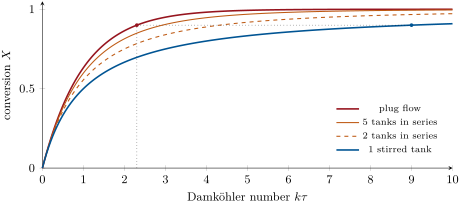
For a first-order reaction, ; for a second-order reaction with equal feed concentrations of the two reactants, is the root in of , with .
Proof. Order 1: , so , and . Order 2: (the two concentrations stay equal), . ∎
The dimensionless group (or ), the Damköhler number, compares the residence time with the time scale of the reaction: it alone fixes the conversion.
Method 5.7 (Sizing a reactor)
- Write the rate law and the required conversion .
- From the balance of the chosen reactor, find the Damköhler number that gives .
- Deduce from and the rate constant at the working temperature, and from the flow rate to be treated.
5.3 The plug-flow reactor
Theorem 5.8 (Conversion in a plug-flow reactor)
In steady operation, the flow rate of A along a plug-flow tube obeys . For a first-order reaction this gives , and for a second-order reaction with equal feeds : the laws of the batch reactor, with the residence time in place of the time.
Proof. Balance of A on the slice between and : , hence the differential equation. With and (the time a slice has spent in the tube), it reads : each slice is a small batch reactor that stays in the tube for . Separating the variables for gives at the outlet; for , . ∎
Proposition 5.9 (Tank or tube)
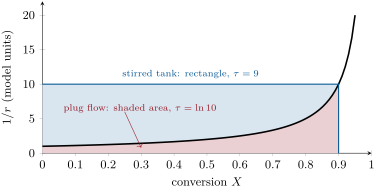
For any rate that increases with the concentration of A (any positive order), a plug-flow reactor reaches a given conversion with a smaller volume than a stirred tank.
Proof. From the balances, (the rate at the outlet composition) and . As decreases when increases, on , so the integral is at most . Graphically, on a chart of against , the tube’s is the area under the curve and the tank’s the rectangle of height (figure below). For order 1: , the same statement in another form. ∎
The stirred tank works entirely at the outlet concentration, the lowest of the system, and so at the lowest rate; the tube uses the high concentrations near its inlet. Its advantages lie elsewhere: a uniform, easily controlled temperature, and simple operation.
Proposition 5.10 (Tanks in series)
equal stirred tanks in series, of total residence time , convert a first-order reaction to , which increases with and tends to the plug-flow value .
Proof. Each tank divides the concentration by . And , since . ∎
Definition 5.11 (Selectivity)
When a reactant can give several products, the selectivity for the desired product B is the amount of B formed divided by the amount of the reactant consumed (times the stoichiometric ratio): it says how much of what reacted went the right way.
Proposition 5.12 (An intermediate in a tank and in a tube)
For consecutive first-order reactions , with a feed of A alone, the outlet concentration of B is largest for in a plug-flow reactor and for in a stirred tank; the maximum is higher in the tube.
Proof. Tube: the batch laws of the Year 1 volume, , maximum where the derivative vanishes, . Tank: and the balance of B, , gives , whose derivative vanishes when . Comparing the maxima is Exercise 5.10. ∎
5.4 Heat balance and safety
Definition 5.13 (Adiabatic temperature rise)
The adiabatic temperature rise of a reaction mixture is the rise of temperature it would undergo if the reaction were complete and no heat were removed.
Proposition 5.14 (Adiabatic rise of a liquid mixture)
For a mixture of density and specific heat capacity , in which the reactant A, at concentration , reacts with the enthalpy per mole of A, the temperature rise at conversion without heat loss is
Proof. For one unit of volume, the heat released, , heats a mass of heat capacity (first law at constant pressure, the two steps of Proposition 1.23). ∎
A dilute mixture is safe: a few degrees of rise. A concentrated, strongly exothermic one can heat itself by hundreds of kelvin, enough to boil the solvent or start another reaction. And the rate grows exponentially with the temperature: heat speeds the reaction, which releases heat faster.
Proposition 5.15 (Steady states of a cooled stirred tank)
For a stirred tank with feed at , cooled by a jacket at with the heat-transfer coefficient times area , the possible steady temperatures are the solutions of
where for a first-order reaction. Generation is an S-shaped curve of , removal a straight line: there may be one or three intersections.
Proof. Energy balance of the tank in steady operation, per unit of time: the heat released by the reaction, , leaves with the outlet stream, which is heated from to , , and through the jacket, . Divide by . With the Arrhenius law, rises from 0 to 1 over a narrow range of temperature: an S. ∎
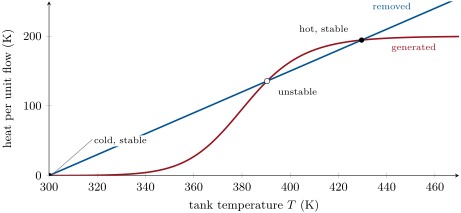
The stability of each state follows from the slopes: at an intersection where the removal line is steeper than the generation curve, a small rise of temperature removes more heat than it generates, and the tank cools back; where the generation curve is steeper, a small rise feeds itself. (The rigorous analysis linearises the time-dependent balances; it is admitted here.)
Definition 5.16 (Thermal runaway)
A thermal runaway is the self-accelerating rise of the temperature of a reacting mixture whose heat generation, growing exponentially with temperature, outpaces the heat removal.
Method 5.17 (Heat balance of a reactor)
- Compute the adiabatic temperature rise: if it is a few kelvin, the reactor is thermally safe.
- Otherwise compute the cooling duty, minus the heat carried by the outlet stream, and check that the jacket or coil can remove it.
- Check the stability of the operating point (slopes on a Semenov diagram), and what would happen if the cooling failed: the maximum temperature reached, for the reactant still present.
5.5 From protocol to plant
A synthesis that works in a flask does not simply scale up a thousandfold. The volume, and the heat released, grow as the cube of the size; the wall, through which the heat leaves, as its square. A vessel ten times wider has a thousand times the volume but only a hundred times the cooling surface: a reaction that stayed tepid in the flask can run away in the tank. Industrial practice therefore adds the most reactive reagent slowly (the reaction cannot release more heat than the reagent fed), dilutes, cools with internal coils, or moves to continuous reactors of small volume, whose small holdup limits what can go wrong.
Selectivity is the other concern. A plant does not throw away what did not react: it separates the product and recycles the reactants, as in the ammonia loop. It can therefore accept a modest single-pass conversion if the selectivity is high, since every by-product is raw material lost and waste to treat.
In the lab — A stirred tank on the bench
The kinetics of a reaction meant for a continuous plant is measured in a small stirred reactor fed by two calibrated pumps, with a conductivity cell or an online spectrometer at the outlet. Varying the flow rate varies ; the steady outlet concentration at each gives the rate directly, by the balance , without any integration.
5.6 Exercises
Exercise 5.1 ★
A stirred tank of is fed at . Compute its residence time in seconds and in hours.
Solution
Solution of Exercise 5.1.
, that is .
Exercise 5.2 ★
A first-order reaction has at the working temperature. Compute the conversion in a stirred tank and in a plug-flow tube of the same residence time, .
Solution
Solution of Exercise 5.2.
. Tank: ; tube: .
Exercise 5.3 ★
What plug-flow residence time gives 99 % conversion of a first-order reaction with ? And a stirred tank?
Solution
Solution of Exercise 5.3.
Tube: . Tank: , , more than twenty times longer: at high conversion the stirred tank pays dearly for working at the outlet concentration.
Exercise 5.4 ★
An aqueous solution at of a reactant whose reaction releases (, ) reacts completely. Compute the adiabatic temperature rise. Is a cooling failure dangerous?
Solution
Solution of Exercise 5.4.
Per litre: released, heating : . A failure of the cooling would warm the mixture noticeably but not dangerously, unless the solvent is near its boiling point or a second reaction starts in that range.
Exercise 5.5 ★★
For a second-order reaction with equal feeds (), compute the residence time for 80 % conversion in a stirred tank and in a plug-flow tube. Compare the ratio with that of a first-order reaction.
Solution
Solution of Exercise 5.5.
Tank: , . Tube: , . Ratio 5, against for order 1: the higher the order, the more the stirred tank suffers from its low concentration.
Exercise 5.6 ★★
Three equal stirred tanks in series, of total residence time , treat a first-order reaction with . Compute the conversion and compare with one tank and with a tube of the same total residence time.
Solution
Solution of Exercise 5.6.
. Three tanks: . One tank: . Tube: .
Exercise 5.7 ★★
A stirred tank converts 70 % of a reactant (first order). The flow rate is doubled. What is the new conversion? By what factor must the volume grow to recover 70 %?
Solution
Solution of Exercise 5.7.
means . Doubling the flow halves : , . To recover 70 % the residence time, hence the volume, must be doubled.
Exercise 5.8 ★★
A tank of works at with a feed of of reactant at , converted at 90 %, , , feed at . Compute the heat released per second, the heat carried away by the outlet stream, and the cooling duty of the jacket.
Solution
Solution of Exercise 5.8.
Released: . Carried by the outlet stream, heated from to : . The jacket must remove the difference, .
Exercise 5.9 ★★
A flask of and a reactor of have the same shape. By what factor are the volume, the wall area and the ratio of the two multiplied? Explain why a reaction that is easy to cool in the flask may run away in the reactor.
Solution
Solution of Exercise 5.9.
Linear dimensions : volume , wall area , area per unit volume . The heat released grows with the volume, the heat removed through the wall with its area: the large reactor removes, per litre, ten times less heat at the same temperature difference.
Exercise 5.10 ★★★
For with and , compute the optimal residence time and the maximum yield of B in a plug-flow reactor and in a stirred tank, and explain why the tube does better for an intermediate.
Solution
Solution of Exercise 5.10.
Tube: , . Tank: , . In the tank, fresh A and finished B are mixed in the same volume: some B always stays long enough to be converted to C while some A has barely arrived; in the tube every slice has the same history.
Exercise 5.11 ★★★
Using the Semenov diagram of the chapter, describe what happens when the coolant temperature is slowly raised, then slowly lowered again: show that the tank jumps from the cold to the hot branch at one temperature and back at another (hysteresis).
Solution
Solution of Exercise 5.11.
Raising the coolant (and feed) temperature moves the removal line to the right. The cold intersection rises slowly until the line becomes tangent to the lower bend of the S; beyond, the cold state disappears and the tank jumps to the hot branch (ignition). Lowering the temperature again, the tank stays on the hot branch until the line becomes tangent to the upper bend, and only then falls back (extinction), at a lower temperature than ignition: a hysteresis loop.
Exercise 5.12 ★★★
A batch reactor is charged with of reactant (, ) and heated to the working temperature. Then the cooling fails at 25 % conversion. Compute the temperature the mixture can reach. In a semi-batch operation, the same reactant is added slowly and consumed as it arrives, so that at most 5 % of the charge is present unreacted: what is now the worst-case rise?
Solution
Solution of Exercise 5.12.
Batch: 75 % of remain, , above the working temperature, enough to reach a boiling point or a decomposition. Semi-batch: at most unreacted, . Slow addition caps the energy stored in the reactor.
5.7 Problem: Soap in a Tank
Problem 5.1
Weekend problem — the saponification of an ester in a stirred tank: kinetics, sizing for 90 % conversion, the alternatives of a tube and of a cascade, and the heat balance
Ethyl ethanoate is saponified by sodium hydroxide, , a second-order reaction (first order in each reactant). A plant treats of a mixture whose concentrations of ester and of hydroxide at the inlet are both . For this problem take at the working temperature and (values set for the exercise); the mixture has the density and heat capacity of water, , .
Part I — Kinetics.
- Write the rate law. Why do the two concentrations stay equal?
- In a batch flask, how long does 90 % conversion take?
- Compute the half-life in the flask. Why does it depend on ?
- Write the Damköhler number of the reaction for a residence time .
Part II — One stirred tank.
- Write the balance of ester in the tank in steady operation.
- Show that .
- Compute the Damköhler number required for .
- Compute the residence time.
- Compute the volume of the tank.
- Which concentration does the reaction “see” everywhere in the tank, and why is the tank so large?
Part III — A tube, a cascade.
- Compute the Damköhler number and the volume of a plug-flow tube for the same duty.
- Compute the ratio of the two volumes.
- Three equal tanks in series: write the relation between the outlet concentrations of two successive tanks.
- The total volume of the three tanks that gives 90 % is . Check it by computing the concentration leaving each tank.
- Which arrangement would you build, and why might a single tank still be preferred?
Part IV — Heat.
- Compute the adiabatic temperature rise of the mixture.
- Compute the heat released per second in the tank.
- Is cooling needed? Is a runaway possible?
- What would change for a mixture fed at ?
- Compute the mass of sodium ethanoate produced per day.
- If the reaction is run at a higher temperature, how does the tank volume change, and what is the cost?
- State the volume of the single stirred tank that converts 90 % of the ester at this feed.
Solution
Solution of Problem 5.1.
1. ; equal feeds and a 1 : 1 stoichiometry keep the two concentrations equal, . 2. with : , , about . 3. ; for order 2 the rate falls with the square of the concentration, so the time to halve it depends on where one starts. 4. ( in seconds). 5. , that is . 6. With : . 7. . 8. , . 9. , . 10. The outlet concentration, : the rate is everywhere a hundred times lower than at the inlet. 11. , , . 12. Ten times less volume for the tube. 13. , with the residence time of one tank. 14. , . Solving : , , : 90 % conversion. 15. The tube, or the cascade (ten and five times smaller than one tank). A single tank may still win for its uniform temperature, easy cleaning and control, and because here volume is cheap. 16. ( at 90 %). 17. . 18. No: the outlet stream carries the heat away with a rise of about a kelvin; no runaway is possible. 19. Twenty times more concentrated: the adiabatic rise becomes and the heat , worth a cooling coil; the rate being twenty times higher, the tank for 90 % would be twenty times smaller (). 20. , of sodium ethanoate per day. 21. The rate constant grows with temperature (Arrhenius), so the volume shrinks; the cost is the heating of the feed and, for other reactions, a lower selectivity and more vapour. 22. The single stirred tank must hold .