A sports cold pack holds a bag of water and a few spoonfuls of ammonium nitrate. Squeeze it, the inner bag bursts, the salt dissolves, and within seconds the pack is cold enough to soothe a sprained ankle. The dissolution absorbs heat — it is endothermic — and yet it runs on its own, to completion. The enthalpy of the previous chapter cannot be the whole story: a reaction does not go only “downhill in heat”. The missing quantity is entropy, which the second law of thermodynamics, met in physics, makes the judge of every spontaneous change. This chapter tabulates entropies, computes the entropy of a reaction, and combines enthalpy and entropy into one function, the Gibbs energy, whose reaction derivative decides the direction of every reaction at fixed temperature and pressure.
You already know
From physics: the second law. Every system has a state function, its entropy S (extensive); in a transformation of a closed system, dS=δQ/Text+δSc, where the created entropy δSc is zero for a reversible change and positive otherwise; for a closed system of fixed composition, dU=TdS−pdV. Chapter 1: reaction quantities ΔrX=(∂X/∂ξ)T,p and standard reaction enthalpies. The Year 1 volume stated, as laws “that follow from the second law”, that a reaction evolves until Q=K∘; this chapter and the next two derive them.
A cold pack: when its inner bag is broken, ammonium nitrate dissolves in water and the pack cools. The dissolution is endothermic and spontaneous; its entropy explains why (Example 2.16).
2.1 Standard entropies and the third law
Unlike enthalpy, entropy has a natural zero.
Theorem 2.1(Third law of thermodynamics)
The entropy of a pure, perfectly ordered crystal tends to zero as its temperature tends to 0K.
Proof.Admitted at this level.∎
Remark 2.2(Where the zero comes from)
Walther Nernst stated in 1906 that reaction entropies between condensed phases vanish as T→0; Max Planck sharpened it into the statement above. Its origin is statistical: entropy counts the microscopic arrangements compatible with the state of a system, and a perfect crystal at 0K has a single one. The counting is done in the Year 3 volume, with partition functions.
Definition 2.3(Standard molar entropy)
The standard molar entropySm∘(T) of a substance is the entropy of one mole of it in its standard state at temperature T, the zero being that of the third law. Unlike ΔfH∘, it is an absolute quantity, positive for every substance, elements included.
Proposition 2.4(Absolute entropy from heat capacities)
Heating a substance at constant pressure p∘ from 0K to T,
the integral being taken in each phase over its range of temperature.
Proof. Heat the substance reversibly at constant pressure: δSc=0 and δQ=dH=CpdT, so dS=CpdT/T. At a transition (melting, boiling) the temperature stays at Ttrs while the heat ΔtrsH is received reversibly: the entropy jumps by ΔtrsH/Ttrs. Add the pieces from the third-law zero. ∎
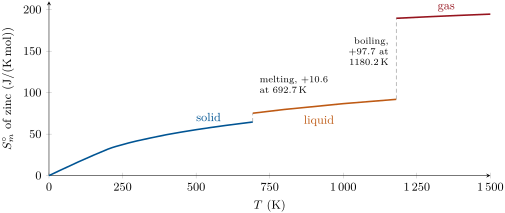
Standard molar entropy of zinc from the third-law zero. It grows with temperature as the metal stores heat, then jumps at the melting point by ΔfusH/Tfus and, much more, at the boiling point by ΔvapH/Tb: a gas is far more disordered than a liquid.
The figure gives orders of magnitude worth remembering. At room temperature a metal or a hard crystal holds a few tens of J/(Kmol), a liquid around a hundred, a gas one to three hundred; melting adds a little, boiling adds a lot. The standard molar entropies used in this volume are tabulated with the formation enthalpies.
2.2 Reaction entropy
Definition 2.5(Reaction entropy)
The reaction entropy is ΔrS=(∂S/∂ξ)T,p, and the standard reaction entropy is ΔrS∘(T)=∑iνiSm,i∘(T), in J/(Kmol).
Because standard entropies are absolute, no formation reaction is needed: the elements count with their own entropies.
Example 2.6(Three reaction entropies)
At 298.15K:
CaCOX3(s)CaO(s)+COX2(g): ΔrS∘=39.75+213.79−92.9=+160.6J/(Kmol), a gas made from a solid;
NX2(g)+3HX2(g)2NHX3(g): ΔrS∘=2(192.77)−191.61−3(130.68)=−198.1J/(Kmol), four molecules of gas becoming two;
When gases take part, the sign of ΔrS∘ is in general that of Δνgas=∑gasesνi, and its size is about 100 to 200J/(Kmol) per mole of gas made or consumed. When Δνgas=0, or no gas is involved, ΔrS∘ is small and its sign must be computed.
Justification. The molar entropy of a gas at 298K is between 130 and 300J/(Kmol), that of a solid or a liquid a few tens: making or consuming one mole of gas dominates every other contribution. This is a rule of thumb, not a theorem: the dissolution of a salt, with no gas, can still change the entropy by a hundred J/(Kmol). ∎
Method 2.8(Predicting the sign of ΔrS∘)
Count Δνgas: if it is not zero, it gives the sign.
Otherwise compare the order of the states: dissolving a crystal, melting, breaking a molecule into two pieces raise the entropy; precipitating, freezing, joining two molecules into one lower it.
When the decision matters, compute ∑iνiSm,i∘.
The Year 1 volume met a consequence: an elimination makes more molecules than a substitution with the same reagents (the alkene, the leaving group and the protonated base, against the substitution product and the leaving group). Its reaction entropy is larger, and the entropy term, which grows with temperature as shown in the next section, is why heat favours elimination over substitution.
2.3 The Gibbs energy
Definition 2.9(Gibbs energy)
The Gibbs energy (or free enthalpy) of a system is the state function G=H−TS, extensive, in joules.
Definition 2.10(Reaction Gibbs energy)
The reaction Gibbs energy is ΔrG=(∂G/∂ξ)T,p, and the standard reaction Gibbs energy is ΔrG∘(T)=∑iνiGm,i∘(T), both in kJ/mol.
Proposition 2.11(Enthalpy and entropy terms)
ΔrG=ΔrH−TΔrS, and ΔrG∘=ΔrH∘−TΔrS∘.
Proof. Differentiate G=H−TS with respect to ξ at fixed T and p: T is a constant of the derivative. ∎
Proposition 2.12(Differential of G for a reacting system)
For a closed system in which one reaction takes place, at uniform T and p,
dG=Vdp−SdT+ΔrGdξ.
Proof.G(T,p,ξ) has the exact differential dG=(∂G/∂T)p,ξdT+(∂G/∂p)T,ξdp+ΔrGdξ. The first two partial derivatives are taken at fixed composition: they are those of a closed system of fixed composition, for which physics gives dU=TdS−pdV, so that dG=dU+pdV+Vdp−TdS−SdT=Vdp−SdT. Hence (∂G/∂T)p,ξ=−S and (∂G/∂p)T,ξ=V. ∎
2.4 The evolution criterion
Theorem 2.13(Evolution criterion)
In a closed system kept at constant temperature and pressure, exchanging no work other than that of the pressure forces, a reaction can only advance in the direction that makes
ΔrGdξ≤0,
with equality at equilibrium. If ΔrG<0 the reaction runs forward, if ΔrG>0 it runs backward, and the system is at equilibrium when ΔrG=0.
Proof. Take an infinitesimal change at uniform T and p, equal to those of the surroundings. The first law with pressure work only gives dU=δQ−pdV; the second gives δQ=TdS−TδSc. Then
dG=dU+pdV+Vdp−TdS−SdT=−TδSc+Vdp−SdT.
Comparing with Proposition 2.12, at fixed T and p: ΔrGdξ=−TδSc. Since δSc≥0, ΔrGdξ≤0, and δSc=0 (a reversible, equilibrium change) needs ΔrG=0. ∎
Remark 2.14(What the criterion says, and what it does not)
The entropy created by a reaction at constant T and p is −ΔrGdξ/T: the Gibbs energy is the second law, restricted to the conditions of the laboratory and written with quantities of the system alone. It says in which direction a reaction may go, never how fast: diamond, for which the conversion to graphite has ΔrG∘<0, lasts for ever on a ring. And it assumes no other work: a cell that gives electrical work, or an electrolyser that receives it, obeys a modified criterion (Chapter 9).
Definition 2.15(Exergonic and endergonic)
A reaction is exergonic in a given state when ΔrG<0 and endergonic when ΔrG>0. With every species in its standard state these words apply to the sign of ΔrG∘.
The criterion uses ΔrG, the value in the actual state of the system; ΔrG∘ refers to every species in its standard state, which is rarely the state of a real mixture. The link between them, through the composition, is the subject of Chapter 3, and gives the Year-1 law Q=K∘ in Chapter 4. For reactions between pure solids and liquids, and gases at 1bar, the two coincide.
Example 2.16(The cold pack)
For NHX4NOX3(s)NHX4X+(aq)+NOX3X−(aq) at 298.15K, standard states: ΔrH∘=−339.87+365.56=+25.69kJ/mol and ΔrS∘=259.8−151.08=+108.7J/(Kmol), so ΔrG∘=25.69−298.15×0.1087=−6.7kJ/mol: the dissolution is endothermic and exergonic. The ions, free in the water, are more disordered than in the crystal, and the entropy term TΔrS∘=32.4kJ/mol outweighs the enthalpy cost.
History— Josiah Willard Gibbs
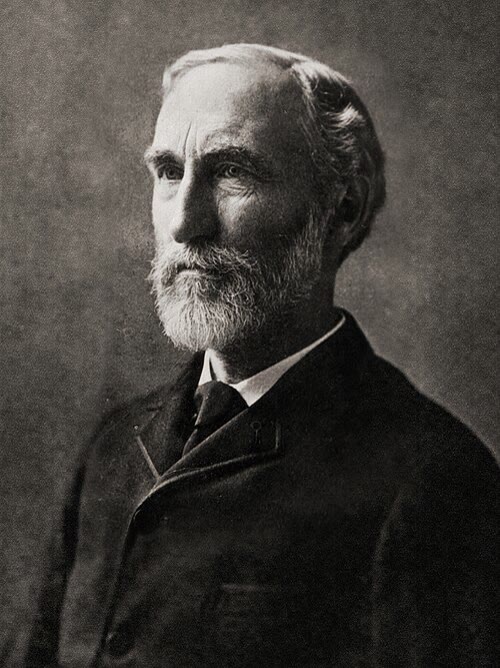
Josiah Willard Gibbs (1839–1903), professor of mathematical physics at Yale, published between 1876 and 1878 On the Equilibrium of Heterogeneous Substances, some three hundred pages in the transactions of a small academy, where the free energy, the chemical potential and the phase rule of the next chapters all appear. Few chemists read it until it was translated in the 1890s. (Photograph: public domain, Wikimedia Commons.)
2.5 Standard reaction Gibbs energies and temperature
Definition 2.17(Ellingham approximation)
The Ellingham approximation treats ΔrH∘ and ΔrS∘ as independent of the temperature over an interval containing no change of state. Then ΔrG∘(T)=ΔrH∘−TΔrS∘ is a straight line in T, of slope −ΔrS∘.
Proof. With every species in its standard state, G∘(T,ξ) has (∂G∘/∂T)ξ=−S∘ (Proposition 2.12). By Schwarz’s theorem,
dTdΔrG∘=∂ξ∂TG∘=−∂ξS∘=−ΔrS∘.
Then dTd(ΔrG∘/T)=T2−TΔrS∘−ΔrG∘=−T2ΔrH∘. Finally, dSm∘=Cp,m∘dT/T for each species (Proposition 2.4), and the same combination gives the last relation. If ΔrCp∘ is small, ΔrH∘ (Kirchhoff) and ΔrS∘ hardly change. ∎
Definition 2.19(Inversion temperature)
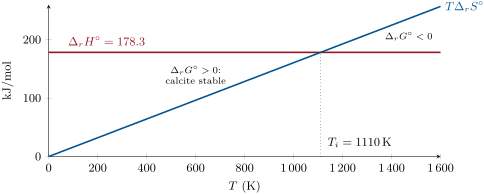
When ΔrH∘ and ΔrS∘ have the same sign, the inversion temperature of the reaction is the temperature where ΔrG∘ changes sign; in the Ellingham approximation, Ti=ΔrH∘/ΔrS∘.
The enthalpy and entropy terms of CaCOX3(s)CaO(s)+COX2(g) in the Ellingham approximation. Below the inversion temperature the enthalpy cost wins and limestone is stable under 1bar of carbon dioxide; above it the entropy term wins and limestone decomposes.
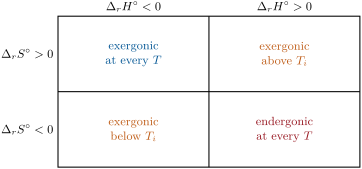
The four cases of ΔrG∘=ΔrH∘−TΔrS∘ (Ellingham approximation). Combustions are in the upper left box; the decomposition of limestone and the cold pack in the upper right; the synthesis of ammonia in the lower left.
Method 2.20(A standard reaction Gibbs energy at temperature T)
From the tables at 298.15K, compute ΔrH∘ and ΔrS∘.
Check that no species changes state between 298K and T; otherwise add the transition (enthalpy and entropy) or start from the new state.
Where ΔrCp∘ is not small or the interval is long, use tabulated ΔfG∘(T) directly.
Example 2.21(Two tests of the approximation)
For limestone, ΔrCp∘=42.80+37.13−81.88=−2.0J/(Kmol): the approximation is excellent, and ΔrG∘=178.3−T×0.1606 gives Ti=1110K. For ammonia, ΔrG∘(700)≈−91.9+700×0.1981=+46.8kJ/mol, while the tables give 2ΔfG∘(NHX3,700)=+54.4kJ/mol: here ΔrCp∘=−44J/(Kmol) and the error is 8kJ/mol, a factor of 4 on the equilibrium constant at that temperature.
2.6 Exercises
Exercise 2.1★
Predict the sign of ΔrS∘ for: (a) 2HX2(g)+OX2(g)2HX2O(l); (b) CaCOX3(s)CaO(s)+COX2(g); (c) NX2OX4(g)2NOX2(g); (d) AgX+(aq)+ClX−(aq)AgCl(s); (e) HX2O(s)HX2O(l); (f) HX2(g)+ClX2(g)2HCl(g).
Solution
Solution of Exercise 2.1.
(a) Three moles of gas become liquid: ΔrS∘<0. (b) A gas is made: >0. (c) One gas molecule gives two: >0. (d) Ions in solution form a crystal: <0. (e) Melting: >0. (f) Δνgas=0: small, and here positive (+20J/(Kmol) from the tables, HCl being less symmetrical than HX2 and ClX2).
Exercise 2.2★
Compute ΔrS∘ and ΔrG∘ at 298.15K for the synthesis of ammonia, NX2(g)+3HX2(g)2NHX3(g), with ΔrH∘=−91.9kJ/mol and the entropies of the chapter. Is it exergonic?
Solution
Solution of Exercise 2.2.
ΔrS∘=2(192.77)−191.61−3(130.68)=−198.1J/(Kmol); ΔrG∘=−91.9−298.15×(−0.1981)=−32.8kJ/mol: exergonic at 298K, though the entropy term (+59.1kJ/mol) works against it.
Exercise 2.3★
Compute ΔrG∘(298.15K) of HX2(g)+21OX2(g)HX2O(l) from ΔfH∘(HX2O,l)=−285.83kJ/mol and the standard entropies HX2(g) 130.68, OX2(g) 205.15, HX2O(l)69.95J/(Kmol). Why is this value the standard Gibbs energy of formation of liquid water?
Solution
Solution of Exercise 2.3.
ΔrS∘=69.95−130.68−21(205.15)=−163.3J/(Kmol); ΔrG∘=−285.83+298.15×0.1633=−237.14kJ/mol. It is the formation reaction of liquid water (one mole from the elements in their reference states), so its standard reaction Gibbs energy is by definition ΔfG∘(HX2O,l); the tables give the same value.
Exercise 2.4★
Use the figure of the entropy of zinc to read its standard molar entropy at 298K and at 1000K, and its jumps at the melting and boiling points. Deduce its enthalpies of fusion and of vaporisation.
Solution
Solution of Exercise 2.4.
About 42J/(Kmol) at 298K and 87J/(Kmol) at 1000K (liquid). Jumps: 10.6J/(Kmol) at 692.7K and 97.7J/(Kmol) at 1180.2K. ΔfusH=10.6×692.7=7.3kJ/mol and ΔvapH=97.7×1180.2=115kJ/mol.
Exercise 2.5★★
For HX2O(l)HX2O(g) at 298.15K, compute ΔrH∘, ΔrS∘ and ΔrG∘ from the tables of the chapter. Explain why ΔrS∘=ΔrH∘/T at 298K, what the positive ΔrG∘ means, and estimate in the Ellingham approximation the temperature at which liquid water and its vapour at 1bar are in equilibrium. Compare with the boiling point.
Solution
Solution of Exercise 2.5.
ΔrH∘=44.00kJ/mol, ΔrS∘=188.84−69.95=118.9J/(Kmol), ΔrG∘=44.00−298.15×0.1189=+8.55kJ/mol. At 298K the change is not reversible (liquid water and vapour at 1bar are not in equilibrium), so ΔS=Q/T: ΔrH∘/T=147.6J/(Kmol). The positive ΔrG∘ means that at 298K water does not evaporate into an atmosphere of pure vapour at 1bar: the vapour condenses. The two are in equilibrium where ΔrG∘=0: T=44004/118.9=370K, within 3K of the normal boiling point (373K): the Ellingham approximation is good over 75K.
Exercise 2.6★★
For NX2OX4(g)2NOX2(g), ΔrH∘=57.1kJ/mol and ΔrS∘=175.7J/(Kmol). Compute the inversion temperature, and explain why a sealed tube of the brown gas NOX2 pales when it is cooled in ice.
Solution
Solution of Exercise 2.6.
Ti=57100/175.7=325K. Below it ΔrG∘>0 and colourless NX2OX4 is favoured; cooling the tube shifts the gas towards NX2OX4 and the brown colour of NOX2 fades (the quantitative link with the composition is in Chapter 4).
Exercise 2.7★★
A reaction has ΔrG∘=−12.0kJ/mol at 300K and −4.0kJ/mol at 400K. In the Ellingham approximation, find ΔrH∘ and ΔrS∘, and check the Gibbs–Helmholtz relation.
Solution
Solution of Exercise 2.7.
ΔrS∘=−dΔrG∘/dT=−(−4.0+12.0)/100=−0.080kJ/(Kmol)=−80J/(Kmol) and ΔrH∘=ΔrG∘+TΔrS∘=−12.0+300×(−0.080)=−36.0kJ/mol. Check: ΔrG∘/T goes from −0.0400 to −0.0100kJ/(Kmol), slope 3.00×10⁻⁴ per kelvin, equal to −ΔrH∘/T2=36.0/3462=3.00×10−4 at the geometric mean temperature 300×400=346K.
Exercise 2.8★★
Compute ΔrG∘ of the formation of methane, C(s)+2HX2(g)CHX4(g), at 298.15K, from ΔfH∘=−74.87kJ/mol and the entropies C (graphite) 5.74, HX2 130.68, CHX4186.25J/(Kmol). Above which temperature does methane become unstable with respect to its elements under the standard pressure?
Solution
Solution of Exercise 2.8.
ΔrS∘=186.25−5.74−2(130.68)=−80.8J/(Kmol), ΔrG∘=−74.87+298.15×0.0808=−50.8kJ/mol, the tabulated ΔfG∘ of methane. Both terms having the same sign, methane becomes unstable above Ti=74870/80.8≈926K (Ellingham approximation): hot methane cracks to carbon and hydrogen, a route to both.
Exercise 2.9★★
A haloalkane reacts with a base by substitution or by elimination. Write both reactions for 2-bromopropane and hydroxide. With ΔrH∘(elimination)−ΔrH∘(substitution)=+40kJ/mol and ΔrS∘(elimination)−ΔrS∘(substitution)=+90J/(Kmol) (orders of magnitude), find above which temperature the elimination becomes the more exergonic of the two, and explain the role of the number of molecules.
Solution
Solution of Exercise 2.9.
Substitution: CHX3CHBrCHX3+OHX−CHX3CH(OH)CHX3+BrX−; elimination: CHX3CHBrCHX3+OHX−CHX2=CHCHX3+HX2O+BrX−. The difference of the two standard reaction Gibbs energies is Δ(ΔrG∘)=40−T×0.090, negative above 40000/90≈440K. Elimination makes one more molecule than substitution: its entropy is larger, and the entropy term grows in proportion to T.
Exercise 2.10★★★
Crystalline carbon monoxide does not reach zero entropy at 0K: each molecule can sit as CO or OC almost at random, the two orientations having nearly the same energy. Admitting Boltzmann’s formula S=kBlnW, where W is the number of arrangements (counted in the Year 3 volume), compute the residual molar entropy. Why does the third law not apply to this crystal?
Solution
Solution of Exercise 2.10.
Each of the NA molecules has 2 orientations: W=2NA, so S=kBln2NA=Rln2=5.76J/(Kmol). The crystal is not perfectly ordered: at low temperature the molecules are frozen in their random orientations and cannot reach the single ordered arrangement the third law assumes.
Exercise 2.11★★★
Show that if ΔrCp∘ is a constant c, ΔrS∘(T)=ΔrS∘(T0)+cln(T/T0) and ΔrG∘(T)=ΔrH∘(T0)−TΔrS∘(T0)+c[T−T0−Tln(T/T0)]. Apply it to limestone (c=−2.0J/(Kmol)) at 1100K, and measure the error of the Ellingham approximation.
Solution
Solution of Exercise 2.11.
Integrate dΔrS∘/dT=c/T: ΔrS∘(T)=ΔrS∘(T0)+cln(T/T0); Kirchhoff gives ΔrH∘(T)=ΔrH∘(T0)+c(T−T0); subtract TΔrS∘(T). For limestone at 1100K: Ellingham 178.32−1100×0.16064=1.62kJ/mol; correction c[T−T0−Tln(T/T0)]=−0.00195×(801.85−1436.3)=+1.24kJ/mol: ΔrG∘=2.86kJ/mol. The error, 1.2kJ/mol, is less than one per cent of ΔrH∘, but near the inversion temperature it decides the sign.
Exercise 2.12★★★
Titanium is made from its oxide, rutile, through its chloride. (a) Compute ΔrH∘ and ΔrS∘ at 298K of TiOX2(s)+2ClX2(g)TiClX4(g)+OX2(g), with TiOX2 (−944.0kJ/mol, 50.62J/(Kmol)) and TiClX4(g) (−763.2, 353.2), and its ΔrG∘ at 1000K in the Ellingham approximation. (b) Carbon is added: C(s)+OX2(g)COX2(g), ΔrH∘=−393.5kJ/mol, ΔrS∘=+2.9J/(Kmol). Compute ΔrG∘(1000K) of the sum of the two reactions and explain how the second drives the first.
Solution
Solution of Exercise 2.12.
(a) ΔrH∘=−763.2+944.0=+180.8kJ/mol, ΔrS∘=353.2+205.15−50.62−2(223.08)=+61.6J/(Kmol); ΔrG∘(1000)=180.8−61.6=+119.2kJ/mol: endergonic, no chlorination. (b) For C+OX2COX2, ΔrG∘(1000)=−393.5−2.9=−396.4kJ/mol. The sum, TiOX2(s)+2ClX2(g)+C(s)TiClX4(g)+COX2(g), has ΔrG∘=−277.2kJ/mol: carbon consumes the dioxygen made by the first reaction, and the coupled reaction is strongly exergonic.
2.7 Problem: The Lime Kiln
Problem 2.1
Weekend problem — the entropy and enthalpy of a decomposition, its Gibbs energy against temperature, the evolution criterion in a kiln, and the energy and carbon dioxide of a tonne of lime
Lime, CaO, is made by heating limestone, CaCOX3, in a kiln. Data at 298.15K: ΔfH∘ (kJ/mol) CaCOX3(s)−1206.92, CaO(s)−635.09, COX2(g)−393.51; Sm∘ (J/(Kmol)) 92.9, 39.75, 213.79; Cp,m∘ (J/(Kmol)) 81.88, 42.80, 37.13. Molar masses: CaO56.08g/mol, COX244.01g/mol, CHX416.04g/mol; combustion of methane, water as vapour, ΔrH∘=−802.3kJ/mol.
Check the Gibbs–Helmholtz relation on this expression.
Estimate, with the formula of Exercise 2.11, the change of ΔrG∘ at Ti caused by ΔrCp∘, and the resulting shift of Ti.
Part III — The kiln. In this part the carbon dioxide above the solids is at 1bar, so that ΔrG=ΔrG∘.
What does the evolution criterion say at 1000K? And at 1300K?
What happens to a mixture of lime and carbon dioxide at 1bar cooled below Ti?
How much entropy is created per mole of limestone decomposed at 1300K?
Kilns are swept by the combustion gases, poorer in carbon dioxide. Guess, before the next chapter, whether this helps the decomposition.
Part IV — A tonne of lime.
Compute the amount of lime in one tonne.
Compute the heat absorbed by the reaction per tonne of lime (take ΔrH∘ as constant).
Compute the mass of carbon dioxide released by the limestone per tonne of lime.
The heat comes from burning methane with a useful efficiency of 50 %. Compute the mass of methane burnt per tonne of lime.
Compute the carbon dioxide from this methane.
Compute the total carbon dioxide per tonne of lime, and the share due to the limestone itself.
Why can a cleaner fuel reduce only part of these emissions?
State the temperature above which limestone decomposes under 1bar of carbon dioxide.
Solution
Solution of Problem 2.1.
1.CaCOX3(s)CaO(s)+COX2(g). 2.ΔrH∘=−635.09−393.51+1206.92=+178.3kJ/mol: endothermic. 3.ΔrS∘=39.75+213.79−92.9=+160.6J/(Kmol), positive because a gas is formed from a solid. 4.ΔrG∘=178.32−298.15×0.16064=+130.4kJ/mol. 5. Yes: ΔrG<0 is needed for decomposition, and here it is strongly positive; the carbon dioxide of the air, far below 1bar, lowers ΔrG but by far less than 130kJ/mol (next chapter). 6.ΔrCp∘=42.80+37.13−81.88=−1.95J/(Kmol), tiny: ΔrH∘ and ΔrS∘ hardly change with T. 7.ΔrG∘(T)=178.32−0.16064T (kJ/mol). 8.+17.7kJ/mol at 1000K; −30.5kJ/mol at 1300K. 9.Ti=178320/160.64=1110K. 10.ΔrG∘/T=178.32/T−0.16064, whose derivative is −178.32/T2=−ΔrH∘/T2. 11. At Ti, c[Ti−T0−Tiln(Ti/T0)]=−0.00195×(811.9−1459.4)=+1.26kJ/mol; ΔrG∘ reaches zero 1260/160.6≈8K higher, at about 1118K: less than one per cent. 12. At 1000K, ΔrG>0: the decomposition cannot proceed (lime would absorb carbon dioxide). At 1300K, ΔrG<0: limestone decomposes. 13.ΔrG becomes positive: lime takes up the carbon dioxide and turns back into carbonate. 14.δSc=−ΔrGdξ/T=30506/1300=23.5J/K per mole. 15. Yes: Chapter 3 will show that ΔrG=ΔrG∘+RTln(pCOX2/p∘), lowered when the pressure of carbon dioxide is below 1bar, so that the decomposition starts below Ti. 16.n=106/56.08=1.783×104mol. 17.1.783×104×178.32=3.18×10⁶kJ, that is 3.18GJ per tonne. 18.1.783×104×44.01=785kg of COX2. 19. Heat to supply 3.18×10⁶/0.50=6.36×106kJ, so 6.36×10⁶/802.3=7.93×103mol of methane, 127kg. 20.7.93×103×44.01=349kg of COX2. 21.785+349=1134kg per tonne of lime, 69 % of it from the limestone. 22. The limestone’s carbon dioxide is set by the stoichiometry, whatever heats the kiln; only the fuel’s share can be cut. 23. Limestone decomposes under 1bar of carbon dioxide above its inversion temperature, Ti≈1.11×10³K (about 840∘C).