University Chemistry — Year 2 · Bachelor Year 2
18Transition Metals and Coordination Complexes
In 1893 a chemist of twenty-six, Alfred Werner, set out to explain a puzzle. Cobalt(III) chloride forms four compounds with ammonia, , and two of formula , one green and one violet. Silver nitrate precipitates all three chlorides of the first at once, two of the second, and only one of each of the last two. Werner’s answer — six groups held around the metal at the corners of an octahedron, the rest outside — founded coordination chemistry. This chapter extends the complexes of the Year 1 volume to their geometry, their isomers, their names, and a count of electrons that predicts which metal carbonyls exist.
You already know
The Year 1 volume: complex, central atom, ligand, polydentate ligand, chelate, formation constants, coordination number; electron configurations of the transition-metal ions (the s electrons lost first); Lewis acids and bases, dative bonds; VSEPR; oxidation numbers; enantiomers. Chapter 13: the d orbitals and the order of the 4s and 3d levels.
18.1 The d block
Definition 18.1 (Transition element)
A transition element is an element whose atom, or one of whose common ions, has a partly filled d subshell. An ion of such an element with electrons in its d orbitals has a configuration.
Proposition 18.2 (Counting d electrons)
A transition-metal ion of the group numbered (3 to 12) has a configuration with .
Proof. The neutral atom has electrons beyond the preceding noble gas, in the s and d orbitals. In the ions, the d orbitals lie below the s orbital (Example 13.15): all the remaining valence electrons are d electrons. ∎
For example (group 8) is , (group 11) , (group 9) , (group 10) .
18.2 Ligands
Definition 18.3 (Denticity)
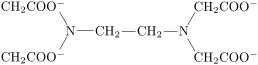
The denticity of a ligand is the number of its atoms bound to the same central atom. A monodentate ligand binds through one atom (, , , ), a bidentate ligand through two (ethane-1,2-diamine, written en; the ethanedioate ion, ox). A bridging ligand binds to two metal atoms at once. An ambidentate ligand can bind through either of two different atoms, such as the nitrite ion (through N or O) or thiocyanate (through S or N).
Definition 18.4 (Coordination sphere)
The coordination sphere of a complex is the set of the central atom and the ligands bound to it, written within square brackets; ions outside the brackets are counter-ions, not bound to the metal.


18.3 Coordination numbers and geometries
Two, four and six are the commonest coordination numbers. Silver(I) and gold(I) give linear complexes (); four ligands form a tetrahedron (, ) or a square (, ); five, a trigonal bipyramid (); six, by far the most frequent, an octahedron.
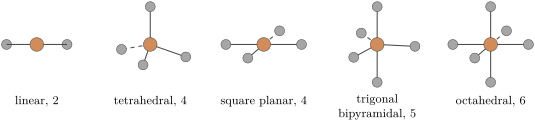
VSEPR, which places electron pairs of the central atom as far apart as possible, fails here: a ion such as carries four pairs of d electrons and four ligands, yet its complexes are square, not tetrahedral or octahedral. The d electrons are not localised pairs pushing the ligands: their energies depend on the geometry in a way the next chapter computes.
Proposition 18.5 (Square-planar )
Four-coordinate complexes of ions of the second and third transition series (, , ) are square planar.
Proof. Admitted at this level. ∎
The explanation, the splitting of the d levels by the ligands, comes in Chapter 19.
18.4 Isomers
Definition 18.6 (Isomers of complexes)
In an octahedral complex , the fac isomer has the three B ligands on one face of the octahedron, the mer isomer on a meridian (three positions in a plane through the metal). Linkage isomers differ by the atom through which an ambidentate ligand binds. Ionisation isomers exchange a ligand with a counter-ion, giving different ions in solution.
Proposition 18.7 (Counting octahedral isomers)
In an octahedron, has two isomers (cis and trans), two (fac and mer), and , with three bidentate ligands, two enantiomers, and .
Proof. In an octahedron any two positions are either adjacent (cis, ) or opposite (trans, ): two arrangements for the two B ligands. For three B ligands, either no two are trans (they occupy one face: fac) or exactly one pair is trans (the third is cis to both: mer); three mutually trans positions do not exist. For , each chelate spans two cis positions; the three chelates wind round the threefold axis as the blades of a propeller, turning either clockwise or anticlockwise when viewed along that axis: two mirror images, not superimposable since the complex has no mirror plane. ∎
![Top: cis and trans isomers of MA_4B_2 (B ligands blue), fac and mer isomers of MA_3B_3 (B red). Bottom: the two enantiomers of a tris-chelate such as [Co(en)3]3+, viewed along the threefold axis, schematic: each chelate (blue arc) joins an upper and a lower position, and the three turn one way () or the other ().](/images/onecourse/chapters/chemistry-3/b2-coordination-complexes/fig-69690792f2c7.svg)
![Top: cis and trans isomers of MA_4B_2 (B ligands blue), fac and mer isomers of MA_3B_3 (B red). Bottom: the two enantiomers of a tris-chelate such as [Co(en)3]3+, viewed along the threefold axis, schematic: each chelate (blue arc) joins an upper and a lower position, and the three turn one way () or the other ().](/images/onecourse/chapters/chemistry-3/b2-coordination-complexes/fig-61bb91f0e162.svg)
18.5 Names and electron counts
Method 18.8 (Naming a complex)
- In the formula, write the coordination sphere in square brackets, metal first, then the ligands; the charge of the complex outside.
- In the name, list the ligands in alphabetical order with multiplying prefixes (di-, tri-, tetra-; bis-, tris- for complex ligand names): anionic ligands end in -o (chlorido, cyanido, oxido, hydroxido), neutral ones keep their names (aqua, ammine, carbonyl).
- Then the metal, with the ending -ate if the complex is an anion (ferrate, cuprate, cobaltate), and its oxidation number in Roman numerals.
- Cations are named before anions: is hexaamminecobalt(III) chloride, potassium hexacyanidoferrate(II).
Definition 18.9 (Electron count)
The valence electron count of a complex is the number of d electrons of the metal ion plus the electrons given by the ligands (two for each donor pair). The 18-electron rule states that stable complexes of low-oxidation-state metals with strongly bonding -acceptor ligands such as tend to have 18 valence electrons.
Definition 18.10 (Hapticity)
The hapticity of a ligand is the number of its atoms bound to the metal through one continuous system; it is written : an ethene bound by its bond is , a cyclopentadienyl ring bound by all five carbons .
Method 18.11 (Counting electrons)
- Assign charges to the ligands as closed-shell species (, , ; , , neutral) and deduce the oxidation state of the metal.
- Count the metal’s d electrons, .
- Add two electrons per donor pair: one per monodentate ligand, six for an -, six for an -benzene, two for an -alkene.
- A metal–metal bond counts one electron for each metal.
Proposition 18.12 (Metal carbonyls)
The stable binary carbonyls of the first transition series , , and all have 18 valence electrons per metal atom.
Proof. Chromium(0), , with six CO: . Iron(0), , five CO: . Nickel(0), , four CO: . Manganese(0), , five CO and one Mn–Mn bond: ; a monomeric , with 17, does not exist as a stable compound, and pairs up. The reason why 18 is favoured — nine valence orbitals of the metal, all bonding or nonbonding ones filled — is given in Chapter 19. ∎
Ferrocene, , holds an iron(II) ion () between two cyclopentadienyl anions, each giving six electrons: . The rule fails for most complexes of high oxidation states and for many with weak ligands: has 13 electrons, 21.
History — Werner and the octahedron
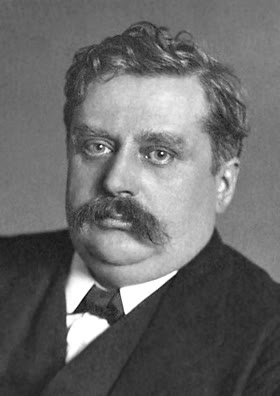
Alfred Werner proposed in 1893 that a metal has, besides its valence, a coordination number of groups held directly around it, and that cobalt(III) holds six at the corners of an octahedron. He then predicted how many isomers each formula should have and spent twenty years preparing them; in 1911 he resolved a cobalt complex into its two enantiomers, proving that chirality does not require a carbon atom. He received the Nobel Prize in Chemistry in 1913. (Portrait, Les Prix Nobel, 1914, public domain, Wikimedia Commons.)
18.6 Exercises
Exercise 18.1 ★
Give the configuration of , , , , , , and .
Solution
Solution of Exercise 18.1.
, , , , , , , .
Exercise 18.2 ★
Give the denticity of water, ethane-1,2-diamine, the ethanedioate ion, edta and the thiocyanate ion, and say which is ambidentate.
Solution
Solution of Exercise 18.2.
Water 1, en 2, ethanedioate 2, edta 6, thiocyanate 1; thiocyanate is ambidentate (through S or N).
Exercise 18.3 ★
Name , , and .
Solution
Solution of Exercise 18.3.
Tetraamminecopper(II) sulfate; potassium hexacyanidoferrate(III); tetraamminedichloridocobalt(III) chloride; tetracarbonylnickel(0).
Exercise 18.4 ★
Predict the geometry of , , and .
Solution
Solution of Exercise 18.4.
Linear; tetrahedral; square planar (, third series); octahedral.
Exercise 18.5 ★★
How many isomers does square-planar have? Draw them. (One of them, cisplatin, is an anticancer drug.)
Solution
Solution of Exercise 18.5.
Two: cis (the two chlorides adjacent) and trans (opposite). In a tetrahedron there would be only one.
Exercise 18.6 ★★
Count the valence electrons of , , , and . Which one breaks the rule, and how does it behave?
Solution
Solution of Exercise 18.6.
18; 18; 18; : ; 18 per manganese. breaks the rule: it is paramagnetic and easily reduced to , which has 18.
Exercise 18.7 ★★
Count the valence electrons of ferrocene and of cobaltocene . Which is easily oxidised, and to what?
Solution
Solution of Exercise 18.7.
Ferrocene: Fe(II) + 12 = 18. Cobaltocene: Co(II) + 12 = 19. Cobaltocene loses its extra electron easily, giving the cobaltocenium ion , with 18.
Exercise 18.8 ★★
The nickel(II) complex of edta has , far above that of complexes in which nickel binds six separate nitrogen or oxygen donors. Explain this chelate effect in terms of the number of particles released when the chelate replaces six water molecules.
Solution
Solution of Exercise 18.8.
One edta replaces six water molecules: , seven particles from two. The entropy of reaction is strongly positive, and very large. Six separate ligands replace six water molecules with no gain in the number of particles.
Exercise 18.9 ★★
Draw the two linkage isomers of .
Solution
Solution of Exercise 18.9.
Nitrito- (, the nitro isomer, yellow) and nitrito- (, the nitrito isomer, red).
Exercise 18.10 ★★★
How many stereoisomers does have? Which are chiral?
Solution
Solution of Exercise 18.10.
Three: the trans isomer (achiral: mirror planes) and the two enantiomers of the cis isomer (the two chelates and the two chlorides wind one way or the other).
Exercise 18.11 ★★★
For , count the isomers predicted by a planar hexagon and by a trigonal prism of six ligands, and explain how the number of isomers found decides between the geometries.
Solution
Solution of Exercise 18.11.
Planar hexagon: B at positions 1,2 (ortho), 1,3 (meta), 1,4 (para): three isomers. Trigonal prism: B along an edge of a triangle, along a vertical edge, or across a rectangular face: three. The octahedron gives two. Finding no more than two, despite many attempts and several compounds, rules out the other two geometries — if no third isomer has been overlooked.
Exercise 18.12 ★★★
Count the valence electrons of and of ( a two-electron donor, as hydride). Which one could take up two more ligands?
Solution
Solution of Exercise 18.12.
: Rh(I) + 4 × 2 = 16. : Ir(I) + 5 × 2 = 18. The rhodium complex, with 16 electrons, can take two more (oxidative addition, Chapter 20).
18.7 Problem: Werner’s Cobalt Ammines
Problem 18.1
Weekend problem — four cobalt(III) chloride ammines and the chloride they release, their formulas in brackets, the two isomers of the tetraammine and what they prove about the geometry, and the optical activity of a tris-chelate
Data: four compounds A (orange-yellow), B (purple), C and D (green and violet). With excess silver nitrate, one mole of A precipitates 3 mol of , B 2 mol, C and D 1 mol each. Molar conductivities show 4, 3, 2 and 2 ions per formula unit.
Part I — Chloride and ions.
- Which chlorides react at once with silver ions?
- How many chlorides are bound to cobalt in each compound?
- Check the numbers of ions against the conductivities.
- What is the oxidation number of cobalt in all four?
- What is its configuration?
- What total number of ligands does cobalt hold in each compound?
Part II — Formulas and names.
- Write A, B, C and D with square brackets.
- Name A and B.
- Name the cation of C and D.
- What kind of isomers are C and D?
- What would a compound be, and how many ions would it give?
- How many isomers would that compound have in an octahedron?
Part III — The geometry.
- Draw cis and trans in an octahedron.
- Count the isomers of predicted for six ligands at the corners of a planar hexagon.
- Count those predicted for a trigonal prism.
- Werner never found more than two. What does it prove?
- Is the proof complete? What would a third isomer have meant?
- Which of C and D is cis, knowing that the cis isomer can be converted into a chelate with ethanedioate and the trans cannot?
Part IV — Optical activity.
- Draw .
- Does it have a mirror plane? A centre of inversion?
- How many stereoisomers does it have?
- What does the resolution of such a cation into enantiomers prove?
- Is chiral in its cis form? In its trans form?
- Why did Werner’s resolution of a complex containing no carbon at all matter?
- State the number of isomers of predicted by the octahedron, and by the planar hexagon and the trigonal prism.
Solution
Solution of Problem 18.1.
1. The chlorides outside the coordination sphere, free in solution. 2. A: 0; B: 1; C and D: 2. 3. A: + 3 : 4 ions; B: 3; C, D: 2. They agree. 4. +3. 5. . 6. Six in each: 6 ; 5 + 1 Cl; 4 + 2 Cl. 7. ; ; (twice). 8. Hexaamminecobalt(III) chloride; pentaamminechloridocobalt(III) chloride. 9. Tetraamminedichloridocobalt(III). 10. Geometric (cis–trans) isomers. 11. , a neutral complex: no ions, no chloride precipitated at once. 12. Two: fac and mer. 13. Cis: the two Cl at ; trans: at . 14. Three (ortho, meta, para positions on the hexagon). 15. Three. 16. It supports the octahedron, the only one of the three that predicts two. 17. No: absence of a third isomer is negative evidence. A third isomer would have ruled out the octahedron. 18. The one that forms the chelate: a bidentate ethanedioate can span only two cis positions. 19. Three en chelates around cobalt, each spanning two cis positions. 20. Neither: no mirror plane and no centre of inversion. 21. Two enantiomers, and . 22. That the six ligands are arranged in three dimensions, as in an octahedron; a planar arrangement would give an achiral ion. 23. Cis: chiral (two enantiomers). Trans: achiral. 24. It showed that optical activity belongs to molecular geometry in general, not to carbon, and confirmed the octahedron. 25. The octahedron predicts isomers of ; the planar hexagon and the trigonal prism predict .