University Chemistry — Year 2 · Bachelor Year 2
15Fragment Orbitals and Polyatomic Molecules
The Lewis structure of water shows two equivalent O–H bonds and two equivalent lone pairs. Yet when water is ionised by ultraviolet light, the electrons come out with four different energies, not two; methane, with four equivalent C–H bonds, shows two. Electrons in a molecule do not sit in bonds between pairs of atoms: they occupy orbitals spread over the whole molecule. This chapter builds those orbitals from the orbitals of fragments, explains why water is bent and ethene is flat, and why a carbocation prefers to have alkyl groups around it.
You already know
Chapter 14: LCAO, overlap and symmetry, two interacting levels, bonding and antibonding orbitals. The Year 1 volume: VSEPR shapes, hybridisation as a description, resonance, carbocations and their order of stability (the interaction of the C–H bonds with the empty orbital was announced there).
15.1 The fragment method
Definition 15.1 (Fragments)
A fragment is a group of atoms of a molecule considered on its own (an atom, a pair of hydrogens, a group), and a fragment orbital one of its orbitals. The orbitals of the molecule are built by letting the orbitals of two fragments interact, two by two, as the atomic orbitals of a diatomic molecule.
Definition 15.2 (Symmetry-adapted combination)
A symmetry-adapted combination of equivalent atomic orbitals is a combination that each symmetry operation of the molecule (a reflection in a mirror plane, a rotation about an axis) either leaves unchanged or turns into its opposite, or, for degenerate sets, transforms into combinations of the same set.
Proposition 15.3 (Two hydrogens)
For two equivalent hydrogens with 1s orbitals and , the symmetry-adapted combinations are and : the first is unchanged, the second changes sign, under any operation that exchanges the two atoms.
Proof. An operation that exchanges the atoms turns into and into : is unchanged and becomes . ∎
Proposition 15.4 (Three and four hydrogens)
For four hydrogens at the corners of a tetrahedron, the combinations are one totally symmetric combination and a set of three degenerate combinations with one nodal plane each, shaped like p orbitals. For three hydrogens of a triangle (as in ammonia), one symmetric combination and a degenerate pair.
Proof. Admitted at this level. ∎
The shapes of the degenerate combinations, and their names (a, e, t), come from group theory, developed in the Year 3 volume; here the names are only labels.
Proposition 15.5 (Only like interacts with like)
A fragment orbital interacts only with orbitals of the other fragment that behave in the same way under every symmetry operation of the molecule; the strength of the interaction grows with the overlap and falls with the energy gap.
Proof. If two orbitals behave differently under some reflection, one is symmetric and the other antisymmetric with respect to that plane, and their overlap and resonance integral vanish (Proposition 14.7). The dependence on overlap and gap is that of Theorem 14.14. ∎
Method 15.6 (A fragment diagram)
- Split the molecule into two fragments, usually a central atom and the set of atoms around it.
- Build the symmetry-adapted combinations of the outer orbitals.
- Sort the orbitals of both fragments by their behaviour under the mirror planes and axes of the molecule.
- Let each orbital interact with those of the same behaviour, more strongly when close in energy; leftovers stay nonbonding.
- Fill with the valence electrons and read: highest occupied level, bonding character, shape preferences.
15.2 Water
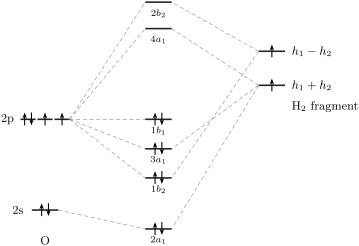
Place water in the plane, the axis bisecting the H–O–H angle. Two mirror planes contain the axis: the molecular plane and the plane perpendicular to it. With respect to the plane, which exchanges the two hydrogens, is symmetric and antisymmetric. On oxygen, 2s and are symmetric with respect to both planes; (in the molecular plane, perpendicular to ) is antisymmetric with respect to ; is antisymmetric with respect to the molecular plane, which no hydrogen combination is.
So mixes with 2s and , with , and stays nonbonding. Six orbitals result, four of them filled by the eight valence electrons.
Proposition 15.7 (Why water is bent)
In a linear H–O–H, two oxygen p orbitals perpendicular to the axis are nonbonding. Bending lets one of them, the one in the molecular plane, overlap with and mix with the 2s orbital: that filled level drops, by more than the other filled levels rise. With eight valence electrons the bent molecule is the more stable.
Argument. In the linear molecule ( along H–O–H), has zero overlap with and (each is antisymmetric with respect to a plane containing the axis, the combination symmetric); they are two degenerate nonbonding pairs. On bending in the plane, points partly towards the hydrogens: its overlap with grows from zero, and the filled level it carries is stabilised (the level of the bent molecule). The bonding level loses a little overlap and rises slightly. The net is a lowering, largest when the descending level is filled, as it is with eight electrons. A molecule with only four valence electrons, such as , has that level empty and is linear. ∎
15.3 Methane, ammonia and photoelectron spectra
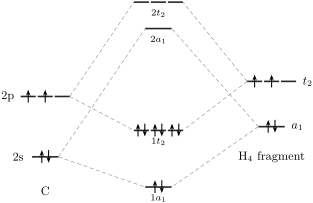
In methane the four hydrogen orbitals give the symmetric combination, which matches the 2s orbital of carbon, and a degenerate set of three, which matches its three 2p orbitals. Four bonding orbitals are filled: one low () and three degenerate at a higher energy (). Ammonia, with three hydrogens, keeps a filled orbital pointing away from the hydrogens on nitrogen, its lone pair, as the highest occupied level.
Definition 15.8 (Photoelectron spectroscopy)
Photoelectron spectroscopy measures the kinetic energies of the electrons ejected from molecules by monochromatic radiation of known energy; each band of the spectrum corresponds to the removal of an electron from one occupied level, and its position gives the ionisation energy of that level.
Proposition 15.9 (Koopmans’ approximation)
The energy needed to remove an electron from an occupied orbital is approximately minus the energy of that orbital, .
Proof. Admitted at this level. ∎
The approximation neglects the relaxation of the other electrons after the ionisation; it is justified in the Year 3 volume. It turns a photoelectron spectrum into an orbital diagram: water shows four valence bands, methane two, in line with the fragment diagrams — and against the picture of two equivalent lone pairs and two equivalent bonds in water, which describes the same total electron density in a different way but does not give the energies of the electrons removed.
15.4 Ethene
Ethene can be built from two fragments. Each has, besides the orbitals of its two C–H bonds, an orbital pointing away from the hydrogens in the plane (which forms the C–C bond with its partner) and a p orbital perpendicular to the plane. The two p orbitals combine into a filled and an empty .
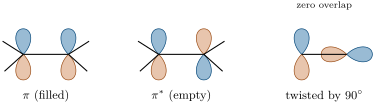
The bond holds ethene flat: twisting one end turns the p orbitals away from each other, their overlap falls as the cosine of the twist angle, and at the bond is gone. The energy of a bond must be supplied to twist the molecule, which is why cis and trans isomers of alkenes do not interconvert at room temperature, while rotation about a single bond is free.
15.5 Hyperconjugation
Definition 15.10 (Hyperconjugation)
Hyperconjugation is the interaction of a filled orbital of a C–H or C–C bond with a neighbouring empty or partly filled p or orbital parallel to it.
Proposition 15.11 (Alkyl groups stabilise carbocations)
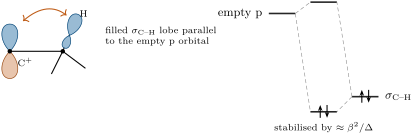
A carbocation is stabilised by each C–H or C–C bond on a neighbouring carbon that can align with its empty p orbital: the more such bonds, the more stable the cation, whence the order tertiary > secondary > primary > methyl.
Argument. The empty p orbital of the cationic carbon and a filled orbital next to it form a two-level system with a large gap and a small coupling (non-zero only if the bond is roughly parallel to the p orbital). By Theorem 14.14, the filled level is lowered by about , and the two electrons gain twice that; the empty level rises, at no cost. Each suitably aligned bond adds its own stabilisation; a methyl group always has one C–H bond nearly aligned whatever its rotation. ∎
15.6 Exercises
Exercise 15.1 ★
Write the two symmetry-adapted combinations of the 1s orbitals of the hydrogens of water and say which of them changes sign in the plane that bisects the H–O–H angle perpendicular to the molecule.
Solution
Solution of Exercise 15.1.
and . The plane , which bisects the angle and is perpendicular to the molecule, exchanges the two hydrogens: changes sign, does not.
Exercise 15.2 ★
How many valence molecular orbitals does water have, how many valence electrons, and how many filled valence orbitals?
Solution
Solution of Exercise 15.2.
Six valence orbitals (oxygen 2s and three 2p, two hydrogen 1s), eight valence electrons, four filled orbitals.
Exercise 15.3 ★
Why does the photoelectron spectrum of methane show two valence bands, one of them three times as intense as the other?
Solution
Solution of Exercise 15.3.
The filled valence levels are one orbital and a set of three degenerate orbitals: two energies, two bands. The band removes electrons from three orbitals holding six electrons, against one orbital and two electrons for .
Exercise 15.4 ★
Why are the six atoms of ethene in one plane?
Solution
Solution of Exercise 15.4.
The bond needs the two p orbitals of the carbons to be parallel, which places both planes in a common plane.
Exercise 15.5 ★★
The first ionisation energy of ammonia is , that of methane . Which orbital loses the electron in each case, and why is ammonia the easier to ionise?
Solution
Solution of Exercise 15.5.
Ammonia loses an electron from its lone pair, a mostly nonbonding orbital on nitrogen; methane from a bonding orbital. A nonbonding electron lies higher, closer to the atomic level, than a bonding one: it is removed more easily.
Exercise 15.6 ★★
Compare the occupied levels of linear and bent water, and explain why a molecule like , with four valence electrons, is linear.
Solution
Solution of Exercise 15.6.
Linear water has two degenerate filled nonbonding p orbitals; bending lowers one of them and slightly raises a bonding level: a net gain with eight electrons. has only four, which fill the two bonding orbitals; the orbital that bending would lower is empty, while the bonding levels lose overlap: the linear shape is best.
Exercise 15.7 ★★
Explain, with the two-level result, the order of stability of the carbocations , , , .
Solution
Solution of Exercise 15.7.
Each C–H or C–C bond on a carbon next to the cationic centre can align with the empty p orbital and gives about of stabilisation. has no such neighbour; ethyl, isopropyl and tert-butyl cations have one, two and three methyl groups next to the centre, each offering an aligned bond: stability grows in that order.
Exercise 15.8 ★★
The overlap of two p orbitals twisted by an angle about the bond is proportional to . With the resonance integral proportional to the overlap, how does the stabilisation depend on ? At which angle does it fall to half?
Solution
Solution of Exercise 15.8.
For two equal levels the splitting is and the two electrons gain , proportional to . It falls to half at and to zero at .
Exercise 15.9 ★★
Borane is planar, ammonia pyramidal. Using the fragment orbitals of a central atom and three hydrogens, explain the difference by the electrons each has.
Solution
Solution of Exercise 15.9.
Borane has six valence electrons: they fill the three bonding orbitals, and the p orbital of boron perpendicular to the plane stays empty; nothing is gained by pyramidalising. Ammonia has two more: they occupy the orbital that is nonbonding in the planar shape, and, as in water, pyramidalising lets it mix with the 2s orbital and the hydrogen combination and drop.
Exercise 15.10 ★★★
The ion is an equilateral triangle. With and for the 1s orbitals and overlap neglected, find its three orbital energies (the symmetric combination has energy ) and explain why two electrons suffice to bind it.
Solution
Solution of Exercise 15.10.
The secular equations for give ; the two combinations orthogonal to it give (degenerate). Two electrons in : energy , lower than () since .
Exercise 15.11 ★★★
The allyl system has three parallel p orbitals. Guess the shapes of its three orbitals (signs on each carbon) from the number of nodes, and which one is the highest occupied level of the allyl anion.
Solution
Solution of Exercise 15.11.
: all three coefficients of one sign, no node (bonding); : opposite signs on the end carbons and a node at the centre (nonbonding); : alternating signs, two nodes (antibonding). The anion has four electrons: is its highest occupied level, with density only on the end carbons.
Exercise 15.12 ★★★
Build the system of carbon dioxide from the 2p orbitals perpendicular to the O–C–O axis: how many orbitals, which are bonding, nonbonding, antibonding, and how many electrons do they hold?
Solution
Solution of Exercise 15.12.
In each of the two planes containing the axis, three parallel p orbitals (O, C, O) give a bonding, a nonbonding (on the oxygens only) and an antibonding orbital: six orbitals in all. The two bonding and the two nonbonding ones are filled: eight electrons (two bonds and two oxygen lone pairs in the Lewis picture).
15.7 Problem: The Shape of Water
Problem 15.1
Weekend problem — the oxygen and fragments, the orbitals of a linear H–O–H, the levels that move when it bends, and the photoelectron spectrum with Koopmans’ approximation
Data: geometry of water, , angle ; first ionisation energies: , . Water lies in the plane, along the bisector.
Part I — Fragments.
- How many valence electrons does water have, and from which atoms?
- Write the two symmetry-adapted combinations of the hydrogen 1s orbitals.
- Which oxygen orbitals are symmetric with respect to both mirror planes?
- Which oxygen orbital is antisymmetric with respect to the plane only?
- Which oxygen orbital has no partner among the hydrogen combinations?
- How many molecular orbitals result, and how many are filled?
Part II — A linear H–O–H.
- In a linear molecule along , which combination interacts with the oxygen ?
- Which interacts with the oxygen 2s?
- Which oxygen orbitals stay nonbonding, and with which degeneracy?
- Fill the levels with the eight valence electrons.
- Would linear water be paramagnetic?
- Where would its highest occupied level lie, compared with an oxygen 2p orbital?
Part III — Bending.
- The linear molecule lying along is bent in the plane. Which nonbonding orbital starts to overlap with ?
- What happens to the filled level it carries?
- Which bonding level rises slightly, and why?
- Conclude: why is water bent?
- Compare the measured angle with (pure p bonding) and .
- Which nonbonding orbital is left untouched by the bending?
Part IV — The photoelectron spectrum.
- How many valence bands does the spectrum show?
- By Koopmans’ approximation, from which orbital does the first band come?
- Why is that band narrow, while bands of bonding orbitals are broad?
- Compare the first ionisation energy of water with that of the oxygen atom, and explain the difference.
- What becomes of the “two equivalent lone pairs” of the Lewis structure?
- State the number of valence ionisation bands of water and the energy of the lowest.
Solution
Solution of Problem 15.1.
1. Eight: six from oxygen, one from each hydrogen. 2. and . 3. 2s and . 4. . 5. , perpendicular to the molecular plane. 6. Six; four filled. 7. , which changes sign, like , through the plane perpendicular to the axis at oxygen. 8. . 9. and , perpendicular to the axis: a degenerate nonbonding pair. 10. (2s, ) bonding, (, ) bonding, then . 11. No: the degenerate pair is full, every electron is paired. 12. At the energy of an oxygen 2p orbital: it is nonbonding. 13. (the axis of the linear molecule along , bending in ). 14. It mixes with 2s and and drops: the level. 15. The (, ) bonding level, which loses some overlap as the hydrogens leave the axis: it becomes . 16. The filled level that drops gains more than the other loses: with eight electrons the bent shape is the more stable. 17. , between (bonds made of p orbitals only) and : the 2s orbital takes some part in the bonding. 18. , which stays the nonbonding . 19. Four. 20. From , the nonbonding orbital of oxygen. 21. Removing a nonbonding electron hardly changes the bonds: the ion has the geometry of the molecule and little vibrational energy is excited. Removing a bonding electron changes the bond lengths and angles, and the band spreads over many vibrational levels. 22. against : oxygen in water carries a partial negative charge drawn from the hydrogens, which raises its 2p levels. 23. They are not two equal levels: their two combinations are the and orbitals, of different energies. Both pictures describe the same total electron density; only the delocalised orbitals give the energies of ionisation. 24. Water has four valence ionisation bands, the lowest at .