A hydrogen fuel-cell bus carries a stack of a few hundred thin cells. In each, hydrogen and the oxygen of the air combine to water without a flame, and the energy comes out as an electric current. Two numbers govern such a stack, and both come straight from tables of Gibbs energies: no cell can give more than 1.23V, and no fuel cell, however perfect, turns all the energy of its hydrogen into electrical work. This chapter connects the voltage of a cell to the Gibbs energy of its reaction, derives the Nernst equation used since the Year 1 volume, and reads entropies and enthalpies of reaction off a voltmeter and a thermometer.
You already know
The Year 1 volume: cells, half-cells, anode and cathode, salt bridge, cell voltage, electrode potential, standard potential and the standard hydrogen electrode, the Nernst equation (admitted there), equilibrium constants from potentials. Chapter 2: ΔrG, ΔrG∘ and ΔrG=ΔrG∘+RTlnQ; the evolution criterion. Chapter 3: activities. The school volume: electrolysis.
A hydrogen fuel-cell bus at a stop: the hydrogen tanks are under the fairing on the roof, and the only exhaust is water, dripping under the bus.
9.1 Electrical work and the Faraday constant
Definition 9.1(Faraday constant)
The Faraday constant is the electric charge of one mole of elementary charges, F=NAe=96485.33C/mol.
Proposition 9.2(Charge passed)
If the reaction of a cell, written with n electrons exchanged, advances by Δξ, the charge that flows through the external circuit is Q=nFΔξ.
Proof. An advancement Δξ transfers nΔξ moles of electrons from the anode to the cathode through the wire, each of charge e in magnitude: Q=nΔξNAe. ∎
When a charge Q is driven through a circuit by a voltage U, the work received by the circuit is QU. Seen from the cell, which delivers that work, the electrical work it receives is δWel=−UδQ=−nFUdξ.
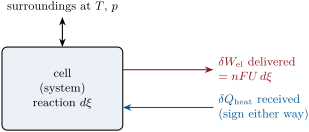
A cell as a thermodynamic system at constant temperature and pressure: it exchanges heat with its surroundings and delivers electrical work through the external circuit. With the sign convention of the first law (work and heat received counted positive), δWel=−nFUdξ.
9.2 The Gibbs energy of a cell reaction
Theorem 9.3(Electrical work and Gibbs energy)
A cell working at constant T and p delivers an electrical work at most equal to the decrease of its Gibbs energy: for an advancement dξ, nFUdξ≤−ΔrGdξ. When it works reversibly (an infinitesimal current), the equality holds, and the cell voltage is the electromotive force
ΔrG=−nFE.
Proof. First law at constant pressure, with the pressure work separated: dH=δQ+δWel. Second law: dS≥δQ/T. At constant T and p, dG=dH−TdS≤δWel=−nFUdξ. With dG=ΔrGdξ, ΔrGdξ≤−nFUdξ, that is nFUdξ≤−ΔrGdξ. For a reversible change the inequality of the second law is an equality, and the voltage then measured, with no current, is E: ΔrG=−nFE. ∎
A cell can thus run forward (dξ>0, delivering work) only if ΔrG<0, that is E>0 with the poles chosen so that the reaction written runs from anode to cathode. A real cell, through which a current flows, delivers less work than −ΔrG: the difference is dissipated as heat in its resistance and at its electrodes (Chapter 10).
Example 9.4(The Daniell cell)
For Zn+CuX2+ZnX2++Cu, ΔrG∘=ΔfG∘(ZnX2+)−ΔfG∘(CuX2+)=−147.06−65.49=−212.55kJ/mol, and n=2: E∘=212550/(2×96485)=1.10V, the voltage measured on a Daniell cell in standard conditions.
9.3 The Nernst equation and standard potentials
The Year 1 volume admitted the Nernst equation; it now follows from ΔrG=ΔrG∘+RTlnQ.
Theorem 9.5(The Nernst equation, derived)
For a half-reaction αOx+ne−⇌βRed, the potential of the electrode at temperature T is
E=E∘+nFRTlnaRedβaOxα,
where the activities include those of every other species of the half-reaction (HX+, water excepted), with their stoichiometric powers.
Proof. The potential of an electrode is the voltage of the cell made of the standard hydrogen electrode (anode) and that electrode (cathode). Its reaction is
αOx+2nHX2⟶βRed+nHX+,
whose reaction quotient, with aHX+=1 and pHX2=p∘ at the standard hydrogen electrode, reduces to aRedβ/aOxα. From Theorem 9.3, E=−ΔrG/(nF)=−ΔrG∘/(nF)−(RT/nF)lnQ; with E∘=−ΔrG∘/(nF) this is the formula. At 298.15K, RTln10/F=0.0592V. ∎
Proposition 9.6(Standard potentials from Gibbs energies)
With the conventions ΔfG∘(HX+,aq)=0 and ΔfG∘(HX2,g)=0, the standard potential of a couple is E∘=−ΔrG∘/(nF), where ΔrG∘ is the standard Gibbs energy of the half-reaction written as a reduction, the electrons counted as having zero Gibbs energy.
Proof. In the reaction against the hydrogen electrode, 2nHX2 and nHX+ contribute nothing to ΔrG∘ under those conventions: the standard Gibbs energy of the cell reaction is that of the half-reaction alone. ∎
Method 9.7(A standard potential from tables)
Write the half-reaction as a reduction, balanced with HX+ and HX2O, with n electrons.
Compute ΔrG∘=∑νiΔfGi∘ (products positive), with zero for the elements, HX+ and the electrons.
E∘=−ΔrG∘/(nF), in volts with ΔrG∘ in joules per mole.
Example 9.8(The silver chloride electrode)
AgCl(s)+eX−Ag(s)+ClX−: ΔrG∘=−131.228−(−109.789)=−21.439kJ/mol, E∘=21439/96485=0.222V. Its potential depends on the chloride activity only: in a saturated potassium chloride solution it is a stable reference electrode.
Proposition 9.9(Combining potentials)
If a half-reaction (3), with n3 electrons, is the sum of half-reactions (1) and (2), with n1 and n2 electrons, then
n3E3∘=n1E1∘+n2E2∘;
the potentials themselves do not add.
Proof. Standard Gibbs energies add, ΔrG3∘=ΔrG1∘+ΔrG2∘, and the electron counts add, n3=n1+n2. Divide each ΔrG∘ by −F. ∎
Example 9.10(Iron in its two oxidation states)
FeX3++eX−FeX2+ has E∘=(−78.90+4.7)/(−96.485)=0.77V and FeX2++2eX−Fe has E∘=−78.90/(2×96.485)=−0.41V. Hence FeX3++3eX−Fe: E∘=(0.77−0.82)/3=−0.02V, not the sum of the two.
9.4 Temperature, entropy and the efficiency of a fuel cell
Definition 9.11(Temperature coefficient)
The temperature coefficient of a cell is the derivative (∂E/∂T)p of its electromotive force with respect to temperature.
Proposition 9.12(Entropy and enthalpy from cell data)
For the standard cell reaction,
ΔrS∘=nFdTdE∘,ΔrH∘=−nF(E∘−TdTdE∘),
and a cell working reversibly at temperature T receives from its surroundings the heat TΔrS per mole of reaction.
Proof.ΔrS∘=−dΔrG∘/dT (from dG=−SdT+Vdp, differentiated with respect to ξ) =nFdE∘/dT; then ΔrH∘=ΔrG∘+TΔrS∘. For the reversible change, δQ=TdS=TΔrSdξ. ∎
Method 9.13(From cell data to the thermodynamics of the reaction)
Measure E at several temperatures; the slope is dE/dT.
ΔrG=−nFE, ΔrS=nFdE/dT, ΔrH=ΔrG+TΔrS.
Heat exchanged per mole when the cell works reversibly: TΔrS; when it delivers a current at a voltage U<E, the heat released is −ΔrH−nFU per mole.
For the hydrogen–oxygen cell producing liquid water, the CODATA key values give ΔrH∘=−285.83kJ/mol and
ΔrS∘=69.95−130.68−21×205.15=−163.3J/(Kmol),
so ΔrG∘=−237.14kJ/mol and E∘=1.229V; the temperature coefficient is ΔrS∘/(2F)=−0.85mV/K. A hydrogen fuel cell gives less voltage hot than cold.
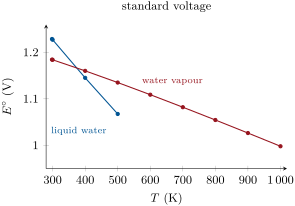
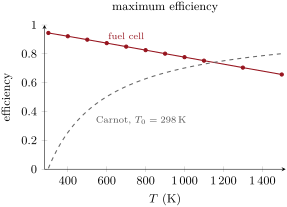
The hydrogen–oxygen cell from the JANAF tables. Left: standard voltage −ΔrG∘/(2F) with liquid water (up to 500K, the liquid kept under its standard state) and with water vapour. Right: maximum efficiency ΔrG∘/ΔrH∘ of the cell producing vapour, against the Carnot efficiency of a heat engine working between T and 298K; the engine wins only above about 1150K.
Definition 9.14(Thermodynamic efficiency of a fuel cell)
The thermodynamic efficiency of a fuel cell is the ratio of the electrical work it delivers to the heat its fuel would release by combustion at the same temperature, −ΔrH per mole.
Proposition 9.15(Maximum efficiency of a fuel cell)
The thermodynamic efficiency of a fuel cell is at most ΔrG/ΔrH, reached when it works reversibly, and equal to (nFU)/(−ΔrH) at a working voltage U. Unlike a heat engine, it is not limited by the Carnot efficiency 1−T0/T.
Proof. By Theorem 9.3 the work per mole is nFU≤−ΔrG; divide by −ΔrH. The cell converts chemical energy directly into work at a single temperature: no heat is taken from a hot source and partly given to a cold one, so the Carnot bound, which concerns such cycles, does not apply. Its own bound is set by TΔrS, the heat the reversible cell must exchange. ∎
Where the energy of one mole of hydrogen goes in a fuel cell at 298K (liquid water). Top: the heat a flame would release. Middle: the reversible cell, which must give up −TΔrS∘=48.7kJ as heat whatever its design. Bottom: a real cell working at 0.70V.
History— Faraday’s laws of electrolysis
In 1834 Michael Faraday, measuring the products of electrolyses with a voltameter of his own design, stated that the mass of a substance produced at an electrode is proportional to the quantity of electricity passed, and that for a given quantity of electricity the masses of different substances are in the ratio of their chemical equivalents. He coined the words electrode, anode, cathode, ion, anion and cation. The constant that bears his name turns those laws into Q=nFΔξ. (Portrait by Thomas Phillips, 1842, public domain, Wikimedia Commons.)
9.5 Concentration cells
Definition 9.16(Concentration cell)
A concentration cell is made of two half-cells of the same couple that differ only in the concentration (or pressure) of one species.
Proposition 9.17(Voltage of a concentration cell)
Two electrodes of a metal M dipping into solutions of MXn+ at concentrations c1<c2, joined by a salt bridge, give a voltage
U=nFRTlnc1c2,
the positive pole being the more concentrated side. The cell works until the two concentrations are equal.
Proof. By the Nernst equation each electrode has Ei=E∘+(RT/nF)lnci (ideal dilute solutions); E∘ cancels in the difference. The reaction is MXn+(side 2) →MXn+(side 1): metal is deposited on the concentrated side (cathode) and dissolved on the dilute side (anode), which evens the concentrations out; ΔrG=RTln(c1/c2)<0 until they are equal. ∎
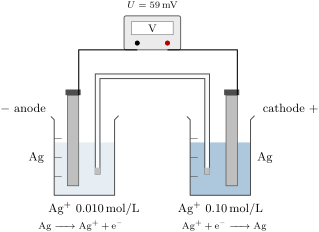
A silver concentration cell at 25∘C. The dilute side is the anode: silver dissolves there and is deposited on the concentrated side, until the two concentrations are equal. U=0.0592log(0.10/0.010)=59mV.
The same principle measures concentrations. A glass electrode, whose thin membrane separates a reference solution from the sample, develops a membrane potential of (RT/F)ln10=59mV per unit of pH difference at 25∘C: the pH meter of the Year 1 volume is a concentration cell for HX+. Across the membrane of a living cell, the unequal concentrations of KX+ create in the same way a potential of several tens of millivolts.
9.6 Exercises
Exercise 9.1★
From ΔfG∘(HX2O,l)=−237.14kJ/mol, compute the standard voltage of the hydrogen–oxygen cell.
A battery is rated 1.0Ah. Compute the charge it holds, in coulombs, and the mass of zinc consumed at its anode (ZnZnX2++2eX−) when it is fully discharged.
Solution
Solution of Exercise 9.2.
Q=1.0×3600=3.6×10³C; n(Zn)=3600/(2×96485)=1.87×10−2mol, that is 1.22g.
Exercise 9.3★
A Daniell cell delivers 1.10V with no current. Compute ΔrG for one mole of zinc and the maximum electrical work for 10.0g of zinc.
Solution
Solution of Exercise 9.3.
ΔrG=−2×96485×1.10=−212kJ/mol. For 10.0g, 10.0/65.38=0.153mol: at most 32.5kJ.
Exercise 9.4★
Two copper electrodes dip into copper(II) sulfate solutions of 1.0×10⁻³mol/L and 0.10mol/L. Compute the voltage at 25∘C and name the poles.
Solution
Solution of Exercise 9.4.
U=(0.0592/2)log(0.10/1.0×10−3)=0.059V; the positive pole (cathode) is the electrode in the 0.10mol/L solution.
Exercise 9.5★★
A cell (n=2) has E∘=1.015V and dE∘/dT=−4.0×10−4V/K at 298K (exercise data). Compute ΔrG∘, ΔrS∘ and ΔrH∘.
The cell of Exercise 9.5 discharges one mole of reaction (a) reversibly; (b) at 0.90V. Compute in each case the electrical work and the heat exchanged with the surroundings.
Solution
Solution of Exercise 9.6.
(a) Work delivered 195.9kJ; heat TΔrS=−23.0kJ: 23.0kJ released. (b) Work 2×96485×0.90=173.7kJ; heat released −ΔrH−173.7=218.9−173.7=45.2kJ. The extra 22.2kJ is the work lost to the current.
Exercise 9.7★★
Compute E∘(FeX3+/Fe) from the Gibbs energies of formation (FeX2+−78.90kJ/mol, FeX3+−4.7kJ/mol) and check that it equals (E1∘+2E2∘)/3.
Solution
Solution of Exercise 9.7.
FeX3++3eX−Fe: ΔrG∘=+4.7kJ/mol, E∘=−4700/(3×96485)=−0.016V. With E1∘=0.769 and E2∘=−0.409V: (0.769−0.818)/3=−0.016V.
Exercise 9.8★★
Compute the standard potential of the couple AgCl/Ag, then the potential of a silver chloride electrode dipping into 0.10mol/L potassium chloride.
Solution
Solution of Exercise 9.8.
E∘=0.222V (as in the chapter). E=0.222−0.0592log0.10=0.281V.
Exercise 9.9★★
Zinc–air cells use 2Zn+OX22ZnO (ΔfG∘(ZnO)=−318.30kJ/mol). Compute the standard voltage and the maximum electrical energy, in kWh, per kilogram of zinc.
Solution
Solution of Exercise 9.9.
ΔrG∘=2(−318.30)=−636.6kJ for n=4: E∘=636600/(4×96485)=1.65V. Per kilogram of zinc, 1000/65.38=15.3mol, 15.3×318.3=4.87MJ, that is 1.35kWh.
Exercise 9.10★★★
A direct methanol fuel cell runs CHX3OH(l)+23OX2COX2+2HX2O(l). From ΔfH∘ (kJ/mol): CHX3OH(l)−239, COX2−393.51, HX2O(l)−285.83; and S∘ (J/(Kmol)): CHX3OH(l) 127.2, COX2 213.8, HX2O(l) 69.95, OX2 205.15, compute n, E∘ and the maximum efficiency.
Solution
Solution of Exercise 9.10.
Carbon goes from −2 to +4: n=6. ΔrH∘=−393.51+2(−285.83)+239=−726.2kJ/mol; ΔrS∘=213.8+2(69.95)−127.2−1.5×205.15=−81.2J/(Kmol); ΔrG∘=−726.2+298.15×0.0812=−702.0kJ/mol. E∘=702000/(6×96485)=1.21V; maximum efficiency 702.0/726.2=0.967. (Real methanol cells work far below this voltage.)
Exercise 9.11★★★
A cell (n=2) has E=0.500V and dE/dT=+3.0×10−4V/K at 298K (exercise data). Show that, working reversibly, it delivers more electrical work than −ΔrH, and explain where the extra energy comes from.
Solution
Solution of Exercise 9.11.
ΔrG=−2×96485×0.500=−96.5kJ; ΔrS=+57.9J/K; ΔrH=−96.5+298×0.0579=−79.2kJ. The work, 96.5kJ, exceeds −ΔrH=79.2kJ: the cell absorbs TΔrS=17.3kJ of heat from its surroundings and turns it into work as well. The second law is not violated, since the entropy of the reaction increases by as much.
Exercise 9.12★★★
Two hydrogen electrodes (1bar of HX2) dip into a reference solution of pH 7.00 and into a sample. The voltage is 0.177V at 25∘C, the reference being the positive pole. Find the pH of the sample, and explain why the result does not depend on any standard potential.
Solution
Solution of Exercise 9.12.
Each hydrogen electrode has E=−0.0592pH: U=0.0592(pHs−7.00)=0.177, pHs=10.0. The two electrodes are of the same couple: the standard potential cancels, as in any concentration cell.
9.7 Problem: The Fuel-Cell Bus
Problem 9.1
Weekend problem — the standard voltage of the hydrogen–oxygen cell from Gibbs energies, its temperature coefficient, the efficiency and heat of a real stack, and the energy in a tank of hydrogen
A fuel-cell stack has 400 cells in series, each with a proton-exchange membrane (acidic electrolyte). Data at 298.15K (CODATA, JANAF): ΔfH∘(HX2O,l)=−285.83kJ/mol, ΔfG∘(HX2O,l)=−237.14kJ/mol, ΔfG∘(HX2O,g)=−228.58kJ/mol; S∘ (J/(Kmol)): HX2O(l) 69.95, HX2 130.68, OX2 205.15. F=96485C/mol; M(HX2)=2.016g/mol.
Part I — The standard voltage.
Write the half-reactions at the anode and at the cathode, and the cell reaction.
How many electrons are exchanged per molecule of hydrogen?
Compute E∘ when the water is formed as a liquid.
Compute it when the water leaves as vapour.
Explain the difference with the Gibbs energy of vaporisation of water.
Compute ΔrH∘ and the maximum efficiency at 298K.
Part II — Temperature.
Compute ΔrS∘ for liquid water.
Deduce dE∘/dT.
Estimate E∘ at 80∘C, the working temperature of the stack.
Compare your method with the JANAF value at 400K, ΔfG∘(HX2O,l)=−221.01kJ/mol.
What heat does the reversible cell exchange per mole of hydrogen at 298K? Is it received or released?
Estimate the maximum efficiency at 80∘C.
Part III — The real stack at 0.70V per cell.
Compute the electrical work per mole of hydrogen.
Compute the efficiency referred to ΔrH∘ and to ΔrG∘.
Compute the heat released per mole of hydrogen.
How much of it is unavoidable, and how much is due to the current?
The stack delivers 300A. Compute the hydrogen consumption of one cell, then of the stack, in moles and grams per second.
Compute the electrical power of the stack.
Compute the heat power the cooling circuit must remove.
Part IV — The tank.
What amount of hydrogen is in 5.0kg?
What charge passes through the cells, counted over all of them, when this hydrogen is oxidised?
Compute the electrical energy delivered by the stack, with each cell at 0.70V.
Convert it to kilowatt-hours.
For how long can the stack deliver its power of question 18?
State the electrical energy delivered by 5.0kg of hydrogen at 0.70V per cell.
Solution
Solution of Problem 9.1.
1. Anode: HX22HX++2eX−; cathode: 21OX2+2HX++2eX−HX2O; cell: HX2+21OX2HX2O. 2. Two. 3.E∘=237140/(2×96485)=1.229V. 4.228580/192970=1.185V. 5.ΔrG∘ differs by ΔvapG∘(HX2O)=−228.58+237.14=8.56kJ/mol at 298K: vapour is less stable than liquid there, and the voltage is lower by 8560/192970=0.044V. 6.ΔrH∘=−285.83kJ/mol; 237.14/285.83=0.830. 7.ΔrS∘=69.95−130.68−102.58=−163.3J/(Kmol). 8.dE∘/dT=−163.3/192970=−8.46×10−4V/K. 9.1.229−8.46×10−4×55=1.182V. 10. The same estimate at 400K gives 1.229−8.46×10−4×101.85=1.143V; JANAF gives 221010/192970=1.145V: treating ΔrS∘ as constant costs only 2mV. 11.TΔrS∘=298.15×(−163.3)=−48.7kJ per mole: 48.7kJ released. 12.ΔrG∘(353)≈−237.14+55×0.1633=−228.2kJ; with ΔrH∘ nearly unchanged, 228.2/285.8=0.80. 13.2×96485×0.70=135.1kJ. 14.135.1/285.83=0.47; 135.1/237.14=0.57. 15.285.83−135.1=150.7kJ. 16.48.7kJ would be released even by a reversible cell; the other 102.0kJ come from the losses due to the current (resistance and electrode overpotentials). 17. One cell: 300/(2×96485)=1.55×10−3mol/s; the stack: 400×1.55×10−3=0.622mol/s, 1.25g/s. 18.400×0.70×300=84kW. 19.0.622×150.7=93.7kW: more heat than electricity. 20.5000/2.016=2.48×103mol. 21.2×2480×96485=4.79×10⁸C. 22. Each coulomb passing through a cell gives 0.70J: 4.79×108×0.70=3.35×10⁸J. 23.3.35×108/3.6×106=93kWh. 24.93/84=1.1h at full power. 25.5.0kg of hydrogen at 0.70V per cell deliver ≈93kWh of electrical energy.