University Chemistry — Year 2 · Bachelor Year 2
20Organometallic Catalysis: Elementary Steps and Cycles
A few milligrams of a palladium salt can join two aromatic rings in a flask holding kilograms of reagents: the same metal atom does the job thousands of times, coming back to its starting state after each pass. How it does so is told by a catalytic cycle, a closed sequence of a handful of elementary steps. There are only a few kinds of step, and each changes the oxidation state, the electron count and the number of ligands of the metal in a fixed way. With the electron count of Chapter 18, a cycle can be read, checked, and sometimes predicted.
You already know
Chapter 18: oxidation state, , valence electron count, 18-electron rule, hapticity. Chapter 19: -acceptor ligands and back-donation. The Year 1 volume: catalyst, homogeneous catalysis, elementary step, rate-determining step, organometallic compound, oxidation number.
20.1 The language of organometallic complexes
Organometallic complexes are counted as in Method 18.11, with a few more ligands: a hydride and an alkyl or aryl anion give two electrons each and count in the oxidation state; , phosphines and -alkenes give two electrons and count 0; a halide gives two and counts .
Definition 20.1 (Unsaturated complexes)
A coordinatively unsaturated complex has fewer than 18 valence electrons (often 16) and can bind another ligand: it has a vacant site, a position of its coordination sphere free to receive a two-electron donor.
Square-planar complexes of rhodium(I), iridium(I), palladium(II) and platinum(II) are 16-electron complexes; palladium(0) bisphosphines have 14. Such complexes are the active species of most catalytic cycles.
Method 20.2 (Counting an organometallic complex)
- List the ligands: anionic (, , , ) and neutral (, , alkenes, solvent).
- Oxidation state = charge of the complex sum of the anionic ligand charges.
- oxidation state; count = (number of two-electron donors) 6 per -.
- Coordination number = number of ligand positions occupied.
20.2 Ligand exchange, oxidative addition, reductive elimination
Definition 20.3 (Ligand exchange)
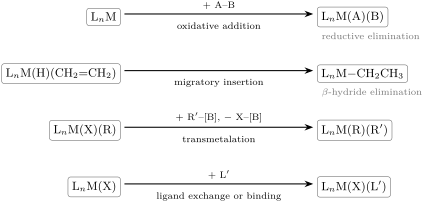
A ligand exchange is an elementary step in which a ligand of the coordination sphere is replaced by another; it changes neither the oxidation state nor, overall, the electron count. Its mechanisms are studied in the Year 3 volume.
Definition 20.4 (Oxidative addition and reductive elimination)
In an oxidative addition, a molecule A–B adds to a metal centre by breaking its A–B bond and forming M–A and M–B bonds. A reductive elimination is the reverse step: two ligands A and B, cis to each other, join into A–B and leave the metal.
Proposition 20.5 (Counting an oxidative addition)
An oxidative addition raises the oxidation state of the metal by 2, its valence electron count by 2 and its coordination number by 2; a reductive elimination lowers each by 2.
Proof. A and B are counted as anions (, , ) once bound: two new anionic ligands raise the oxidation state by 2 and lower by 2; they give two pairs, electrons; the count changes by . Two positions are newly occupied. The reverse step reverses every change. ∎
Example 20.6 (Vaska’s complex)
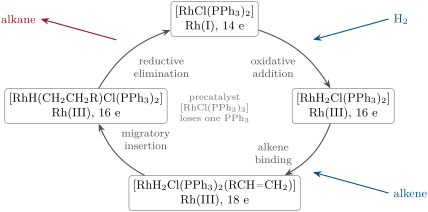
, square planar: iridium(I), , 16 electrons, four-coordinate. It adds dihydrogen: , iridium(III), , 18 electrons, octahedral, the two hydrides cis.
20.3 Insertion, elimination, transmetalation
Definition 20.7 (Insertion and -hydride elimination)
In a migratory insertion, an unsaturated ligand (alkene, ) bound to the metal inserts into a cis M–H or M–C bond: and an alkene give an alkyl ; and give an acyl . A -hydride elimination is the reverse of an alkene insertion: a hydrogen on the carbon to the metal moves onto the metal, releasing an alkene.
Proposition 20.8 (Counting an insertion)
A migratory insertion keeps the oxidation state and lowers the electron count by 2 (one ligand position is freed); a -hydride elimination raises the count by 2.
Proof. Before: (or , anionic) and the alkene (neutral), two ligands, four electrons. After: one alkyl (anionic), two electrons. The anionic charge is unchanged: same oxidation state; two electrons and one position lost. ∎
Proposition 20.9 (Conditions for -hydride elimination)
A metal alkyl undergoes -hydride elimination only if the alkyl carries a hydrogen on its carbon and the metal has a vacant site cis to the alkyl.
Argument. The step goes through a four-membered arrangement M–C–C–H in which the hydrogen reaches the metal: it needs that hydrogen, and an empty position next to the alkyl to receive it. Methyl, benzyl, neopentyl and aryl groups, which have no hydrogen able to reach the metal, are stable towards it. ∎
Definition 20.10 (Transmetalation)
A transmetalation transfers an organic group from one metal (or metalloid: boron, zinc, tin) to another, usually in exchange for a halide.
20.4 Reading a catalytic cycle
Definition 20.11 (Catalytic cycle)
A catalytic cycle is a closed sequence of elementary steps that consumes the reagents, releases the products and regenerates its first complex. The compound added to the reaction, which turns into the first complex of the cycle, is the precatalyst. The turnover number (TON) is the amount of product formed per amount of catalyst; the turnover frequency (TOF) is the turnover number per unit time.
Proposition 20.12 (The overall equation)
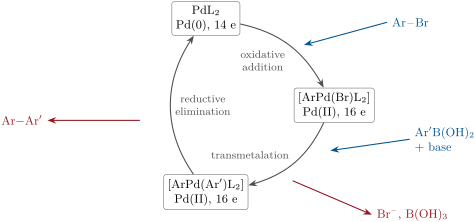
The sum of the steps of a catalytic cycle is the equation of the catalysed reaction: every metal complex appears once as a product and once as a reactant, and cancels.
Proof. The cycle being closed, each intermediate is formed by one step and consumed by the next; adding the steps, these species appear on both sides and cancel. What remains are the species that enter from outside (reagents) and leave (products). ∎
Method 20.13 (Reading a cycle)
- For each complex, compute the oxidation state, the electron count and the coordination number.
- Name each step from the changes (: oxidative addition; count at constant oxidation state: insertion; and so on).
- Check that no complex exceeds 18 electrons and that a step needing a vacant site starts from an unsaturated complex.
- Add the steps: the sum must be the overall equation.
In the Heck reaction, the aryl–palladium complex formed by oxidative addition binds an alkene instead of a borate; migratory insertion puts the aryl on the alkene, and a -hydride elimination releases the substituted alkene (usually the trans isomer) and a palladium hydride, from which a base removes to regenerate palladium(0).
Hydroformylation, the addition of and across an alkene to give an aldehyde, runs on cobalt or rhodium hydrides through insertion of the alkene, insertion of into the metal–alkyl bond, oxidative addition of and reductive elimination of the aldehyde. The direction of the first insertion decides the product: the metal on the terminal carbon gives the linear aldehyde, on the inner carbon the branched one; bulky phosphines favour the linear product.
History — Cross-coupling
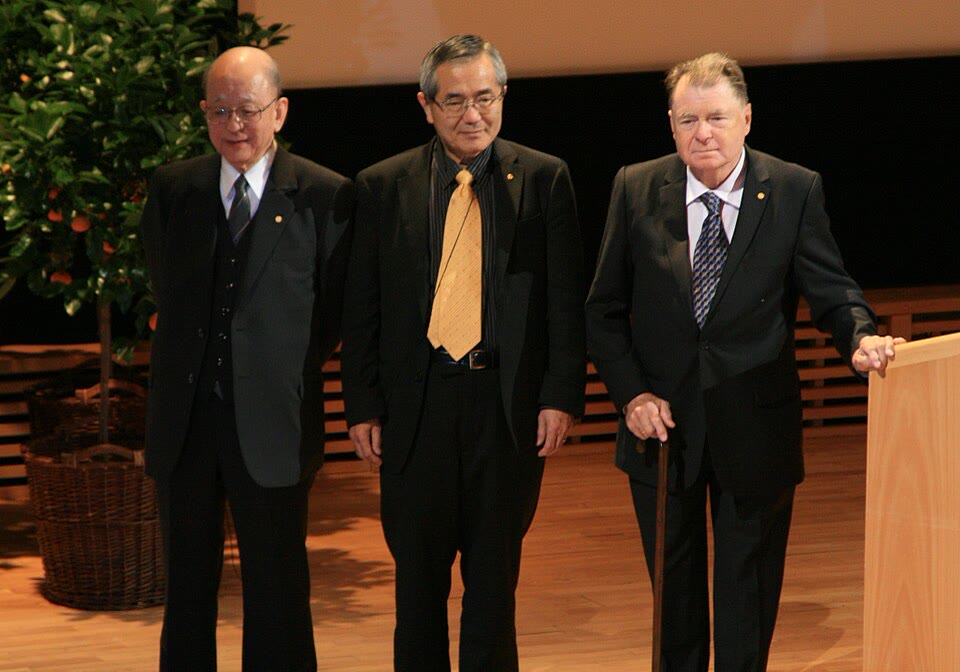
Palladium-catalysed couplings of aryl and vinyl halides with alkenes (Richard Heck, from 1968), with organozinc reagents (Ei-ichi Negishi, 1977) and with organoboron compounds (Akira Suzuki, 1979) made the joining of two carbon frameworks routine; they are now among the most used reactions in the making of medicines and materials. The Nobel Prize in Chemistry was awarded to the three in 2010. (Photograph: Suzuki, Negishi and Heck, left to right, 2010; BloodIce, CC BY-SA 4.0, Wikimedia Commons.)
Proposition 20.14 (Turnover)
With the amount of product formed in a time by an amount of catalyst, and the mean turnover frequency is .
Proof. Each turn of the cycle makes one product molecule per metal atom; the number of turns made by each atom on average is , and the rate of turning is that number per unit time. ∎
Safety


Palladium(II) ethanoate is corrosive to the eyes and toxic to aquatic life; triphenylphosphine is harmful and a sensitiser. They are weighed in a fume hood, and the palladium residues are collected for recovery, never poured down the drain.
20.5 Exercises
Exercise 20.1 ★
Give the oxidation state, and electron count of Vaska’s complex before and after it adds .
Solution
Solution of Exercise 20.1.
Before: Ir(I), , electrons. After: Ir(III), , electrons, octahedral.
Exercise 20.2 ★
Name the step: ; .
Solution
Solution of Exercise 20.2.
The first is a reductive elimination (Pt(IV) to Pt(II), ethane formed from two methyls). The second is a ligand exchange (one phosphine replaced by ethene) followed by a migratory insertion of ethene into the Pd–Ph bond.
Exercise 20.3 ★
A reaction uses of catalyst and gives of product in . Compute the TON and the mean TOF.
Solution
Solution of Exercise 20.3.
TON ; TOF .
Exercise 20.4 ★
Add the three steps of the Suzuki cycle and check that palladium cancels.
Solution
Solution of Exercise 20.4.
Sum: ; every palladium species cancels.
Exercise 20.5 ★★
Which of these alkyl palladium complexes can undergo -hydride elimination: , , , , ?
Solution
Solution of Exercise 20.5.
Ethyl and isopropyl (they have hydrogens). Methyl has no carbon; neopentyl’s carbon carries no hydrogen; benzyl’s carbon is an aromatic ring carbon that carries no hydrogen.
Exercise 20.6 ★★
Predict the product of the Heck reaction of iodobenzene with methyl propenoate, and its geometry.
Solution
Solution of Exercise 20.6.
Methyl (E)-3-phenylpropenoate, , the phenyl added to the terminal carbon, trans product.
Exercise 20.7 ★★
Write the linear and branched aldehydes formed by the hydroformylation of propene, and explain which insertion leads to each.
Solution
Solution of Exercise 20.7.
Butanal (linear: the metal adds to the terminal carbon, the hydride to the inner one) and 2-methylpropanal (branched: the metal on the inner carbon).
Exercise 20.8 ★★
Why can add only after losing a phosphine, while adds it at once?
Solution
Solution of Exercise 20.8.
has 16 electrons: adding (+2) would give 18 with six coordination positions, too crowded with three bulky phosphines. has 14 and an open site: oxidative addition gives a 16-electron complex easily.
Exercise 20.9 ★★
In the Suzuki coupling, why is a base needed, and what does it do to the boronic acid?
Solution
Solution of Exercise 20.9.
The boronic acid is a poor nucleophile; the base adds hydroxide (or alkoxide) to boron, giving a borate , whose aryl group is more electron-rich and transfers to palladium.
Exercise 20.10 ★★★
A proposed cycle for the hydrogenation of an alkene on a complex (16 e) starts with the binding of the alkene to give a 20-electron complex, then oxidative addition of . Find the error and correct the order.
Solution
Solution of Exercise 20.10.
A 20-electron complex is not reasonable. The complex must first lose a ligand (14 e), then add (16 e), bind the alkene (18 e), insert it into an M–H bond (16 e) and eliminate the alkane (14 e), before taking the ligand back or starting again.
Exercise 20.11 ★★★
The amount of product of a catalysed reaction grows as with , and of catalyst (exercise data). Compute the initial TOF and the final TON.
Solution
Solution of Exercise 20.11.
Initial rate ; initial TOF . Final TON .
Exercise 20.12 ★★★
Propose a cross-coupling to prepare 4-methoxybiphenyl, choosing the halide and the boronic acid, and write the cycle.
Solution
Solution of Exercise 20.12.
4-Bromoanisole with phenylboronic acid (or bromobenzene with 4-methoxyphenylboronic acid), a palladium(0) phosphine catalyst and a base. Cycle: oxidative addition of the aryl bromide, transmetalation from the borate, reductive elimination of 4-methoxybiphenyl.
20.6 Problem: Reading the Suzuki Cycle
Problem 20.1
Weekend problem — the precatalyst and the active palladium(0), the oxidative addition, transmetalation and reductive elimination of a Suzuki coupling, the yield and the turnover number, and the side reactions
Run (exercise data): of 4-bromotoluene, of phenylboronic acid, of potassium carbonate, of palladium(II) ethanoate and of triphenylphosphine in a mixture of toluene, ethanol and water, heated under nitrogen; isolated product: of 4-methylbiphenyl. Molar masses (): 4-bromotoluene 171.04, phenylboronic acid 121.93, 4-methylbiphenyl 168.24, palladium(II) ethanoate 224.51.
Part I — The catalyst.
- Give the oxidation state and of palladium in palladium(II) ethanoate.
- In the flask it is reduced to . Give its oxidation state, and electron count.
- Why is that complex coordinatively unsaturated?
- Why is the reaction run under nitrogen?
- What is the role of the excess triphenylphosphine?
- Is palladium(II) ethanoate the catalyst or the precatalyst?
Part II — The steps.
- Write the oxidative addition of 4-bromotoluene and count the product.
- What does the carbonate do to phenylboronic acid?
- Write the transmetalation.
- Why must the two aryl groups be cis before the next step?
- Write the reductive elimination and count the palladium species formed.
- Add the three steps.
Part III — Yield and turnover.
- Which reagent is limiting?
- Compute the amount of product isolated.
- Compute the yield.
- Compute the catalyst loading in mol % relative to the bromide.
- Compute the turnover number of palladium.
- The run took . Compute the mean turnover frequency per hour.
Part IV — Side reactions.
- Some biphenyl is found. Suggest how it forms.
- Why is no -hydride elimination possible here?
- An aryl chloride reacts much more slowly than the bromide. Which step suffers?
- What happens to the palladium at the end of the reaction, and why is it recovered?
- Why is a small excess of boronic acid used?
- State the turnover number of palladium in the run.
Solution
Solution of Problem 20.1.
1. Pd(II), . 2. Pd(0), , electrons. 3. With 14 electrons it can accept two more pairs: it has vacant sites. 4. Palladium(0) phosphine complexes are oxidised by air, and phosphines are oxidised to phosphine oxides. 5. It reduces palladium(II) to palladium(0) (being oxidised itself) and binds the palladium(0), keeping it in solution. 6. The precatalyst. 7. : Pd(II), , electrons. 8. It turns it into the borate , which transfers its phenyl group. 9. . 10. Reductive elimination joins two cis ligands; trans aryls must first isomerise. 11. : palladium(0), 14 electrons, ready for another turn. 12. . 13. 4-Bromotoluene (, against of boronic acid). 14. , . 15. . 16. mol %. 17. . 18. . 19. Two phenyl groups transferred to the same palladium (homocoupling of the boronic acid, favoured by traces of oxygen), then eliminated together. 20. The aryl groups have no hydrogen able to reach the metal. 21. The oxidative addition: the bond is stronger than . 22. It ends as palladium(0) particles or salts in the residues; it is expensive and toxic, and is recovered. 23. Part of the boronic acid is lost to side reactions (homocoupling, loss of boron from the ring); the excess keeps the bromide limiting. 24. The palladium turned over times.