University Chemistry — Year 2 · Bachelor Year 2
35Lab Techniques II: Synthesis and Analysis in Practice
A Grignard reaction fails on a Monday morning: the flask had been rinsed but not dried, and the few drops of water left in it destroyed the reagent as it formed. Run again in glassware dried in an oven, under nitrogen, with the halide added drop by drop into a stirred, cooled flask, the same reaction works. The chemistry did not change; the set-up did. This chapter is about the practice that turns a reaction on paper into a product in a vial: controlling the reaction, keeping air and water out, working it up, purifying it and proving what was made.
You already know
The Year 1 volume: hazards and GHS labels, extraction, recrystallisation, distillation, thin-layer chromatography and , melting point, Grignard reagents. Chapter 1: reaction enthalpy and adiabatic temperature rise. Chapter 31, Chapter 33 and Chapter 34: analysis.
35.1 Running a reaction under control
A reaction in a flask releases its heat where it happens. The chemist controls temperature with a bath (ice and water, ice and salt, dry ice and acetone for the lowest temperatures), with the reflux of a boiling solvent, which caps the temperature at its boiling point while the condenser returns the vapour, and by the rate at which a reagent is added. An internal thermometer, in the liquid rather than in the bath, measures what matters.
Proposition 35.1 (Accumulation)
If a reagent is added faster than it reacts, the unreacted amount accumulates. Should it then react all at once, with no cooling, the temperature of the mixture of heat capacity rises by
Proof. The reaction of releases at constant pressure (Chapter 1); without heat exchange, all of it warms the mixture, as in the adiabatic flame temperature (Definition 1.22): . ∎
The danger is greatest when a reaction is slow to start, as Grignard formations often are: halide added before initiation piles up, and when the reaction finally starts it runs away. The rule is to add a small portion, see the reaction start (warming, cloudiness, gentle reflux), and only then add the rest at the rate the cooling can follow.
35.2 Dry conditions and inert atmosphere
Definition 35.2 (Inert atmosphere)
A reaction is run under an inert atmosphere when the air in the apparatus has been replaced by an unreactive gas, nitrogen or argon, kept at a slight overpressure so that air cannot enter.
Organometallic reagents, metal hydrides and many catalysts react with water and oxygen. Glassware is dried in an oven and assembled warm, or flamed under a stream of gas; solvents are bought dry or dried over a reagent that reacts with water; liquids are transferred with syringes through rubber septa. The gas leaves through an oil bubbler, which shows the flow and stops air from flowing back. The Schlenk line and the glovebox, for the most sensitive compounds, come in the Year 3 volume.
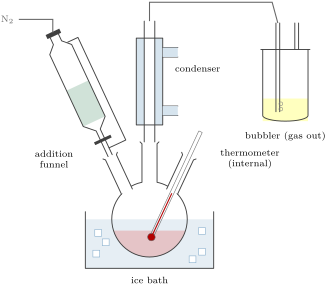
Method 35.3 (Setting up a dry reaction under nitrogen)
- Dry the glassware in an oven and assemble it hot, greasing or sleeving the joints; fit a septum or the addition funnel, the condenser and the bubbler.
- Flush with nitrogen while it cools; keep a slow flow (a bubble every second or two) throughout.
- Add solids before flushing, dry solvents and liquid reagents by syringe or cannula through a septum.
- Cool or heat as planned; start the addition with a small portion and check that the reaction starts before going on.
35.3 Work-up
Definition 35.4 (Work-up)
The work-up of a reaction is the sequence of operations, after the reaction, that turns the reaction mixture into the crude product: quenching, extraction and washing, drying, filtration and evaporation of the solvent.
Definition 35.5 (Acid–base extraction)
An acid–base extraction separates acidic, basic and neutral organic compounds dissolved in an organic solvent by washing the solution with aqueous acids or bases, which convert one class of compounds into ions that pass into the water.
Proposition 35.6 (Who goes where)
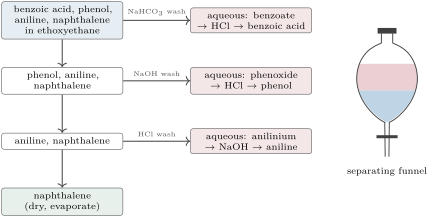
Aqueous sodium hydrogencarbonate (pH 8.3) extracts a carboxylic acid ( about 4) but not a phenol ( about 10), which needs sodium hydroxide; dilute hydrochloric acid extracts an amine whose conjugate acid has a of 4.6 or more; neutral compounds stay in the organic layer.
Proof. A species is mainly in its basic form when , and in more than 99 % when . At pH 8.3, benzoic acid (4.2) is more than 99 % benzoate, an ion that stays in the water; phenol (9.99) is about 2 % phenoxide () and stays essentially in the organic layer, where the neutral form partitions. In sodium hydroxide (pH above 12) phenol is converted to phenoxide. In dilute hydrochloric acid (pH about 1), aniline (anilinium 4.6) is more than 99 % anilinium. Each ion, once in water, is recovered by bringing the pH back the other way, which regenerates the neutral compound, then extracting it again. ∎
Definition 35.7 (Drying agent)
A drying agent is an anhydrous salt, such as magnesium or sodium sulfate, that binds the water dissolved in an organic solution as water of hydration and is then removed by filtration.
Method 35.8 (From the reaction flask to the crude product)
- Quench: destroy the remaining reactive reagents with a suitable aqueous solution, slowly and with cooling.
- Extract into an organic solvent; separate the layers (check which is which by adding a drop of water); extract the aqueous layer again.
- Wash the combined organic layers (acid, base, then brine, a saturated sodium chloride solution that removes most of the dissolved water).
- Dry with a drying agent until some of it stays free-flowing; filter.
- Remove the solvent on a rotary evaporator under reduced pressure; weigh the crude product.
35.4 Purification
Definition 35.9 (Flash chromatography)
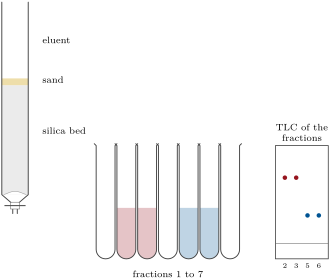
Flash chromatography is preparative column chromatography on silica in which the eluent is pushed through the column by a slight gas pressure, so that a separation of grams of material takes minutes; the eluent is chosen from thin-layer chromatography on the same silica.
Proposition 35.10 (Column volumes)
A compound that runs at on a TLC plate leaves a column of the same silica and eluent after about column volumes of eluent.
Argument. On the plate the compound travels times as far as the solvent front: its average speed is times that of the eluent. On the column the same partition gives the same ratio of speeds, so the compound needs times the volume of eluent that fills the column (the hold-up volume) to come out; in the language of Chapter 31, . A compound at comes out after about four column volumes, well separated from one at 0.5 (two volumes). ∎
Method 35.11 (Running a flash column)
- Choose the eluent by TLC: the wanted compound at about 0.25–0.35, as far as possible from the impurities.
- Pack the silica (about 30 to 100 times the mass of crude product) as a slurry or dry; add a layer of sand.
- Load the crude product in the least volume of solvent (or adsorbed on a little silica).
- Elute under slight pressure; collect fractions; check them by TLC; combine the pure ones and evaporate.
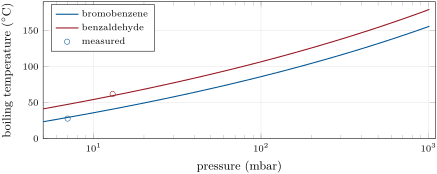
Liquids that decompose near their boiling point are distilled at reduced pressure, where they boil lower.
Definition 35.12 (Distillation under reduced pressure)
A distillation under reduced pressure is carried out in an apparatus connected to a vacuum pump through a manometer, at a pressure where the liquid boils at a temperature it can stand.
Proposition 35.13 (Boiling at reduced pressure)
With the boiling temperature at the reference pressure and treated as constant, the boiling temperature at pressure is given by
Proof. A liquid boils when its vapour pressure equals the pressure above it. The Clausius–Clapeyron relation of physics, for an ideal vapour and a negligible liquid volume, integrates between and to ; rearranging gives the result. ∎
35.5 Purity and identity
A product is identified by comparing its spectra and physical constants with those of the expected compound (Chapter 33); its purity is measured separately, because a product can be the right compound and still contain several per cent of something else.
Method 35.14 (Reporting purity and yield)
- Check the melting range of a solid (sharp and close to the literature value for a pure compound) and its TLC (one spot in two eluents).
- Measure purity: area per cent in GC or HPLC (only an estimate unless response factors are known, Chapter 31), or quantitative proton NMR, comparing an integral of the product with one of each impurity, or with a weighed internal standard.
- Convert to a mass fraction of product in the isolated material.
- Report the yield corrected for purity: , where is the mass isolated, the amount of limiting reagent and the molar mass.
For an optically active product, the specific rotation adds a check of its stereochemical purity; enantiomeric excess and its measurement are treated in the Year 3 volume.
Safety


Ethoxyethane and oxolane are extremely flammable and form explosive peroxides on storage; no flame in the laboratory, test old bottles before distilling. Bromobenzene is flammable and toxic to aquatic life; magnesium turnings are flammable. Vacuum glassware is checked for star cracks and shielded.
35.6 Exercises
Exercise 35.1 ★
Which bath would you use for a reaction run at about , at about , and at ?
Solution
Solution of Exercise 35.1.
Ice and water; ice and salt; dry ice and acetone (as for the enolates of Chapter 25).
Exercise 35.2 ★
An extraction uses dichloromethane, denser than water. Which layer is organic? How do you check?
Solution
Solution of Exercise 35.2.
The lower layer. Add a few drops of water: they join the aqueous layer, here the upper one.
Exercise 35.3 ★
How do you know that enough magnesium sulfate has been added to an ether solution?
Solution
Solution of Exercise 35.3.
The first portions clump as they take up water; when newly added solid stays loose and swirls freely, the solution is dry.
Exercise 35.4 ★
In 4 : 1 hexane–ethyl acetate a product has and an impurity 0.75. What would you change for a column, and in which direction?
Solution
Solution of Exercise 35.4.
is too high for a column (about 0.3 is wanted) and the two spots are close: use a less polar eluent, more hexane (9 : 1, for instance), which lowers both and widens their separation in column volumes.
Exercise 35.5 ★★
Give the order of the washes that separate benzoic acid, phenol, aniline and naphthalene from an ether solution, justifying each with a , and how each compound is recovered.
Solution
Solution of Exercise 35.5.
- Sodium hydrogencarbonate (pH 8.3 4.2 + 2): benzoate in water; acidify, extract benzoic acid.
- Sodium hydroxide (pH 12 9.99 + 2): phenoxide in water; acidify, extract phenol.
- Hydrochloric acid (pH about 1 4.6 2): anilinium in water; make basic, extract aniline.
- Naphthalene stays in the ether: dry, evaporate.
The hydrogencarbonate wash must come first: hydroxide would extract the acid and the phenol together.
Exercise 35.6 ★★
Estimate the boiling temperatures of bromobenzene and benzaldehyde at .
Solution
Solution of Exercise 35.6.
: bromobenzene about , benzaldehyde about (figure of Proposition 35.13).
Exercise 35.7 ★★
During an addition, of a reagent has accumulated unreacted. With and a heat capacity of for the mixture (exercise data), what temperature rise could follow?
Solution
Solution of Exercise 35.7.
.
Exercise 35.8 ★★
An HPLC trace shows the product at 96.0 % of the total area. Why is that not yet a mass purity? A proton spectrum of the same sample shows a product singlet (1H) of integral 1.00 and an impurity singlet (3H) of integral 0.12; product , impurity (exercise data). Compute the mass fraction of product.
Solution
Solution of Exercise 35.8.
Each compound has its own response: area per cent is a mass per cent only if the response factors are equal. NMR: mol of impurity per mol of product, that is per of product; .
Exercise 35.9 ★★
of a product () of purity 95.0 % (mass) are obtained from of limiting reagent. Compute the yield, uncorrected and corrected.
Solution
Solution of Exercise 35.9.
Theoretical mass . Uncorrected ; corrected .
Exercise 35.10 ★★★
A Grignard reaction gave benzene and almost no alcohol after addition of the aldehyde. List the possible causes and how each is avoided.
Solution
Solution of Exercise 35.10.
Benzene means the reagent formed and was then protonated: water in the glassware, the solvent or the aldehyde; air (moisture) entering through a leak; an aldehyde partly oxidised to benzoic acid, whose acidic hydrogen destroys the reagent. Remedies: oven-dried glassware, dry solvent, freshly distilled aldehyde, a nitrogen overpressure checked at the bubbler. Little reagent at all would point to an initiation failure (a magnesium surface covered by oxide), avoided by fresh or activated turnings.
Exercise 35.11 ★★★
On scale-up, of a halide reacts with in a reactor whose cooling removes at most (exercise data). What is the shortest safe addition time? What happens if the addition is faster?
Solution
Solution of Exercise 35.11.
at : at least , half an hour, and only if the halide reacts as fast as it is added. Faster, the heat release exceeds the cooling: the temperature rises, or reagent accumulates and may later react all at once (Proposition 35.1).
Exercise 35.12 ★★★
A crude solid of could be purified by recrystallisation (one step, 80 % recovery, purity 99 %) or by flash chromatography (95 % recovery, purity 99.5 %, of solvent) (exercise data). Compare the two routes.
Solution
Solution of Exercise 35.12.
Recrystallisation: at 99 %. Column: at 99.5 %, but of solvent to buy, evaporate and dispose of. The column gives about more of slightly purer product; recrystallisation is simpler, cheaper and less wasteful, and is preferred when its purity suffices.
35.7 Problem: A Grignard Done Right
Problem 35.1
Weekend problem — hazards and a dry set-up, a controlled addition and the accumulation danger, the work-up, purification by flash chromatography and a purity-corrected yield
Exercise data. Phenylmagnesium bromide is made from of bromobenzene and of magnesium turnings in dry ethoxyethane, then of benzaldehyde is added; work-up with aqueous ammonium chloride gives diphenylmethanol. Formation of the reagent: ; heat capacity of the mixture ; start at . TLC (9 : 1 hexane–ethyl acetate): biphenyl , diphenylmethanol 0.25. Isolated after the column: . Proton NMR of this material: the singlet (1H) integrates 1.00, the aromatic region 10.90. Molar masses (): bromobenzene 157.01, benzaldehyde 106.12, diphenylmethanol 184.24, biphenyl 154.21; Mg 24.305.
Part I — Hazards and set-up.
- Give the main hazards of ethoxyethane, bromobenzene and magnesium.
- Write the reaction of phenylmagnesium bromide with water, and explain the oven-dried glassware.
- Why work under nitrogen?
- What does the bubbler show, and what does it prevent?
- Why is ethoxyethane a good solvent here?
- Compute the amounts of bromobenzene and magnesium. Which is in excess?
Part II — Controlled addition.
- What heat does the complete formation of the reagent release?
- Why is the bromobenzene added drop by drop?
- The reaction is slow to start, and 20 % of the bromobenzene is added before it does. What heat can then be released at once?
- Compute the adiabatic temperature rise.
- Compare the final temperature with the boiling point of ethoxyethane. What happens?
- How should the addition be conducted?
Part III — Addition and work-up.
- Write the reaction with benzaldehyde and identify the limiting reagent.
- Why quench with ammonium chloride rather than a strong acid?
- Which layer is organic in the separating funnel?
- What is the brine wash for?
- How is the solution dried, and how is the solvent removed?
- Biphenyl is the main by-product. How does it form, and what favours it?
Part IV — Purification and purity.
- Which compound leaves the column first?
- After how many column volumes does each come out?
- From the NMR integrals, compute the molar ratio of biphenyl to alcohol in the isolated material.
- Compute the mass fraction of diphenylmethanol.
- Compute the mass of pure diphenylmethanol.
- Compute the theoretical mass.
- Compute the yield without correction for purity.
- State the yield corrected for purity.
Solution
Solution of Problem 35.1.
1. Ethoxyethane: extremely flammable, harmful, forms peroxides. Bromobenzene: flammable, toxic, toxic to aquatic life. Magnesium: flammable solid, releases hydrogen with water. 2. : every drop of water destroys reagent; oven drying removes the film of water on the glass. 3. To keep out moisture and oxygen, which also destroys the reagent. 4. The flow of nitrogen; it prevents air from entering through the outlet. 5. It does not react with the reagent, its oxygen lone pairs stabilise the magnesium, and its low boiling point () lets reflux limit the temperature. 6. bromobenzene; magnesium, in 10 % excess. 7. . 8. So that the heat is released at the rate at which reflux and the bath remove it. 9. . 10. . 11. About , far above the boiling point of ethoxyethane (): violent boiling that can overwhelm the condenser and throw flammable vapour out of the flask. 12. Add about a tenth of the bromobenzene, wait for the reaction to start (cloudiness, gentle reflux), then add the rest at the rate of a gentle reflux, with the ice bath ready. 13. gives the alkoxide ; benzaldehyde, , is limiting. 14. The alcohol is benzylic twice over: a strong acid would turn it into a stabilised cation, leading to ethers or substitution products; ammonium chloride is acidic enough to protonate the alkoxide and dissolve the magnesium salts. 15. The upper layer: ethoxyethane is less dense than water. 16. It removes most of the water dissolved in the ether. 17. Magnesium sulfate until free-flowing, filtration, then a rotary evaporator under reduced pressure. 18. Phenylmagnesium bromide couples with unreacted bromobenzene; a high local concentration of bromobenzene and high temperature favour it, another reason for a slow addition. 19. Biphenyl ( 0.85), the less polar. 20. About column volumes for biphenyl, for the alcohol. 21. The alcohol contributes 10 aromatic protons per CH; the extra comes from biphenyl, 10 protons per molecule: 0.090 mol of biphenyl per mol of alcohol. 22. . 23. . 24. . 25. . 26. (70.1 %), purity-corrected.