University Chemistry — Year 2 · Bachelor Year 2
4Equilibrium Constants and Shifts
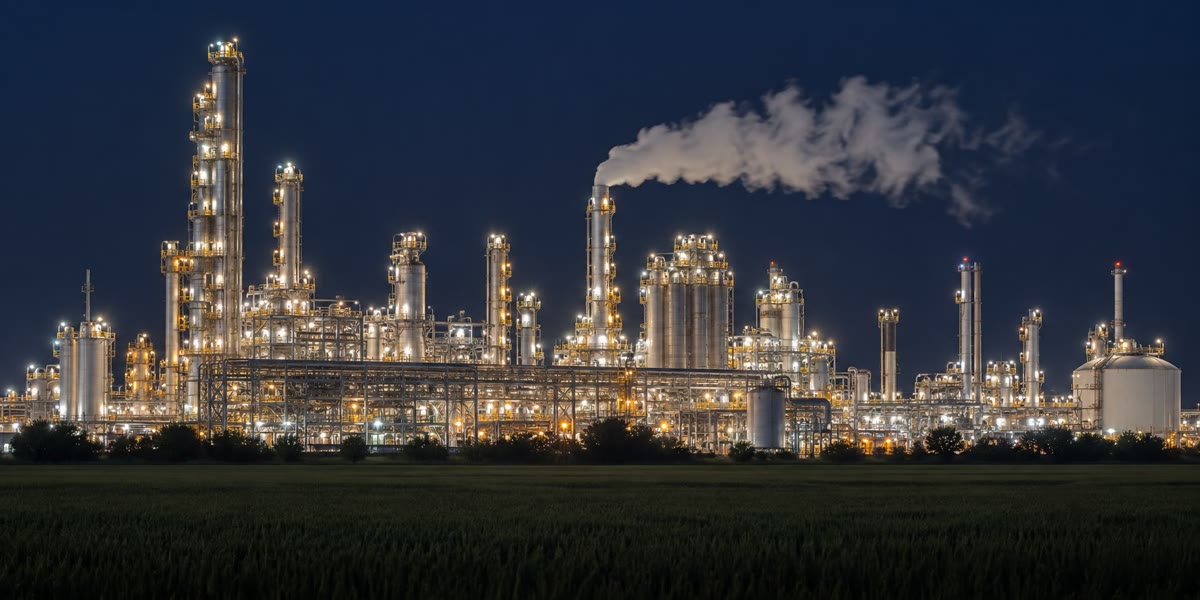
An ammonia plant runs its converter at about and . At room temperature the equilibrium of lies so far towards ammonia that a mixture of the elements could in principle be almost completely converted; yet the engineers heat it, which pushes the equilibrium back, and then compress it to two hundred atmospheres, which costs a great deal of energy. The reasons are a compromise between how far a reaction can go and how fast it goes. This chapter turns the Gibbs energy of the previous chapters into the equilibrium constant of the Year 1 volume, shows how that constant changes with temperature, counts how many conditions an experimenter may choose freely, and predicts in which direction an equilibrium moves when the temperature, the pressure or the composition is changed.
You already know
Chapter 2: the evolution criterion and the Gibbs–Helmholtz relation; Chapter 3: . The Year 1 volume: the quotient , the standard equilibrium constant as the value of at equilibrium, the law of mass action and the rule “: forward”, all stated there as laws; progress tables; final states of one or two reactions. It also promised that the choice of temperature and pressure for ammonia and for sulfur trioxide would be explained here.
4.1 The equilibrium constant from the Gibbs energy
Theorem 4.1 (Standard equilibrium constant)
At equilibrium , and the reaction quotient takes the value
It depends on the temperature alone.
Proof. The evolution criterion makes the condition of equilibrium. With (Proposition 3.13), equilibrium means , a function of only since is. ∎
Corollary 4.2 (The laws of the Year 1 volume)
. Hence a system with evolves forward, one with backward, and one with is at equilibrium (the law of mass action).
Proof. Substitute in ; the sign of is that of , and the evolution criterion requires . ∎
Example 4.3 (Three constants at )
Ammonia synthesis, : (the tables, with more digits, give ). The dissociation of , : . The decomposition of limestone, : , and the equilibrium pressure of carbon dioxide above limestone at room temperature is bar, nothing at all. A change of in at multiplies or divides by ten.
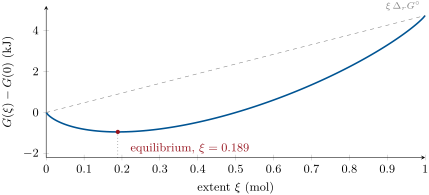
The Gibbs energy of the whole system shows the same thing as a landscape: it is lowest at the equilibrium extent, where its slope, , is zero.
4.2 Temperature: the van ’t Hoff equation
Theorem 4.4 (van ’t Hoff equation)
(the van ’t Hoff equation): the equilibrium constant of an endothermic reaction increases with the temperature, that of an exothermic reaction decreases.
Proposition 4.5 (Integrated form)
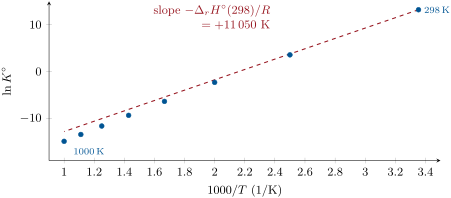
If is constant between and (Ellingham approximation),
and is a straight line of slope against .
Proof. Integrate , noting that . ∎
Method 4.6 (An equilibrium constant at another temperature)
- From tables at , compute , , and .
- Either use the integrated van ’t Hoff equation, or compute and then : the two are the same approximation.
- For a wide interval or a large , prefer tabulated ; an error of at (or at ) is a factor of ten on .
History — Jacobus Henricus van ’t Hoff
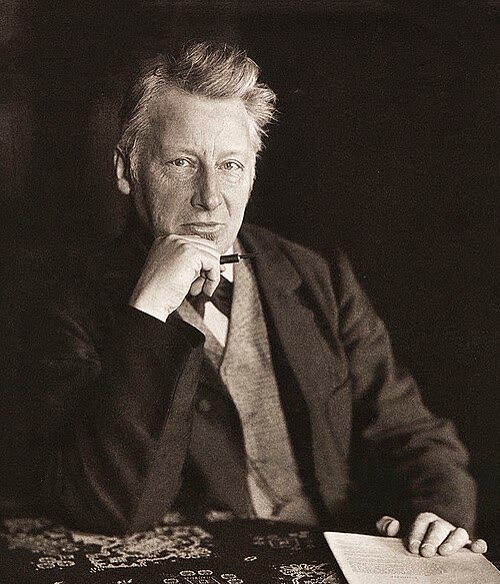
Jacobus Henricus van ’t Hoff (1852–1911) gave in 1884, in his Studies in Chemical Dynamics, the relation between the temperature and the equilibrium constant that bears his name, and the next year the law of osmotic pressure of Chapter 3; ten years earlier he had proposed the tetrahedral carbon atom. He received the first Nobel Prize in Chemistry, in 1901. (Photograph by N. Perscheid, 1904: public domain, Wikimedia Commons.)
4.3 Variance
How many intensive quantities can an experimenter fix freely before the equilibrium state is completely determined?
Definition 4.7 (Variance)
The independent intensive parameters of a system at equilibrium are a set of intensive quantities (temperature, pressure, mole fractions in each phase) that can be chosen independently and that, once chosen, fix all the others. Their number is the variance of the system.
Theorem 4.8 (Phase rule)
For a system of species distributed among phases, linked by independent equilibrium reactions and additional relations between intensive quantities fixed by the preparation (a stoichiometric feed, electroneutrality),
Proof. Intensive variables: , , and in each phase the mole fractions of the species, which sum to 1, so free ones per phase: in all . Relations: each species is at equilibrium between the phases, equalities of chemical potentials per species, in all; each reaction gives , relations; and additional relations. Subtract: . (A species absent from a phase removes one variable and one relation together.) ∎
Method 4.9 (Computing a variance)
- List the species, with their phase, and count and (each pure solid is a phase; all gases form one phase).
- Count the independent reactions among them.
- Count the extra relations : amounts in stoichiometric proportion (only if the relation is between quantities of the same phase), electroneutrality of an ionic solution.
- .
Example 4.10 (Three variances)
Limestone in a closed vessel, : , , (two solids, one gas): . Choose , and the pressure of carbon dioxide is fixed: . A gas mixture of , and at equilibrium: , , , (, and one composition variable); made from ammonia alone, or from a stoichiometric feed, and are in the ratio 1 : 3, and : at given and the composition is fixed, as the weekend problem uses.
4.4 Shifting an equilibrium
Definition 4.11 (Shift of an equilibrium)
When a system at equilibrium is perturbed (a change of temperature, of pressure, or of an amount), it is no longer at equilibrium in general and evolves to a new one. The shift of the equilibrium is forward if the reaction advances () and backward otherwise.
Method 4.12 (Predicting a shift)
Just after the perturbation, compute (or estimate the sign of the change of) and . If now , the shift is forward; if , backward; if the equality still holds, there is no shift.

Proposition 4.13 (Temperature)
At constant pressure, raising the temperature shifts an equilibrium in the endothermic direction (forward if ), lowering it in the exothermic direction.
Proof. At fixed composition and pressure, does not change with (for ideal systems); by van ’t Hoff, increases with if . Just after a rise of , then, : forward. ∎
Proposition 4.14 (Pressure)
At constant temperature and composition, raising the total pressure of a gas-phase equilibrium shifts it in the direction that lowers the number of gas molecules ( forward). If , the pressure has no effect.
Proof. With , : at fixed composition, raising multiplies by , which is if . Then : forward. Condensed phases contribute nothing. ∎
Proposition 4.15 (Adding a constituent or an inert gas)
Adding a small amount of a gaseous constituent to a gas-phase equilibrium changes by
Adding an inert gas has no effect at constant volume, and at constant pressure acts as a lowering of the pressure.
Proof. At constant , : , whose logarithmic derivative with respect to is (zero first term for an inert gas, ). At constant , : and , whose derivative is alone. ∎
Remark 4.16 (A reactant added that drives the reaction backward)
In ammonia synthesis, and : adding nitrogen at constant and changes by , which is positive when . In a mixture already rich in nitrogen, adding more nitrogen dilutes the hydrogen so much that ammonia decomposes. The rule “adding a reactant pushes forward” is safe at constant volume, not always at constant pressure.
Proposition 4.17 (Le Chatelier’s principle)
The propositions above are summed up by Le Chatelier’s principle: a system at equilibrium, perturbed in temperature or pressure, shifts in the direction that opposes the perturbation (it absorbs heat when heated, reduces its gas volume when compressed).
Proof. It restates Proposition 4.13 (the endothermic direction absorbs heat) and Proposition 4.14 (fewer gas molecules occupy less volume at the same and ). For additions of matter at constant pressure the principle is not reliable (Remark 4.16): compute . ∎
Remark 4.18 (When the equilibrium ends)
A shift can end not in a new equilibrium but in the disappearance of a phase. Heated in a closed vessel, limestone decomposes until ; if there is not enough of it to reach that pressure, it disappears entirely and stays below : the system is out of equilibrium for good, as the Year 1 volume already observed.
History — Henry Le Chatelier
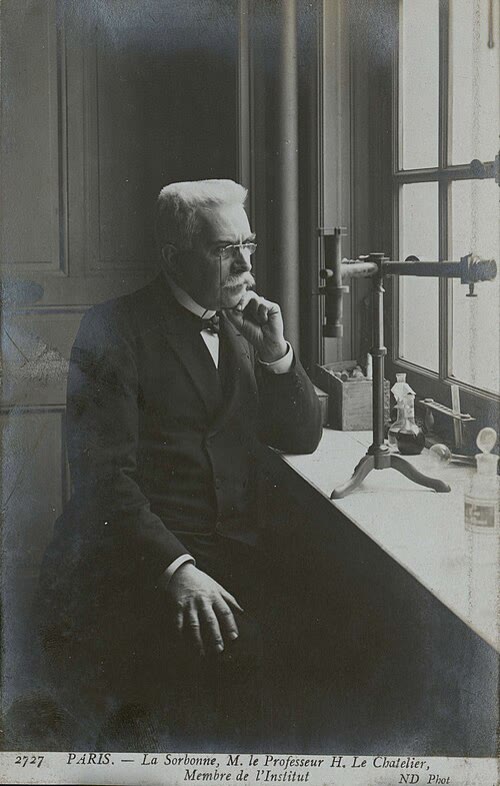
Henry Le Chatelier (1850–1936), a mining engineer and chemist who worked on cements, metallurgy and pyrometry, stated in 1884 the “law of displacement of equilibrium” named after him. He had also tried, around 1901, to make ammonia from its elements under pressure; an explosion in his apparatus ended the attempt. (Photograph: unknown author, CC BY-SA 4.0, Wikimedia Commons.)
4.5 Optimising a synthesis
Ammonia
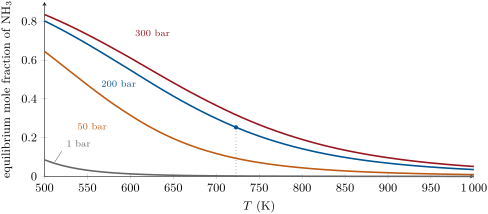
The synthesis is exothermic and reduces four molecules of gas to two: by the propositions above, low temperature and high pressure favour ammonia. At and room temperature the equilibrium is almost complete, but the reaction does not run at all: the triple bond of nitrogen is broken only on a catalyst, and the iron catalyst works only at several hundred degrees. Plants therefore choose:
- a temperature high enough for the rate, as low as the catalyst allows (around );
- a high pressure to recover the yield lost to the temperature, limited by the cost of compression and of thick-walled vessels;
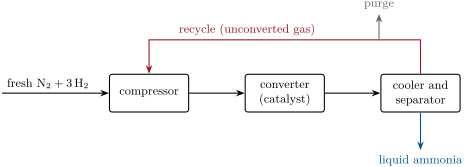
- a loop: the gas leaving the converter is cooled, the ammonia condenses and is removed, and the unconverted gas is recycled with fresh feed; a small purge removes the argon and methane that would otherwise accumulate.
Definition 4.19 (Single-pass conversion, recycle, purge)
In a process with recycling, the single-pass conversion is the fraction of a reactant converted in one passage through the reactor; the unconverted part, separated from the product, is returned to the reactor inlet as the recycle; a purge is a small stream withdrawn continuously from the recycle to keep inert species from accumulating.
History — Haber and Bosch
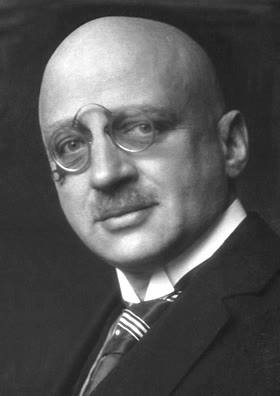
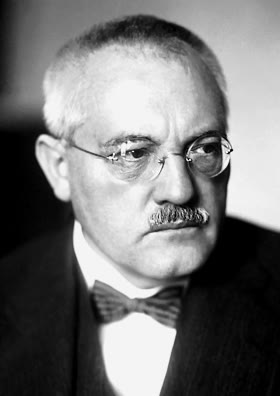
Fritz Haber (1868–1934) measured the equilibrium of ammonia under pressure and, in 1909, made it flow continuously from a laboratory converter over an osmium catalyst. Carl Bosch (1874–1940) turned it into an industry, with steel vessels that resisted hot hydrogen under pressure and a cheap iron catalyst; the first plant started in 1913. Haber received the Nobel Prize in 1918, Bosch in 1931. (Nobel Foundation portraits: public domain, Wikimedia Commons.)
Sulfur trioxide
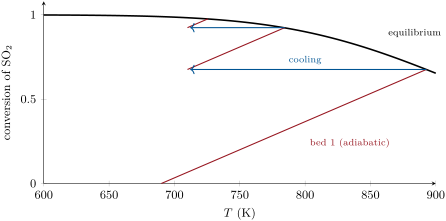
In the contact process, ( for the equation as written) runs over a vanadium oxide catalyst, active only when hot, in several adiabatic beds. In each bed the heat released raises the temperature, which lowers ; the conversion stops when the gas reaches the equilibrium curve. Cooling between beds brings it back to a temperature where the equilibrium allows more conversion.
4.6 Exercises
Exercise 4.1 ★
Compute at for a reaction with , then for . What change of multiplies by 100?
Solution
Solution of Exercise 4.1.
, and for its inverse, . A factor of 100 needs .
Exercise 4.2 ★
For ammonia synthesis and . Estimate at with the integrated van ’t Hoff equation; the tables give 35.6.
Solution
Solution of Exercise 4.2.
, . The tables give 35.6: over the constant- approximation is already off by 20 % (the reaction becomes more exothermic as rises).
Exercise 4.3 ★
Compute the variance of: (a) liquid water in equilibrium with its vapour; (b) in a closed vessel; (c) , , at equilibrium, arbitrary feed; (d) .
Solution
Solution of Exercise 4.3.
(a) , , : (the vapour pressure is a function of ). (b) . (c) . (d) Four species, one reaction, two phases (carbon and the gas): ; if the gas is made only from carbon and steam, in the gas, and .
Exercise 4.4 ★
For , . In which direction is the equilibrium shifted by heating at constant pressure, by compressing at constant temperature, by adding argon at constant volume?
Solution
Solution of Exercise 4.4.
Heating: endothermic direction, towards (forward). Compressing: towards fewer gas molecules, (backward). Argon at constant volume: no change, the partial pressures of the reacting gases are unchanged.
Exercise 4.5 ★★
For , , . Compute at and at (Ellingham approximation), and the mole fraction of in air (, , little consumed) at equilibrium at . Why do engines make this pollutant, and why does it survive in the cooled exhaust?
Solution
Solution of Exercise 4.5.
At : , . At : , . With , : , almost one per cent. Engines burn at such temperatures; as the gases cool, falls enormously, but the decomposition of is very slow: the hot equilibrium is frozen in the exhaust (until a catalyst removes it).
Exercise 4.6 ★★
An esterification in the liquid phase has (activities taken as mole fractions). Starting from of acid A, compute the amount of ester with , then of alcohol B. Explain, with and , why removing the water as it forms drives the reaction to completion.
Solution
Solution of Exercise 4.6.
With mol of ester and a constant total amount, . For : , . For : , . Removing water keeps below whatever : the reaction keeps going forward until the acid is consumed.
Exercise 4.7 ★★
At and , for . Compute the degree of dissociation of of . Then of argon is added at constant total pressure: compute the new degree of dissociation, and explain. What happens if the argon is added at constant volume?
Solution
Solution of Exercise 4.7.
Without argon: amounts , , total ; , . With argon at : total , , so , : diluting at constant total pressure lowers the partial pressures, which favours the side with more gas molecules. At constant volume, the partial pressures of the reacting gases do not change: stays 0.189.
Exercise 4.8 ★★
Ammonium chloride sublimes by dissociating, . Compute the variance when the gas is made only by the solid, and when some ammonia has been added. What does each case mean for the experimenter?
Solution
Solution of Exercise 4.8.
Only the solid: , , (), : ; choose and the pressure is fixed (a “dissociation pressure”). With added ammonia, and : and one pressure can be chosen; the product is fixed by .
Exercise 4.9 ★★
The tables give, for ammonia synthesis, at and at . Deduce in that interval and compare with its value at .
Exercise 4.10 ★★★
Prove the counter-example of Remark 4.16: write of ammonia synthesis with the amounts and the total pressure, compute at constant and , and find the condition on for which adding nitrogen shifts the equilibrium backward. Can the same happen at constant volume?
Solution
Solution of Exercise 4.10.
. At constant , : , positive when , that is . Then exceeds and the equilibrium shifts backward. At constant volume, : always forward.
Exercise 4.11 ★★★
Limestone is heated to in an empty closed vessel of , where for its decomposition (Chapter 2). Compute and the equilibrium pressure of carbon dioxide. Find the final state for and for of limestone.
Solution
Solution of Exercise 4.11.
: at equilibrium, that is of gas. With of limestone, all of it decomposes (): no equilibrium, a break of equilibrium. With , equilibrium: of and , of left.
Exercise 4.12 ★★★
Read on the contact-process figure the conversion and the temperature at the outlet of each bed. Explain why a single adiabatic bed, however long, could not exceed about 68 % conversion with this feed, why the gas is cooled between beds rather than the catalyst kept cold throughout, and what limits the conversion of the last bed.
Solution
Solution of Exercise 4.12.
Bed 1 leaves at about and 68 % conversion, bed 2 at about and 92 %, bed 3 at about and 98 %. In one adiabatic bed the gas heats up as it reacts until it meets the equilibrium curve, which at that temperature allows only about 68 %. A cold catalyst throughout is not an option because the catalyst works only when hot; cooling between beds keeps the rate and moves the equilibrium limit up. The last bed is limited by the equilibrium at the lowest temperature at which the catalyst still works (plants then absorb the trioxide and pass the gas once more over a catalyst).
4.7 Problem: The Ammonia Loop
Problem 4.1
Weekend problem — the equilibrium constant of ammonia synthesis and its temperature dependence, the composition at the converter’s conditions, the shifts caused by pressure, temperature and inert gases, and the loop
Ammonia is made by from a stoichiometric feed. Data: at , , () 192.77, 191.61, 130.68; the tables give at and at . Gases are perfect; .
Part I — The constant.
- Compute , and at , and .
- Compute at and at from the tables.
- Deduce from these two values the mean between and , and compare with question 1.
- Estimate from the two tabulated values with the van ’t Hoff equation.
- Compute in the Ellingham approximation from the data at , and comment on the difference.
Part II — The equilibrium in the converter.
- From a feed of and , write the amounts at extent and the total amount.
- Show that, with the mole fraction of ammonia, the mole fractions of and are and .
- Show that .
- Compute at and .
- Compute at and .
- Compute the variance of the system and explain why and fix the composition.
Part III — Shifts.
- Without computing, in which direction does the equilibrium move when the pressure rises? When the temperature rises?
- Argon enters with the air used to make the nitrogen. At constant total pressure, how does its presence shift the equilibrium?
- A mixture at equilibrium has . Does adding a little nitrogen at constant and shift it forward or backward?
- Would the answer change at constant volume?
- Before the gas returns to the converter, its ammonia is condensed out. What does this do to at the converter inlet?
Part IV — The loop.
- The gas leaves the converter with of ammonia, below the equilibrium value. Why does a real converter not reach equilibrium?
- Compute the single-pass conversion of hydrogen corresponding to from a stoichiometric feed.
- The unconverted gas is recycled. In steady operation, of fresh enters per unit time: how much ammonia leaves, and how much nitrogen passes through the converter per unit time?
- Why must a little gas be purged from the recycle?
- Why is the converter not run at , where the equilibrium is far more favourable?
- State the equilibrium mole fraction of ammonia at and for a stoichiometric feed, in the perfect-gas model.
Solution
Solution of Problem 4.1.
1. , , , . 2. ; . 3. , that is , more negative than at . 4. , with : . 5. , : four times too large, because and change over (). 6. , , , total . 7. , so ; the nitrogen fraction and the hydrogen fraction is three times larger. 8.
take the square root. 9. ; gives . 10. ; : . 11. , , (ratio 1 : 3 kept by the reaction), : . Once and are chosen, nothing is left free. 12. Pressure: forward (). Temperature: backward (exothermic). 13. An inert gas at constant total pressure lowers the partial pressures of the reacting gases, as a pressure drop would: backward. 14. : falls below , forward. 15. No: at constant volume whatever the composition: forward. 16. With almost no ammonia, is far below at the inlet: the gas enters far from equilibrium and reacts forward. 17. The gas spends too short a time on the catalyst for the equilibrium to be reached; a longer contact would cost a larger, more expensive converter for a small gain. 18. gives per mole of fed: single-pass conversion of hydrogen (and of nitrogen) , 31 %. 19. In steady operation all the fresh feed is eventually converted: of ammonia leave per unit time; the converter must pass of per unit time, the rest being recycled. 20. The argon (and methane) that enter with the feed never react and are not removed with the liquid ammonia: without a purge they would accumulate in the loop and lower the partial pressures of the reactants. 21. At the iron catalyst is too slow: the equilibrium would be favourable but would never be approached in an industrial time. 22. At and , stoichiometric feed, perfect gases: .