High School Physics · Grades 10–12
13The Fundamental Interactions
Rub a balloon on your hair and it picks up scraps of paper — beating, with a few square centimetres of rubber, the gravitational pull of the entire planet. That easy victory is why atoms hold together and why heavy nuclei eventually shatter (Chapter 19). The universe runs on exactly four interactions; this chapter meets them, weighs them against each other, and assigns each its floor.
13.1 Matter from quarks to galaxies
Definition 13.1 (The structure ladder)
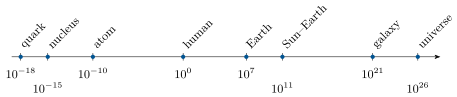
Matter is built in floors, each assembled from the one below: three quarks (pointlike, smaller than ) bind into a nucleon — proton or neutron, about across; nucleons pack into a nucleus ( to ); a nucleus plus its electron cloud is an atom (); atoms bind into molecules and crystals ( up), which assemble into everyday objects (), planets (), planetary systems (), galaxies () and the observable universe ().
Definition 13.2 (The four interactions)
A fundamental interaction is a force not reducible to other forces; there are exactly four: gravitation, the electromagnetic interaction, the strong interaction and the weak interaction.
Remark 13.3
The floors are separated by voids: an atom is times wider than its nucleus — scale the nucleus up to a marble and the electron cloud is a kilometre across. Something must hold these sparse floors together, and gravity is almost never it.
13.2 Electric charge
Definition 13.4 (Electric charge)
Electric charge is the property of matter on which the electromagnetic interaction acts, as mass is the property gravitation acts on. It is measured in coulombs () and comes in two signs, positive and negative, which cancel when added; like charges repel, unlike charges attract.
Definition 13.5 (Elementary charge)
Charge is grained: every observed charge is a whole multiple of the elementary charge . The proton carries , the electron , the neutron ; a charge holds elementary charges.
Proposition 13.6 (Conservation of charge)
The total charge of an isolated system never changes: charge is neither created nor destroyed, only transferred — in practice by electrons, the lightest carriers.
Proof. Admitted at this level. ∎
Remark 13.7
No violation has ever been observed; the deep reason, a symmetry of electromagnetism, is given in the university volumes.
Definition 13.8 (Charging by friction and by contact)
Rubbing two insulators tears electrons off one and onto the other, leaving opposite charges of equal magnitude (charging by friction); touching a charged object to a neutral one shares the charge (charging by contact). Only electrons move; the total charge is conserved.
Example 13.9 (Counting electrons)
A balloon rubbed on hair acquires : it has gained electrons, and the hair is left with exactly .
13.3 Coulomb’s law
Theorem 13.10 (Coulomb’s law)
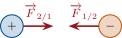
Two point charges and a distance apart exert on each other forces along the line joining them, of equal magnitudes and opposite directions — repulsive for like signs, attractive for unlike signs — with
Proof. Admitted at this level. ∎
Remark 13.11
Coulomb established the law in 1785 by measuring the twist of a thin torsion fibre; why the exponent is exactly is answered in the university volumes.

Remark 13.12 (A formal twin of gravitation)
Coulomb’s law is, symbol for symbol, the law of universal gravitation (Chapter 4) with charges in place of masses:
| source | mass | charge |
| law | ||
| [1.5ex] constant | ||
| sign | always attractive | attractive or repulsive |
The two differences drive everything below: electricity is overwhelmingly stronger, and it alone can cancel itself.
Example 13.13 (Two protons, both forces at once)
Two protons () sit apart — nuclear neighbours. Electric repulsion:
— the weight of a -kg suitcase, carried by a particle of kilograms. Gravitational attraction: . The ratio is distance-independent ( cancels): between elementary particles, gravity is times too weak to matter — at any distance.
13.4 The strong and weak interactions
The example leaves a scandal: a helium nucleus holds two protons that repel with tens of newtons — and yet helium exists.
Definition 13.14 (The strong interaction)
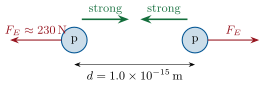
The strong interaction binds quarks into nucleons and nucleons into nuclei. At it is attractive and far stronger than the electric repulsion (thousands of newtons between nucleons); beyond a few metres it vanishes: its range is about . It grips protons and neutrons alike and ignores charge.
Remark 13.15 (Why nuclei exist — and why heavy ones give way)
The two forces in the nucleus scale differently. The strong glue is short-ranged: a nucleon binds only its few neighbours within . The electric repulsion is long-ranged: every proton pushes on every other proton. As nuclei grow, repulsion accumulates faster than glue: heavy nuclei need extra neutrons (glue without charge), and beyond about protons even that fails — the heaviest nuclei live on borrowed time (Chapter 19).
Definition 13.16 (The weak interaction)
The weak interaction, of range shorter still, lets a neutron turn into a proton (and back): it drives the radioactivity of Chapter 19.
13.5 Who rules which floor
Method 13.17 (Auditing a scale)
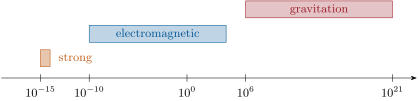
To find which interaction rules a structure of size , check range and cancellation:
- : the strong interaction rules — it beats the electric repulsion, and gravity is out.
- atoms to mountains ( to ): the strong force is out of range; the electromagnetic interaction rules — bonds, cohesion, friction, contact.
- planets and beyond (): matter is neutral to fantastic precision, so electricity cancels itself; mass has one sign and always adds — gravitation rules the sky.
The weak interaction holds no floor: it binds nothing, but arbitrates transformations ( decay).
13.6 Exercises
Exercise 13.1 ★
Give the order of magnitude of each size and its floor of the ladder: proton ; water molecule ; grain of sand ; Earth ; Milky Way .
Exercise 13.2 ★
A balloon rubbed on hair carries . Has it gained or lost electrons, and how many? What is the hair’s charge afterwards, and which law says so?
Solution
Solution of Exercise 13.2.
Negative charge: it gained electrons. The hair carries , by conservation of charge (Proposition 13.6).
Exercise 13.3 ★
Charges and sit apart. Compute the force; attractive or repulsive? Compare the forces on and on .
Solution
Solution of Exercise 13.3.
, attractive (unlike signs). The two forces have the same magnitude, opposite directions.
Exercise 13.4 ★
Two charges attract with a force . What does it become if: the distance doubles; the distance is divided by ; one charge doubles; both charges and the distance double?
Solution
Solution of Exercise 13.4.
; ; ; (numerator , denominator ).
Exercise 13.5 ★
Name the interaction responsible for: (a) the Moon orbiting the Earth; (b) the cohesion of a salt crystal; (c) the cohesion of a helium nucleus; (d) the decay of carbon-14; (e) the balloon of Exercise 13.2 sticking to a wall.
Solution
Solution of Exercise 13.5.
(a) gravitation; (b) electromagnetic; (c) strong; (d) weak; (e) electromagnetic.
Exercise 13.6 ★★
The two protons of a helium nucleus sit apart (). Compute their electric repulsion, their gravitational attraction, and the ratio. What keeps the nucleus whole?
Solution
Solution of Exercise 13.6.
; . Ratio . The strong interaction holds the nucleus, gravity is irrelevant.
Exercise 13.7 ★★
In a hydrogen atom, the electron () sits from the proton (). Compute the electric and gravitational forces between them and their ratio. What holds atoms together?
Solution
Solution of Exercise 13.7.
; . Ratio : the electromagnetic interaction holds atoms together.
Exercise 13.8 ★★
Sphere A carries ; an identical sphere B is neutral. They are touched together, then separated to . What charge does each carry (check the conservation of charge)? Compute the force between them — attractive or repulsive?
Solution
Solution of Exercise 13.8.
By contact the charge is shared: (total still ). Then , repulsive (like signs).
Exercise 13.9 ★★
Two identical charges repel with : how far apart are they? Where does the force drop to ?
Exercise 13.10 ★★
Two protons in neighbouring molecules sit apart. Compute their electric repulsion. What does the strong interaction contribute at this distance? Which interaction binds molecules?
Solution
Solution of Exercise 13.10.
. The strong interaction contributes nothing: m is times its range. Molecules are bound by the electromagnetic interaction.
Exercise 13.11 ★★
Each of two coins holds about electrons. Move one electron in a million between them and set the coins apart. Compute each coin’s charge, then the force. The weight of what mass equals it? Conclude on the neutrality of everyday matter.
Solution
Solution of Exercise 13.11.
on each coin. — the weight of , a loaded freight train, from a millionth of the electrons. Everyday matter must be (and is) neutral to far better than one part in a million.
Exercise 13.12 ★★★
A uranium nucleus has diameter and protons. Compute the repulsion between two protons at opposite ends. Can the strong interaction bind this pair — why not? How many repelling proton pairs are there? Why do heavy nuclei need extra neutrons, and why beyond some size can even neutrons not save them?
Solution
Solution of Exercise 13.12.
— still enormous at this scale. No: they are times the strong range apart; each is glued only to its nearest neighbours. Pairs: , all repelling at any distance, while the glue does not grow with size. Neutrons add attraction without repulsion and dilute the protons; but repulsion grows with the square of the proton number and glue only with the number of neighbours, so beyond about protons no neutron budget balances the books — such nuclei decay (Chapter 19).
Exercise 13.13 ★★★
Two balls of mass hang from threads tied to the same point. Given the same charge , they settle apart. Each ball is in equilibrium under its weight, the thread’s tension and the electric force: show that (: angle of thread to vertical) and that here . Compute , then , then the number of elementary charges moved.
Solution
Solution of Exercise 13.13.
Equilibrium: vertically , horizontally , so . Here , and for small angles . Then ; ; elementary charges.
Exercise 13.14 ★★★
Data: , , Earth–Moon distance . Compute the Earth–Moon gravitational force. Gravity is switched off: what charges on the Earth and on the Moon keep the same attraction? How many electrons is , and what do they weigh ()? Comment.
Solution
Solution of Exercise 13.14.
. Setting : . That is electrons, of mass : a few hundred kilograms of electrons could do the work of of Moon — electricity’s strength and gravity’s weakness in one number.
Exercise 13.15 ★★★
In a salt crystal, Na and Cl ions (charges ) sit apart; a Cl ion has mass . Compute the force between neighbouring ions and the weight of a Cl ion; give the ratio. Then explain how gravity wins at large scales — no mountain tops — though each bond beats it by fifteen orders of magnitude.
Solution
Solution of Exercise 13.15.
; weight ; ratio . Each bond has a fixed strength, but weight grows with the whole mass above: pile up rock and the load on the bottom layer grows without limit while its bonds do not. Around of rock the load crushes the electric bonds — gravity wins not by strength per particle but by adding up when charge cancels.
13.7 Problem: The audit of the four forces
Problem 13.1
Weekend problem — why the world neither collapses nor flies apart: the four interactions audited floor by floor, down to matter’s neutrality to two parts in
Atoms do not implode, nuclei mostly hold, the Moon neither crashes nor escapes; this problem audits who deserves the credit. Data: , , , , , , , Earth–Moon distance .
Part I — The ladder.
- List the floors of the ladder from quark to galaxy, one order of magnitude of size each.
- Scale model: the nucleus becomes a marble; how wide is the atom?
- What fraction of an atom’s volume does its nucleus occupy?
- A hair is thick. How many atoms span it?
- How many powers of ten from the quark ceiling () to a galaxy ()?
Part II — The electric floor.
- In a hydrogen atom the electron sits from the proton: compute the electric force between them.
- Compute the gravitational force between them, and the ratio of the two. Which one holds the atom together?
- What changes if gravity is switched off inside atoms? And if electricity is?
- Why are the “contact” forces of everyday life — the floor pushing on your feet, friction — electromagnetic in disguise?
- Each of two coins holds about electrons. Transfer one electron in a billion between them, set them apart: compute the charges and the force. Conclusion?
- Which interaction rules the floors from to , and why does the strong interaction not compete?
Part III — The nuclear floor.
- Two protons sit apart in a nucleus: compute their electric repulsion.
- Unrestrained, what acceleration would this force give a proton? Compare with .
- List the three properties the strong interaction needs to explain why nuclei exist, why neutrons are gripped too, and why nuclei are tiny.
- In a uranium nucleus (diameter , protons), compute the repulsion between two protons at opposite ends. Can the strong interaction bind that pair directly? Explain why repulsion wins as nuclei grow, and what the neutrons are for.
- In one sentence, as promised: what does the weak interaction do?
Part IV — The astronomical floor, and the verdict.
- Compute the gravitational force between the Earth and the Moon.
- The Earth contains about protons (and as many electrons), the Moon about . What fraction of each body’s proton charge, left uncancelled, would make the electric force match the gravitational one?
- Why does gravitation, the weakling of question 7, rule astronomy? Two reasons.
- Verdict — one sentence per floor (nucleus, atom to mountain, planet and up): what holds it together? Then answer the title: why does the world neither collapse nor fly apart?
Solution
Solution of Problem 13.1.
1. Quark ; nucleon ; nucleus –; atom ; molecule ; everyday object ; planet ; planetary system ; galaxy .
2. Scale factor : the atom is wide.
3. : matter is empty.
4. atoms — about a million across one hair.
5. From to : powers of ten.
6. .
7. ; ratio . Electricity holds the atom; gravity is a spectator.
8. Without gravity: nothing measurable changes (it is below). Without electricity: no atoms, no molecules, no matter at all.
9. “Contact” is the electric repulsion between the electron clouds of atoms brought to about : nothing ever touches. Floor reaction and friction are Coulomb’s law in bulk.
10. each; — a plainly visible force from one electron in a billion. Everyday matter is neutral to far better than .
11. The electromagnetic interaction. The strong force is out of range beyond about — times smaller than a single atom.
12. .
13. , about times : no everyday force comes close.
14. Stronger than at (nuclei exist); acting on protons and neutrons alike, blind to charge (neutrons are gripped); range about (nuclei stay tiny — the glue cannot reach further).
15. . No: times the range. Repulsion acts across all proton pairs; the glue binds only nearest neighbours, so growth favours repulsion. Neutrons add glue and spacing without adding repulsion — until, beyond about protons, no mixture balances and the nucleus decays.
16. The weak interaction turns a neutron into a proton (and back), causing decay — it transforms; it never binds.
17. .
18. , . Matching forces means :
an imbalance of two parts in would cancel gravity.
19. Charge comes in two signs and cancels (question 18 shows how perfectly), so the stronger force switches itself off at large scales; mass has one sign, adds forever, and nothing screens it.
20. Nucleus: the strong interaction outmuscles the protons’ repulsion at . Atom to mountain: the electromagnetic interaction binds electrons to nuclei and atoms to each other. Planet and up: gravitation, unopposed once charge cancels, holds planets, orbits and galaxies. The world does not collapse because each floor is propped by a binder stiffer than the load, and does not fly apart because matter is neutral to about — so every scale has exactly one force in charge, and it is attractive where it must be.