High School Physics · Grades 10–12
32Radioactive Decay
In a museum basement, a Geiger counter clicks over a sliver of wood from a pharaoh’s coffin. Each click is lawless: nothing announced it, nothing predicts the next. Yet by Friday the lab will print a date good to a century. This chapter resolves the paradox — how events perfectly random one by one add up, by the trillion, to the steadiest clocks we own.
32.1 Lawless one by one, clockwork by the mole
Last year (Chapter 19) we met the unstable nuclei, balanced their and equations, and saw half of any large sample vanish per half-life . What we could not say was when between the stairs — nor why a random process keeps a schedule at all. Both questions have one answer.
Definition 32.1 (Decay constant)
For each unstable nuclide there is a constant , its decay constant (unit ), such that during any short interval each nucleus has probability of decaying — the same for every nucleus of the species, whatever its age, and untouched by temperature, pressure or chemistry.
Remark 32.2 (Lawless singly, exact in crowds)
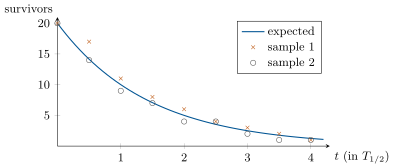
A nucleus that has waited ten thousand years is exactly as likely to decay this second as one made this morning: no wearing out, no warning — which one goes next is genuinely unpredictable. Crowds are another matter. Toss coins: expect heads, but be unsurprised by — fluctuations of order , here . Toss : the relative fluctuation is , the outcome certain to ten decimals. A gram of matter holds some nuclei: lawlessness averages into clockwork, an exact law for , the number of nuclei still intact at time .
32.2 The decay law
Proposition 32.3 (The evolution equation)
In a large sample of nuclei, during the number changes by
the population shrinks at a rate proportional to itself.
Proof. Each of the nuclei decays during with probability : expected decays , and for large the actual count sticks to the expected one (Remark 32.2); each decay removes one nucleus. ∎
Theorem 32.4 (Law of radioactive decay)
A sample holding nuclei at holds, at time ,
Proof. Check by substitution: , and : equation and start both right. (That no other function fits is proved, with integrals, in the university volume.) ∎
Definition 32.5 (Exponential decay)
A quantity following undergoes exponential decay: in equal times, equal fractions are lost. It is exactly the discharging capacitor of Chapter 30, with playing : one differential equation, learned once, runs circuits and nuclei alike.
Proposition 32.6 (Half-life)
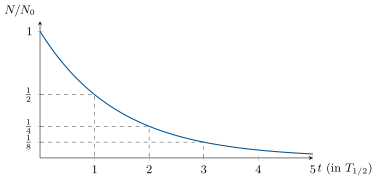
The half-life (Definition 19.14) of a nuclide is set by its decay constant: , and after half-lives , whole or not.
Proof. requires , i.e. ; and for any : the exponential threads the staircase and fills in between the stairs. ∎
Example 32.7 (Twenty powers of ten)
With year :
| nuclide | () | ||
| polonium-214 | uranium chain link | ||
| technetium-99m | hours | medical imaging | |
| iodine-131 | days | thyroid medicine | |
| caesium-137 | years | reactor fallout | |
| carbon-14 | years | archaeology | |
| potassium-40 | years | rock dating | |
| uranium-238 | years | Earth’s inner heat |
One law, twenty powers of ten of .
32.3 Activity: counting the clicks
Proposition 32.8 (Activity)
The activity of a sample — its decays per second, in becquerels (Definition 19.18) — is
proportional to the surviving population, and equally exponential.
Proof. nuclei, each with probability per second: decays per second; multiplying Theorem 32.4 by gives . ∎
Example 32.9 (Huge , tiny )
A banana ticks at about , a human body at about , a cubic metre of granite at some (Chapter 19). Behind the modest clicks sit astronomical populations: the body’s potassium-40 contributes with : nuclei, of which barely a few thousand fire each second.
Method 32.10 (Measuring a half-life)
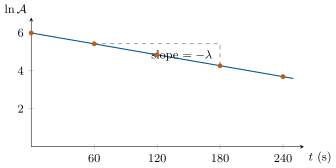
- Count decays with a Geiger counter over successive equal intervals: this samples at successive times.
- Plot against : since , exponential decay shows as a straight line — crooked data means another law, or a mixture of nuclides.
- Read off as minus the slope; .
Remark 32.11 (Becquerels are not harm)
The becquerel counts decays, not damage. Harm is tracked by the dose in sieverts (Chapter 19), weighing the energy deposited per kilogram of tissue by each radiation’s destructiveness: a technetium scan is routine, far fewer becquerels of inhaled emitter are not; converting to is university material.
32.4 Dating: reading time off a ratio
The decay law run backwards is a clock: measure the surviving fraction, and the exponential names the elapsed time.
Method 32.12 (Radiocarbon dating)
Example 32.13 (A hearth in a cave)
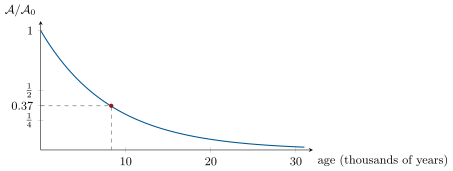
Charcoal from a buried hearth gives decays per minute per gram: , so years. The fire went out eight thousand years ago — the wood itself is the archive.
Example 32.14 (Clocks for rocks)
Carbon-14 goes silent beyond some years; geology keeps slower clocks. Potassium–argon: potassium-40 ( years) decays to argon, a gas that escapes molten lava but is trapped once rock crystallises — solidification zeroes the clock. Uranium–lead: uranium-238 heads a chain of decays ending at stable lead-206 (Chapter 19), and the lead-to-uranium ratio in a crystal dates it. Both clocks agree on the oldest minerals ( years) and, via meteorites, on the Solar System’s age.
Remark 32.15 (Chains, and the gas in the cellar)
Between uranium and lead the chain passes through radium, then radon-222, a radioactive gas ( days). Born in granite and soil, it seeps into basements and accumulates; its -emitting daughters decay in the lungs — most people’s largest natural dose, and the cheapest to reduce: open the cellar window.
32.5 Exercises
Exercise 32.1 ★
Iodine-131 has . Compute its half-life in seconds, then in days.
Solution
Solution of Exercise 32.1.
days — iodine-131’s clock.
Exercise 32.2 ★
Radon-222 has days. Compute in , then the activity of a sample of nuclei.
Solution
Solution of Exercise 32.2.
; ; .
Exercise 32.3 ★
Verify by substitution that satisfies and ; then compute .
Solution
Solution of Exercise 32.3.
— the equation holds; ; .
Exercise 32.4 ★
A caesium-137 source ( years) has activity today. Compute its activity in years, then in years.
Solution
Solution of Exercise 32.4.
years : . years : .
Exercise 32.5 ★
A semi-log plot of against for a technetium sample is a straight line through and . Find (in and ) and .
Solution
Solution of Exercise 32.5.
Slope , so ; hours — technetium-99m.
Exercise 32.6 ★★
One gram of radium-226 ( years; molar mass ; ): compute the number of nuclei, then , then the activity — history’s first activity unit, the curie.
Solution
Solution of Exercise 32.6.
; , so ; — one curie, the activity of Marie Curie’s gram of radium.
Exercise 32.7 ★★
Two students seal samples of and nuclei of one same nuclide. What does each expect after one half-life? Whose prediction is reliable? (Estimate the relative fluctuation for each.)
Solution
Solution of Exercise 32.7.
Both expect half to remain: , and . Fluctuations of the count: with decays, about — or would be no surprise; with , about . Only the large sample obeys the law to measurable precision.
Exercise 32.8 ★★
A body holds about of potassium, of which is potassium-40 ( years, molar mass ). Compute the number of potassium-40 nuclei, then their activity; compare with the body’s total .
Solution
Solution of Exercise 32.8.
; . ; — about half the body’s total (most of the rest is carbon-14).
Exercise 32.9 ★★
A patient receives of technetium-99m ( hours). Compute the activity hours later, then the time for it to fall below .
Solution
Solution of Exercise 32.9.
. At hours: . Below : — about half-lives.
Exercise 32.10 ★★
Charcoal from one pit shows decays per minute per gram of carbon; bone from another shows of the living rate ( per minute per gram, years). Date both samples.
Solution
Solution of Exercise 32.10.
Charcoal: , exactly half-lives: years. Bone: years.
Exercise 32.11 ★★
A cellar is sealed with a batch of radon-222 inside ( days). After how long has the batch’s activity fallen to ? Real cellars stay radioactive for decades: where does fresh radon come from, and why must ventilation be permanent rather than one-off?
Solution
Solution of Exercise 32.11.
; days (about half-lives). But the uranium chain in the surrounding granite and soil breeds radon continuously: a one-off airing is undone within weeks, so ventilation must be permanent.
Exercise 32.12 ★★★
Show from that . A bone retains of its living carbon-14: date it.
Solution
Solution of Exercise 32.12.
gives , and gives . Here years.
Exercise 32.13 ★★★
In a crystal that trapped no argon at solidification, each decayed potassium-40 nucleus leaves one argon atom in place. Show that ; a rock shows a ratio of : find its age ( years).
Solution
Solution of Exercise 32.13.
and , so . Ratio : , so and years.
Exercise 32.14 ★★★
A Geiger counter gives, at , , , , seconds, rates of , , , , counts per second. Compute at each time, check alignment, and deduce and .
Solution
Solution of Exercise 32.14.
, , , , : drops of – per — aligned. Slope: ; .
Exercise 32.15 ★★★
For a single nucleus, the probability of surviving half-lives is . Compute the probability that (a) one given nucleus survives half-lives; (b) all of watched nuclei survive one half-life. (c) Of nuclei, how many are expected after half-lives — and can the law say which? Conclude on what the law predicts.
Solution
Solution of Exercise 32.15.
(a) . (b) . (c) expected — but the law is silent on which: it predicts populations exactly and individuals not at all.
32.6 Problem: The age of things
Problem 32.1
Weekend problem — the age of things: a museum lab calibrates the carbon clock, dates a statue and a papyrus, learns why no clock reads past its dial, and pushes a volcanic rock back a billion years
A week in a museum’s dating laboratory. Data: living tissue shows carbon-14 decays per minute per gram of carbon; years (carbon-14), years (potassium-40); year ; ; molar mass of carbon ; the counters resolve about decays per minute per gram.
Part I — Monday: calibrating the clock.
- Why is the carbon-14 proportion constant in living tissue, and what changes at death?
- Compute for carbon-14 in .
- Verify by substitution that solves .
- From , compute the number of carbon-14 atoms per gram of carbon in living tissue.
- How many carbon atoms does one gram hold? Deduce the carbon-14 proportion — compare with “one in ”.
- Show that a measured activity dates a sample as .
Part II — Tuesday: the statue and the papyrus.
- A wooden statue gives decays per minute per gram. Date the wood.
- What event, exactly, does that date mark — the carving or something else? What caution follows?
- An Egyptian papyrus gives decays per minute per gram. Date it. Is a scribe of twenty-two centuries ago plausible?
- The activity is measured to decays per minute. Estimate the papyrus’s age uncertainty, using .
- A dealer’s “ancient” parchment gives decays per minute per gram. Verdict?
Part III — Thursday: the limits of the clock.
- After how many half-lives does a sample’s activity fall below the counters’ decays per minute per gram? What age is that?
- The best laboratories reach about ten half-lives. What is the practical horizon of radiocarbon dating, in years?
- A dinosaur bone is about years old: how many carbon-14 half-lives? Using question 4, after how many half-lives is not even one atom of the gram’s carbon-14 left? Conclude about “carbon-dating dinosaurs”.
- What kind of nuclide could date the dinosaur’s rock instead?
Part IV — Friday: the volcanic rock.
- Argon is a gas, potassium a solid’s faithful resident: explain why the solidification of lava zeroes the potassium–argon clock.
- Assuming each decayed potassium-40 nucleus leaves one trapped argon atom, show that .
- The rock under the museum’s fossil shows . Date the rock.
- Could carbon-14 have dated this rock, or potassium–argon the statue? Give each clock’s useful window in half-lives.
- Friday report, one sentence: the three ages found this week, and the single law that read them all.
Solution
Solution of Problem 32.1.
1. Exchange with the atmosphere (eating, breathing) keeps the proportion topped up at the atmospheric value; death stops the intake and decay takes over.
2. , so .
3. , and .
4. per gram; atoms per gram.
5. carbon atoms; proportion — one in , as promised.
6. gives , and turns it into .
7. years.
8. The death of the wood — the tree’s felling, not the carving; a statue cut from old timber (or a fake carved from ancient wood) predates or postdates its material’s date.
9. years — fully consistent with a scribe of twenty-two centuries ago.
10. with per year: years — a date good to a century or two.
11. years — indistinguishable from modern within the -year uncertainty: the parchment is recent, the “antique” a fake.
12. needs : half-lives (since ), about years.
13. Ten half-lives: about years — the practical horizon, some sixty thousand years.
14. half-lives. One gram’s atoms are exhausted after , i.e. half-lives ( years): long before the dinosaurs’ age, not one carbon-14 atom is left — there is nothing to count.
15. A much slower clock: potassium-40 or uranium-238, with half-lives of billions of years.
16. Molten lava lets argon bubble away, so the freshly solidified crystal holds potassium but zero argon: the ratio starts at at solidification — the clock is zeroed.
17. As in the exercise: , , so .
18. : years.
19. No, twice: at years carbon-14 has run half-lives — silence; at years potassium-40 has run of a half-life — the argon ratio is unmeasurably small. Each clock reads only from about a tenth of a half-life to about ten.
20. Statue years, papyrus years, rock years — three clocks, one law: , read backwards.