Press a camera’s shutter halfway: a thin whine climbs for two seconds, a light turns green — only then will the flash fire, dumping in a millisecond what it spent two seconds gathering. This chapter meets the two components that give circuits a memory and a clock — capacitor and coil — and physics’ first differential equations, checkable with this year’s derivatives.
30.1 The capacitor
Definition 30.1(Capacitor and capacitance)
A capacitor is a pair of facing metal plates separated by a thin insulator. Wired to a source, the plates take opposite charges +q and −q — an electric field fills the gap (Chapter 14) — and the voltageu across the plates is proportional to the stored charge:
q=Cu.
The constant C is the capacitance, in farads (F): 1F=1C/V.
Example 30.2(Orders of magnitude)
One farad is enormous — one coulomb parked per volt. Ceramics of radio circuits: pF to nF; electrolytics of power supplies and flashes: µF to mF; supercapacitors: thousands of farads.
Proposition 30.3(Current into a capacitor)
The current arriving on a capacitor’s plate is the rate at which its charge grows:
i=dtdq=Cdtdu,
lowercase marking time-varying quantities (U, I stay steady, Chapter 12).
Proof. Current is charge delivered per second (Definition 12.1): over a shrinking interval, i is the derivative of q; and q=Cu with C constant gives Cdu/dt. ∎
Remark 30.4(Two consequences)
If u is constant, i=0: a charged capacitor passes no steady current. And u can never jump — a step would demand infinite current: the capacitor’s voltage is the circuit’s memory.
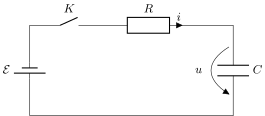
The RC charging circuit: closing K lets the source push charge through R onto the plates of C.
Theorem 30.5(Charging law of the RC circuit)
After the switch closes, the capacitorvoltage obeys, then follows from u(0)=0:
RCdtdu+u=E,u(t)=E(1−e−t/τ),τ=RC.
Proof.Voltages along the loop add (Proposition 12.4): E=uR+u=Ri+u at every instant; substitute i=Cdu/dt (Proposition 30.3). Now verify the candidate: du/dt=(E/τ)e−t/τ, so RC(E/RC)e−t/τ+E(1−e−t/τ)=E, true for all t; and u(0)=E(1−1)=0. That no other curve fits the equation and the start is proved in this year’s mathematics course on differential equations. ∎
Definition 30.6(Time constant)
The time constant of an RC circuit is τ=RC. Units: Ω×F=(V/A)(C/V)=C/A=s — the circuit’s own tempo.
Method 30.7(Reading τ on the curve)
Three equivalent readings, straight off a graph:
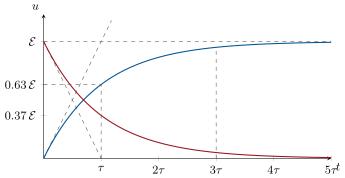
tangent at the origin:u′(0)=E/τ, so the initial tangent reaches the asymptote at t=τ;
63%:u(τ)=E(1−e−1)≈0.63E;
95%:u(3τ)≈0.95E — charged, for practical purposes (5τ: 99%).
Proposition 30.8(Discharge)
A capacitor charged to U0 and closed on a resistor R alone obeys RCdu/dt+u=0 and follows
u(t)=U0e−t/τ,τ=RC
— 37% left at τ, 5% at 3τ.
Proof. Same loop law, no source; substitution again: RC(−U0/τ)e−t/τ+U0e−t/τ=0, with u(0)=U0. ∎
Charge (blue, from u=0 toward E) and discharge (red, from U0=E). Both initial tangents meet their asymptote at t=τ; 63% done at τ, 95% at 3τ.
Example 30.9(A flash unit’s numbers)
A photo flash charges C=800µF through R=1.0kΩ: τ=103×8.0×10−4=0.80s, so the “ready” light — wired to trip at 95% — waits 3τ≈2.4s: the whine of the hook. Fired through the flash tube’s mere 0.50Ω, the samecapacitor empties with τ′=0.40ms: two thousand times faster out than in.
30.3 The coil: inductance and the RL circuit
Definition 30.10(Inductor and inductance)
An inductor is a coil of wire: its current threads its own turns with a magnetic field (Chapter 15); whenever it changes, a voltage appears across the coil:
u=Ldtdi.
The constant L is the inductance, in henries (H): 1H=1Vs/A.
Proof.Admitted at this level.∎
Remark 30.11(The coil resists change)
Why a changing current makes a voltage — induction — is derived in the university volumes; here we take the law and its character: the coilopposes changes of its current. Mirror twins: a capacitor’s u cannot jump, a coil’s i cannot jump.
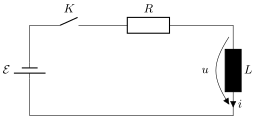
The RL circuit: after K closes, the coil lets the current climb only at its own pace τ=L/R.
Proposition 30.12(Current rise in an RL circuit)
Closing the switch on a source E, a resistor R and a coilL in series gives E=Ri+Ldi/dt, i.e.
RLdtdi+i=RE,solved byi(t)=RE(1−e−t/τ),τ=RL.
Proof. The loop law again; and it is the same equation as in Theorem 30.5 with u→i, E→E/R, RC→L/R — the same substitution verifies the solution, and every reading of Method 30.7 transfers. ∎
Example 30.13(An electromagnet wakes up)
A relay coil, L=0.30H and R=6.0Ω, on a 12V supply: final current E/R=2.0A, at the pace τ=0.30/6.0=50ms — awake in 3τ≈0.15s.
Remark 30.14(The spark at opening)
Open a switch on a live coil and i must crash to zero in a fraction of a millisecond: di/dt is huge and u=Ldi/dt reaches hundreds or thousands of volts — a spark jumps the contact. A car’s ignition coil does it on purpose, thousands of times a minute.
30.4 Stored energy
Proposition 30.15(Energy in a capacitor, energy in a coil)
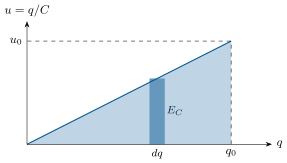
Proof. Landing a small charge dq on plates already at voltageu costs udq (Definition 12.3); stacking the costs, the total is the area under the line u=q/C — the triangle below — so EC=21qu=21Cu2. The same triangle for the coil (raising i by di costs Lidi) gives EL=21Li2. ∎
Each slice dq costs udq; the whole charge costs the triangle’s area EC=21q0u0 — the early coulombs board at low voltage.
Example 30.16(Energy orders of magnitude)
The flash capacitor of Example 30.9: 21×8.0×10−4×3002=36J. A 3000F supercapacitor at 2.7V: 1.1×10⁴J — an AA battery’s worth. A 10mHcoil at 10A: 0.50J. Less than batteries hold — but releasable in a millisecond.
Remark 30.17(What the two time-keepers are for)
Slow-in, fast-out powers the camera flash and the defibrillator. The delayτ=RC runs timing circuits: intermittent wipers, blinking beacons, stairwell lights. A capacitor across a supply smoothsvoltage (u cannot jump); a series coil smooths current (i cannot jump). And coil plus capacitor together make an oscillator (Chapter 31).
30.5 Exercises
Exercise 30.1★
A 470µFcapacitor is charged to 12V: what charge does it hold? What voltage would put 2.0mC on 100µF?
Solution
Solution of Exercise 30.1.
q=Cu=4.7×10−4×12≈5.6mC; u=q/C=2.0×10−3/10−4=20V.
Exercise 30.2★
Attribute 47pF, 2200µF and 10F among a power-supply smoother, a radio tuner and a supercapacitor; compute the last one’s energy at 2.7V.
Solution
Solution of Exercise 30.2.
47pF: radio tuner; 2200µF: smoother; 10F: supercapacitor. E=21×10×2.72≈36J.
Exercise 30.3★
The voltage across a 220µFcapacitor rises steadily from 0 to 5.0V in 10ms: what current flows in? What current once the voltage holds still, and why?
Solution
Solution of Exercise 30.3.
i=CΔu/Δt=2.2×10−4×5.0/0.010=0.11A. Then i=Cdu/dt=0: a charged capacitor is an open circuit — no steady current.
Exercise 30.4★
Compute τ for R=10kΩ, C=100µF, then for L=0.10H, R=50Ω. Check, unit by unit, that both combinations are seconds.
A capacitor charges toward 6.0V, passing 3.8V at t=2.0s. Read off the time constant; when is the charge 95% done?
Solution
Solution of Exercise 30.5.
3.8/6.0=0.63, so τ=2.0s; 95% at 3τ=6.0s.
Exercise 30.6★★
An RC circuit: E=9.0V, R=4.7kΩ, C=220µF. Compute τ, u(τ), u(3τ), and the current at the instant the switch closes.
Solution
Solution of Exercise 30.6.
τ=4700×2.2×10−4≈1.0s; u(τ)=0.63×9.0=5.7V; u(3τ)=0.95×9.0=8.6V; I0=E/R=9.0/4700≈1.9mA (empty capacitor: all of E sits across R).
Exercise 30.7★★
Verify by substitution that u(t)=E(1−e−t/RC) satisfies RCdu/dt+u=E; what do its value at t=0 and its large-t limit encode physically?
Solution
Solution of Exercise 30.7.
du/dt=(E/RC)e−t/RC, so RCdu/dt+u=Ee−t/RC+E(1−e−t/RC)=E. u(0)=0: the capacitor starts empty; u→E: fully charged, the current has stopped.
Exercise 30.8★★
A 100µFcapacitor charged to 12V discharges through 47kΩ: compute τ, u(τ), and the time for u to drop below 0.60V.
Solution
Solution of Exercise 30.8.
τ=4.7×104×10−4=4.7s; u(τ)=12e−1≈4.4V; 0.60V is 5%, reached at 3τ≈14s.
Exercise 30.9★★
The current in a 0.50Hcoil climbs steadily from 0 to 2.0A in 40ms: what voltage appears across it? With u=Ldi/dt, why does opening a switch on a coil spark, not closing?
Solution
Solution of Exercise 30.9.
u=LΔi/Δt=0.50×2.0/0.040=25V. Closing, i climbs at the circuit’s own pace, di/dt modest; opening forcesi to zero almost instantly, di/dt is huge and u reaches sparking values.
Exercise 30.10★★
The relay of Example 30.13: verify by substitution that i(t)=(E/R)(1−e−Rt/L) satisfies Ldi/dt+Ri=E, then compute i(τ) and i(3τ).
Solution
Solution of Exercise 30.10.
di/dt=(E/L)e−Rt/L, so Ldi/dt+Ri=Ee−Rt/L+E(1−e−Rt/L)=E. i(τ)=0.63×2.0=1.3A; i(3τ)=0.95×2.0=1.9A.
Exercise 30.11★★
Show that u′(0)=E/τ, and deduce that the tangent at the origin meets the asymptote at t=τ. On a recorded curve that gives τ=0.50s, with R=2.0kΩ: find C.
Solution
Solution of Exercise 30.11.
u′(t)=(E/τ)e−t/τ, so u′(0)=E/τ: the tangent u=(E/τ)t reaches E at t=τ. C=τ/R=0.50/2000=250µF.
Exercise 30.12★★★
Rank by stored energy, computing each: a 3000F supercapacitor at 2.7V; a flash capacitor, 800µF at 300V; a 10mHcoil at 10A; an AA battery (E≈1.3×10⁴J). What do the first three offer that the battery cannot?
Solution
Solution of Exercise 30.12.
Supercapacitor 21×3000×2.72≈1.1×10⁴J; flash 21×8.0×10−4×3002=36J; coil21×0.010×102=0.50J. Battery (1.3×10⁴J) > supercapacitor ≫ flash ≫coil — but all three can dump their energy in milliseconds: power, not energy.
Exercise 30.13★★★
A stairwell timer lights while u<0.63E across its charging capacitor, going dark at t=τ. Design the light to last 5.0s using C=100µF: what R? For a threshold 0.50E, show the delay is τln2 and compute it.
Solution
Solution of Exercise 30.13.
τ=5.0s, so R=τ/C=5.0/10−4=50kΩ. 1−e−t/τ=0.50 gives e−t/τ=0.50, t=τln2≈0.69τ=3.5s.
Exercise 30.14★★★
A 2200µFcapacitor smooths a supply: between recharges, it alone feeds a load drawing 0.50A for 10ms. From i=Cdu/dt, compute the voltage droop, then the capacitance keeping it under 0.50V.
Solution
Solution of Exercise 30.14.
Δu=iΔt/C=0.50×0.010/2.2×10−3≈2.3V. Need C≥iΔt/Δu=5.0×10−3/0.50=10mF.
Exercise 30.15★★★
An ignition coil, L=0.80H, carries 2.0A when the breaker cuts it off in about 1.0ms. Estimate the coilvoltage during the cut and the spark’s energy; why does a slow interruption give no spark?
Solution
Solution of Exercise 30.15.
u≈LΔi/Δt=0.80×2.0/10−3=1.6kV; EL=21×0.80×2.02=1.6J. Cut slowly, di/dt stays small, u stays a few volts: no spark.
30.6 Problem: The camera flash
Problem 30.1
Weekend problem — the camera flash: a two-second whine, a millisecond of glory, and the wall-mounted cousin that restarts hearts — one exponential runs them all
A compact flash unit stores energy in a capacitorC=800µF, charged through R=1.0kΩ from a converter modeled as an ideal source E=300V; the “ready” light trips at 95% of full voltage. Fired, the capacitor sees only the flash tube, Rf=0.50Ω. Data: an AA cell delivers 1.5V and 2.4Ah; e=1.60×10⁻¹⁹C.
After what time does the ready light turn green, and at what voltage? Recognize the two-second whine.
Compute the initial charging current; why does it then die away?
Part III — The millisecond of glory.
Write the discharge law u(t) through the tube and compute the new time constantτ′.
Compute the peak current through the tube.
Compute the peak power; compare it with a 2.2kW kettle.
Taking the flash as over at 3τ′, give its duration and average power.
Form the ratio of charging time to flash time: same capacitor, same charge — what changed, and what does that make a capacitor: an energy tank, or a power lever?
Part IV — The cousin on the wall. A defibrillator must deliver EC=200J at U0=1500V; chest and paddles present about 50Ω.
Compute the shock’s time constant and duration (3τ); compare with the flash.
Compute the peak current and peak power in the patient.
The recharge circuit must make the device ready (95%) in 6.0s: find the required charging resistance and the initial charging current — the numbers a designer would order.
Solution
Solution of Problem 30.1.
1.q=CU0=8.0×10−4×300=0.24C.
2.N=0.24/1.60×10−19=1.5×1018.
3.EC=21×8.0×10−4×3002=36J.
4.1.3×104/36≈360 times.
5. The cell stores plenty but delivers slowly; the capacitor turns modest energy into enormous power.
6.E=Ri+u with i=Cdu/dt: RCdu/dt+u=E.
7.du/dt=(E/RC)e−t/RC: Ee−t/RC+E(1−e−t/RC)=E for all t, and u(0)=0.
8.τ=RC=103×8.0×10−4=0.80s.
9. At 3τ=2.4s, u=0.95×300=285V — the two-second whine.
10.I0=E/R=0.30A; as u climbs, the remainder E−u across R shrinks, so i=(E−u)/R dies away.
11.u(t)=U0e−t/τ′ with τ′=RfC=0.50×8.0×10−4=0.40ms.
12.I0=U0/Rf=300/0.50=600A.
13.P0=U0I0=300×600=180kW — about 80 kettles at once.
14. Duration 3τ′=1.2ms; average power≈36/1.2×10−3=30kW.
15.2.4/1.2×10−3=2000. Only the resistance changed (1.0kΩ in, 0.50Ω out): a power lever.
16.C=2EC/U02=400/15002≈1.8×10−4F=180µF.
17.q=CU0=1.78×10−4×1500≈0.27C.
18.τ=50×1.78×10−4≈8.9ms, duration 3τ≈27ms — some twenty times the flash.
19.I0=1500/50=30A; P0=1500×30=45kW.
20.3τc=6.0s gives τc=2.0s, so Rc=τc/C=2.0/1.78×10−4≈11kΩ and I0=1500/1.12×104≈0.13A — ready in six seconds, on a tenth of an ampere.