High School Physics · Grades 10–12
28Mechanical Oscillators and the Measurement of Time
A grandfather clock ticks: each tick is a brass pendulum crossing the vertical, repeated fifteen million times since New Year. A quartz sliver in your watch flexes times a second; a cesium atom hums nine billion times faster. Everything that swings can keep time: this chapter follows the swinging, from Huygens to the satellites.
28.1 Free oscillations
Definition 28.1 (Oscillator, period, frequency, amplitude)
A mechanical oscillator is a system that, displaced from a stable equilibrium position and released, swings back and forth around it: these are free oscillations. The motion repeats after the period (); the frequency (, Chapter 20); the amplitude is the maximum displacement.
Example 28.2 (A zoo of oscillators)
A playground swing: . A guitar’s A string: . A quartz crystal: . The cesium oscillation defining the second: about . Ten orders of magnitude, one job: counting.
28.2 The simple pendulum
Definition 28.3 (Simple pendulum)
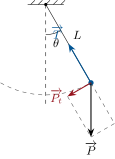
A simple pendulum: a small bob of mass on an inextensible wire of length and negligible mass, swinging in a vertical plane. Of the two forces on the bob (Chapter 25), the tension is perpendicular to the motion, while the weight’s component along the trajectory points back toward the lowest point: the weight is the restoring force, opposing the displacement.
Proposition 28.4 (Period of the simple pendulum)
For small amplitudes (below about ), the period is
It depends neither on the mass of the bob nor — while the angle stays small — on the amplitude: small swings are isochronous, all taking the same time.
Proof. Admitted at this level. ∎
Remark 28.5 (Dimensional analysis, and where the lives)
The formula can be guessed. From (), () and (), the only combination with the unit of a time is — and the mass cannot enter, no other datum carrying a kilogram to cancel it. Dimensions cannot give the pure number in front: the comes from solving the equation of motion, done in the Year 1 volume. Nor is the small-angle condition optional: at the true period is longer, and isochronism fails.
Example 28.6 (The seconds pendulum)
Which length beats the second, , one tick each way? Solving, . Nearly a meter: pendulum clocks are tall because seconds are long.
28.3 The spring–mass oscillator
Definition 28.7 (Restoring force of a spring)
A glider of mass slides on a horizontal frictionless rail, tied to a spring of stiffness (). Let be its displacement from equilibrium. Stretched or compressed, the spring pulls or pushes the glider back with the force : proportional to the displacement and opposed to it — a restoring force again, now supplied by elasticity.
Proposition 28.8 (Equation of motion and its solution)
Newton’s second law along the rail (Chapter 25) gives , i.e. . Whatever the constants and ,
satisfies this equation: oscillation with period , independent of the amplitude.
Proof. Differentiating, ; again, , which is exactly when . ∎
Remark 28.9 (All the motions there are)
That every motion of the glider is one of these functions is admitted, proved in the Year 1 volume. And no in : stiffer swings faster, heavier slower, the same on the Moon.
Definition 28.10 (Amplitude and phase)
In the positive constant is the amplitude — the extremes are — and is the phase, growing by each period; the initial phase records the start: released at rest from , . For instance on gives ; pulled to and released, in centimeters.
28.4 Energy, damping, resonance
Proposition 28.11 (Energy of the oscillator)
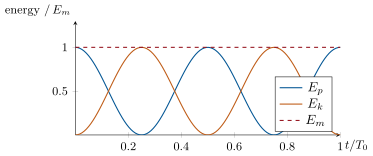
A spring stretched by stores the elastic potential energy (justified in Chapter 29). During frictionless oscillation the mechanical energy
is constant: all elastic at the extremes, all kinetic at equilibrium. The pendulum plays the same duet between and gravitational (Chapter 18).
Proof. With , the derivative of is by the equation of motion; the value is read at an extreme. ∎
Definition 28.12 (Damped oscillations)
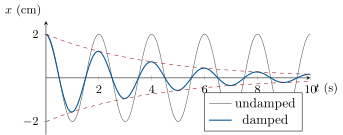
Friction drains mechanical energy from every real oscillator: its free oscillations are damped. Under light damping the system still oscillates, with a dying amplitude but a nearly unchanged repeat time, the pseudo-period, close to ; under heavy damping (honey) it creeps back to equilibrium without ever overshooting; the energy, proportional to amplitude squared, decays into heat.
Definition 28.13 (Forced oscillations and resonance)
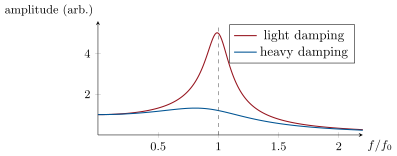
Push an oscillator periodically — forced oscillations — and after a brief transient it oscillates at the driving frequency , not its own. Its amplitude peaks when nears the natural frequency of the free oscillator: this is resonance, each push arriving in step with the motion, feeding in energy every cycle; the lighter the damping, the taller and sharper the peak.
Example 28.14 (Resonance for good and ill)
A parent pushing a swing pushes at its own frequency — resonance put to work. In the new Millennium Bridge in London swayed alarmingly when the crowd’s steps locked onto a natural frequency near ; it closed two years for dampers. Every quartz watch keeps its crystal singing by driving it at resonance, .
28.5 Measuring time
Method 28.15 (Timing a period)
Never time one oscillation: start the stopwatch as the bob crosses the vertical (fastest, easiest to judge), count oscillations, divide by — a reaction error becomes on . Repeat, and compare runs.
Example 28.16 (Three centuries of tick)
Huygens built the first pendulum clock in : isochronism took clocks from a quarter hour of drift per day to seconds, and compensated pendulums to fractions of a second per day. The quartz wristwatch () swapped the rod for a crystal flexing at : tenths of a second per month. Since the second itself is defined by an atomic oscillation: the duration of periods of the microwave radiation of an internal transition of cesium-133 (Chapter 34). The best cesium clocks drift one second in a hundred million years.
Remark 28.17 (Why chase the nanosecond)
A GPS receiver finds its position by timing radio signals from satellites; light travels per nanosecond, so a clock error of one microsecond misplaces you by . Satellites therefore carry atomic clocks — and at that precision the rate of a clock depends on how fast it moves and how high it sits, an effect we meet in Chapter 35.
28.6 Exercises
Exercise 28.1 ★
(a) Compute the period and frequency of a simple pendulum. (b) The length is quadrupled: what happens to the period?
Exercise 28.2 ★
A resting heart beats times per minute; a dragonfly’s wing at . Give the heart’s frequency and period, the wing’s period; which chapter word names the maximum chest rise per beat?
Exercise 28.3 ★
A glider rides a spring: compute and . What does doubling the mass do to the period?
Solution
Solution of Exercise 28.3.
, . Doubling : .
Exercise 28.4 ★
Successive maxima of a damped oscillator: , , , at , , , . Read the pseudo-period; show the amplitude falls by a fixed factor each period; predict the next maximum.
Exercise 28.5 ★
An astronaut carries a pendulum and a spring–mass oscillator to the Moon (). By what factor does each period change? Explain.
Solution
Solution of Exercise 28.5.
Pendulum: , so (slower). Spring–mass: unchanged — no in .
Exercise 28.6 ★★
(a) Check that has the dimension of a time. (b) Why can no formula for built from , , contain the mass? (c) Could this argument ever produce the ?
Solution
Solution of Exercise 28.6.
(a) ; its square root is a time. (b) The kilogram appears only in : nothing else could cancel it, so cannot enter. (c) Never: pure numbers like are invisible to dimensions.
Exercise 28.7 ★★
Verify by differentiating twice that satisfies if and only if .
Solution
Solution of Exercise 28.7.
, so . Equality with for all holds exactly when , i.e. .
Exercise 28.8 ★★
A spring of stiffness carries a glider with amplitude . Compute the mechanical energy and the maximum speed. Where is the speed maximal? Zero?
Solution
Solution of Exercise 28.8.
; — at ; zero at the extremes .
Exercise 28.9 ★★
(a) Compute the length of the seconds pendulum (). (b) Its length grows by : with , find the relative change of and the daily error.
Solution
Solution of Exercise 28.9.
(a) . (b) : — seven minutes slow per day.
Exercise 28.10 ★★
A lightly damped oscillator loses of its energy each period. (a) The amplitude drop per period? (b) How many periods to lose half the energy? (c) Is the pseudo-period far from ?
Exercise 28.11 ★★
Explain with the resonance curve: (a) why pushing a swing works only at its own rhythm; (b) why soldiers break step on footbridges; (c) why a washing machine shudders at one speed while spinning up.
Solution
Solution of Exercise 28.11.
(a) At each push arrives in step and adds energy; off the peak, pushes alternately help and hinder. (b) Marching in step is a periodic drive; near the bridge’s it would climb the resonance peak. (c) The drum sweeps through the frame’s natural frequency during spin-up: momentary resonance, then past the peak.
Exercise 28.12 ★★★
A pendulum clock, exact at sea level, moves to an observatory where . (a) Fast or slow? By how many seconds per day? (b) How much shorter must its pendulum be?
Solution
Solution of Exercise 28.12.
(a) : slow, by , i.e. per day. (b) at fixed : shorten by .
Exercise 28.13 ★★★
A glider obeys , with , . Compute the maximum speed, the maximum acceleration, the stiffness and the mechanical energy.
Solution
Solution of Exercise 28.13.
; ; ; .
Exercise 28.14 ★★★
To measure : a pendulum with makes oscillations in . Compute and its relative uncertainty (add those of and ); does the result agree with ?
Solution
Solution of Exercise 28.14.
; . Uncertainty , i.e. : the interval contains — consistent.
Exercise 28.15 ★★★
Compare timekeepers by relative drift (error over elapsed time): a pendulum clock losing per day, a quartz watch per month, a cesium clock per hundred million years: compute the three ratios. A GPS clock wrong by : position error? Which family does GPS need?
Solution
Solution of Exercise 28.15.
Pendulum ; quartz ; cesium . A error is of position: GPS needs the atomic family.
28.7 Problem: The Clockmaker’s Bench
Problem 28.1
Weekend problem — the clockmaker’s bench: a wall clock brought back to time — fifty swings timed, a brass rod that stretches in summer, the escapement’s whispered push, a quartz challenger — the verdict rendered in seconds per month
A pendulum wall clock arrives at the bench “running wrong”. Treat its brass rod and heavy bob as a simple pendulum of effective length , bob mass ; the gearing counts each full oscillation as exactly .
Part I — Taking the clock’s pulse.
- Why time oscillations rather than one? Estimate the error left on if your reaction time is .
- The stopwatch reads for oscillations: the period?
- Deduce the present effective length of the pendulum.
- What length would give exactly ? Should the rating nut raise or lower the bob, and by how much?
- Unadjusted, is the clock fast or slow, by how many seconds per day?
- Sensitivity to : the period on the Moon ()? The daily error at an observatory where ?
Part II — The summer slump. Brass expands: a warming stretches the rod to , per kelvin. The clock is adjusted at .
- Compute for a summer room at .
- Using , show that .
- Compute and the daily summer error: fast or slow?
- Same questions for a winter hallway at .
- Old precision clocks used “gridiron” pendulums mixing brass rods with steel ones (which expand about half as much) in alternating directions. Explain how this can hold the rate.
Part III — The whispered push. With the escapement disengaged, the swing, started at amplitude , halves its amplitude in ; in service, a tiny push from the escapement each period keeps constant.
- How many periods does the halving take?
- At the extreme the bob has climbed (radians): deduce and compute it (Chapter 18).
- Energy is proportional to amplitude squared: what fraction of is lost per period?
- Deduce the energy of each push, and the average power needed.
- The drive weight descends per week: is that enough energy, at what efficiency?
Part IV — The quartz challenger. A quartz movement oscillates at and drifts about per month; the restored pendulum still drifts per day.
- Compute the quartz period. Show : why is a power of two exactly what a watch circuit wants?
- Compute the relative drifts of quartz and restored pendulum, and each in seconds per month. Who wins, by what factor?
- The cesium standard — periods make one second — drifts per hundred million years: its relative drift? How many orders of magnitude below quartz, and why does GPS demand it?
- The verdict, one sentence with numbers: what does the restored clock earn on the wall, and who now owns the second?
Solution
Solution of Problem 28.1.
1. The reaction error is divided by : about on .
2. .
3. .
4. (the seconds pendulum): lower the bob, lengthening by .
5. Too short, so too quick: fast, by minutes per day.
6. Moon: — unusable. Observatory: : loses per day.
7. .
8. .
9. : per day, slow (longer rod, longer period).
10. : , gains per day.
11. Steel and brass expand differently; hung in alternating directions, the brass rods lower the bob while the steel ones raise it. Sized so the two shifts cancel, the effective length — and the rate — survives the seasons.
12. periods.
13. : .
14. Per period the amplitude shrinks by , the energy by : about of per period.
15. Push ; power — tens of microwatts.
16. A week is periods, needing ; the weight supplies : enough, at efficiency.
17. . : fifteen divide-by-two stages turn the crystal’s signal into an exact tick.
18. Quartz: . Pendulum: , i.e. per month. Quartz wins by a factor .
19. : nine orders of magnitude below quartz. GPS times signals to nanoseconds — of light travel each — so only atomic clocks will do.
20. Restored, the wall clock holds per month against the quartz’s : keep it for the chime, trust the quartz for the train — and the second itself now belongs to the cesium atom.