An infrared heat lamp can bathe your skin all evening and never mark it; ten minutes of thin mountain sunlight leaves a burn. The lamp delivers far more energy — but energy is not what marks skin. Light, this chapter shows, arrives in grains, and only a grain that hits hard enough does chemistry: one ultraviolet grain snaps a bond that a billion infrared grains only warm. Follow the grains and a century opens: metals leaking electrons, atoms singing in spectral lines, electrons interfering like waves.
34.1 Light arrives in grains: the photon
Definition 34.1(The photon)
Light of frequencyν exchanges energy with matter only in whole grains called photons, each of energy
E=hν=λhc,h=6.63×10⁻³⁴Js,
where h is Planck’s constant (Planck, 1900; Einstein, 1905) and λ the wavelength in vacuum. A beam’s intensity measures the number of photons per second; each grain’s energy is fixed by the frequency alone.
Notation 34.2(The electronvolt)
Atomic physics uses the electronvolt, 1eV=1.60×10⁻¹⁹J: the energy one elementary charge gains crossing 1V (Chapter 14). Handy: E(eV)≈1240/λ(nm).
One scale for the electromagnetic family (Chapter 22): wavelength (top), energy per photonhc/λ (blue), from radio grains of a microelectronvolt to the MeV gamma grains of Chapter 19 — yet a 1.0mW pointer pours 3×10¹⁵ grains per second: everyday light flows as smoothly as poured sand.
34.2 The photoelectric effect
Shine light on a clean metal plate in vacuum and electrons pop out — the photoelectric effect. Its rules broke classical physics.
Proposition 34.3(What the experiment shows)
For each metal there is a threshold frequencyν0:
below ν0, no electron leaves, however intense the light;
above ν0, emission starts without delay, however faint;
intensity raises the number of electrons per second, not their maximum kinetic energy; frequency raises Ek,max.
None of it fits a continuous wave, which any color should let charge up — over months in faint light (Exercise 34.14) — and whose intensity should set the electrons’ energy: all three predictions fail.
Proof.Admitted at this level.∎
Theorem 34.4(Einstein’s photoelectric relation)
An electron needs at least the work functionW0 of the metal to escape its surface. One photon is absorbed whole by one electron, so
hν=W0+Ek,max,hence ν0=hW0.
Proof.Energy bookkeeping: hν in, W0 spent on escape, the rest kinetic — at most hν−W0, less for electrons starting deeper. Below ν0 one grain cannot pay the exit toll, whatever their number. ∎
Definition 34.5(Stopping potential)
To measure Ek,max, a reverse voltage brakes the electrons (Chapter 14); the stopping potentialUs is the smallest voltage canceling the current: the fastest electrons just fail to cross, so Ek,max=eUs.
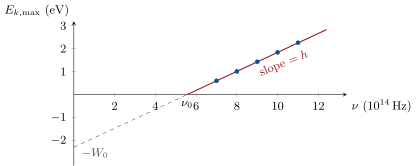
Measured Ek,max=eUs against frequency (sodium): a straight line of slope h, cutting the axis at ν0; extrapolated (dashes), it reveals −W0 at ν=0.
Plot Ek,max=eUs against ν: Einstein promises the straight line hν−W0.
Read the slope: it ish; the intercepts give ν0 and −W0.
34.3 Energy levels: why atoms emit lines
Definition 34.7(Energy levels)
The energy of an electron bound in an atom is quantized: restricted to a discrete ladder of energy levelsE1<E2<⋯<0, counted negative from the free electron. The lowest rung is the ground state, the others excited states; reaching 0 is ionization.
so E1=−13.6eV, E2=−3.40eV, E3=−1.51eV, E4=−0.85eV, crowding toward 0.
Proof.Admitted at this level.∎
Remark 34.9(Where the ladder comes from)
Why these numbers is quantum mechanics, kept for the university volumes — as is de Broglie’s formula: the electron’s matter wave (Definition 34.15 below) must close on itself around the nucleus, and only certain wavelengths fit — like a guitar string, an atom has a discrete set of notes.
Theorem 34.10(Photon of a transition)
An atom changes level only by emitting or absorbing one photon carrying exactly the difference: dropping from level p to a lower level n emits hν=Ep−En; climbing from n to p absorbs that same energy.
Proof.Energy conservation, one grain at a time: the photon is the only currency light accepts, and the atom’s books must balance. ∎
Remark 34.11(Line spectra explained)
Here is the answer promised by Chapter 2: a hot gas emits only the frequencies (Ep−En)/h of its own ladder — a barcode of bright lines — and a cool gas steals exactly those frequencies from white light, printing matching dark absorption lines. Each element has its own ladder, hence its own barcode — how we read starlight.
Example 34.12(The visible lines of hydrogen)
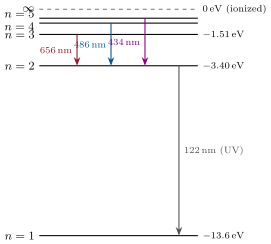
Transitions ending on n=2 fall in the visible. With E(eV)=1240/λ(nm): 3→2: 1.89eV, 656nm (red); 4→2: 2.55eV, 486nm (blue-green); 5→2: 2.86eV, 434nm (violet). Transitions to n=1 exceed 10eV: all ultraviolet.
The hydrogen ladder, to scale: the visible lines all end on n=2; the drop to the ground state is deep ultraviolet.
Remark 34.13(Lasers, in one breath)
A photon of exactly Ep−En passing an excitedatom can trigger it to emit an identical photon — same energy, same direction, in step. Keep more atoms up than down and one photon becomes an avalanche of clones: stimulated emission — and a laser is little more.
34.4 Matter waves
Proposition 34.14(Electrons interfere)
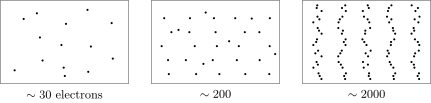
Send electrons one at a time through a double slit (Chapter 22): each lands as a single sharp dot — a particle. But as thousands accumulate, the dots draw interference fringes: each electron, alone, passes as a wave through both slits. Crystals diffract electron beams too (Davisson and Germer, 1927).
Proof.Admitted at this level.∎
One electron, one dot; thousands, fringes. Where the next dot lands is random — like one nucleus’s decay (Chapter 19) — but the wave fixes the probability: bright fringe, likely; dark, nearly never. Individual chance ruled by an exact wave: the heart of quantum physics.
Definition 34.15(De Broglie wavelength)
Every particle of momentump=mv travels as a matter wave of de Broglie wavelength
λ=ph=mvh.
Proof.Admitted at this level.∎
Example 34.16(Why you never diffract)
An electron accelerated through 100V has Ek=1.60×10⁻¹⁷J, p=2meEk=5.4×10⁻²⁴kgm/s, so λ≈0.12nm — the spacing of atoms in a crystal, which therefore acts as its double slit. A 58g tennis ball at 25m/s: λ=6.63×10⁻³⁴/1.45≈4.6×10−34m, some 1019 times smaller than a nucleus — no slit will ever show it fringing. h is so small that quantum graininess surfaces only at the atom’s scale.
Example 34.17(The electron microscope)
Diffraction forbids resolving detail much smaller than the wavelength used (Chapter 22): visible light stops near 0.5µm. Electrons at 10kV have λ≈12pm — tens of thousands of times shorter: electron microscopes image viruses, cell machinery, even single atoms. The matter wave handed physics a new eye.
34.5 Exercises
Exercise 34.1★
A green laser pointer emits 1.0mW at 530nm. Compute one photon’s energy in joules and electronvolts, then the photons per second.
Solution
Solution of Exercise 34.1.
E=hc/λ=1.99×10−25/5.30×10−7=3.75×10−19J=2.35eV. N=1.0×10⁻³/3.75×10−19≈2.7×1015photons per second.
Exercise 34.2★
An FM station broadcasts at 100MHz. Compute its photonenergy in eV and compare it to a visible photon: why is radio graininess undetectable?
Solution
Solution of Exercise 34.2.
E=hν=6.63×10−34×108=6.63×10⁻²⁶J≈4.1×10⁻⁷eV — about five million times less than a visible photon. Any detectable radio signal involves so many photons per second that the flow is perfectly smooth.
A photocell is lit above threshold. What happens to (a) the current, (b) the stopping potential, when the intensity is doubled at fixed frequency? When the frequency is raised? Which fact contradicts the wave picture, and why?
Solution
Solution of Exercise 34.7.
Intensity doubled: current doubles (twice the photons), Us unchanged (same energy per photon). Frequency raised: Us rises, Ek,max=hν−W0. The wave picture ties the electrons’ energy to the intensity, not the frequency — exactly what is not observed.
From n=1: 13.6eV, λ=1240/13.6≈91nm, far ultraviolet. From n=2: 3.40eV, λ≈365nm, near ultraviolet.
Exercise 34.9★★
White light crosses a jar of cool hydrogen (all atoms in the ground state). Explain why the transmitted spectrum shows no dark line in the visible, yet Balmer absorption lines appear in the spectra of hot stars.
Solution
Solution of Exercise 34.9.
From the ground state the smallest jump costs E2−E1=10.2eV (122nm): every absorption line is ultraviolet, none visible. In a hot stellar atmosphere collisions keep some atoms in n=2, from which visible Balmer photons (1.89 to 3.40eV) can be absorbed.
Exercise 34.10★★
Compute the de Broglie wavelength of (a) an electron accelerated through 100V, (b) a 0.10g fly at 1.0m/s. Compare each to the size of an atom (∼10−10m); conclude.
Solution
Solution of Exercise 34.10.
(a) Ek=1.6×10⁻¹⁷J, p=2meEk=5.4×10⁻²⁴kgm/s, λ=h/p≈1.2×10−10m — atom-sized: crystals diffract it. (b) p=1.0×10−4×1.0=1.0×10⁻⁴kgm/s, λ≈6.6×10⁻³⁰m — 1020 times smaller than an atom: the fly’s wave is forever invisible.
Exercise 34.11★★
A dark-adapted eye responds to about 90photons of 505nm light. Compute that energy, compare it to the kinetic energy of a 2.5mg mosquito flying at 0.50m/s, and interpret the ratio.
Solution
Solution of Exercise 34.11.
One photon: 1.99×10⁻²⁵/5.05×10−7=3.94×10−19J; ninety: ≈3.5×10⁻¹⁷J. Mosquito: 21×2.5×10−6×0.502=3.1×10⁻⁷J — 1010 times more. The eye works within a hundred grains of the absolute limit: almost a photon counter.
Exercise 34.12★★★
A photocell gives Us=1.19V at 405nm and Us=0.40V at 546nm. From these two points measure h, then the work function in eV. Which metal of this chapter is the cathode?
A hydrogen lamp shows lines at 486nm and 434nm. Convert each to a photonenergy and identify the two transitions by matching differences of the levels En=−13.6/n2eV.
Classical delay estimate: faint light of intensity 1.0×10⁻⁶W/m2 falls on potassium (W0=2.3eV). If an atom collected only the energy crossing its cross-section (radius 1.0×10⁻¹⁰m), how long would it need to gather W0? Compare with the observed delay (under 10−9s).
Solution
Solution of Exercise 34.14.
Cross-section πr2≈3.1×10⁻²⁰m2, collected power3.1×10−26W; t=3.7×10⁻¹⁹/3.1×10−26≈1.2×107s — four months, against under a nanosecond observed. The energy cannot be spread over the wavefront: it travels concentrated, in grains.
Exercise 34.15★★★
In an electron microscope the electrons are accelerated through 5.0kV. Compute their de Broglie wavelength, compare it to green light (550nm), and explain via diffraction (Chapter 22) why this buys resolution.
Solution
Solution of Exercise 34.15.
Ek=8.0×10⁻¹⁶J, p=2meEk=3.8×10⁻²³kgm/s, λ=h/p≈1.7×10−11m=17pm — about 3×10⁴ times shorter than 550nm. Diffraction blurs detail smaller than ∼λ, so shrinking λ by 104 buys 104 in resolution.
34.6 Problem: The Solar-Panel Physics Lab
Problem 34.1
Weekend problem — the solar-panel physics lab: the 1021 grains a rooftop drinks each second, a photocell that measures Planck’s constant, a hydrogen lamp read line by line — one weekend, one h
Your class instruments the school’s rooftop solar panel for a weekend. Data: solar irradiance at noon 1.0×10³W/m2; mean solar wavelength550nm; panel area 1.0m2, efficiency20%; the day delivers the equivalent of 5.0h of full sun.
Which part of the sunlight could eject electrons from this cathode — and which half of the spectrum is useless for it?
Compare your h to 6.63×10⁻³⁴Js: relative error in percent?
Part III — The hydrogen calibration lamp. The kit’s wavelength scale is checked against a hydrogen lamp, En=−13.6/n2eV.
Compute E2, E3, E4 and E5.
Compute the photon energies of the transitions 3→2, 4→2, 5→2.
Deduce the three wavelengths and give each line’s color.
Why does the lamp emit lines rather than a continuous rainbow? One sentence, naming the key idea.
Could the lamp’s hydrogen absorb light at 500nm? Justify with the ladder.
Part IV — Inspecting the cells: the electron wave. Micro-cracks in a cell lie far below the 0.5µm reach of light microscopes; the lab’s scanning electron microscope runs at 10kV.
Compute the electrons’ speed; check it stays below 0.25c (classical formula).
4. With 1021 grains per second, the statistical flicker is fantastically small: graininess averages into a perfectly smooth current, as sand poured fast pours like water.
5. Damage needs one grain of 3 to 4eV: ultraviolet grains qualify, infrared grains (∼0.1eV) never do — numbers cannot substitute for punch per grain.
6.Us is the reverse voltage that just stops the fastest electrons: eUs=Ek,max=hν−W0.
7.ν=c/λ: 8.22, 7.41, 6.88 and 5.49×10¹⁴Hz.
8.eUs=hν−W0 is affine in ν with slope h. Successive slopes: (0.94−0.37)/1.39=0.41 and (1.50−0.94)/1.34=0.42eV per 1014Hz — the three points align.
10. At 546nm: W0=hν−eUs=3.64×10⁻¹⁹−0.59×10−19=3.05×10⁻¹⁹J=1.90eV; ν0=W0/h=4.60×1014Hz; λ0≈653nm.
11. Only λ<653nm ejects: the violet-to-red visible and the ultraviolet. The whole infrared side — roughly half the Sun’s energy — is useless to this cathode.
12.(6.64−6.63)/6.63≈0.2% — a two-permille physics-lab measurement of a universal constant.
16. The atom’s energies are quantized, so it can only emit the discrete differences Ep−En: a ladder makes lines, not a rainbow.
17. No: 500nm means 2.48eV, which matches no level difference (E2 upward gives 1.89, 2.55, 2.86, 3.40eV; from E1 everything costs at least 10.2eV) — the gas is transparent there.
20. Gain =5.50×10⁻⁷/1.23×10−11≈4.5×104. The weekend’s two numbers: h=6.64×10⁻³⁴Js, measured to 0.2% with filters and a voltmeter, and a microscope forty-five-thousand times sharper because electrons wave.