A roller coaster has no engine past the first hill: every loop, every burst of speed afterwards is spent from the account opened on the way up. This chapter turns the bookkeeping into two numbers — kinetic and potential energy — and one rule: while only weightworks, their sum does not change. Friction is the fee; we will learn to read it off the books.
18.1 Kinetic energy
Definition 18.1(Kinetic energy)
A body of mass m (kg) moving at speed v (m/s) carries the kinetic energy
a pedestrian, 70kg at 1.4m/s: Ek=21×70×1.42≈69J;
a car, 1300kg at 130km/h=36.1m/s: Ek≈8.5×10⁵J;
a high-speed train, m=3.85×10⁵kg, at 320km/h=88.9m/s: Ek≈1.5×10⁹J;
a rifle bullet, 8.0g at 800m/s: Ek≈2.6kJ.
Seven orders of magnitude separate the stroll from the train. And Ek grows like the square of the speed: at 130km/h the car carries 4 times the energy it has at 65km/h — four times what its brakes must remove.
18.2 The kinetic-energy theorem
Theorem 18.3(Kinetic-energy theorem)
For a body of mass m moving along a straight line from A to B, the change of kinetic energy equals the total work (Chapter 17) received:
ΔEk=Ek(B)−Ek(A)=∑WAB(F),
the sum running over all forces acting on the body. It extends to motion along any path, as we also admit here.
Proof.Admitted at this level.∎
Example 18.4(Free fall, checked frame by frame)
A 0.200kg ball is dropped and filmed; the frames give:
t (s)
0.10
0.20
0.30
0.40
fallen height h (m)
0.049
0.196
0.441
0.785
speed v (m/s)
0.98
1.96
2.94
3.92
Ek=21mv2 (J)
0.096
0.384
0.864
1.54
W=mgh (J)
0.096
0.385
0.865
1.54
Starting from Ek=0, at every frame Ek matches the workmgh of the weight: ΔEk=W(P), i.e. v2=2gh — the theorem, verified to the precision of the readings.
Remark 18.5(Where the proof lives)
The general statement — valid along any path, not only a straight line — follows from Newton’s second law and a little calculus, both later in this book (Chapters 25 and 29); until then the free-fall check is our warrant, and we admit the curved-path version and use it freely.
18.3 Gravitational potential energy
Definition 18.6(Gravitational potential energy)
A body of mass m at altitude z, measured upward from a chosen reference level where z=0, stores the gravitational potential energy
Ep=mgz,g=9.81N/kg.
Remark 18.7(Only differences matter)
Moving from A to B changes Ep by mg(zB−zA)=−WAB(P): the opposite of the work of the weight (Chapter 17). The reference level is a free choice — floor, sea level, table top — shifting Ep everywhere by a constant that drops out of every difference. Put it where the numbers are simplest, and do not move it mid-problem.
Example 18.8(A book on a shelf)
A 1.2kg book sits 1.8m above the floor, itself 9.0m above the street. Reference at the floor: Ep=1.2×9.81×1.8≈21J; in the street: Ep≈127J. Falling to the floor releases 21J in both accounts.
18.4 Mechanical energy and its conservation
Definition 18.9(Mechanical energy)
The mechanical energy of a body is
Em=Ek+Ep=21mv2+mgz.
Theorem 18.10(Conservation of mechanical energy)
If the only force working on a body is its weight (no friction; other forces, like the reaction of a frictionless track, perpendicular to the motion), Em is conserved: for any two points A, B of the motion,
21mvA2+mgzA=21mvB2+mgzB.
Proof. By the kinetic-energy theorem, Ek(B)−Ek(A)=WAB(P)=mg(zA−zB)=Ep(A)−Ep(B): what Ek gains, Ep loses. ∎
Example 18.11(Water slide)
A child starts at rest atop a frictionless slide of height h=3.2m. Reference at the bottom: mgh=21mv2, so v=2gh≈7.9m/s (29km/h) — whatever the mass and whatever the shape of the slide: straight, curved or spiral, only the height drop enters.
Example 18.12(Pendulum)
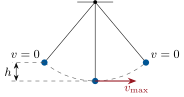
A pendulum bob is pulled aside until it rises h=12cm above its lowest point, then released. At the extremes v=0; at the bottom the whole mgh is kinetic, v=2gh≈1.5m/s; on the far side the bob climbs back to exactly 12cm.
The pendulum trades Ep for Ek and back: all potential at the extremes, all kinetic at the bottom, the same rise h twice.
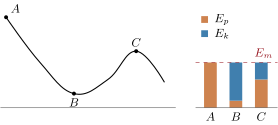
Energy bar chart of a frictionless coaster: at every position the Ep and Ek bars stack to the same total Em (dashed line).
Example 18.13(Ski jump landing speed)
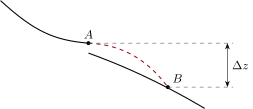
A ski jumper leaves the takeoff at vA=25m/s and lands Δz=40m lower. Neglecting air resistance, vB=vA2+2gΔz=625+785≈38m/s — no knowledge of the flight path needed.
Ski jump: whatever the curve flown from A to B, only the drop Δz enters the energy balance.
Proof. The kinetic-energy theorem now reads ΔEk=WAB(P)+WAB(f)=−ΔEp+WAB(f); move ΔEp across. Friction opposes the motion, so its work is negative. ∎
Example 18.16(Toboggan audit)
A child and sled (m=40kg) start at rest, drop h=5.0m along 12m of snow, and arrive at 7.0m/s instead of the frictionless 2gh≈9.9m/s. Reference at the bottom: ΔEm=21×40×7.02−40×9.81×5.0=980−1962=−982J. So W(f)=−982J over 12m: an average frictionforcef=982/12≈82N, and 982J of warmth in the runners and the snow.
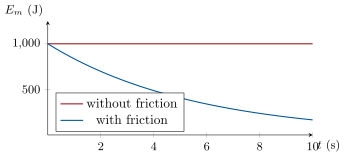
Em along a motion: level without friction, decreasing with it — the drop at each instant is the heat produced so far.
Method 18.17(Energy bookkeeping)
Choose a reference level and keep it; name A (data), B (question).
Write Em=21mv2+mgz at A and at B.
No friction: Em(A)=Em(B); solve — typically vB=vA2+2g(zA−zB).
Friction: Em(B)−Em(A)=−fℓ (ℓ = path length); solve for the unknown.
Check: the Ek/Ep bars stack to Em, level unless friction.
18.6 Exercises
Exercise 18.1★
Compute the kinetic energy of (a) a 90kg scooter and rider at 25km/h; (b) a 1200kg car at 130km/h. (c) By what factor does Ek change when the speed doubles? Triples?
A pendulum bob is released 8.0cm above its lowest point. Find its speed at the bottom and the height reached on the other side.
Solution
Solution of Exercise 18.5.
v=2×9.81×0.080≈1.3m/s; it rises back to 8.0cm (conservation).
Exercise 18.6★★
Using Example 18.2: by what factor does the train’s kinetic energy exceed the bullet’s? To what height could its own Ek lift the train (h=v2/2g)?
Solution
Solution of Exercise 18.6.
1.5×10⁹/2.6×103≈5.9×105: about six hundred thousand bullets. h=88.92/(2×9.81)≈4.0×102m — its own speed could lift the train 400 meters.
Exercise 18.7★★
Two frictionless slides drop from the same 3.0m platform, one straight and steep, one long and winding. Compare the arrival speeds (compute them) and the arrival times (no computation).
Solution
Solution of Exercise 18.7.
Same speed v=2×9.81×3.0≈7.7m/s (only the drop enters). The steep slide wins on time: it reaches high speed sooner and its path is shorter.
Exercise 18.8★★
A ball is thrown straight up at 12m/s. Find the maximum height reached, then the speed at 4.0m — on the way up and on the way down.
Solution
Solution of Exercise 18.8.
h=v2/2g=144/19.62≈7.3m. At 4.0m: v=144−2×9.81×4.0≈8.1m/s — the same both ways: Em depends on height, not on direction of travel.
Exercise 18.9★★
A ski jumper leaves the takeoff at 23m/s and lands 35m lower. Predict the landing speed without air resistance; is the real value larger or smaller, and why?
Solution
Solution of Exercise 18.9.
v=232+2×9.81×35=1216≈35m/s. Smaller in reality: air resistance dissipates part of Em.
Exercise 18.10★★
A 45kg sled starts at rest, drops 6.0m along 15m of slope, arriving at 8.0m/s. Find the mechanical energy lost, then the average frictionforce. Where did the energy go?
Solution
Solution of Exercise 18.10.
ΔEm=21×45×8.02−45×9.81×6.0=1440−2649≈−1.2×10³J; f=1209/15≈81N. Into heat, in the runners and the snow.
Exercise 18.11★★
Galileo’s peg: a pendulum released 15cm above its lowest point meets a peg blocking the upper half of the string at the vertical. Find the speed at the bottom and the rise beyond the peg; what does the peg change, and what not?
Solution
Solution of Exercise 18.11.
v=2×9.81×0.15≈1.7m/s; it rises to 15cm again. The peg changes the path (a tighter circle), not the energy: heights and speeds are untouched.
Exercise 18.12★★★
A skateboarder drops into a half-pipe from 2.5m; each traverse (side to side) dissipates 10% of the mechanical energy. Find the speed at the bottom of the first descent, then — computing the successive rise heights — the first traverse ending below 1.0m.
Solution
Solution of Exercise 18.12.
v=2×9.81×2.5=7.0m/s. Rise heights scale with Em, so ×0.9 each traverse: 2.25, 2.03, 1.82, 1.64, 1.48, 1.33, 1.20, 1.08, 0.97 — first below 1.0m on the 9th traverse.
Exercise 18.13★★★
From a 45m cliff top, a stone is thrown at 15m/s — upward, horizontally, or at any angle. Show that the landing speed is the same in all cases and compute it. What does depend on the angle?
Solution
Solution of Exercise 18.13.
Same initial Em=21m×152+m×9.81×45 whatever the angle, so the ground speed is v=225+2×9.81×45=1108≈33m/s. The angle fixes the direction of the landing velocity, the flight time and the range — not the landing speed.
Exercise 18.14★★★
An 80kg downhill skier starts at rest and descends 120m of drop along an 800m run, against a constant 65Nfrictionforce. Find the arrival speed and the fraction of Emdissipated.
Solution
Solution of Exercise 18.14.
21mv2=mgh−fℓ=80×9.81×120−65×800=94176−52000=4.22×10⁴J, so v=2×42176/80≈32m/s (117km/h). Fraction dissipated: 52000/94176≈55%.
Exercise 18.15★★★
A pumped-storage plant lifts V=2.0×10⁶m3 of water (1000kg per m3) through 300m. Compute the stored energy in joules and in kWh; turbined back at 85%efficiency (Chapter 9), how many homes drawing 10kWh per day does it feed for one day?
Solution
Solution of Exercise 18.15.
m=2.0×10⁹kg: Ep=2.0×109×9.81×300≈5.9×10¹²J=5.9×10¹²/3.6×106≈1.6×106kWh. Recovered: 0.85×1.64×106≈1.4×10⁶kWh — about 1.4×10⁵ homes for a day.
18.7 Problem: Designing the loop
Problem 18.1
Weekend problem — an energy audit of a roller coaster: the launch height a loop dictates, the speeds it promises, the friction confessed by two sensors, the brakes that close the account — the whole ride hanging from one number
A train of mass m=2.0×10³kg is released at rest from a launch hill of height H and coasts, engineless, through a vertical circular loop of radius R=8.0m whose top sits at height 2R. Circular-motion analysis (next year) supplies the one datum we borrow: at the loop top the train presses on the track only if vtop2≥gR. Parts I and II ignore friction.
Part I — The hill the loop dictates.
Compute the minimum safe speed at the top of the loop.
The brakes must stop it in d=45m: compute the required (constant) braking force.
Comfort check: compute the deceleration a=F/m; compare to g.
How much energy did track friction dissipate over the whole ride? Verify that friction+ brakes =mgH, to the joule.
Punchline, one sentence: which single number fixed the loop’s safety, every speed, the friction bill and the brake force — and what was the price of ignoring friction?
4.vtop=2g(H−2R)=2×9.81×8.0≈12.5m/s; vtop2/(gR)=2.0 — twice the minimum.
5. Every energy is proportional to m, so m cancels: same speeds and same safety, full or empty.
6.v=2×9.81×24≈21.7m/s≈78km/h.
7.v=2×9.81×(24−8.0)≈17.7m/s.
8.mgH=4.71×10⁵J. (Ep,Ek): launch (4.71×105,0); bottom (0,4.71×105); side (1.57×105,3.14×105); top (3.14×105,1.57×105) — each pair sums to 4.71×10⁵J.
9.v=2×9.81×(24−12)≈15.3m/s.
10.v(z)=2g(H−z): fastest at the lowest point of the track, slowest at the top of the loop.
11. Same height, so ΔEp=0 and ΔEm=ΔEk=21×2000×(19.22−20.42)≈−4.75×10⁴J: the placement makes the deficit pure kinetic, read off two speedometers.
12.W(f)=−4.75×10⁴J; f=4.75×10⁴/60≈7.9×102N.
13.Thermal energy, in the wheels, the rails and the air.
14.Em at the first sensor: 4.16×10⁵+3.9×104=4.55×10⁵J; loss 4.75×10⁴/4.55×105≈10% per 60m. At Hmin the top of the loop is reached exactly at gR; any loss drops it below the safety speed.
15. Losing ≈10% per 60m, about 15% of mgH (≈7.1×10⁴J) is gone: Em≈4.00×10⁵J, still above the required 3.92×10⁵J — safe, with only 2% to spare. The margin was no luxury.
16.Ek=21×2000×18.02=3.24×10⁵J.
17.F=3.24×10⁵/45=7.2×103N.
18.a=7200/2000=3.6m/s2≈0.37g: firm but comfortable.
20. The launch height H=24m fixed the loop’s safety, every speed 2g(H−z), the friction bill and the brake force; the price of ignoring friction is the margin — the 4m of hill that the rubbing world quietly consumes.