High School Physics · Grades 10–12
35Special Relativity: Time Dilation
Every GPS satellite carries an atomic clock good to one second in three million years — and before launch, engineers deliberately detune it: left honest, it would gain 38 millionths of a second per day, and by tomorrow evening your phone would place you eleven kilometres from where you stand. The clock is not at fault — time itself ticks differently for the moving and the still: this chapter follows Einstein from one stubborn fact to that conclusion.
35.1 One speed refuses to add
Speeds depend on the frame and compose by addition (Chapter 5): a passenger walking at toward the front of a train doing passes the trackside observer at .
Definition 35.1 (Inertial frame)
An inertial frame is a reference frame (Chapter 5) in which a force-free body keeps a constant velocity: the ground, near enough, and every frame in uniform straight-line motion relative to it.
Push the rule to the extreme: the train’s headlight beam should pass the ground observer at . In 1887 Michelson and Morley compared the speed of light along and across the Earth’s orbital rush, hunting such differences; to exquisite precision they found none — the same in every direction, in every season. Einstein, in 1905, believed the experiment and rebuilt time and space around it, on two postulates judged by their consequences — tested for a century now without a single failure.
Theorem 35.2 (The postulates of special relativity)
- Relativity principle: the laws of physics take the same form in every inertial frame; none is “truly at rest”.
- Invariance of : light in vacuum travels at in every inertial frame, whatever the motion of source or observer.
Proof. Admitted at this level. ∎
35.2 Farewell to “the same instant”
Proposition 35.3 (Relativity of simultaneity)
Two events simultaneous in one inertial frame are, in general, not simultaneous in another: “now, everywhere” is frame-dependent.
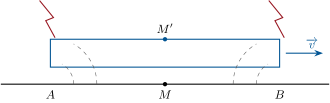
Proof. Einstein’s train. Two lightning bolts strike the two ends of a moving train, scorching the track. The platform observer , midway between the marks, receives the two flashes together; each crossed the same distance at the same speed , so the strikes were simultaneous. The passenger , midway along the train, rides toward the front flash, which reaches him first; but in his frame too both flashes covered equal distances (half a train) at the same speed — second postulate! — so the front strike happened first. Each verdict is correct in its own frame; the disagreement, nanoseconds for a train, is why no one had noticed. ∎
35.3 The light clock and the factor
Definition 35.4 (Event, proper time)
An event is a happening at one place and one instant — a tick, a flash, a decay. When a single clock is present at two events, the interval it reads between them is the proper time . A frame in which that clock moves measures a generally different interval .
Theorem 35.5 (Time dilation)
A clock moving at constant speed through an inertial frame is measured there to run slow: between two events at the clock,
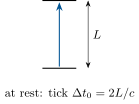
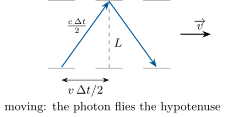
Proof. Build the simplest clock imaginable: two facing mirrors a distance apart, a photon bouncing between them; one round trip is one tick, and at rest a tick lasts . Now bolt the clock to a ship crossing at speed , mirrors perpendicular to the motion, and time one tick from the ground: while the photon climbs, the mirrors slide sideways, so the photon flies a slanted path — two motions at once, like the projectile of Chapter 24. If the tick lasts , each half-tick advances horizontally and vertically; and — the crucial step — the second postulate fixes the photon’s ground speed at , so the slanted half-path measures . Pythagoras:
And any clock riding beside it — wristwatch, heartbeat, decaying nucleus — must stay in step, or the comparison would betray the ship’s motion and violate the first postulate. ∎
Example 35.6 (Gamma in numbers)
| 0.01 | 0.1 | 0.5 | 0.8 | 0.9 | 0.99 | 0.999 | |
| 1.00005 | 1.005 | 1.155 | 1.667 | 2.294 | 7.09 | 22.4 |
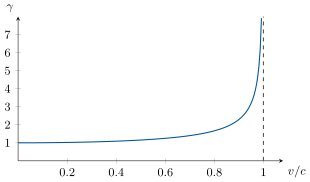
Nothing happens for pages, then everything: hugs up to a third of light speed, passes near , and blows up as .
Remark 35.7 (Why daily life never noticed)
For , write : since and , we get . A car at has (one second lost per four million years of driving); a jet manages , one second per ninety thousand years aloft. Our clocks were simply too coarse.
35.4 The verdict of experiment
Example 35.8 (Muons reach the ground)
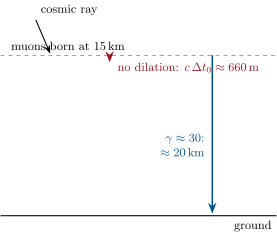
Cosmic rays striking the upper atmosphere create muons — short-lived particles of proper lifetime — about up, moving at nearly . Without relativity a muon covers per lifetime: the descent takes some lifetimes, and the surviving fraction should make sea-level muons vanishingly rare. Yet detectors count about one per square centimetre per minute. Time dilation resolves it: arriving with , the muons live on our clocks — range , the whole atmosphere.
Confirmations pile up. In 1971 Hafele and Keating flew caesium atomic clocks (Chapter 28) around the world on airliners; on landing they differed from ground clocks by the predicted fractions of a microsecond. Accelerators bank on dilation daily, their particles boosted to in the thousands surviving laps they could never classically complete. And GPS is a running experiment with a price tag.
Remark 35.9 (The relativity bill of GPS)
A GPS satellite orbits at about , so special relativity slows its clock by some per day. Gravity, weaker at altitude, works the other way and wins: general relativity (Einstein’s theory of gravitation, told in the university volumes) speeds it by about per day; net, per day fast. Positioning converts clock readings to distances at speed : an uncorrected day would smear positions by — hence the detuned clocks of the opening paragraph.
Proposition 35.10 (Length contraction)
A body of length in its rest frame is measured shorter along its direction of motion in a frame where it moves at speed : .
Proof. Admitted at this level. ∎
Remark 35.11 (The muon’s own story)
Length contraction is time dilation’s flip side (derived honestly in the university volumes): the muon’s clock ticks normally in its own frame, but the atmosphere rushing up is contracted to , crossed well within — both frames agree the muon reaches the ground.
35.5 Mass, energy, and the classical world regained
Theorem 35.12 (Mass–energy equivalence)
A body of mass possesses, by its mass alone, the energy
Mass is a concentrated form of energy; energy, conversely, has mass.
Proof. Admitted at this level. ∎
Remark 35.13 (Where you have met it)
This is the ledger behind nuclear energy (Chapter 33): the mass defect of a reaction, times , is the energy released. One gram of mass is — a full day’s output of a large power station. The honest derivation belongs to the university volumes; the reactors and the stars run on it regardless.
Remark 35.14 (Newton was not wrong)
Set : , times agree, lengths uncontract, simultaneity turns absolute — the mechanics of the last three years reappears, intact, as the low-speed limit. Relativity did not demolish Newton; it drew the boundary of his empire. That is how physics grows: by refining theories, each new one handing back the old as a limiting case.
35.6 Exercises
Exercise 35.1 ★
Compute , to three significant figures, for , , , .
Solution
Solution of Exercise 35.1.
: (); (); (); ().
Exercise 35.2 ★
A ship cruises at ; its metronome beats every by the ship’s clock. What interval does the ground measure? Which is the proper time, and why?
Solution
Solution of Exercise 35.2.
, so the ground measures . The ship’s is the proper time: the metronome (one clock) is present at both beats.
Exercise 35.3 ★
At what speed (as a fraction of ) is ? And ?
Solution
Solution of Exercise 35.3.
: gives ; gives .
Exercise 35.4 ★
A car drives at . Compute , then (Remark 35.7); how long must it drive for its clock to fall behind?
Solution
Solution of Exercise 35.4.
, ; . One second lost after — about four million years of driving.
Exercise 35.5 ★
In Einstein’s train experiment, explain — citing the postulate used — why the passenger concludes the front strike came first, and why neither observer is mistaken.
Solution
Solution of Exercise 35.5.
The passenger rides toward the front flash, so it reaches him first; by the second postulate both flashes travel at the same over the equal half-train distances in his frame, so an earlier arrival means an earlier strike. Simultaneity is frame-dependent: each verdict is correct in its own frame.
Exercise 35.6 ★★
Charged pions live . A beam leaves an accelerator at . Compute , the lifetime in the lab, the classical range , and the actual mean range.
Exercise 35.7 ★★
From the curve, read the speeds giving and (check by computation). What does the vertical asymptote at say about accelerating a massive body?
Solution
Solution of Exercise 35.7.
at ; at . The asymptote: (and the energy cost of further speed) diverges as — no finite effort brings a massive body to light speed.
Exercise 35.8 ★★
A light clock has mirrors apart. Compute its tick at rest, then its tick as measured from the ground when it cruises at .
Solution
Solution of Exercise 35.8.
; at , , so .
Exercise 35.9 ★★
Who measures the proper time between: (a) two ticks of a wristwatch — the wearer, or a passer-by? (b) birth and decay of a muon — the muon, or the lab? (c) leaving Earth and reaching Mars — pilot, or mission control?
Solution
Solution of Exercise 35.9.
Proper time belongs to the clock present at both events: (a) the wearer; (b) the muon; (c) the pilot — only the ship is at both the departure and the arrival.
Exercise 35.10 ★★
The space station orbits at . Compute , then by how much an astronaut’s clock trails a ground clock after six months ().
Solution
Solution of Exercise 35.10.
; over the astronaut trails by — about five milliseconds younger.
Exercise 35.11 ★★
Compute the energy content of of matter. Compare it with the daily output of a power station, and with the kinetic energy of a car at .
Solution
Solution of Exercise 35.11.
. A station delivers per day — one gram is one day of its output, and : a hundred million speeding cars.
Exercise 35.12 ★★★
Show from that ; deduce the speed of the muons, to five significant figures in units of .
Solution
Solution of Exercise 35.12.
Square and invert: , so , hence . For : .
Exercise 35.13 ★★★
Retell the muon’s journey from its own frame: how thick is the atmosphere at , how long does it sweep past at , and does that fit within one proper lifetime?
Solution
Solution of Exercise 35.13.
Contracted thickness ; sweep time . Both frames agree the muon reaches the ground — one blames a stretched lifetime, the other a shrunken atmosphere.
Exercise 35.14 ★★★
A linear accelerator pushes electrons to along a tube. How long does the trip take in the lab? How long in the electron’s frame, and how “long” is the tube there?
Solution
Solution of Exercise 35.14.
Lab: (speed ). Electron frame: tube contracted to , crossed in .
Exercise 35.15 ★★★
Proxima Centauri lies light-years away (a light-year is the distance light covers in a year). A probe cruises there at : how long does the trip take on Earth’s calendar, and on the probe’s clock?
Solution
Solution of Exercise 35.15.
Earth: . With , the probe’s clock logs .
35.7 Problem: The Muon and the Twin
Problem 35.1
Weekend problem — the muon’s journey and the astronaut’s twin: a particle outliving its clock, a light clock rebuilt, a traveler younger than her twin, and the bookkeeping that keeps GPS honest
Data: muon proper lifetime ; muons born about up at nearly ; sea-level flux about one muon per per minute; .
Part I — The muon’s impossible arrival.
- Without relativity, how far does a muon travel in one lifetime?
- How many lifetimes does the descent then take?
- After lifetimes a fraction survives: estimate it, confront the measured flux, and pass verdict on classical physics in one sentence.
- These muons in fact arrive with . Compute their lifetime as measured from the ground and the resulting range.
- Compute their speed, using , to five significant figures in units of .
Part II — The light clock, rebuilt. A light clock () rides a ship at .
- Compute the tick read on board.
- Seen from the ground, a tick lasts : give the horizontal advance per half-tick, the photon’s vertical climb, and — naming the postulate that fixes it — the slanted half-path’s length.
- Apply Pythagoras to the half-tick triangle and solve for , showing that .
- Compute and numerically.
- Which observer measures the proper time between two ticks? Justify from the definition.
Part III — The traveler and her twin. An astronaut leaves her twin on Earth for a round trip at ; Earth clocks time the whole trip at .
- Compute at (exact fraction, then decimal).
- How much time elapses on the astronaut’s clock?
- How far out (Earth frame, in light-years) did the turnaround lie?
- What is the age difference on reunion, and which twin is younger?
- “But motion is relative — the astronaut could claim Earth did the traveling!” Resolve the objection in one sentence.
Part IV — The GPS bill. A GPS satellite orbits at radius , period .
- Compute its orbital speed .
- Compute .
- Deduce, in microseconds, how far the satellite clock falls behind ground clocks per day ().
- If this drift alone went uncorrected, positions err by (drift): compute the error after one day.
- Gravity, weaker at altitude, runs the clock fast by per day (general relativity): compute the net drift and the daily position error in kilometres — the number that obliges engineers to detune every GPS clock.
Solution
Solution of Problem 35.1.
1. .
2. lifetimes.
3. : fewer than one muon in ten billion should arrive, yet the flux is one per per minute — classical physics is flatly contradicted by the sky.
4. Ground lifetime ; range : the arrival is explained.
5. .
6. .
7. Horizontal ; vertical ; the slanted half-path measures because the second postulate fixes the photon’s speed at in the ground frame too.
8. gives , so .
9. ; .
10. The ship’s: its one clock is present at both ticks, so it reads the proper time; the ground needs two synchronized clocks.
11. .
12. .
13. Outbound at : light-years.
14. : the astronaut is four years younger than her twin.
15. The situation is not symmetric: only the astronaut turns around — she accelerates and changes inertial frame, while the Earth twin stays in one — so only her clock logs the shorter time.
16. .
17. .
18. per day slow.
19. of position error per day.
20. Net drift per day fast; error per day — the relativity bill that every GPS clock pays in advance, detuned on the ground so it ticks true in orbit.
Here ends the physics of school — not the physics. In the university volumes, mechanics returns armed with calculus; electricity and magnetism reveal themselves as one structure in which light, and relativity itself, was hiding all along; the quantum world, glimpsed last chapter, becomes a working theory of matter. Each theory will be obliged, like relativity, to hand back what you now know as a limiting case. Carry it forward: it is the part that will not change.