High School Physics · Grades 10–12
26Free Fall and Projectile Motion
Every jet of a garden hose draws the same curve in the air. So does a basketball arcing toward the hoop, a long jumper, a cannonball: any body abandoned to its weight. This chapter earns that curve — a parabola — from Newton’s second law in two lines of calculus, reads apex, flight time and range off its equation, then lets the air back in to see what it spoils.
26.1 Free fall
Definition 26.1 (Free fall)
A body is in free fall when the only force acting on it is its weight : no support, no string, air resistance negligible. A dropped stone or a ball that has left the hand is, to good accuracy, in free fall — “fall” includes rising.
Theorem 26.2 (Galileo’s law of free fall)
In free fall, all bodies share the same acceleration, whatever their mass:
directed straight down: the field strength of Chapter 4 in its other outfit, .
Proof. Newton’s second law (Chapter 25) with the weight as only force: , and the mass cancels. Hammer and feather differ only through the air. ∎
Proposition 26.3 (Vertical fall from rest)
Dropped from rest, with the fallen depth counted downward from the release point, a body in free fall obeys
Proof. is the antiderivative of the constant vanishing at (Chapter 24); that of vanishing at . ∎
Example 26.4 (Orders of magnitude)
After , , seconds of free fall: , , (, , ) and , , . From a rooftop: , arriving at . Times grow like — and past a few seconds the air refuses to stay negligible (last section).
Example 26.5 (Vertical throw)
Thrown straight up at , axis upward from the hand: the same two antiderivatives give and . The apex, where , comes at , height — the energy answer of Chapter 18 run backward; thrown down, flips sign. For : apex at , back at , at .
26.2 The projectile: one law, two antiderivatives
Definition 26.6 (Projectile)
A projectile is a body launched with a velocity and then left in free fall. Axes at the launch point: horizontal in the vertical plane of , vertical upward; the launch angle of above the horizontal fixes its coordinates .
Theorem 26.7 (Equations of motion)
A projectile launched from the origin with speed and angle has at every instant, hence
Proof. Newton’s second law gives . Antiderivatives axis by axis: from with initial value , then position from , from . ∎
Proposition 26.8 (Independence of the two motions)
The horizontal motion is uniform — never changes — and the vertical motion is exactly the vertical throw of the previous section: neither equation mentions the other’s coordinate. In particular, a ball fired horizontally and a ball dropped at the same instant from the same height stay level with each other — they land together.
Proof. In Theorem 26.7, involves only , only and ; both balls have , so both obey . ∎
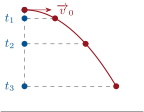
Remark 26.9 (The falling monkey)
A zookeeper aims a dart straight at a monkey, who lets go of its branch at the shot. Bad move: dart and monkey each drop below their no-gravity positions — the aiming line, the branch — so they meet exactly, whatever the dart’s speed (Exercise 26.15).
26.3 The parabola, read in full
Theorem 26.10 (Trajectory)
Eliminating between and : the trajectory of a projectile () is the downward-opening parabola
Proof. , substituted into of Theorem 26.7. ∎
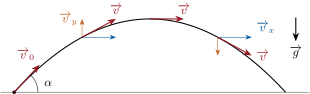
Definition 26.11 (Range)
For a projectile over level ground, the range is the horizontal distance covered when it returns to its launch height; the time of flight is that trip’s duration.
Proposition 26.12 (Apex, flight time, range)
Over level ground, with :
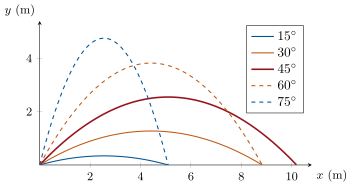
The range is greatest at , where ; complementary angles and give the same range.
Proof. gives : launch, and . The apex, , sits at ; substitute into . Then . The sine peaks at , and . ∎
Example 26.13 (Goal kick)
A goalkeeper strikes at , : ; real clearances land nearer — the air’s cut.
Method 26.14 (Projectile bookkeeping)
- Axes at the launch point, horizontal, up; coordinates of .
- Check free fall (weight only): then ; antiderivatives twice, initial conditions each time.
- Question about a place: eliminate (trajectory). About an instant: keep .
- Dictionary: apex ; launch height ; wall at ; floor below .
- Sanity: flight symmetric about the apex; ; air only ever shortens.
26.4 What the air changes
Definition 26.15 (Terminal speed)
Air resistance opposes the velocity and grows with speed. A falling body therefore accelerates only until drag balances weight; from there : it falls at a constant terminal speed.
Example 26.16 (Terminal orders of magnitude)
A flat-out skydiver: about (). A raindrop: about — in vacuum, of fall would deliver it at . A feather: about , reached within centimeters — the secret of its slowness: it spends its whole fall at terminal speed; the hammer never gets near its own.
Remark 26.17 (Real ballistics)
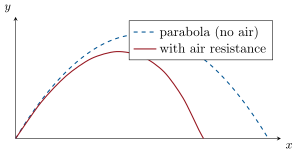
Drag pushes against the velocity all along the flight: the range shortens, the apex lowers, and the symmetry breaks — the descent steeper than the climb, long shots visibly short of the parabola. The honest, quantitative treatment is a differential equation solved in the Year 1 volume; this year, the parabola is the right model for dense, moderately fast projectiles — a basketball at , not a golf ball at .
26.5 Exercises
Exercise 26.1 ★
A stone dropped from a bridge hits the water later: height of the bridge, and impact speed in and ?
Solution
Solution of Exercise 26.1.
; .
Exercise 26.2 ★
On the Moon, an astronaut dropped a hammer and a feather together: they landed together. Why — and why does the feather lose so badly on Earth?
Solution
Solution of Exercise 26.2.
No air on the Moon: both in free fall, gives for any mass. On Earth, drag on the feather is comparable to its tiny weight: it rides at a terminal speed of about while the hammer barely notices the air.
Exercise 26.3 ★
Neglecting air, compute fall time and arrival speed from , , . How do the times grow with the height?
Solution
Solution of Exercise 26.3.
, , ; , , . Times grow like : in height is only in time.
Exercise 26.4 ★
A ball is thrown straight up at : apex height and time, total time back to the hand, and return speed?
Solution
Solution of Exercise 26.4.
at ; back at , at again (symmetry).
Exercise 26.5 ★
A marble rolls off a table of height at . Find the fall time and the landing distance from the edge. Does the fall time depend on the marble’s speed?
Solution
Solution of Exercise 26.5.
; . No: the fall time belongs to the vertical motion alone (independence).
Exercise 26.6 ★★
From the five-angle figure of the course: which pairs of launch angles share their range, and which angle wins? For a range below the maximum, which of the two possible angles flies longer? Justify with .
Solution
Solution of Exercise 26.6.
and share their range; wins. The steeper of a complementary pair flies longer: grows with .
Exercise 26.7 ★★
From a balcony a ball is thrown straight down at . Find the time to the ground and the impact speed; check the latter with an energy balance (Chapter 18).
Exercise 26.8 ★★
A projectile leaves level ground at , : time of flight, apex height and range?
Solution
Solution of Exercise 26.8.
; ; .
Exercise 26.9 ★★
Model a long jumper as a projectile: takeoff at , . Compute the range; champions jump nearly — name two ingredients the point model leaves out.
Solution
Solution of Exercise 26.9.
. Left out: the center of mass takes off high (extended body) and lands low and far forward (legs thrown ahead), and the jumper is no point — the missing live in that geometry, not in the parabola.
Exercise 26.10 ★★
At above flat ground, one bullet is dropped and an identical one fired horizontally at . Which lands first? Compute the fall time and the fired bullet’s landing distance. What principle is tested?
Solution
Solution of Exercise 26.10.
Together: both have , so the same ; the fired one lands away. It tests the independence of horizontal and vertical motions.
Exercise 26.11 ★★
Show algebraically that and share their range, then find the two angles landing a projectile away.
Solution
Solution of Exercise 26.11.
: same . Here : or .
Exercise 26.12 ★★★
Water leaves a garden hose at : greatest horizontal reach? greatest vertical height? the two nozzle angles watering a flowerbed away?
Solution
Solution of Exercise 26.12.
(at ); (straight up). : or .
Exercise 26.13 ★★★
A ball is kicked from the ground at , , toward a hedge away. Using the trajectory equation, decide whether it clears, and by how much.
Solution
Solution of Exercise 26.13.
: it clears the hedge by about .
Exercise 26.14 ★★★
An skydiver falls flat at terminal speed . (a) The drag force? (b) Sketch the shape of from the jump. (c) A raindrop falls from : vacuum arrival speed vs. its real ?
Solution
Solution of Exercise 26.14.
(a) Drag balances weight: . (b) rises with ever-smaller slope and levels off at . (c) Vacuum: , twenty times the real — raindrops spend nearly the whole fall at terminal speed.
Exercise 26.15 ★★★
The falling monkey, proved: a dart leaves the origin aimed exactly at a monkey at distance , height (), who drops at . Show that when the dart reaches its height equals the monkey’s — whatever .
Solution
Solution of Exercise 26.15.
At the dart is at height , exactly the dropped monkey’s . Both hang below their no-gravity spots — they meet for any .
26.6 Problem: The Basketball Buzzer-Beater
Problem 26.1
Weekend problem — the basketball buzzer-beater: a free throw dissected arrow by arrow, fingertips cleared by centimeters, a full-court heave weighed against what an arm can give, a lob over the backboard — and a verdict on the most theatrical shot in sport
The rim of a basketball hoop is a horizontal ring above the floor; Nora releases every shot at , so with axes at the release point ( horizontal toward the hoop, up) the rim center sits above the origin. Air is neglected except where stated.
Part I — The free throw. Nora shoots from (horizontal) with launch angle .
- What forces act once released? Give , citing the law used.
- Derive the coordinates of .
- Derive and .
- Eliminate to obtain the trajectory .
- The ball must pass the rim center, : solve for , in and .
Part II — Over the fingertips, into the ring.
- How long does the ball take to reach the rim?
- Find the apex time and height; check the ball is already descending at the rim.
- A defender in front of Nora stretches fingertips to . By how much does the ball clear them?
- Compute and at the rim, the speed there, and the angle of the velocity below the horizontal.
- Why must a ball arrive descending — and why steep?
Part III — The full-court heave. Buzzer about to sound, Nora is from the far rim.
- The rise is small against : justify a level-ground model, and derive the time of flight from .
- Deduce and the angle of greatest range.
- Compute the needed to cover at .
- A strong player can hurl a basketball at about . What is her maximum range — is the shot humanly feasible?
- At , find the two angles landing the ball away, and their flight times: with on the clock, which one beats the buzzer?
Part IV — The lob over the backboard. From behind the baseline Nora lobs: release from the rim center, ; the board’s plane crosses her shot before the rim center, top edge above the floor.
- Find the that drops the ball through the rim center.
- Compute the ball’s height at the board’s plane (): does it clear the top edge, by how much?
- Find the apex height and flight time — why do crowds love it?
- Qualitatively, what does air resistance change on these three shots, and which one does it threaten most?
- The buzzer-beater verdict, two sentences: compare the speed the full-court shot demands with what an arm supplies, give the margin, and rule — possible or myth?
Solution
Solution of Problem 26.1.
1. Weight only (air neglected); Newton’s second law: , so .
2. , .
3. , .
4. : .
5. : .
6. .
7. Apex at , height ; : descending at the rim.
8. above release, i.e. above the floor: above the fingertips.
9. ; ; , at below the horizontal.
10. The rim is a horizontal ring: the ball must cross its plane from above. The steeper the entry, the larger the ring’s opening looks along the velocity — more margin for error.
11. : negligible. gives , so .
12. ; maximal at .
13. .
14. : feasible, with of range to spare.
15. : or ; flight times and . Only the flat shot beats the buzzer.
16. : .
17. above release, i.e. above the floor: above the board’s top edge.
18. Apex ; flight — two full seconds with the ball hanging up.
19. Drag shortens every shot and steepens the descent; the effect grows with speed, so the full-court heave suffers most — its real range falls a few meters short of , eating into the margin.
20. The buzzer-beater verdict: the shot demands and an arm supplies about , a range margin of () that air resistance trims but does not erase. Possible — which is exactly why, a few times a season, it goes in.