High School Physics · Grades 10–12
4Universal Gravitation and Weight
Drop an apple: it falls. The Moon, sixty Earth radii up, never seems to. Newton’s great insight is that the Moon is falling — about 1.4 millimetres every second, exactly the amount an attraction weakening as the square of the distance predicts. One formula, with one universal constant, governs the apple, the Moon, the tides and the planets. The first volume described gravitation with words; this chapter measures it.
4.1 The law of universal gravitation
Definition 4.1 (Gravitational force)
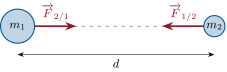
Any two bodies attract each other, whatever they are made of and however far apart they sit. This attraction is the gravitational force, and the phenomenon is gravitation. It needs no contact, no rope and no medium, and it is mutual: each body pulls the other.
Theorem 4.2 (Law of universal gravitation)
Two bodies of masses and (in ), whose centers are a distance apart (in ), attract each other with two forces directed along the line joining the centers, each pointing toward the other body, of equal magnitude
where is the same constant for every pair of bodies in the universe.
Proof. Admitted at this level. ∎
Remark 4.3 (Where the law comes from)
Newton distilled this law from the observed motion of the planets (Kepler’s laws); the honest deduction is carried out in the Year 1 volume. Chapter 27 will already put the law to work on satellites and planets.
Definition 4.4 (The gravitational constant)
The constant
is the gravitational constant. Its minuscule value is the reason gravity between everyday objects is imperceptible: only when at least one mass is astronomical does amount to anything.
Remark 4.5 (Reading the formula)
Four features deserve attention.
- Mutual and equal. The Earth pulls you with your weight — and you pull the Earth with exactly the same force. (The Earth just responds less: it is about times heavier.)
- Inverse square. Doubling divides the force by ; moving ten times farther divides it by .
- Distance between centers. For spherical bodies — stars, planets, cannonballs — is measured center to center, not surface to surface.
- Both masses matter. Doubling either mass doubles the force; the formula is symmetric in and .
Example 4.6 (Two friends)
Two friends stand with their centers apart:
Each friend’s weight is about — two billion times larger. Their mutual attraction is real, but hopeless to feel.
Example 4.7 (The Earth holds the Moon)
With (Earth), (Moon) and :
And the Moon pulls the Earth back with the same — a pull the oceans answer twice a day, as the tides.
Method 4.8 (Computing a gravitational force)
- Convert the masses to kilograms and the center-to-center distance to meters.
- Apply .
- Check the power of ten separately from the digits, as in Chapter 1: gravitational forces range from newtons (two people a metre apart) to newtons (Sun on Earth), so a misplaced exponent is easy to catch.
4.2 Weight and the strength of gravity
Definition 4.9 (Weight)
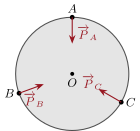
The weight of an object at the surface of a star (a planet, a moon, …) is the gravitational force the star exerts on it. It points toward the star’s center — the direction we call vertical — and is measured in newtons.
Proposition 4.10 (Weight at the surface of a star)
At the surface of a spherical star of mass and radius , an object of mass has weight
depends only on the star, not on the object.
Proof. The object’s center and the star’s center are a distance apart, so the law of universal gravitation (Theorem 4.2) gives . The bracket is the same for every object at the surface: call it . ∎
Definition 4.11 (Gravitational field strength)
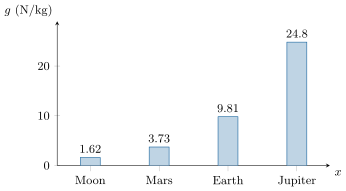
The quantity , in newtons per kilogram, is the gravitational field strength at the star’s surface: the star pulls on each kilogram with newtons. On Earth, .
Example 4.12 (Computing )
For the Earth (, ):
For the Moon (, ) the same computation gives — six times less: the Moon is far lighter, and being smaller does not make up for it. For Mars, .
Remark 4.13 (Why astronauts bounce)
An astronaut of mass (body plus suit) weighs on Earth but only on the Moon. Muscles trained under suddenly carry a sixth of the load: hence the famous slow, bounding lunar gait. The mass — and with it the effort needed to stop or turn — is unchanged, which is why lunar astronauts fell over so often.
4.3 Mass or weight? The balance and the spring scale
Everyday language says a sack of flour “weighs three kilos”. Physics splits that sentence in two.
Remark 4.14 (Mass is not weight)
- The mass measures the quantity of matter, in kilograms. It is a property of the object alone: the same on Earth, on the Moon, or adrift in deep space.
- The weight is a force, in newtons, exerted by a star on the object. It changes from star to star with — and fades away far from every star.
Confusing them is harmless at the market and fatal in a physics problem: the kilogram is not a unit of force.
Method 4.15 (The balance and the spring scale)
- A beam balance compares the object with standard masses: both pans’ weights scale by the same , so the comparison measures the mass — same verdict on any star.
- A spring scale measures the force stretching its spring: it reads the weight, in newtons, and its reading changes from star to star. To recover the mass, divide by the local field strength: .
Example 4.16 (Flour on the Moon)
A sack of flour balances against of standard masses on Earth and on the Moon. A spring scale, however, reads on Earth and on the Moon. A merchant selling “by the newton” on the Moon would hand out six times the flour — trade, like science, runs on mass.
4.4 Falling around the Earth: Newton’s cannon
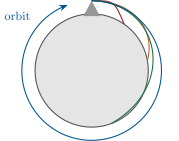
Throw a stone horizontally: gravity bends its path into an arc and it lands a few meters away. Throw it faster: it lands farther. Newton’s thought experiment pushes the idea to its limit. The Earth is round, and its surface drops about below the horizontal for every traveled; a freely falling body drops in its first second (Chapter 26 will establish this). So a projectile skimming the Earth at falls exactly as fast as the ground curves away: it falls forever without ever landing.
Definition 4.17 (Satellite and orbit)
A satellite of a star is a body that falls around the star without ever reaching its surface; the path it repeats is its orbit.
Remark 4.18 (The Moon is a falling stone)
The Moon is the Earth’s natural satellite: it falls toward us by about every second, and its sideways motion carries it around before it can come any closer (Exercise 4.15 lets you redo Newton’s own check of this number). The astronauts of an orbiting station are in the same free fall as their ship — that, and not any absence of gravity, is why they float. Gravitation shapes every trajectory, from the stone’s arc to the planet’s ellipse; the quantitative story of orbits is told in Chapter 27.
Notation 4.19 (Data card)
Unless an exercise says otherwise, use and:
| mass () | radius () | () | |
| Earth | 9.81 | ||
| Moon | 1.62 | ||
| Mars | 3.73 | ||
| Sun | — | — |
Earth–Moon distance: ; Earth–Sun distance: (center to center).
4.5 Exercises
Exercise 4.1 ★
Two dance partners hold each other with their centers apart.
- Compute their mutual gravitational attraction.
- Compare it with the weight of a mosquito.
Exercise 4.2 ★
A student has a mass of .
Solution
Solution of Exercise 4.2.
1. .
2. Her mass is unchanged: (same quantity of matter). Her weight becomes — six times less.
Exercise 4.3 ★
- From the data card, recompute the gravitational field strength at the surface of Mars.
- A rover is sent there. Compute its weight on Mars and its weight on Earth.
Solution
Solution of Exercise 4.3.
1. .
2. On Mars: . On Earth: — the rover weighs about times less on Mars, with the same mass.
Exercise 4.4 ★
Using the data card, compute the force exerted by the Earth on the Moon. What force does the Moon exert on the Earth?
Solution
Solution of Exercise 4.4.
The Moon exerts on the Earth a force of the same magnitude, , in the opposite direction: gravitation is mutual.
Exercise 4.5 ★
Two bodies attract each other with a force . What does the force become if:
- the distance between centers is doubled;
- the distance is halved;
- both masses are doubled (same distance);
- one mass is tripled and the distance is tripled?
Solution
Solution of Exercise 4.5.
1. Distance doubled: is multiplied by , so .
2. Distance halved: .
3. Both masses doubled: is multiplied by , so .
4. Numerator , denominator : .
Exercise 4.6 ★★
Two loaded supertankers of each are moored with their centers apart.
- Compute their mutual gravitational attraction.
- What mass has a weight equal to this force on Earth?
- The force is surprisingly large — yet the tankers show no inclination to drift together. Compute the acceleration it gives one tanker and comment.
Solution
Solution of Exercise 4.6.
1. .
2. : the two ships attract each other with the weight of a large motorcycle.
3. . Even unopposed, the tankers would take about five days to pick up walking pace; in practice, water resistance and moorings swamp the attraction completely.
Exercise 4.7 ★★
A lunar shop sells a bag of rice.
- What do a beam balance and a spring scale indicate for this bag on Earth? On the Moon?
- A customer pays for “”. Which instrument guarantees a fair deal on any world, and why?
Solution
Solution of Exercise 4.7.
1. The beam balance indicates on both worlds: the bag and the standard masses see their weights divided by the same factor, so the comparison is unchanged. The spring scale reads the weight: on Earth, on the Moon.
2. The balance: it measures mass, which is what the customer is buying. A spring scale calibrated in “kilograms” on Earth would read for the same bag on the Moon — the shopkeeper would give away six bags for the price of one.
Exercise 4.8 ★★
The International Space Station flies at an altitude of .
- Compute the Earth’s gravitational field strength at that altitude. (Careful: what is the distance to the Earth’s center?)
- Express it as a percentage of the surface value.
- The astronauts on board float. Reconcile this with your answer.
Solution
Solution of Exercise 4.8.
1. Distance to the center: . Then .
2. of the surface value.
3. Gravity is nearly full strength up there: the astronauts float because the station and everything in it are falling together around the Earth (free fall), not because gravity has vanished.
Exercise 4.9 ★★
At the surface of Venus, , and the planet’s radius is . Deduce the mass of Venus and compare it with the Earth’s.
Solution
Solution of Exercise 4.9.
From ,
about times the Earth’s mass — Venus is nearly the Earth’s twin in size and mass.
Exercise 4.10 ★★
- Compute the force exerted by the Sun on of sea water, then the force exerted by the Moon on the same kilogram.
- The Sun pulls harder — by what factor?
- Yet the Moon dominates the tides. The tide is driven not by the pull itself but by the difference between the pulls on the near and far sides of the Earth. Explain, without computing, why the nearby Moon can beat the distant Sun on that criterion.
Solution
Solution of Exercise 4.10.
1. Sun: . Moon: .
2. The Sun pulls about times harder.
3. The Earth’s diameter is a much larger fraction of the Earth–Moon distance () than of the Earth–Sun distance (), so the Moon’s pull changes far more from the near side to the far side of the globe. Tides feed on that difference — and there the Moon wins.
Exercise 4.11 ★★
- A planet has twice the Earth’s mass and twice its radius. Express its surface field strength in terms of the Earth’s , then in .
- What radius would a planet of the Earth’s mass need for its surface field strength to be ?
Solution
Solution of Exercise 4.11.
1. : the doubled radius wins over the doubled mass.
2. We need , so and — about .
Exercise 4.12 ★★★
Somewhere on the Earth–Moon line, the two pulls on a space probe cancel. Let be the distance from the Earth’s center to that point and the Earth–Moon distance.
- Show that at that point .
- Deduce . What fraction of the trip to the Moon is that?
Solution
Solution of Exercise 4.12.
1. Equal pulls per kilogram: . Cross-multiplying and dividing by : .
2. , so , i.e. . The balance point sits of the way to the Moon: the Earth’s pull dominates almost the whole trip.
Exercise 4.13 ★★★
Newton’s cannon, with numbers. A projectile skims the Earth horizontally at speed .
- After of horizontal travel, the spherical Earth has “dropped away” by a height satisfying . Using for small , show that and compute .
- A freely falling body drops in its first second. Compare with and deduce the speed at which the projectile never lands.
- Compute the duration of one full orbit at that speed, skimming the surface.
Solution
Solution of Exercise 4.13.
1. Expanding: ; since is tiny compared with , drop : , so .
2. In one second the projectile falls — almost exactly the the ground drops away over . So at the fall never catches the ground: the projectile orbits.
3. — close to the roughly of real low-orbit satellites, which fly a little higher.
Exercise 4.14 ★★★
A neutron star packs (1.4 times the Sun’s mass) into a radius of .
- Compute the gravitational field strength at its surface.
- What would a human weigh there? Compare with their weight on Earth.
- What is the weight, there, of a grain of sand? What mass has that weight on Earth?
Solution
Solution of Exercise 4.14.
1.
2. , versus on Earth: about times more. No structure made of atoms survives standing there.
3. . On Earth that is the weight of — a grain of sand weighing as much as a hundred-tonne locomotive.
Exercise 4.15 ★★★
Newton’s Moon test (1666). The Moon’s orbit radius is about Earth radii.
- By what factor is the Earth’s pull per kilogram weaker at the Moon than at the Earth’s surface, if gravity follows the inverse square?
- Near the surface, a falling body drops in its first second. How far should the Moon fall toward the Earth each second?
- Check against the orbit: the Moon covers its circle of radius in days. Compute its speed , the distance it covers in one second, then the fall (as in Exercise 4.13).
- Compare the answers of questions 2 and 3, and state what Newton concluded.
Solution
Solution of Exercise 4.15.
1. The distance is times larger, so the pull per kilogram is times weaker.
2. The fall in one second scales the same way: — about .
3. , so , and in one second. The fall is .
4. The two numbers agree: the Moon falls toward the Earth each second exactly as much as inverse-square gravity, calibrated on a falling apple, predicts. Newton concluded that the force holding the Moon is the force that drops the apple — gravity is universal.
4.6 Problem: Weighing the Earth
Problem 4.1
Weekend problem — from two lead spheres in a shed to the mass of the Earth and then of the Sun: what one small constant, measured once, is worth
In 1798 Henry Cavendish suspended a light rod carrying two small lead spheres from a thin wire, brought two big lead spheres close, and measured the almost nonexistent twist of the wire. The newspapers said he had weighed the Earth — and they were right: once is known, the Earth’s own and radius hand over its mass, and the Earth’s yearly orbit hands over the Sun’s. This problem retraces the whole chain. Use the data card throughout.
Part I — The feeblest force.
- The Eiffel Tower’s iron has a mass of about . A tourist stands from its center of mass. Compute the tower’s pull on the tourist.
- Compare it with the weight of a grain of sand.
- Proportionality drill: what happens to a gravitational force if (a) the distance is multiplied by ; (b) both masses are multiplied by ; (c) both masses and the distance are multiplied by ?
- Compute the Earth’s pull on a object at its surface, from , and . What everyday name and symbol does this number carry?
- Gravity is by far the feeblest interaction you have met — and yet it runs the universe. Explain in one or two sentences why the Earth’s pull on you dominates your neighbor’s.
Part II — Cavendish’s balance. In the torsion balance, a big sphere of mass attracts a small one of mass ; their centers are apart.
- With the modern value of , compute the force between the two spheres.
- Compute the weight of the small sphere and the ratio of the two forces. Why did Cavendish need a torsion wire rather than any ordinary scale?
- Cavendish’s measured twist corresponds (in modern units) to . Deduce his value of and compare it with today’s.
- With , and , deduce the mass of the Earth. (This is the step the newspapers celebrated.)
- Deduce the Earth’s average density , with . Surface rocks have densities around : what does the comparison reveal about the deep interior?
Part III — Other worlds.
- From the data card, recompute the Moon’s surface field strength.
- On Earth, a good push-off lifts your center of mass by . For the same push-off, the height reached is inversely proportional to (as the energy chapter, Chapter 9, will justify). How high does the same jump carry you on the Moon?
- Mercury: , . Compute its surface field strength and compare with Mars. Mercury is much smaller than Mars — how can the two values be so close?
- At what altitude above the Earth’s surface has the field strength dropped to half its surface value?
- At what distance from the Earth’s center does the Earth’s pull per kilogram fall to the Moon’s surface value, ? Express it in Earth radii.
Part IV — Weighing the Sun. The Earth travels a near-circular orbit of radius in one year, . Take as given (it is proved in Chapter 27) that a body on a circular path of radius at speed needs a pull of newtons per kilogram toward the center.
- Compute the Earth’s orbital speed .
- Deduce the pull per kilogram that the Sun exerts on the Earth.
- That pull is also . Deduce the mass of the Sun.
- How many Earths is that? Compare with .
- Finale. Cavendish’s spheres, the Earth, the Sun: one constant served for all three. State in one sentence what the word universal in “universal gravitation” bought us in this problem.
Solution
Solution of Problem 4.1.
1. .
2. The sand grain weighs : the whole Eiffel Tower pulls the tourist about times less than the weight of a grain of sand.
3. (a) Distance : force divided by . (b) Both masses : force multiplied by . (c) Masses and distance : — the force is unchanged.
4. : the weight of one kilogram — this is exactly the field strength .
5. Gravity is feeble per kilogram but only ever attracts, so the pulls of all kilograms of Earth add up in the same direction — and an astronomical mass beats a neighborly one by twenty-two powers of ten.
6. .
7. The small sphere weighs — about times the attraction to be detected. No pan scale resolves one part in fifty million; a fine torsion wire, which twists visibly under nanonewton-scale torques, can.
8. — within about of the modern , from a wooden shed in 1798.
9. From :
Six million billion billion kilograms: the Earth, weighed.
10. , so — twice the density of surface rock. The interior must hide something much denser than granite: the Earth has a heavy (iron) core.
11. .
12. Height : — a standing jump over a basketball hoop, in slow motion.
13. — almost exactly Mars’s . Mercury has less mass, but its smaller radius (a smaller below) compensates: it is a much denser world.
14. Half the field strength requires , so and — about up.
15. gives Earth radii. From only one and a half radii above the ground, the Earth pulls no harder than the Moon’s surface does.
16. — thirty kilometers every second.
17. : the Sun pulls each kilogram of the Earth with about six millinewtons.
18. gives
19. : the Sun is a third of a million Earths.
20. Because the same governs every pair of masses, measuring it once between two lead spheres in a shed let us put on the scales first the planet under our feet, then the star we orbit — that is what universal is worth.