High School Physics · Grades 10–12
27Satellites and Planetary Motion
The dish on the balcony is bolted down, yet all day it stares at one fixed point of the sky, up; the space station crosses the evening sky in minutes; a constellation of flying clocks tells your phone where you stand. None of these machines has an engine running: they are all simply falling. This chapter computes how fast and how high each must fall — then weighs planets with the same law.
27.1 Falling around the Earth
Everything rests on the law measured earlier (Chapter 4): the Earth, of mass , pulls a satellite of mass whose center is a distance from its own with a force directed toward the Earth’s center, of magnitude
Mind what is: the distance between centers. A satellite at altitude has , with the Earth’s radius — forgetting the is the classic blunder of this chapter.
Remark 27.1 (Newton’s cannon, revisited)
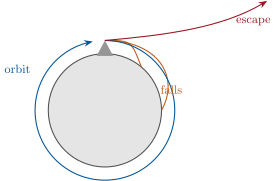
Fired horizontally, a cannonball lands; faster, it lands farther; at the right speed the ground curves away exactly as fast as the ball falls, and the fall closes on itself: an orbit. A satellite needs no engine — only the right sideways speed.
27.2 The circular orbit: one speed, one period
Theorem 27.2 (Orbital speed)
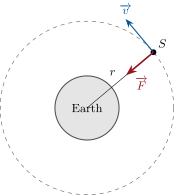
A satellite in uniform circular orbit of radius around a body of mass travels at the speed
which does not depend on the satellite’s mass.
Proof. Gravity is the only force, so Newton’s second law (Theorem 25.5) reads ; project it on the Frenet frame (Definition 24.13). The force aims at the center: its tangential component is zero, so the speed is constant; its normal component is the whole , and circular motion has (Theorem 24.12). Hence , and — dividing out — . ∎
Proposition 27.3 (Orbital period)
The satellite completes its orbit in the period
Proof. One lap is the circumference at constant speed; insert : . ∎
Neither nor contains : a screw shaken loose from the space station orbits right alongside it. And both fall with : the higher the orbit, the slower the satellite, in speed () and in angle ().
Example 27.4 (The space station)
The International Space Station flies at altitude , so ; with , and : a lap of the planet every hour and a half, about sixteen sunrises a day for the astronauts.
Example 27.5 (The Moon falls like the apple)
The Moon, at , orbits in , so and — precisely , and the Moon sits Earth radii away: the pull that drops the apple bends the Moon, weakened by the inverse square. Each second the Moon “falls” about toward us, its sideways kilometer carrying it around — the check Newton made in 1666.
27.3 Kepler’s laws
Newton did not guess the inverse square: he extracted it from three regularities that Johannes Kepler distilled, between 1609 and 1619, from Tycho Brahe’s twenty years of naked-eye planet positions — the best data of the pre-telescope world.
Definition 27.6 (Ellipse)
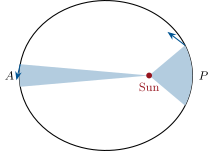
An ellipse is the set of points whose distances to two fixed points, the foci, have a constant sum; half its longest diameter is the semi-major axis , and a circle is the case where the foci merge. A planet’s orbit points nearest and farthest from the Sun are its perihelion and aphelion.
Theorem 27.7 (Kepler’s laws)
For the planets orbiting the Sun (mass ):
- each orbit is an ellipse with the Sun at one focus;
- the Sun–planet segment sweeps equal areas in equal times;
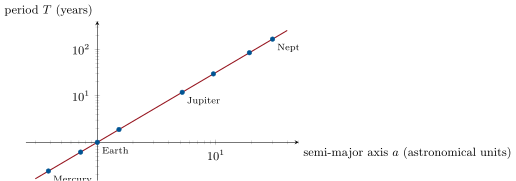
- the ratio of squared period to cubed semi-major axis is the same for all planets: .
The same laws govern any family of satellites around any central body, with the central mass.
Proof. Admitted at this level. ∎
Remark 27.8 (What we can prove this year)
For a circular orbit the third law is ours: squaring Proposition 27.3 gives — one constant for every satellite of the same center. That ellipses, equal areas and the general follow from the inverse square is shown, with more calculus, in the Year 1 volume. Meanwhile the second law can be read: the planet moves fastest at perihelion, where the short sweep segment must hurry.
27.4 Orbits at work
Definition 27.9 (Geostationary orbit)
A satellite is geostationary when it hangs over one fixed point of the ground. Its orbit must be circular, equatorial, and of period one sidereal day, ( ): the time the Earth takes to turn once relative to the stars. (The day is relative to the Sun, toward which the Earth also advances a degree a day.)
Example 27.10 (The geostationary altitude)
Kepler’s third law, read backward, dictates the radius: — an altitude , traveled at . Every relay that “hangs still” sits on this one circle over the equator — there is no other.
Example 27.11 (The navigation constellation)
Satellite-navigation systems fly some thirty satellites at (altitude ), where Proposition 27.3 gives : half a sidereal day, so each satellite retraces its ground track daily. Your receiver compares the arrival times of their clock signals against orbits known to meters.
Method 27.12 (Weighing a world from its satellite)
To measure the mass of a planet or a star: find any satellite of it (a moon, a probe, a planet), measure its orbit radius and period , and invert the third law:
This weighs the central body only — the satellite’s mass cancelled in Theorem 27.2. Every data-card mass came this way: the Earth from the Moon, the Sun from the Earth’s own orbit.
Remark 27.13 (Higher is slower — but costs more)
Since , the Moon crawls at while the station races at . Yet the higher orbit is the more expensive: climbing against gravity stores potential energy (the account is settled in Chapter 29), and the gain in outweighs the loss in . Hence a rocket burns forward to reach a higher, slower orbit — and a satellite braked by thin air spirals down and speeds up.
Remark 27.14 (Data card)
Unless stated otherwise: ; Earth: , , sidereal day ; Moon’s orbit: , ; Sun: ; Earth–Sun distance ; one year ; Mars: , .
27.5 Exercises
Exercise 27.1 ★
A satellite sits on the launch pad, then flies at altitude . Compute the Earth’s pull in both places: what percentage survives aloft — and why do occupants float?
Solution
Solution of Exercise 27.1.
On the pad: . At : — still of the ground value. The occupants float because they fall together with the station, not because gravity is gone.
Exercise 27.2 ★
For a (theoretical) satellite skimming the Earth’s surface (), compute the orbital speed and the period. Compare with Newton’s cannonball (Remark 27.1).
Solution
Solution of Exercise 27.2.
; . Exactly the cannonball’s : a skimming orbit is Newton’s shot.
Exercise 27.3 ★
A satellite is moved from a circular orbit of radius to one of radius . By what factor do its speed and period change? Do the answers depend on its mass?
Solution
Solution of Exercise 27.3.
: divided by . : multiplied by . Neither contains : no.
Exercise 27.4 ★
Redo the station’s numbers: from , compute , , and the number of orbits completed in .
Exercise 27.5 ★
State Kepler’s three laws. Where along its very stretched ellipse is a comet fastest, and which law says so? Does a satellite’s period depend on its own mass?
Solution
Solution of Exercise 27.5.
Ellipses with the Sun at a focus; equal areas in equal times; identical for all planets. Fastest at perihelion, by the second law (short sweep segment must sweep fast). No: the satellite’s mass cancels — only the central mass enters.
Exercise 27.6 ★★
Weigh the Earth: from the Moon’s orbit radius and period (data card), compute the Earth’s mass and compare with the card’s value.
Solution
Solution of Exercise 27.6.
: — within of .
Exercise 27.7 ★★
A company proposes a satellite hovering permanently above Paris (latitude north). From the direction of gravity, explain why every circular orbit is centered on the Earth’s center; conclude the proposal is impossible. Where can a satellite hover?
Solution
Solution of Exercise 27.7.
Gravity points at the Earth’s center, and in circular motion the net force points at the circle’s center: the two centers coincide. A circle above Paris’s parallel is centered on the axis, not the Earth’s center — impossible. Hovering works only where the parallel is a great circle centered at the center: over the equator.
Exercise 27.8 ★★
Phobos circles Mars at in . Deduce the mass of Mars; compare with the data card.
Solution
Solution of Exercise 27.8.
: — the data card’s Mars.
Exercise 27.9 ★★
Mars orbits the Sun at in . Compute for Mars and for the Earth (data card), check Kepler’s third law, and deduce the mass of the Sun.
Solution
Solution of Exercise 27.9.
Earth: . Mars: , — equal, as the third law demands. Then .
Exercise 27.10 ★★
Newton’s Moon test: from the data card, compute the Moon’s speed and its centripetal acceleration . Show it equals , and say why that convinced Newton that one law rules apple and Moon.
Solution
Solution of Exercise 27.10.
; ; . The Moon sits Earth radii out, and its fall is times weaker than the apple’s: exactly the inverse square — one law for both.
Exercise 27.11 ★★
In Sun units (astronomical units, years) Kepler’s third law reads : the straight line of the course’s log–log plot. Place on it the asteroid Ceres, , and Halley’s comet, : compute both periods. Halley last passed perihelion in 1986 — when is it due back?
Exercise 27.12 ★★★
Thin air brushes the station, yet its speed increases as it loses altitude. Compute at altitudes and , then resolve the paradox: friction slows things down — where does the extra speed come from?
Solution
Solution of Exercise 27.12.
At : ; at (): . Friction does drain mechanical energy — the orbit shrinks; but on the way down gravity’s work more than repays the loss of speed to drag: falls while rises.
Exercise 27.13 ★★★
A telescope finds an exoplanet circling its star at every . Weigh the star, in kilograms and in Suns. Which mass — star’s or planet’s — cannot be obtained this way, and why?
Solution
Solution of Exercise 27.13.
: Suns. The planet’s mass is out of reach: it cancelled from the orbit equations.
Exercise 27.14 ★★★
Mars settlers want an “areostationary” relay over their base. Mars turns relative to the stars in : compute the orbit radius and the altitude above the Martian surface (data card).
Solution
Solution of Exercise 27.14.
, : , so and above the Martian ground.
Exercise 27.15 ★★★
Halley’s comet passes perihelion at moving at ; aphelion is at . At both extremes the velocity is perpendicular to the Sun–comet segment, and Kepler’s second law then forces (equal sweep triangles of area ). Deduce the aphelion speed and comment on the ratio.
Solution
Solution of Exercise 27.15.
. Since , the comet is times farther and times slower: it spends decades dawdling in the dark and weeks sprinting past the Sun.
27.6 Problem: A Seat Over the Equator
Problem 27.1
Weekend problem — putting a satellite over the equator: why the only parking spot in the sky is a circle up, how it compares with the station racing below, and how the same law weighs Jupiter on the way
A telecom company wants a relay that its ground dishes, bolted down once, never have to chase: a geostationary satellite. You are the mission analyst; use the data card. For Part IV: Jupiter’s moon Io orbits at in , and Jupiter turns relative to the stars in .
Part I — The rules of hanging still.
- The satellite must stay over one fixed ground point. What must its period be — and why the sidereal day rather than ?
- In circular motion the net force points at the circle’s center; here the only force is gravity. Deduce that the center of any circular orbit is the Earth’s center.
- A circle hovering above Paris’s latitude would be centered on the Earth’s axis, north of the center. Conclude: in which plane must a geostationary orbit lie?
- Write Newton’s second law in the Frenet frame for a circular orbit of radius and derive .
- Deduce and rewrite it as Kepler’s third law .
Part II — The one circle that works.
- Solve the third law for and compute the geostationary radius.
- Deduce the altitude above the ground.
- Compute the orbital speed from .
- Check it against .
- The company’s satellite has mass ; a rival’s weighs twice that. Compare their geostationary radii, and say what the extra mass changes at launch.
Part III — The station below.
- The space station flies at : compute its speed.
- Compute its period, in seconds and minutes.
- How many orbits does it complete in — about how many sunrises do the astronauts watch per day?
- Compute the ratio of radii , and verify that the ratio of periods is that number to the power , as Kepler’s third law demands.
- Which satellite moves faster, and which took more energy per kilogram to emplace? Reconcile the two in one sentence.
Part IV — Weighing Jupiter on the side.
- From Kepler’s third law applied to Io, express Jupiter’s mass in terms of , and .
- Compute .
- How many Earth masses is that? Roughly what fraction of the Sun’s mass?
- A “jovistationary” relay should hang over one point of Jupiter’s clouds: compute its orbit radius; compare with Io’s.
- Report to the board, two sentences: the altitude where the company must park its relay, and the mass of Jupiter that the very same law delivered for free.
Solution
Solution of Problem 27.1.
1. : the ground turns with the Earth relative to the stars once per sidereal day; the day adds the degree per day the Earth advances around the Sun.
2. The net force of circular motion aims at the circle’s center; the only force, gravity, aims at the Earth’s center: the two centers are the same point.
3. A Paris-hovering circle would be centered on the axis north of the center — excluded by 2. The orbit must lie in the equatorial plane.
4. Normal component of Newton’s second law: , so ( cancels).
5. ; squaring, .
6. .
7. .
8. .
9. — consistent.
10. Identical radii: the mass cancelled in 4. The heavier satellite changes only the launch bill — more fuel for the same orbit.
11. .
12. .
13. orbits: about sunrises a day.
14. ; — Kepler’s third law, verified on the spot.
15. The station is faster ( against ), yet the geostationary cost more energy per kilogram: the climb in potential energy outweighs the loss of speed.
16. .
17. : .
18. Earths — and about of the Sun.
19. : , — Io, at , flies times higher and drifts across Jupiter’s sky.
20. Park the relay on the equatorial circle of altitude , where it rides at and never leaves the dish’s aim; and the same law, fed Io’s month, weighed Jupiter at — Earths — for free.