School Chemistry — Grades 1 to 12 · Grades 1–12
11Atoms and Molecules
Take a drop of water and cut it in two. Each half is still water. Cut a half in two again, and again, and again. Could you go on for ever, or would you reach a piece so small that cutting it once more gives something that is no longer water at all? Around 400 BC, the Greek thinker Democritus guessed the answer: matter is made of tiny pieces that cannot be cut, which he called atoms, from the Greek for “uncuttable”. It took more than two thousand years, and the work of the chemists of the nineteenth century, to turn that guess into science. This chapter describes the pieces — atoms — and how they group into molecules.
You already know
A pure substance, such as water or oxygen, is made of one single chemical species; a mixture, such as air, contains several (Chapter 8). Air is about four fifths nitrogen and one fifth oxygen (Chapter 4).
11.1 Atoms
Definition 11.1 (Atom)
All matter is built from extremely small particles called atoms. There are only about a hundred different kinds of atoms in nature, and every substance — water, air, iron, sugar, our own bodies — is made of atoms of a few of these kinds.
Proposition 11.2 (Atoms are tiny)
The smallest atom, the hydrogen atom, measures about a ten-millionth of a millimetre across; the others are at most a few times larger. Ten million hydrogen atoms in a row would make a line one millimetre long. To picture it: if an apple were blown up to the size of the Earth, each of its atoms would be about the size of a small cherry.
Remark 11.3 (Seen without being seen)
No microscope using light can show an atom: atoms are far smaller than the waves of light. Since the 1980s, special microscopes that feel a surface with an extremely fine tip have made images in which single atoms appear as bumps.
Definition 11.4 (Symbol of an atom)
Each kind of atom has a name and a symbol: one capital letter, sometimes followed by one small letter. The symbol is the same in every language.
| atom | symbol | model colour | atom | symbol | model colour | ||
|---|---|---|---|---|---|---|---|
| hydrogen |  | white | sodium |  | purple | ||
| carbon |  | black | sulfur |  | yellow | ||
| nitrogen |  | blue | chlorine |  | green | ||
| oxygen |  | red | iron, copper | , | — |
Remark 11.5 (Where symbols come from)
Most symbols are the first letters of the name: for hydrogen, for carbon, for oxygen. Some come from an older, Latin name: for sodium (natrium), for iron (ferrum), for copper (cuprum). The second letter is always small: is the cobalt atom, while CO, with a capital O, is something else entirely.
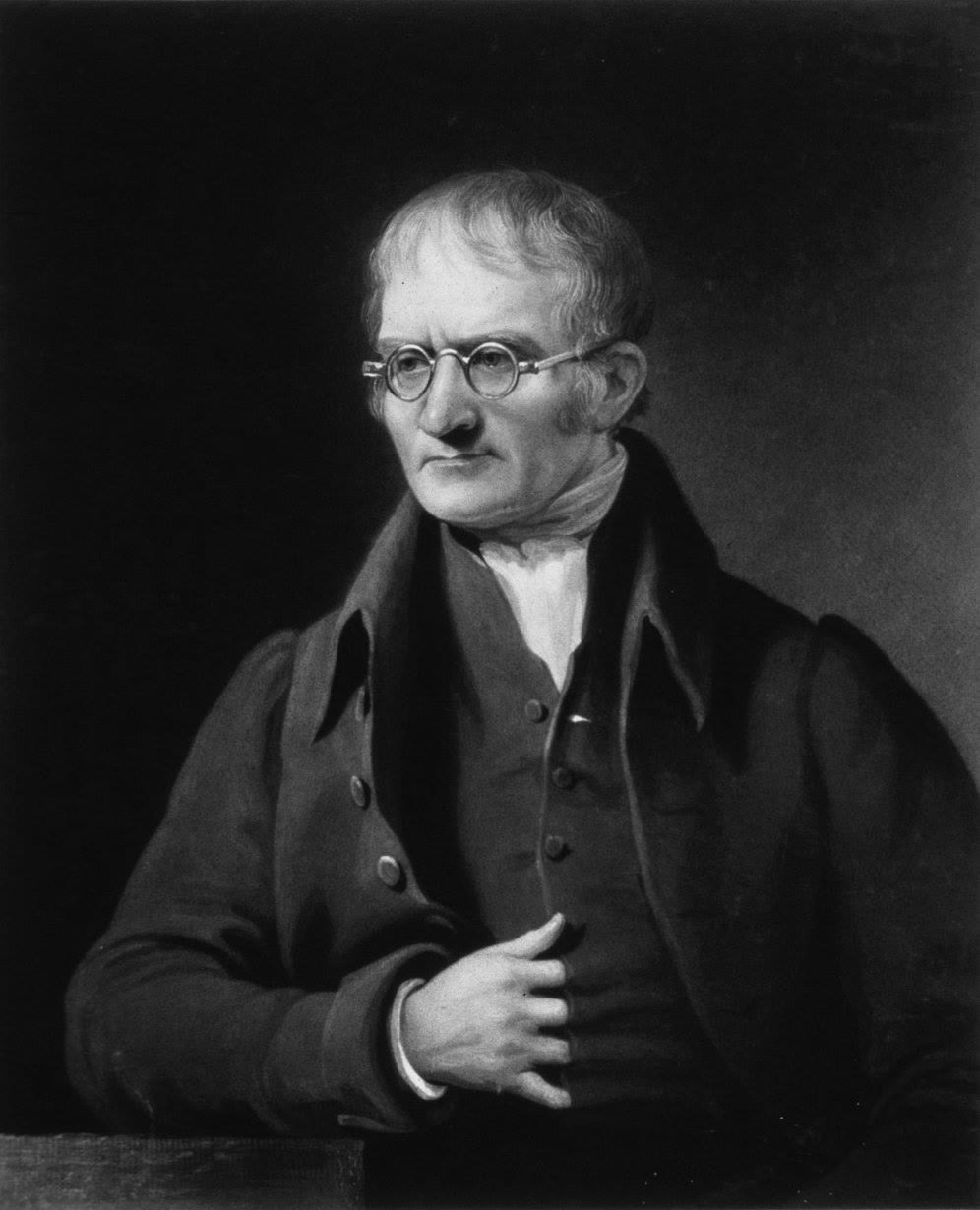
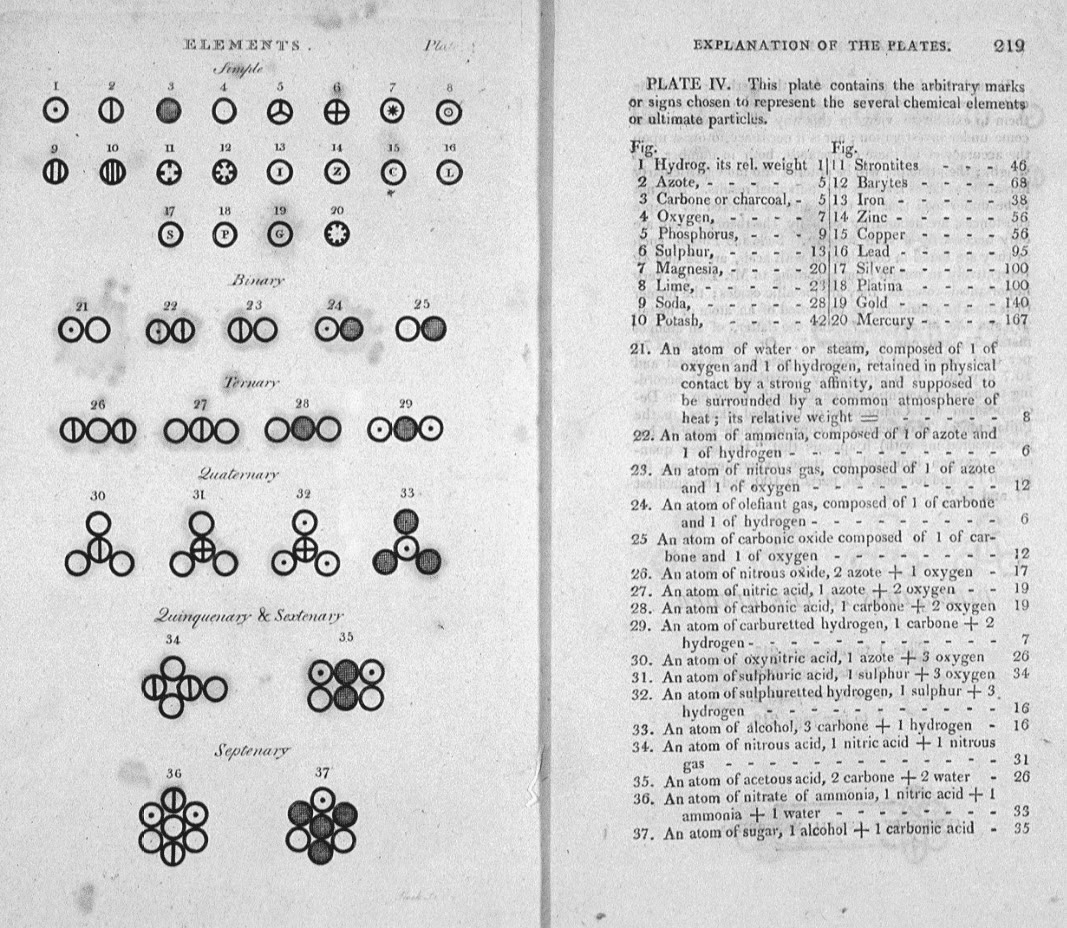
History — Dalton’s atoms, 1808
In 1808 the chemist John Dalton published a table of the atoms then known, each drawn as a small circle with its own sign. He was the first to say that every atom of one kind has the same weight, and that chemists could compare these weights. But he also guessed that water was one hydrogen atom joined to one oxygen atom; it took another fifty years for chemists to agree that a water molecule holds two hydrogen atoms.
11.2 Molecules
Definition 11.6 (Molecule)
A molecule is a group of atoms held tightly together. A molecule is the smallest piece of a substance that is still that substance: a water molecule is the smallest possible amount of water.
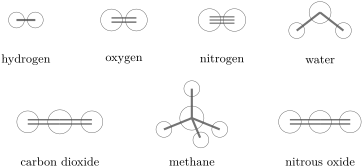
Example 11.7 (Seven molecules)
- the hydrogen molecule: two hydrogen atoms;
- the oxygen molecule, which we breathe: two oxygen atoms;
- the nitrogen molecule, four fifths of the air: two nitrogen atoms;
- the water molecule: two hydrogen atoms and one oxygen atom;
- the carbon dioxide molecule, which we breathe out: one carbon atom and two oxygen atoms;
- the methane molecule, the main part of the natural gas burnt in gas cookers: one carbon atom and four hydrogen atoms;
- the nitrous oxide molecule, an anaesthetic gas: two nitrogen atoms and one oxygen atom.
Proposition 11.8 (Molecules of a pure substance and of a mixture)
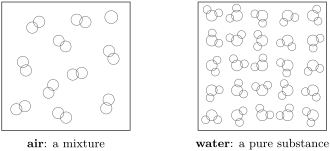
In a pure substance made of molecules, all the molecules are identical: pure water contains only water molecules. A mixture contains molecules of several kinds: air is mostly nitrogen molecules and oxygen molecules, about four of nitrogen for each one of oxygen, with a few argon atoms that stay single, and very few molecules of carbon dioxide.
11.3 Chemical formulas
Definition 11.9 (Chemical formula)
The chemical formula of a molecule lists the symbols of its atoms, each followed by a small number written below the line — the subscript — giving how many atoms of that kind the molecule contains. A subscript 1 is not written.
Example 11.10 (The seven formulas)
The molecules of Example 11.7 have these formulas:
Method 11.11 (Reading a formula)
To read the formula of a molecule:
- split it into symbols: each one starts with a capital letter;
- after each symbol, read the subscript (no subscript means 1);
- add up the subscripts to get the total number of atoms.
For (ethanol, the alcohol of drinks): 2 carbon, 6 hydrogen, 1 oxygen, 9 atoms in all.
Remark 11.12 (A number in front)
A number written in front of a formula counts molecules: means three water molecules, which together hold 6 hydrogen atoms and 3 oxygen atoms. Do not confuse , one molecule made of two oxygen atoms, with , two oxygen atoms that are not joined.
Example 11.13 (Methane in the kitchen)
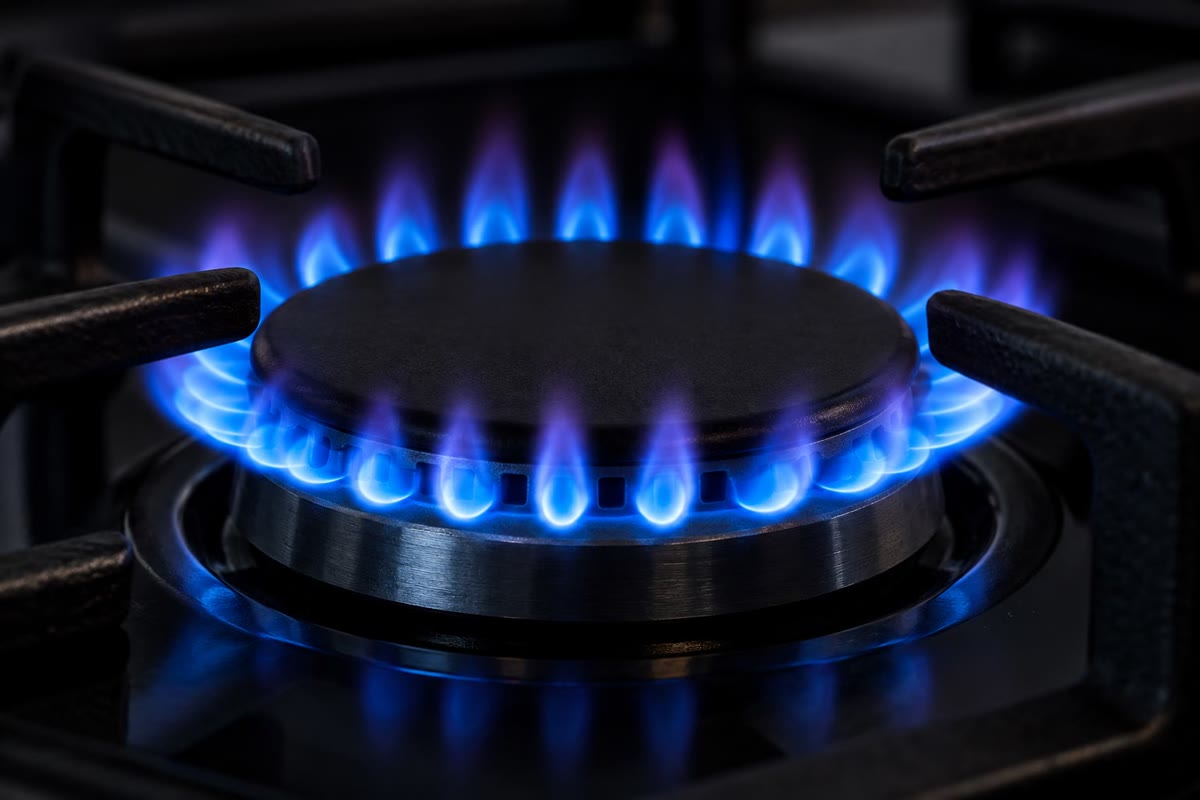
The natural gas of a gas cooker is mostly methane, . Each of its molecules is one carbon atom with four hydrogen atoms around it. The gas is invisible and has no smell: the smell of “gas” is a substance added on purpose, so that a leak is noticed.
11.4 Molecular models
Remark 11.14 (Models, and their colours)
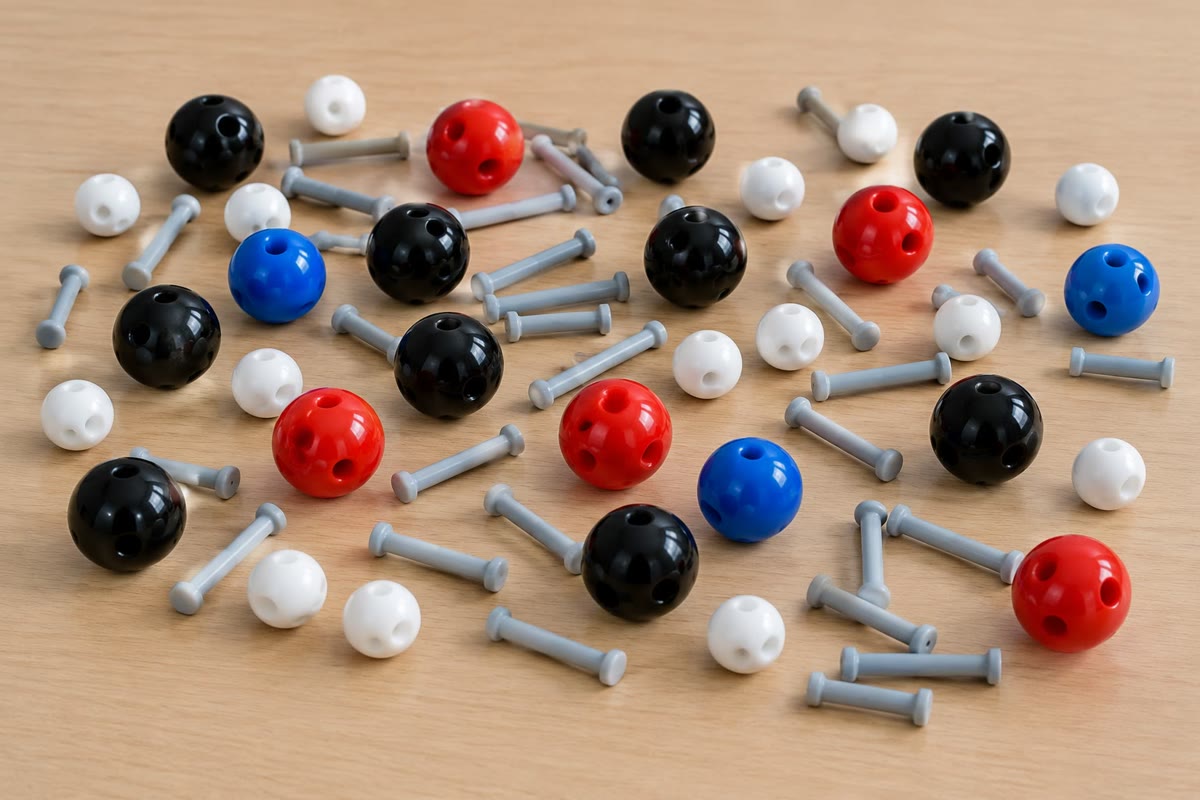
Chemists build molecular models with balls for the atoms and sticks for the bonds between them. The colours are a convention used all over the world — carbon black, hydrogen white, oxygen red, nitrogen blue — and not the real colour of atoms: a single atom has no colour at all. A model also shows the shape of a molecule, which a formula does not: the water molecule is bent, the carbon dioxide molecule is straight.
Method 11.15 (From a model to a formula)
To write the formula of a molecule from its model:
- name the atoms from their colours;
- count the balls of each colour;
- write the symbols with the counts as subscripts, carbon first, then hydrogen, then the other atoms in alphabetical order of their symbols.
A black ball joined to four white ones: one carbon, four hydrogen, .
11.5 Exercises
Exercise 11.1 ★
Exercise 11.2 ★
Give the symbols of hydrogen, carbon, nitrogen, oxygen, sodium and iron.
Solution
Solution of Exercise 11.2.
, , , , , .
Exercise 11.3 ★
How many atoms of each kind are there in one molecule of carbon dioxide, ? How many atoms in all?
Exercise 11.4 ★
Name the molecules , , and .
Solution
Solution of Exercise 11.4.
Water, oxygen, methane, nitrogen.
Exercise 11.5 ★
A molecule of nitrogen dioxide, a brown gas found in polluted air, is made of one nitrogen atom and two oxygen atoms. Write its formula.
Solution
Solution of Exercise 11.5.
.
Exercise 11.6 ★★
Explain the difference between and , and between and .
Exercise 11.7 ★★
How many hydrogen atoms and how many oxygen atoms are there in ? In ?
Exercise 11.8 ★★
A model is made of one black ball joined to two red balls. Name the atoms, write the formula, and name the molecule.
Solution
Solution of Exercise 11.8.
Black is carbon, red is oxygen: one carbon, two oxygen, , carbon dioxide.
Exercise 11.9 ★★
In Dalton’s table, water is made of one hydrogen atom and one oxygen atom. Write the formula Dalton had in mind, and say how many atoms his water molecule is missing.
Exercise 11.10 ★★
Is pure water a mixture? Is air? Answer by describing the molecules each one contains.
Exercise 11.11 ★★★
A hydrogen atom measures about a ten-millionth of a millimetre across. How many hydrogen atoms, side by side, would make a line long? And a line as long as a football pitch, ?
Exercise 11.12 ★★★
Glucose, the sugar that feeds our cells, has the formula . How many atoms does one glucose molecule contain? What percentage of them are hydrogen atoms? What percentage are carbon atoms?
11.6 Problem: The Atoms of a Breath
Problem 11.1
Weekend problem — counting the atoms in a breath of air, before and after it has been in our lungs
Nitrogen passes through the lungs unchanged, so it makes a good yardstick. In dry air, for every 78 molecules of nitrogen there are about 21 molecules of oxygen and 1 atom of argon: 100 particles (molecules or single atoms) in all. In air breathed out, once its water vapour is removed, the same 78 nitrogen molecules come with about 16 molecules of oxygen, 4 molecules of carbon dioxide and 1 atom of argon.
Part I — The air we breathe in.
- Write the formulas of the nitrogen, oxygen and carbon dioxide molecules, and give the number of atoms in each.
- Argon is counted in atoms, not in molecules. What does this tell us about argon?
- In these 100 particles of air breathed in, how many nitrogen atoms are there? How many oxygen atoms?
- How many atoms are there in all in these 100 particles?
- What percentage of these atoms are nitrogen atoms? Round to the nearest whole number.
Part II — The air we breathe out.
- In the air breathed out that goes with the same 78 nitrogen molecules, how many oxygen atoms are there inside oxygen molecules? Inside carbon dioxide molecules? In all?
- Compare with question 3. How many oxygen atoms are missing? Into which molecule, made in the body from the hydrogen of food and removed here with the water vapour, have they gone?
- How many carbon atoms are there in the air breathed in? In the air breathed out?
- Air brings no carbon atoms into the lungs. Where can the carbon atoms of the breath come from? (Think of what the body uses to live.)
- How many oxygen molecules have disappeared, and how many carbon dioxide molecules have appeared?
Part III — The count.
- Describe the ball-and-stick model of each of the four kinds of particle in breathed-out air, with the colours of the balls (argon is shown as a single pale blue ball).
- How many atoms are there in all in the dried air breathed out? By how many atoms does it exceed the air breathed in? Explain the difference with the carbon atoms gained and the oxygen atoms missing.
Solution
Solution of Problem 11.1.
1. Nitrogen , 2 atoms; oxygen , 2 atoms; carbon dioxide , 3 atoms.
2. Argon atoms do not join into molecules: argon is made of single atoms.
3. Nitrogen: atoms. Oxygen: atoms.
4. atoms.
5. , about .
6. In oxygen molecules: ; in carbon dioxide molecules: ; in all .
7. oxygen atoms are missing: one oxygen molecule’s worth. They have gone into water molecules, , which the body makes with the hydrogen of its food; that water leaves partly as water vapour in the breath (removed in these figures).
8. Breathed in: 0. Breathed out: 4 (one in each ).
9. From the food the body uses: sugars and fats contain carbon atoms, and the body releases them in the carbon dioxide it breathes out.
10. oxygen molecules have disappeared and 4 carbon dioxide molecules have appeared.
11. Nitrogen: two blue balls joined by three sticks. Oxygen: two red balls joined by two sticks. Carbon dioxide: a black ball between two red balls, each joined to it by two sticks, in a straight line. Argon: a single pale blue ball.
12. atoms (the 4 carbon dioxide molecules hold 12 atoms). That is atoms more than the air breathed in: 4 carbon atoms gained from food, minus the 2 oxygen atoms that left in water.