School Chemistry — Grades 1 to 12 · Grades 1–12
1What Things Are Made Of
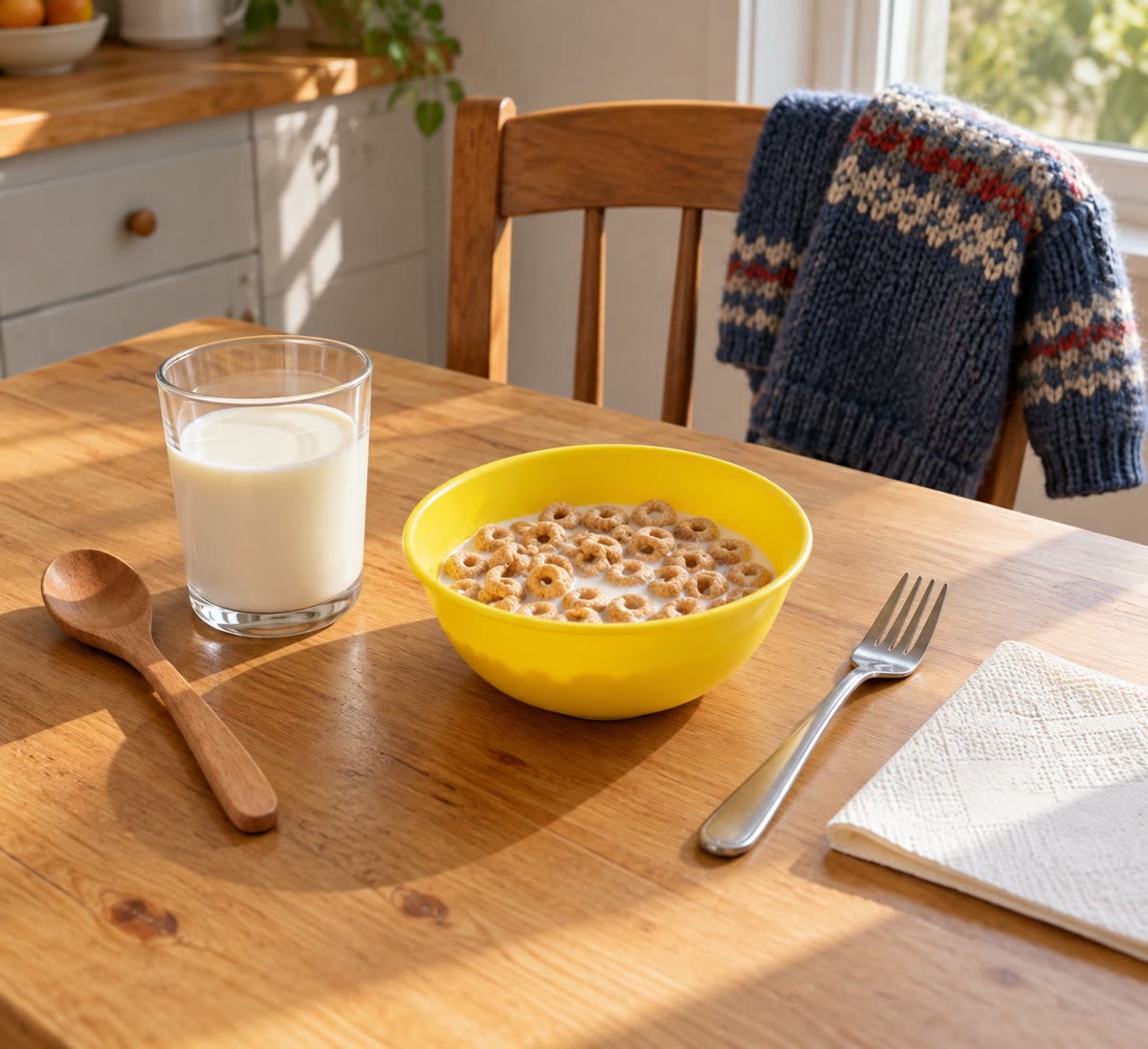
Look at a breakfast table. There is a spoon, a glass of milk, a fork, a napkin, a bowl, and a jumper hanging on the back of a chair. That is many things, and each one is made of something: the spoon of wood, the fork of metal, the glass of glass, the napkin of paper, the bowl of plastic, the jumper of wool. A table full of things, made of only a handful of different stuffs. This chapter is about those stuffs.
1.1 Objects and materials
Definition 1.1 (Object)
An object is a thing we can see and touch, and often hold and use: a spoon, a chair, a ball, a window, a shoe.
Definition 1.2 (Material)
The material of an object is what the object is made of. A spoon can be made of wood, of metal or of plastic: the spoon is the object, the wood is the material.
Example 1.3 (One object, three materials)
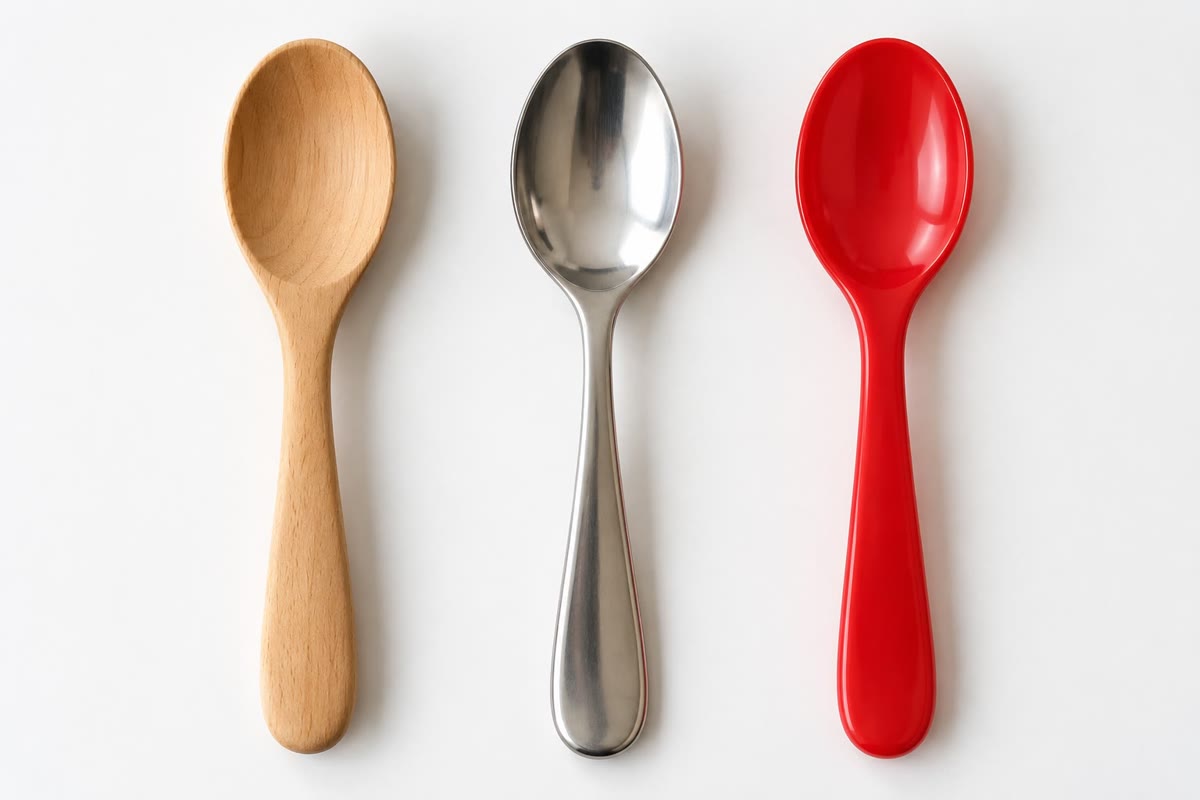
Three spoons lie side by side. They have the same shape and do the same job, so they are the same kind of object. But one is made of wood, one of metal and one of plastic: three different materials.
Example 1.4 (One material, many objects)
Wood is the material of a pencil, a chair, a door, a toy train and a wooden spoon. Many different objects can be made of the same material.
Remark 1.5 (Objects made of several materials)
Many objects are made of more than one material. A pair of scissors has blades of metal and handles of plastic. A pencil is wood outside and a grey stick of graphite inside. A window is glass in a frame of wood, metal or plastic.
1.2 Seven common materials
Proposition 1.6 (Materials all around us)
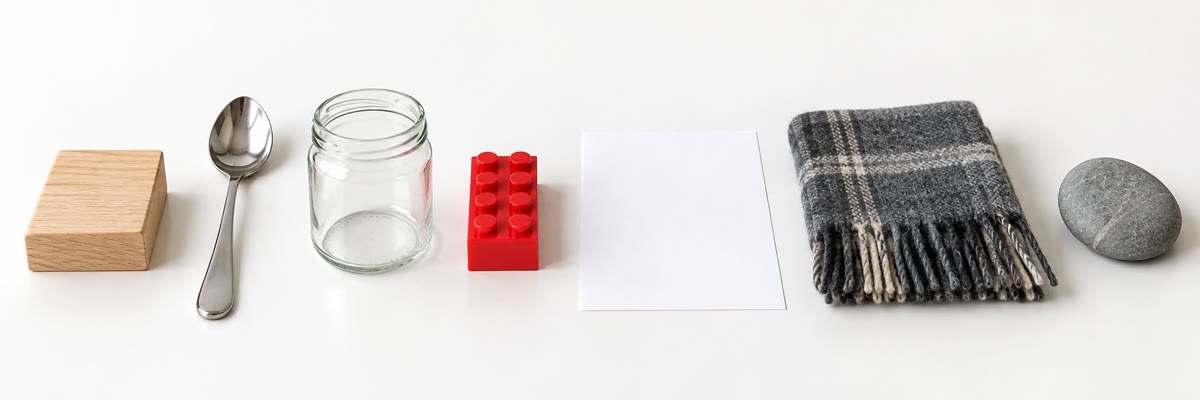
Most of the objects around us are made of a few common materials:
- wood: tables, chairs, pencils, doors;
- metal: forks, keys, nails, pans, bicycles;
- glass: windows, jars, bottles, glasses;
- plastic: bowls, bottles, toys, buckets;
- paper and card: books, napkins, boxes;
- fabric: clothes, curtains, bags — made of wool, cotton or other threads;
- stone: walls, steps, pebbles, statues.
Remark 1.7 (Names that are also materials)
We call a drinking glass “a glass” because it is made of glass, and a sheet of paper “a paper”. The word for the object and the word for the material are then the same. When we speak of materials, we mean the stuff, not the object.
1.3 Properties of materials
Definition 1.8 (Property of a material)
A property of a material is something we can find out about it by looking, touching or testing: is it hard or soft? Can we see through it? Does a magnet pull it? Does it float on water or sink?
Example 1.9 (Hard and soft)
A pebble is hard: pressing it with a thumb leaves no mark. A wool scarf is soft: it bends and folds in the hand. Wood, metal, glass and stone are hard; fabric and paper are soft and bend easily.
Example 1.10 (Seeing through)
We can see the garden through a window: glass lets light through, we say it is transparent. We cannot see through a wooden door, a brick wall or a metal pan. Some plastics are transparent, like a water bottle; others are not, like a red toy brick.
Example 1.11 (Attracted by a magnet)
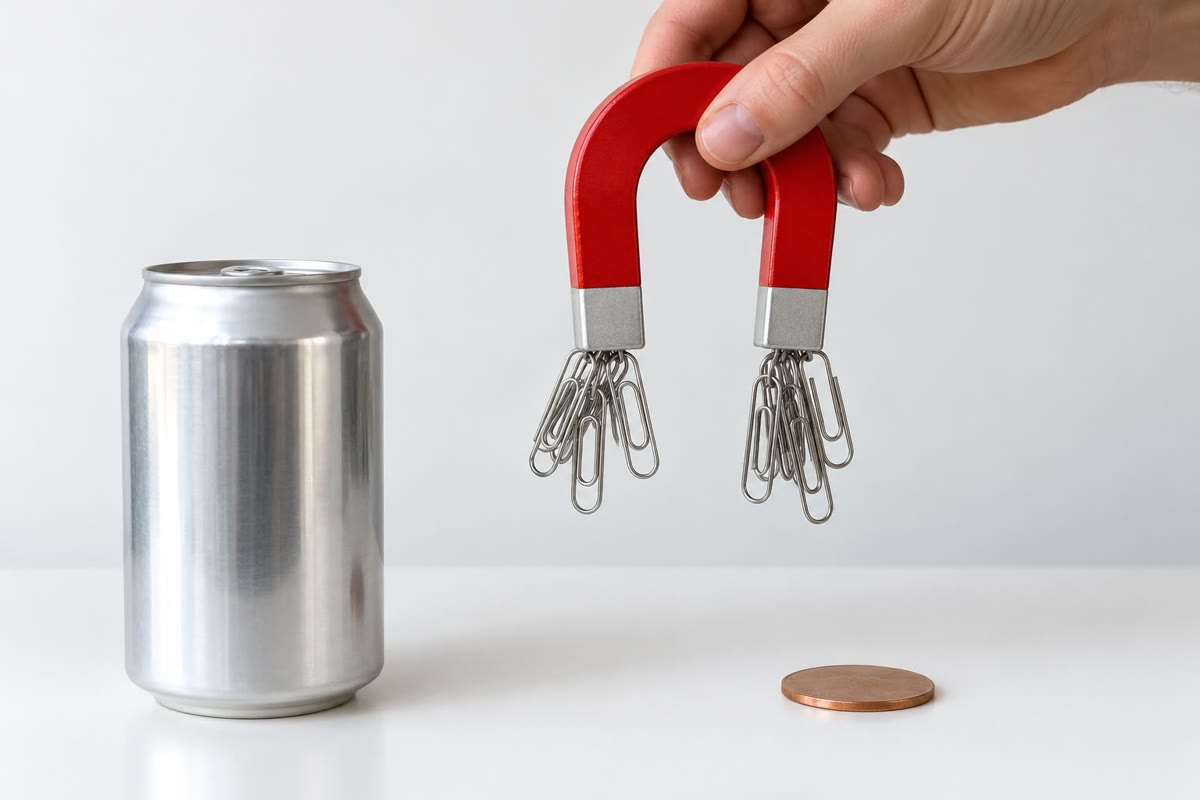
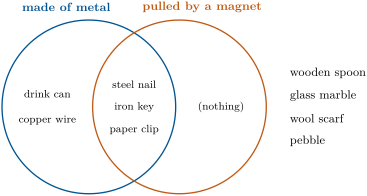
A magnet pulls a steel paper clip, a steel nail or an iron key towards it. It does not pull wood, glass, plastic, paper, fabric or stone. And, surprisingly, it does not pull every metal: a drink can of aluminium and a copper wire stay where they are. A magnet attracts objects made of iron and of steel, which is mostly iron.
Example 1.12 (Floating and sinking)
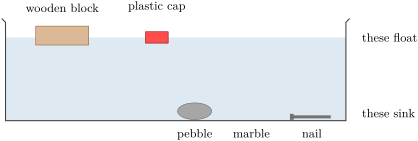
Put a few objects in a basin of water. A wooden block and a plastic bottle cap float. A pebble, a glass marble and a steel nail sink to the bottom. Whether a thing floats or sinks is also a property of its material.
1.4 Sorting materials
Method 1.13 (Sorting by one property)
To sort a pile of objects:
- choose one question, for instance “Does a magnet pull it?”;
- test each object and put it in the “yes” group or the “no” group;
- then, if you wish, sort each group again with another question.
One question at a time: that way every object has exactly one place.
| object (material) | hard? | see-through? | pulled by a magnet? |
|---|---|---|---|
| block (wood) | yes | no | no |
| nail (steel) | yes | no | yes |
| marble (glass) | yes | yes | no |
| bottle cap (plastic) | yes | no | no |
| sheet (paper) | no | no | no |
| scarf (wool) | no | no | no |
| pebble (stone) | yes | no | no |
1.5 The right material for the job
Proposition 1.14 (Each material is chosen for its properties)
People choose the material of an object for what the object must do:
- a window must let light in: it is made of glass, which is transparent;
- a raincoat must keep the rain out and fold up: it is made of plastic or of a fabric that water cannot pass through;
- a pan must not melt on the cooker: it is made of metal;
- a pan’s handle must not burn the hand: it is often made of wood or of a hard plastic, which do not get as hot as metal;
- a pillow must be soft: it is made of fabric filled with feathers or fibres.
Example 1.15 (A boat)
A toy boat must float. It can be made of wood or of plastic. A boat made of a solid lump of stone would sink at once.
Remark 1.16 (Broken glass)
Glass is hard but it breaks, and its pieces are sharp. When a glass breaks, an adult picks up the pieces.
1.6 Exercises
Exercise 1.1 ★
Is a chair an object or a material? Is wood an object or a material?
Exercise 1.2 ★
Name the material of each object: a window pane, a nail, a pebble, a book, a sock.
Solution
Solution of Exercise 1.2.
Window pane: glass. Nail: metal. Pebble: stone. Book: paper. Sock: fabric (wool or cotton).
Exercise 1.3 ★
Give two objects made of wood and two objects made of plastic.
Solution
Solution of Exercise 1.3.
Wood: a pencil, a door (or a chair, a table). Plastic: a bowl, a bucket (or a toy, a bottle).
Exercise 1.4 ★
Find the odd one out, and say why: a wooden spoon, a metal fork, a plastic spoon, a wooden chair. (Look at the materials.)
Solution
Solution of Exercise 1.4.
The metal fork: it is the only one not made of wood or plastic. (Two are made of wood and one of plastic.)
Exercise 1.5 ★
Which material can we see through: wood, glass or stone?
Solution
Solution of Exercise 1.5.
Glass: it is transparent.
Exercise 1.6 ★
A magnet is held near a steel nail, a glass marble and a wooden block. Which one does it pull?
Solution
Solution of Exercise 1.6.
The steel nail. A magnet pulls iron and steel, not glass or wood.
Exercise 1.7 ★
Look at the figure with the basin. How many objects float? How many sink?
Solution
Solution of Exercise 1.7.
Two objects float (the wooden block and the plastic cap); three sink (the pebble, the marble and the nail).
Exercise 1.8 ★
A pair of scissors has blades and handles. Which material is each part made of? Is a pair of scissors made of one material or of two?
Solution
Solution of Exercise 1.8.
The blades are metal, the handles plastic. The scissors are made of two materials.
Exercise 1.9 ★
Look at the figure with the two hoops. In which hoop is the drink can? Why is it not in the orange hoop?
Solution
Solution of Exercise 1.9.
In the blue hoop: it is made of metal. It is not in the orange hoop because a magnet does not pull it: it is made of aluminium, not of iron or steel.
Exercise 1.10 ★★
Why are windows made of glass and not of wood?
Solution
Solution of Exercise 1.10.
A window must let light in, and we must see through it. Glass is transparent; wood is not.
Exercise 1.11 ★★
Sam wants to sort these 8 objects with the question “Does a magnet pull it?”: a steel nail, a paper clip, a pebble, a wooden spoon, an iron key, a drink can, a glass marble, a wool sock. How many objects go in the “yes” group? How many in the “no” group?