School Chemistry — Grades 1 to 12 · Grades 1–12
17Ions and Ionic Solutions
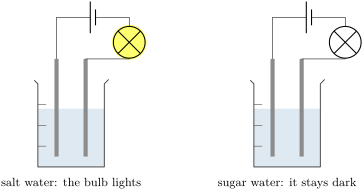
Two clear drinks stand on a gym bench: a bottle of sports drink, sold for its “electrolytes”, and a glass of sugared water. In a laboratory, two metal plates connected to a battery and a small bulb are dipped into each in turn. In the sports drink the bulb lights up; in the sugared water it stays dark. Something in the first liquid carries electric charge, and the sugar does not. That something is ions.
You already know
An atom has a nucleus with protons, each of charge , and electrons around it, each of charge : the atom is neutral (Chapter 16). A solute dissolved in water gives an aqueous solution (Chapter 9). A characteristic test detects a species by a visible result (Chapter 10).

17.1 Atoms that gain or lose electrons
Definition 17.1 (Ion, cation, anion)
An ion is an atom, or a group of atoms, that has lost or gained one or more electrons, and so carries an electric charge. An ion with a positive charge, having lost electrons, is a cation; an ion with a negative charge, having gained electrons, is an anion. The charge is written at the top right of the formula: , , .
Example 17.2 (Sodium and chlorine)
A sodium atom, 11 protons and 11 electrons, loses one electron: it becomes the sodium ion , 11 protons and 10 electrons, charge :
A chlorine atom, 17 protons and 17 electrons, gains one electron: it becomes the chloride ion , 17 protons and 18 electrons:

Proposition 17.3 (Some common ions)
Monatomic ions are made from one atom; polyatomic ions from a group of atoms that stays together:
17.2 Ionic compounds and their formulas
Definition 17.4 (Ionic compound)
An ionic compound is made of cations and anions in such numbers that the whole carries no charge. Its formula gives the proportion of the ions, without their charges: for sodium chloride, one for each ; for calcium chloride, two for each .
Method 17.5 (Writing the formula of an ionic compound)
- Write the two ions with their charges, cation first.
- Find the smallest numbers of each that make the total charge zero.
- Write these numbers as subscripts; a polyatomic ion needing a subscript goes in brackets.
Aluminium oxide: and ; , so . Iron(III) hydroxide: and three : .
Proposition 17.6 (An ionic solid is a stack of ions)
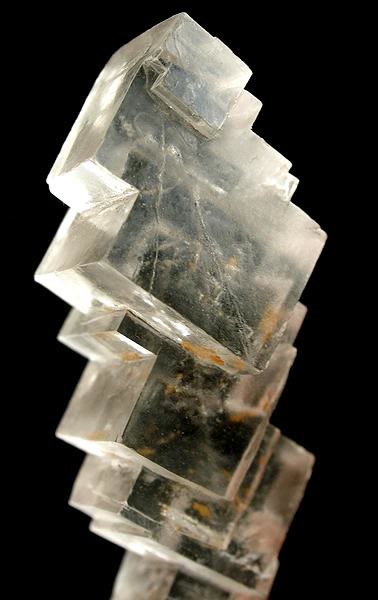
In a crystal of salt, sodium ions and chloride ions alternate in a regular three-dimensional stack, each ion surrounded by ions of the opposite charge, which hold it in place. A grain of table salt holds billions of billions of them; its cubic shape reflects the cubic stack.
17.3 Ionic solutions conduct
Notation 17.7 (The state symbol (aq))
An ion or a molecule dissolved in water is marked (aq), for aqueous: , .
Proposition 17.8 (Ionic solutions conduct electricity)
When an ionic compound dissolves in water, its ions separate and move freely in the solution: salt water contains and . Moving ions carry electric charge, so an ionic solution conducts electricity. A solution of sugar, whose molecules carry no charge, does not; nor does very pure water.
In the lab — Which liquids conduct?
Two metal plates, a low-voltage battery and a small bulb are joined in a circuit by the teacher; the plates are dipped in turn into distilled water, sugar water, salt water and a copper sulfate solution, and rinsed between each. The bulb lights only with the two ionic solutions.
17.4 Precipitation tests for ions
Definition 17.9 (Precipitate)
When two solutions are mixed, a cation of one and an anion of the other may form an ionic compound that does not dissolve. It appears as a fine solid that clouds the liquid and settles: a precipitate. The reaction is a precipitation.
Proposition 17.10 (Tests for common ions)
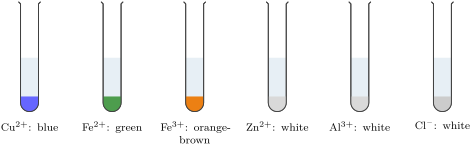
A few drops of a reagent solution identify an ion by the colour of the precipitate it forms:
| ion looked for | reagent | precipitate | colour |
|---|---|---|---|
| copper(II) | sodium hydroxide | blue | |
| iron(II) | sodium hydroxide | green | |
| iron(III) | sodium hydroxide | orange-brown | |
| zinc | sodium hydroxide | white | |
| aluminium | sodium hydroxide | white | |
| chloride | silver nitrate | white, darkens in light |
Example 17.11 (Writing a precipitation)
Only the ions that form the solid are written; the others stay dissolved and take no part:
Safety


Sodium hydroxide: causes severe skin burns and eye damage, and may be corrosive to metals (GHS05); irritating to skin and eyes in dilute form (GHS07). Silver nitrate, the chloride reagent, is an oxidiser, corrosive and very toxic to aquatic life. Goggles, gloves; reagents dispensed by drops by the teacher.
Method 17.12 (Testing for an ion)
- Pour a little of the solution to be tested into a test tube.
- Add the reagent drop by drop.
- Note the colour of any precipitate and compare with the table.
- Conclude, and remember that a test identifies an ion, not a compound: the iron(III) chloride solution gives both the test and the test.
17.5 Exercises
Exercise 17.1 ★
What is an ion? What is the difference between a cation and an anion?
Exercise 17.2 ★
A magnesium atom (12 protons) loses two electrons. Write the formula of the ion formed, and give its numbers of protons and electrons.
Exercise 17.3 ★
Write the formulas of potassium chloride, magnesium chloride and calcium oxide (oxide ion: ).
Solution
Solution of Exercise 17.3.
, , .
Exercise 17.4 ★
Why does salt water conduct electricity while sugar water does not?
Exercise 17.5 ★★
Write the formulas of copper(II) sulfate, aluminium chloride and sodium carbonate.
Solution
Solution of Exercise 17.5.
, , .
Exercise 17.6 ★★
Sodium hydroxide added to a solution gives an orange-brown precipitate. Which ion does the solution contain? Write the equation of the precipitation.
Solution
Solution of Exercise 17.6.
Iron(III), : .
Exercise 17.7 ★★
How many electrons does the sulfate ion carry in excess of its protons? The nitrate ion ?
Exercise 17.8 ★★
A solution gives a white precipitate with silver nitrate and a blue one with sodium hydroxide. Name the dissolved ionic compound and write its formula.
Solution
Solution of Exercise 17.8.
White with silver nitrate: . Blue with sodium hydroxide: . Copper(II) chloride, .
Exercise 17.9 ★★
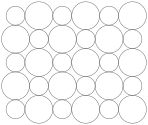
Look at the figure of the salt crystal layer. How many neighbours of opposite charge does an ion in the middle of the layer have in this layer?
Solution
Solution of Exercise 17.9.
Four: one on each side (left, right, above, below).
Exercise 17.10 ★★
Write the equation of the precipitation of iron(II) hydroxide from and ions.
Solution
Solution of Exercise 17.10.
.
Exercise 17.11 ★★★
A white powder may be zinc chloride or sodium chloride. Dissolved in water, it gives a white precipitate with sodium hydroxide. Which is it? Write the equation.
Solution
Solution of Exercise 17.11.
Zinc chloride: sodium ions give no precipitate with sodium hydroxide, zinc ions give a white one: .
Exercise 17.12 ★★★
In a crystal of calcium chloride, how many chloride ions are there for 1000 calcium ions? Check that the crystal is neutral.
17.6 Problem: The Rusty Well
Problem 17.1
Weekend problem — orange stains in a farmhouse sink, two tests, and the number of iron ions in a litre of well water
The water of a farmhouse well leaves orange stains in the sink. A laboratory receives a sample. Freshly drawn, the water is clear; with sodium hydroxide it gives a green precipitate, which turns orange-brown within an hour at the surface, where it meets the air. The laboratory measures of iron, in the form of iron ions, per litre. Take the mass of a nucleon as , and 56 nucleons for an iron atom.
Part I — The tests.
- Which ion does the green precipitate show? Give the formula of the precipitate.
- Which ion does the orange-brown precipitate show? Give its formula.
- An iron(II) ion and an iron(III) ion differ by one electron. Which has more electrons? How many electrons does each have (iron: )?
- Write the equation of the precipitation of iron(III) hydroxide.
Part II — The stains.
- In the sink, the clear water slowly turns cloudy and orange. Which ion does the water hold when it comes out of the well, and which does it end up holding?
- Write the formula of the ionic compound formed by iron(III) ions and hydroxide ions, and check that it is neutral.
- Can the iron of the water be removed by filtering the water as it comes out of the well? After it has turned orange? Explain.
- Is a water containing iron ions a pure substance? A homogeneous mixture?
Part III — Counting the ions.
- Compute the mass of an iron atom, in kilograms.
- Convert into kilograms.
- Why may the mass of an iron ion be taken equal to that of an iron atom?
- Compute the number of iron ions in a litre of the well water.
Solution
Solution of Problem 17.1.
1. Iron(II), : .
2. Iron(III), : .
3. has one more: electrons, against for .
4. .
5. It comes out holding iron(II) ions; in contact with the air they become iron(III) ions, which form the orange solid.
6. : .
7. Not as it comes out: the iron ions are dissolved and pass through a filter. Once the orange solid has formed, yes: it is a precipitate, held back by a filter.
8. No: a mixture (water and dissolved ions). Freshly drawn and clear, it is homogeneous.
9. .
10. .
11. An ion differs from the atom by two or three electrons, whose mass is negligible beside the nucleus.
12. iron ions per litre.