School Chemistry — Grades 1 to 12 · Grades 1–12
18Acids, Bases and pH
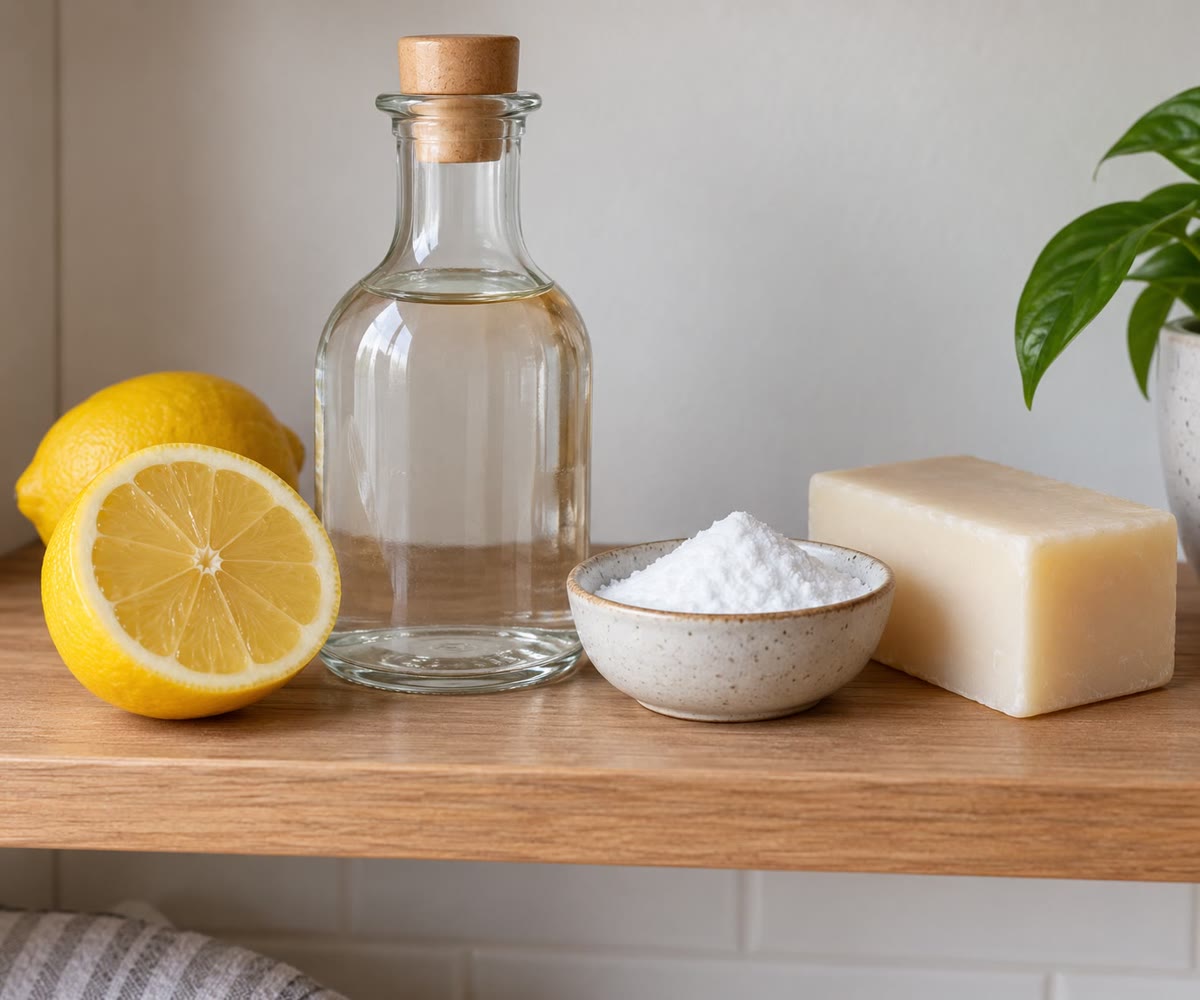
On a kitchen shelf stand a lemon, a bottle of vinegar, a bar of soap and a box of baking soda; under the sink, a bottle of drain cleaner with a black-and-red warning label. Some of these taste sour, some feel slippery, some can burn the skin. One single scale, numbered from 0 to 14, sorts them all — and the same scale is used for swimming pools, garden soil, the blood and the oceans.
You already know
Ions are atoms or groups of atoms carrying a charge; a cation such as is positive, an anion such as or negative. Ionic solutions contain ions marked (aq), which move freely (Chapter 17).
18.1 Acidic, basic and neutral solutions
Definition 18.1 (Acidic, basic and neutral solutions)
Every aqueous solution contains hydrogen ions and hydroxide ions . A solution is an acidic solution when it contains more ions than ions, a basic solution when it contains more ions than ions, and a neutral solution when it contains as many of each.
Example 18.2 (Three solutions)
Hydrochloric acid is an acidic solution: it holds and ions, with very few . A sodium hydroxide solution is basic: and , with very few . Pure water and salt water are neutral.
18.2 The pH scale
Definition 18.3 (pH)
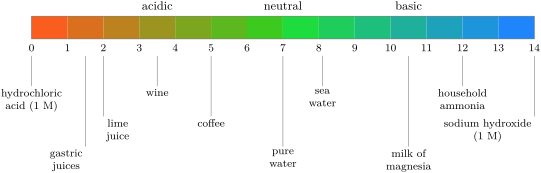
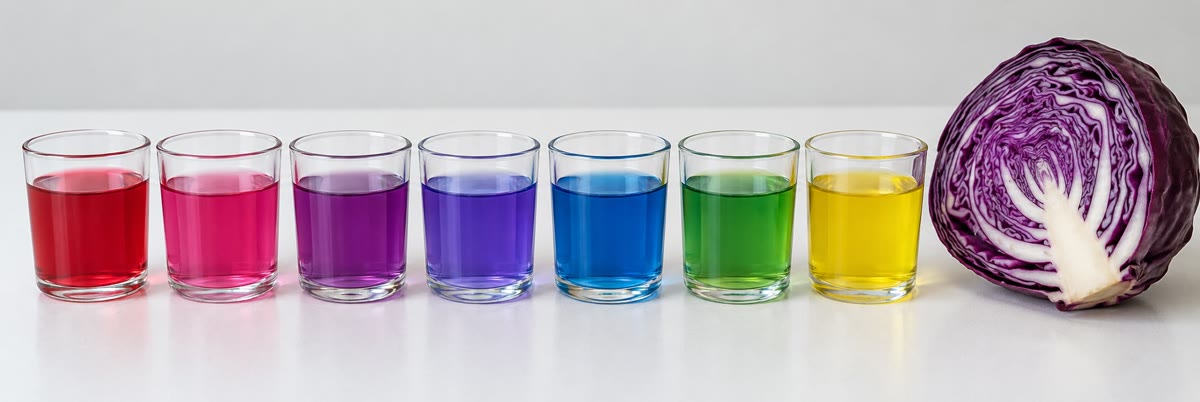
The pH of an aqueous solution is a number, usually between 0 and 14, that tells how acidic or basic it is: at , a neutral solution has pH 7, an acidic solution a pH below 7, a basic solution a pH above 7. The more ions a solution holds, the lower its pH.
Definition 18.4 (pH paper and pH meter)
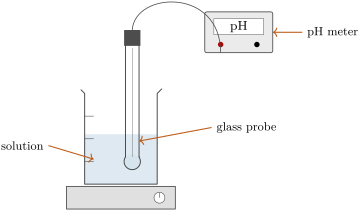
pH paper is a strip of paper soaked in a mixture of dyes that takes a different colour at each pH; a drop of the solution is put on it and the colour is compared with a chart printed on the box. A pH meter measures the pH with a glass probe dipped in the solution and shows it as a number, to one or two decimal places.
Method 18.5 (Measuring a pH with pH paper)
18.3 Diluting an acid
Proposition 18.6 (Diluting brings the pH closer to 7)
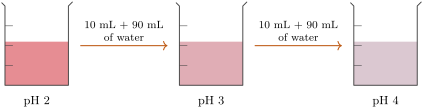
Adding water to an acidic solution spreads its ions through a larger volume: the pH goes up, towards 7, but never beyond. For an acid such as hydrochloric acid, diluting ten times raises the pH by about one unit: one volume of acid at pH 2 plus nine volumes of water gives a solution at pH 3. Diluting a basic solution likewise lowers its pH towards 7.
In the lab — Diluting an acid
To dilute an acid, the teacher always pours the acid slowly into the water, never the water into the acid: the mixing gives out heat, and water poured onto a concentrated acid can boil at once and spit acid out of the container.
18.4 Everyday acids and bases
Proposition 18.7 (Acids and bases around us)
Acidic: lemon and lime juice, vinegar, wine, fizzy drinks, coffee, gastric juices in the stomach. Basic: sea water (slightly), baking soda dissolved in water, soap, milk of magnesia (a remedy for stomach acidity), household ammonia, bleach, drain cleaner (very strongly).
Example 18.8 (The pH of the ocean)
The average pH of the ocean is about 8.1: slightly basic. Since the industrial era began, carbon dioxide dissolving from the air has lowered the pH of surface waters by about 0.1: the oceans are slowly becoming less basic, which harms shellfish and corals.
18.5 Safety with corrosive products
Safety


Concentrated hydrochloric acid and sodium hydroxide (the base of drain cleaners) carry the corrosion pictogram GHS05: they cause severe burns to skin and eyes and attack metals. GHS07: irritant. Goggles and gloves; a splash is rinsed at once with plenty of water.
Remark 18.9 (Never mix cleaning products)
Acidic and basic products react together, sometimes violently, and some mixtures release toxic gases: bleach mixed with an acidic descaler gives off chlorine. Cleaning products are never mixed.
18.6 Exercises
Exercise 18.1 ★
Acidic, basic or neutral? A solution of pH 3, one of pH 7, one of pH 11.
Exercise 18.2 ★
Which ions are more numerous in an acidic solution? In a basic one?
Exercise 18.3 ★
Using the pH scale of this chapter, put in order from the most acidic to the most basic: coffee, sea water, lime juice, household ammonia, pure water.
Solution
Solution of Exercise 18.3.
Lime juice (2), coffee (5), pure water (7), sea water (8.1), household ammonia (12).
Exercise 18.4 ★
Describe how to measure the pH of a solution with pH paper.
Solution
Solution of Exercise 18.4.
A strip on a clean dry dish is touched with a drop of the solution carried by a clean glass rod; the colour is compared at once with the chart.
Exercise 18.5 ★★
A solution of pH 4 is diluted ten times with water. What is its new pH, about? And if it is diluted a hundred times?
Solution
Solution of Exercise 18.5.
About 5 after a tenfold dilution; about 6 after a hundredfold one.
Exercise 18.6 ★★
Can an acidic solution become basic by adding water? Explain.
Exercise 18.7 ★★
Why must an acid be poured into water, and not the other way round?
Solution
Solution of Exercise 18.7.
Mixing gives out heat. Water poured onto a concentrated acid could boil at once and throw acid out; acid poured slowly into water is spread at once in a large volume.
Exercise 18.8 ★★
A bottle carries the GHS05 pictogram. What does it mean? Give two precautions.
Solution
Solution of Exercise 18.8.
Corrosive: burns skin and eyes, attacks metals. Wear goggles and gloves; rinse any splash with plenty of water.
Exercise 18.9 ★★
How many tenfold dilutions are needed to take an acid from pH 1 to pH 4? What total dilution is that?
Solution
Solution of Exercise 18.9.
Three dilutions (1 to 2, 2 to 3, 3 to 4): times.
Exercise 18.10 ★★
Milk of magnesia is taken for stomach acidity. Using the pH scale, explain why.
Solution
Solution of Exercise 18.10.
Milk of magnesia is basic (pH about 10.5): it reacts with part of the excess acid of the stomach.
Exercise 18.11 ★★★
The ocean’s pH has fallen by about 0.1 since the industrial era. Is the ocean acidic today? In which direction is it moving, and why?
Exercise 18.12 ★★★
A student measures the pH of the same vinegar with pH paper (3) and with a pH meter (2.6). Explain why the two results differ and which is more precise.
18.7 Problem: The Acid Spill
Problem 18.1
Weekend problem — a litre of acid spilt in a laboratory sink, and why diluting it is not the answer
A bottle containing of dilute hydrochloric acid, of pH 2, breaks in a laboratory sink. The drain must not receive any solution of pH below 5. Take the rule of this chapter: for this acid, each tenfold dilution raises the pH by one unit.
Part I — The acid.
- Is the solution acidic, neutral or basic? Which ions does it contain most?
- Which pictogram should the bottle carry, and why?
- The teacher measures the pH with a pH meter rather than pH paper. Give one advantage.
- How many more ions are there in a litre at pH 2 than in a litre at pH 3 of the same acid?
Part II — Diluting.
- What volume of solution is obtained by diluting the litre of acid ten times? What is its pH?
- How many tenfold dilutions are needed to reach pH 5?
- What total volume of solution would that make?
- Could any amount of water make the solution basic? Explain.
Part III — A better way. The teacher instead adds, little by little, a solution of a base until the pH paper shows 7: the ions of the acid react with the ions of the base.
- Write the equation of the reaction between and ions.
- Why is this better than diluting?
- Name an everyday basic product that could be used in a kitchen to clean up a small spill of vinegar.
- Compute the volume of water that would have to be added to the litre of acid to bring it to pH 5.
Solution
Solution of Problem 18.1.
1. Acidic: it contains mostly and ions.
2. GHS05, corrosive: an acid attacks skin, eyes and metals.
3. It gives a precise number instead of a colour to compare by eye.
4. Ten times more: one pH unit corresponds to a tenfold dilution.
5. , of pH 3.
6. Three: pH 2 to 3, 3 to 4, 4 to 5.
7. .
8. No: diluting only brings the pH closer to 7.
9. .
10. The acid is destroyed, turned into water, instead of being spread through a huge volume; only a little base is needed and no thousand litres of water.
11. Baking soda dissolved in water (or soapy water).
12. of water.