School Chemistry — Grades 1 to 12 · Grades 1–12
15Plastics and Synthetic Materials
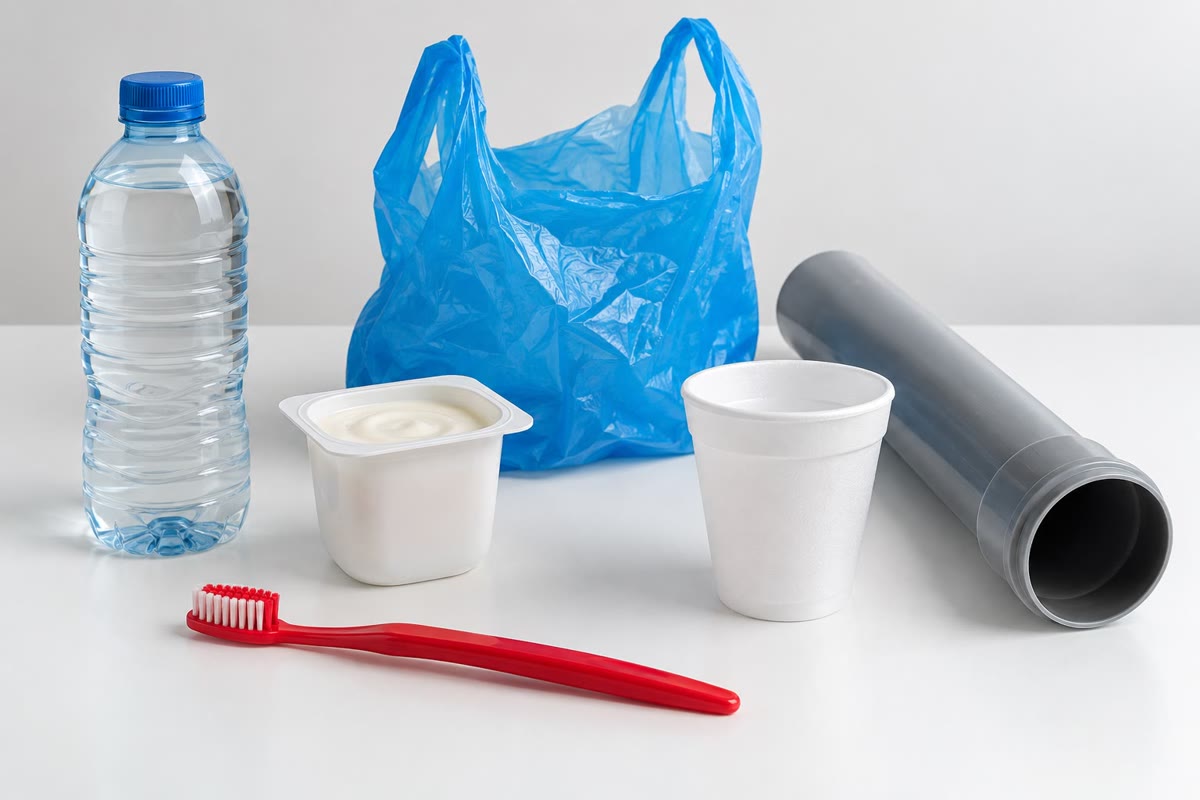
Count the plastic objects you touch in one morning: a toothbrush, a bottle, a raincoat, a phone case, the seat of a bus, the bag of the shopping. Hardly any of them existed a hundred and twenty years ago, and none of them grew on a tree or was dug out of the ground. Plastics are materials invented by chemists — light, cheap, waterproof, shaped into anything — and that very success has become a problem.
You already know
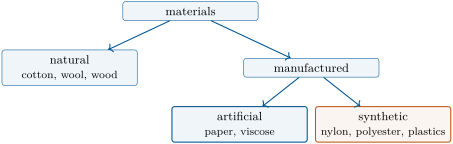
Natural materials are used much as they are found in nature; manufactured materials are made from raw materials by changing them, and recycling turns the material of old objects into new ones (Chapter 7). A combustion of a fuel made of carbon and hydrogen gives carbon dioxide and water (Chapter 14).
15.1 Natural, artificial and synthetic materials
Definition 15.1 (Artificial and synthetic materials)
Among manufactured materials, an artificial material is made by chemically transforming a natural material: paper and viscose (a fabric) from the cellulose of wood. A synthetic material is made from substances built by chemists, most often from crude oil, and has no natural counterpart: nylon, polyester, the plastics.
15.2 What plastics are
Definition 15.2 (Plastic)
A plastic is a synthetic material made of very long molecules, which can be shaped by moulding — most often while it is hot and soft — and keeps its shape when cool. Most plastics are made from crude oil or natural gas.
Remark 15.3 (Very long molecules)
A water molecule holds three atoms; a molecule of a plastic can hold tens of thousands, joined in a long chain, like a necklace of identical beads. How such chains are built is the subject of a chapter at the end of this book.

History — Bakelite, 1907
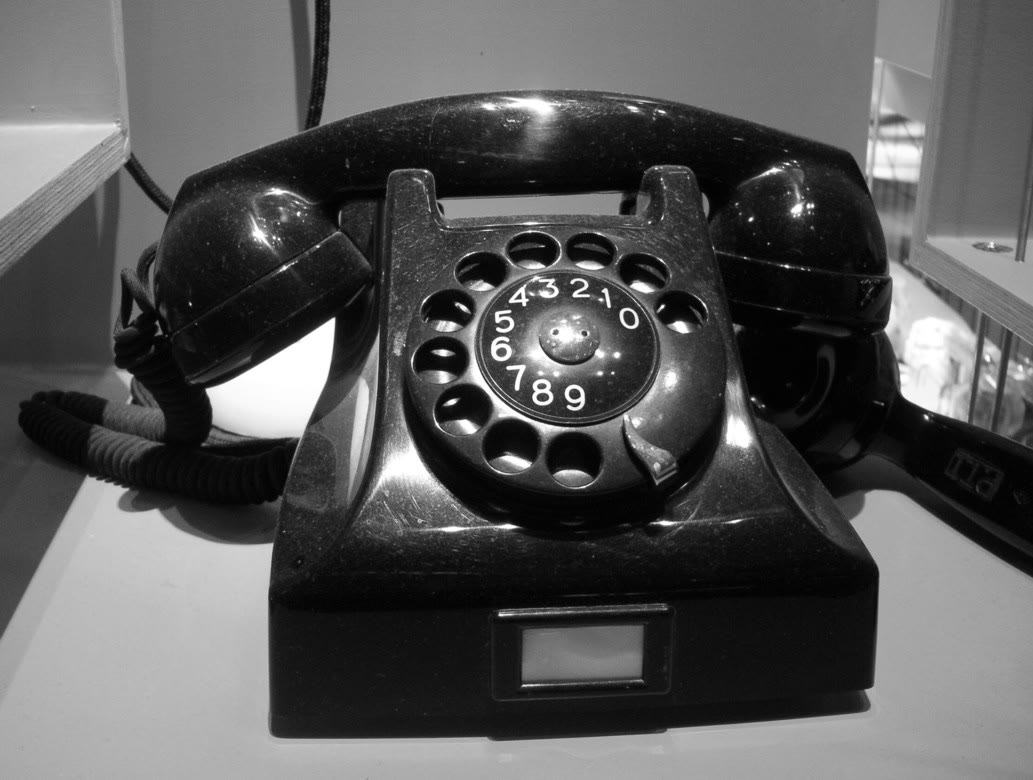
The first fully synthetic plastic was made by the chemist Leo Baekeland in 1907, from phenol, obtained from coal tar, and formaldehyde. Bakelite, hard, dark and heat-resistant, became the material of telephones, radios and electric switches. Nylon followed in the 1930s, then the plastics of bottles and bags after the Second World War.
15.3 The main plastics and their codes
Definition 15.4 (Resin identification code)
The resin identification code is a number from 1 to 7, printed inside a triangle of arrows on a plastic object, that names the plastic it is made of, so that it can be sorted for recycling. The triangle does not mean that the object will be recycled.
Proposition 15.5 (Seven codes)
The codes, with the commonest uses of each plastic:
| code | plastic | typical objects |
|---|---|---|
| 1 | PET, polyethylene terephthalate | water and soda bottles, fleece fibres |
| 2 | HDPE, high-density polyethylene | milk and shampoo bottles, caps |
| 3 | PVC, polyvinyl chloride | pipes, window frames, cables |
| 4 | LDPE, low-density polyethylene | bags, films |
| 5 | PP, polypropylene | yogurt pots, bottle caps, car bumpers |
| 6 | PS, polystyrene | foam cups and trays, CD cases |
| 7 | other plastics | mixtures, multilayer packaging |

15.4 Thermoplastics and thermosets
Definition 15.6 (Thermoplastic and thermoset)
A thermoplastic softens each time it is heated and hardens again when it cools: it can be melted and moulded again and again (PET, polyethylene, PVC, polypropylene, polystyrene). A thermoset sets for good when it is first heated and moulded: heated again, it does not soften but chars (Bakelite, the resins of glues and of boat hulls).
Remark 15.7 (Which can be recycled)
Thermoplastics can be melted and remoulded: they are the plastics that are recycled into new objects. Thermosets cannot be melted again.
15.5 Plastics in the environment
Proposition 15.8 (Plastics last)
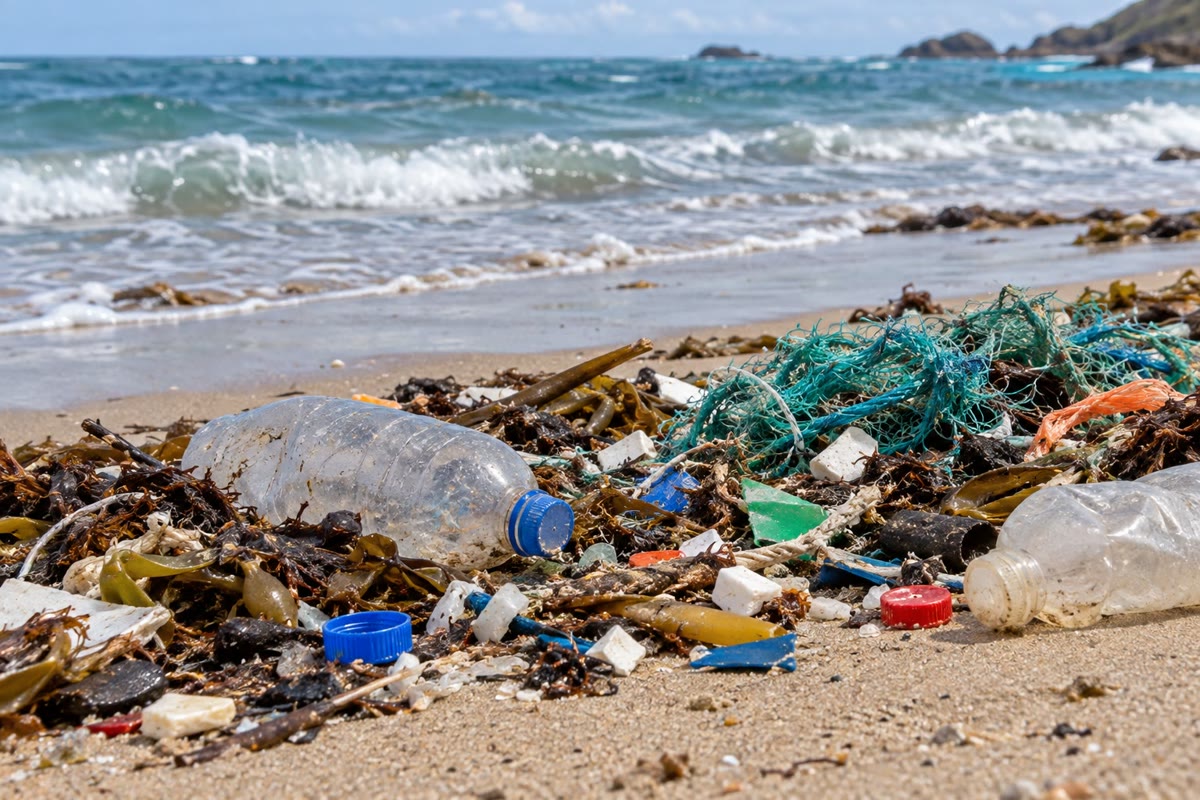
The world used about 460 million tonnes of plastics in 2019 and threw away about 353 million tonnes of plastic waste; recycled plastic made up only about of the plastic used. Plastics do not rot: in nature they break into smaller and smaller pieces, the microplastics, which are found in rivers, oceans, soils and the bodies of animals.
Remark 15.9 (Burning plastics)
Plastics burn, and they make carbon dioxide when they burn completely. But burnt in a garden fire they burn incompletely and release soot, carbon monoxide and other harmful substances; PVC, which contains chlorine, gives off hydrogen chloride, a corrosive gas. Plastic waste is burnt only in incinerators built to clean their fumes.
15.6 Exercises
Exercise 15.1 ★
Natural, artificial or synthetic? Cotton, nylon, paper, wool, polystyrene, viscose.
Solution
Solution of Exercise 15.1.
Natural: cotton, wool. Artificial: paper, viscose. Synthetic: nylon, polystyrene.
Exercise 15.2 ★
From which raw material are most plastics made?
Solution
Solution of Exercise 15.2.
From crude oil (or natural gas).
Exercise 15.3 ★
Which plastic has the code 1? Give one object made of it.
Solution
Solution of Exercise 15.3.
PET (polyethylene terephthalate): water and soda bottles.
Exercise 15.4 ★
What is the difference between a thermoplastic and a thermoset?
Solution
Solution of Exercise 15.4.
A thermoplastic softens each time it is heated and can be remoulded; a thermoset sets for good the first time and chars instead of softening.
Exercise 15.5 ★★
A yogurt pot carries the code 5. Name its plastic, and say whether it could in principle be melted and remoulded.
Solution
Solution of Exercise 15.5.
Polypropylene (PP), a thermoplastic: it can be melted and remoulded.
Exercise 15.6 ★★
Why does a triangle of arrows on an object not mean that the object will be recycled?
Exercise 15.7 ★★
Why is the handle of a frying pan often made of a thermoset rather than a thermoplastic?
Solution
Solution of Exercise 15.7.
A pan gets hot: a thermoplastic would soften, a thermoset does not.
Exercise 15.8 ★★
Using the figures of this chapter for 2019, what percentage of the plastic used became waste that year? Round to the nearest whole number.
Solution
Solution of Exercise 15.8.
: about .
Exercise 15.9 ★★
Why must PVC never be burnt in a garden fire?
Solution
Solution of Exercise 15.9.
PVC contains chlorine: burning it gives off hydrogen chloride, a corrosive gas, besides soot and carbon monoxide from the incomplete combustion of a garden fire.
Exercise 15.10 ★★
A school uses 300 bottles of each per week, during 36 weeks of the year. What mass of plastic is that in a year?
Solution
Solution of Exercise 15.10.
bottles; g, that is .
Exercise 15.11 ★★★
Polyethylene is made of carbon and hydrogen only. Write the products of its complete combustion. Explain why burning it adds carbon dioxide to the air like a fossil fuel.
Solution
Solution of Exercise 15.11.
Carbon dioxide and water. Its carbon comes from crude oil, stored underground for millions of years: burning it adds carbon dioxide to the air, as burning a fossil fuel does.
Exercise 15.12 ★★★
Explain how a plastic bottle lost at sea can end up, years later, as microplastics inside a fish.
Solution
Solution of Exercise 15.12.
The bottle does not rot: sun and waves break it into smaller and smaller pieces. The tiny pieces float or sink in the water, and fish swallow them with their food.
15.7 Problem: The Sorting Line
Problem 15.1
Weekend problem — a tonne of used bottles, their codes, and the clean plastic flakes that come out of the plant
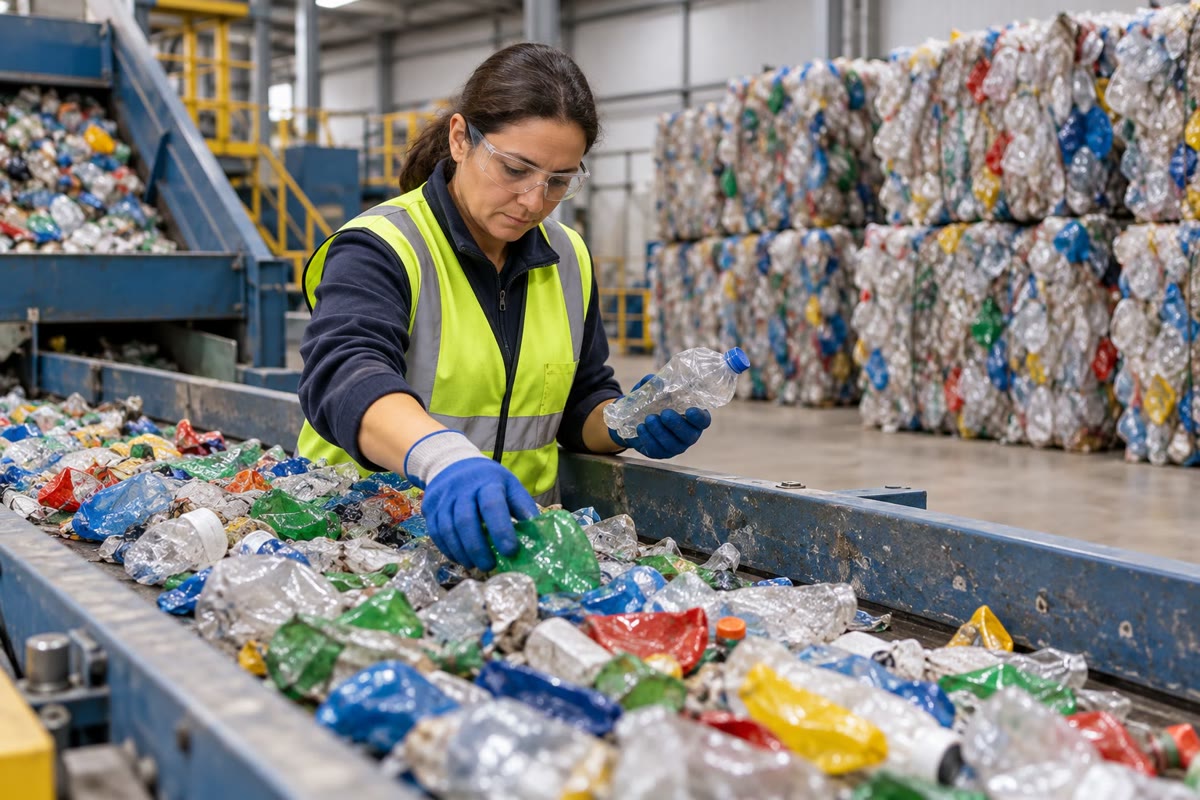
A recycling plant receives bales of used drink bottles. A typical bale of () holds, by mass: of bottle bodies in PET, of caps (HDPE and PP), of labels (PP film) and of dirt and leftover liquid. Machines separate the caps and labels from the bodies, the PET is ground into flakes, and the flakes are washed; the washing loses of the PET. The clean flakes are melted and spun into the fibres of fleece jackets.
Part I — The plastics.
- Which code is printed on the bottle bodies? On the caps?
- Are these plastics natural, artificial or synthetic?
- Can PET be melted and spun again? What kind of plastic does this make it?
- Why are the caps and labels separated from the bodies before the PET is melted?
Part II — The bale.
- What mass of PET does a bale contain?
- What mass of caps? Of labels?
- What mass of the bale is not plastic?
- What percentage of the bale is plastic?
Part III — The flakes.
- What mass of PET is lost in the washing?
- A fleece jacket needs of PET fibre. Why is it better to make it from flakes than from new PET?
- The plant could burn the caps and labels for heat instead of recycling them. Name the gas this would add to the air.
- Compute the mass of clean PET flakes that one bale gives.
Solution
Solution of Problem 15.1.
1. Bodies: 1 (PET). Caps: 2 (HDPE) or 5 (PP).
2. Synthetic: they are made from substances built by chemists, mostly from oil.
3. Yes: PET is a thermoplastic.
4. Each plastic is recycled on its own: melted together, a mixture of plastics gives a poor material.
5. .
6. Caps: . Labels: .
7. of dirt and liquid.
8. .
9. .
10. The flakes save crude oil and the energy of making new PET, and they turn waste into a useful object.
11. Carbon dioxide (and, if the burning is poor, carbon monoxide and soot).
12. of clean PET flakes per bale.