School Chemistry — Grades 1 to 12 · Grades 1–12
24Lewis Structures and the Shape of Molecules
A molecule of carbon dioxide is straight; a molecule of water is bent. That single difference in shape is one of the reasons why water, with molecules lighter than those of carbon dioxide, is a liquid at room temperature while carbon dioxide is a gas. Atoms in a molecule are held together by shared electrons, and the way the electrons are shared decides the shape. This chapter draws the shared electrons, and from them predicts the shape.
You already know
The valence electrons are those of the outer shell; atoms tend to reach the configuration of a noble gas, eight electrons in the outer shell (octet rule) or two for hydrogen (duet rule) (Chapter 23). Molecular models show atoms as balls and bonds as sticks (Chapter 11).
24.1 The covalent bond
Definition 24.1 (Covalent bond)
A covalent bond is a pair of electrons shared by two atoms; each atom usually provides one electron of the pair. Both atoms count the shared pair in their outer shell, which lets both reach a duet or an octet.
Definition 24.2 (Bonding pairs and lone pairs)
In a molecule, the valence electrons of each atom are grouped in pairs. A bonding pair is shared between two atoms and forms a covalent bond; a lone pair belongs to a single atom and takes no part in a bond.
Proposition 24.3 (How many bonds an atom forms)
An atom forms as many covalent bonds as it lacks electrons to complete its duet or octet:
| atom | valence electrons | bonds | lone pairs | example |
|---|---|---|---|---|
| H | 1 | 1 | 0 | |
| C | 4 | 4 | 0 | |
| N | 5 | 3 | 1 | |
| O | 6 | 2 | 2 | |
| Cl | 7 | 1 | 3 |
24.2 Lewis structures
Definition 24.4 (Lewis structure)
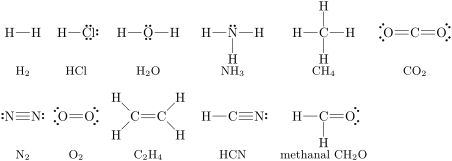
The Lewis structure of a molecule shows its atoms by their symbols, each bonding pair by a line between two atoms and each lone pair by a pair of dots next to its atom.
Definition 24.5 (Double and triple bonds)
Two atoms may share two pairs of electrons, a double bond, drawn as two lines, or three pairs, a triple bond, drawn as three lines.
Method 24.6 (Drawing a Lewis structure)
- Add up the valence electrons of all the atoms, and halve to get the number of pairs.
- Join the atoms by single bonds (hydrogen, which forms one bond, is always on the outside; carbon is usually central).
- Place the remaining pairs as lone pairs, first on the outer atoms, to complete their octets.
- If an atom still lacks an octet, turn a lone pair of a neighbour into a second (or third) shared pair.
- Check: every hydrogen has 2 electrons, every other atom 8, and all the pairs have been used.
Example 24.7 (Carbon dioxide)
: valence electrons, 8 pairs. Single bonds use 2 pairs; 6 lone pairs on the oxygens complete them, but carbon then has only 4 electrons. Turning one lone pair of each oxygen into a shared pair gives two double bonds: each atom now has an octet.
24.3 The shape of molecules
Proposition 24.8 (Electron pairs keep as far apart as possible)
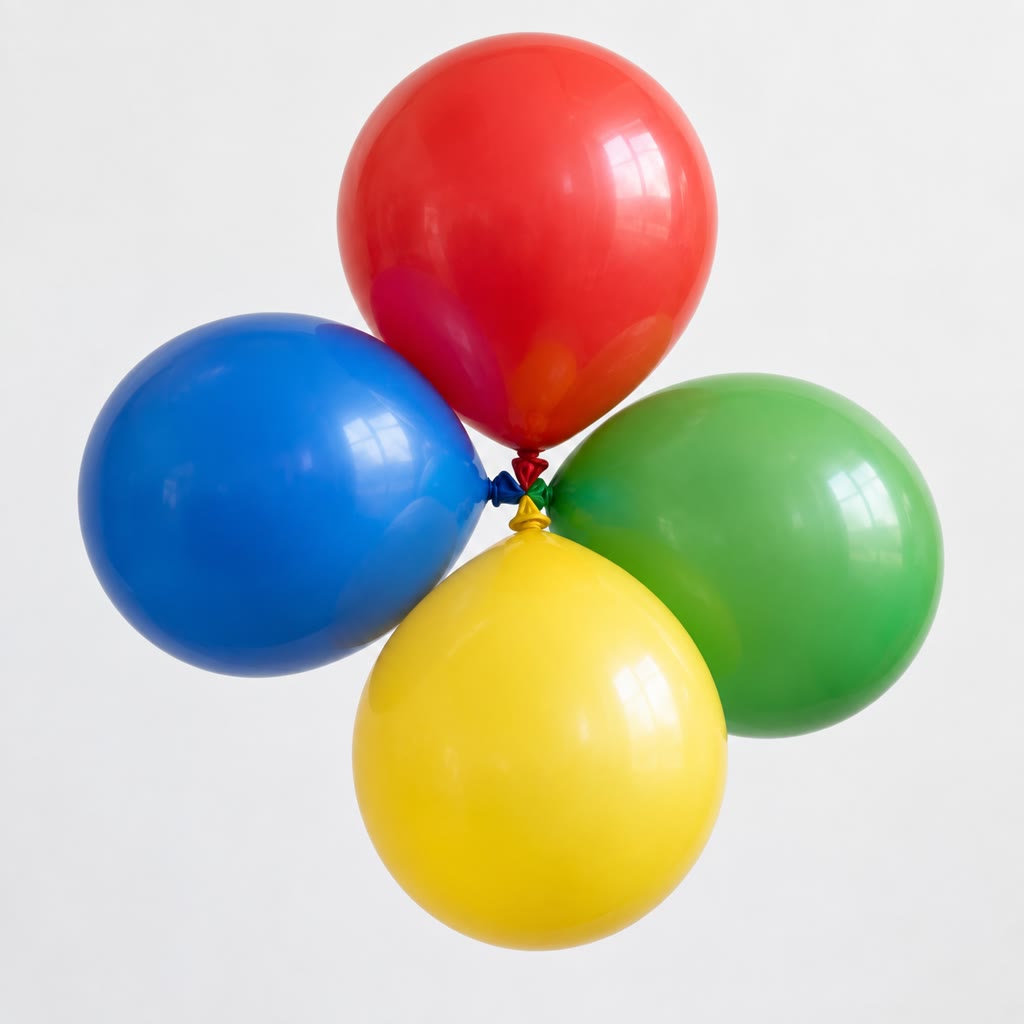
Around a central atom, the groups of electrons — each single, double or triple bond, and each lone pair — repel one another and settle as far apart as possible. The shape of the molecule follows:
| groups around the centre | of which lone pairs | shape | example |
|---|---|---|---|
| 2 | 0 | linear, angle | , |
| 3 | 0 | flat triangle, angle | , |
| 4 | 0 | tetrahedron, angle | |
| 4 | 1 | pyramid | |
| 4 | 2 | bent |
Proof. Admitted at this level. ∎
Remark 24.9 (Where this comes from)
This rule is a model, and it works remarkably well for small molecules; it is made precise, and partly explained, in the Year 1 volume. Lone pairs take up a little more room than bonding pairs: the angle in ammonia () and in water () is a little smaller than the of methane.

24.4 Drawing molecules in space
Notation 24.10 (Wedges and dashes)
To draw a molecule in space on flat paper, a bond in the plane of the paper is a plain line, a bond pointing towards the reader a solid wedge, and a bond pointing away a dashed wedge. Methane is then drawn as below: two bonds in the plane, one towards and one away from the reader.

24.5 Exercises
Exercise 24.1 ★
What is a covalent bond? What is a lone pair?
Solution
Solution of Exercise 24.1.
A pair of electrons shared by two atoms. A pair of valence electrons belonging to one atom only, not shared.
Exercise 24.2 ★
How many covalent bonds do hydrogen, carbon, nitrogen and oxygen usually form? Explain with the octet and duet rules.
Exercise 24.3 ★
Draw the Lewis structure of hydrogen chloride, , and count the electrons around chlorine.
Solution
Solution of Exercise 24.3.
 : chlorine has the shared pair and three lone pairs, 8 electrons.
Exercise 24.4 ★
How many valence electrons, in all, does the molecule have? How many pairs?
Exercise 24.5 ★
Give the shape of , , and .
Solution
Solution of Exercise 24.5.
: tetrahedron. : pyramid. : bent. : linear.
Exercise 24.6 ★★
Draw the Lewis structure of hydrogen sulfide, (sulfur is in the group of oxygen), and predict its shape.
Solution
Solution of Exercise 24.6.
 : like water, four groups around sulfur of which two lone pairs: bent.
Exercise 24.7 ★★
Draw the Lewis structure of nitrogen, , following the method step by step.
Solution
Solution of Exercise 24.7.
electrons, 5 pairs. A single bond and 4 lone pairs leave each nitrogen with 6 electrons; turning two lone pairs into shared pairs gives a triple bond and one lone pair on each atom:  .
.
Exercise 24.8 ★★
Draw the Lewis structure of methanol, , and give the shape around the carbon and around the oxygen.
Solution
Solution of Exercise 24.8.
 : four bonds around carbon, tetrahedral; around oxygen two bonds and two lone pairs, bent.
Exercise 24.9 ★★
Why is linear and bent, although both have a central atom joined to two others?
Solution
Solution of Exercise 24.9.
In carbon has two groups (two double bonds) and no lone pair: they point in opposite directions. In oxygen has four groups (two bonds, two lone pairs) in a tetrahedral arrangement: the two bonds make an angle.
Exercise 24.10 ★★
Draw the Lewis structure of ethene, , and give the shape around each carbon atom.
Solution
Solution of Exercise 24.10.
 : around each carbon, three groups (one double bond, two single bonds): a flat triangle, angles near .
Exercise 24.11 ★★
Draw the Lewis structure of tetrachloromethane, , and predict its shape.
Solution
Solution of Exercise 24.11.
Carbon in the centre, four single bonds to chlorine atoms each with three lone pairs: four groups around carbon, a tetrahedron.
Exercise 24.12 ★★★
Two molecules have the formula . Draw a Lewis structure for each (one has an O–H bond, the other a C–O–C chain).
Solution
Solution of Exercise 24.12.
Ethanol, 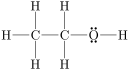 , and methoxymethane,
 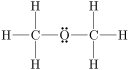 .
.
Exercise 24.13 ★★★
Explain, using lone pairs, why the angle in ammonia () is smaller than in methane (), and in water () smaller still.
Solution
Solution of Exercise 24.13.
A lone pair takes up a little more room than a bonding pair and pushes the bonds closer together. Ammonia has one lone pair, water two: the angle shrinks from methane to ammonia to water.
Exercise 24.14 ★★★
Draw the Lewis structure of hydrogen cyanide, , and of methanal, , and give their shapes.
Solution
Solution of Exercise 24.14.
 : two groups around carbon, linear.
  : three groups around carbon, a flat triangle.
Exercise 24.15 ★★★
Ozone, , is a chain of three oxygen atoms. Count its valence pairs and draw a Lewis structure in which every oxygen has an octet (one double bond, one single bond). Predict whether the molecule is linear or bent.
Solution
Solution of Exercise 24.15.
electrons, 9 pairs:  . The central oxygen has three groups (a double bond, a single bond, a lone pair): the molecule is bent.
24.6 Problem: A Molecule in a Cube
Problem 24.1
Weekend problem — designing the carbon balls of a molecular model kit: at what angle must the holes be drilled?
A company makes molecular model kits. The black carbon balls must have four holes, so that methane, ethane and the other molecules of carbon come out with the right shape. The engineer uses a trick: a regular tetrahedron fits inside a cube, its four corners on four corners of the cube, none two on the same edge.
Part I — Lewis structures.
- Draw the Lewis structures of methane , ammonia and water .
- How many groups of electrons surround the central atom in each?
- How many of them are lone pairs?
- Why does a carbon ball need four holes, and an oxygen ball (for water) only two?
- A model of ethane, , uses two carbon balls. Draw its Lewis structure. How many sticks join the two carbon balls, and how many hydrogen balls are needed?
Part II — Shapes.
- Give the shape of each of the three molecules.
- The measured angles are in ammonia and in water. Explain why they are smaller than the angle of methane.
- Why can the oxygen ball for water not simply be a carbon ball with two holes left empty, if the kit is to show the true angle?
- In carbon dioxide, the carbon atom forms two double bonds. Which angle must separate them in a model?
Part III — The cube. Take a cube of side . The carbon atom is at its centre; the four hydrogen atoms sit on four corners of the cube, none two on the same edge.
- Show that any two of these hydrogen atoms are at the two ends of a diagonal of a face of the cube. Using Pythagoras, compute the distance between them in terms of .
- The diagonal of the whole cube (from a corner to the opposite corner) has length . Deduce the distance from the carbon atom to a hydrogen atom.
- Take in a model: give both distances in centimetres, to two decimal places.
- Why are the four C–H distances equal?
Part IV — The angle. The carbon atom C and two hydrogen atoms H, H form an isosceles triangle. Let M be the midpoint of HH.
- Explain why the triangle C M H has a right angle at M.
- Compute, in this right triangle, the sine of the angle , half of the angle H–C–H.
- Deduce the half-angle, then the angle H–C–H, to one decimal place.
- Compare with the angle of the table of this chapter.
- State the angle at which the holes of a carbon ball must be drilled.
Solution
Solution of Problem 24.1.
1.  ,
,  ,
,  .
.
2. Four groups in each.
3. None for methane, one for ammonia, two for water.
4. Carbon forms four bonds; oxygen forms two (its two other groups are lone pairs, which a kit does not show with sticks).
5.  : one stick joins the two carbon balls, and six hydrogen balls are needed.
6. Tetrahedron, pyramid, bent.
7. Lone pairs take more room than bonding pairs and squeeze the bonds together; water, with two lone pairs, has the smallest angle.
8. A carbon ball’s holes make ; water’s true angle is : an oxygen ball needs its own two holes at .
9. : two groups around carbon point in opposite directions, and the molecule is linear.
10. Two corners not on the same edge are opposite corners of one face: their distance is the face diagonal, .
11. The centre is halfway along a body diagonal: .
12. H–H: ; C–H: .
13. Each hydrogen is at a corner of the cube and carbon at its centre: every corner is at the same distance from the centre.
14. The triangle C H H is isosceles (C H = C H); the line from its apex to the midpoint of the base is perpendicular to the base.
15. .
16. Half-angle ; angle H–C–H .
17. It is the of the tetrahedron in the table.
18. The holes must be drilled at from one another.