School Chemistry — Grades 1 to 12 · Grades 1–12
33Functional Groups and Families
Open a bottle of vinegar, a bottle of nail-varnish remover, a bag of pear drops, and walk past a fishmonger’s stall: four smells, sharp, sweet-solvent, fruity and fishy, and four different kinds of molecule. Each owes its smell, and most of its chemistry, not to its carbon skeleton but to a small group of atoms attached to it: oxygen and hydrogen in one place, a nitrogen atom in another. Chemists sort organic compounds by these groups.
You already know
Skeletal formulas, the names of alkanes and alkyl groups, isomers (Chapter 32). Polar bonds and hydrogen bonds (Chapter 30).
33.1 Functional groups
Definition 33.1 (Functional group)
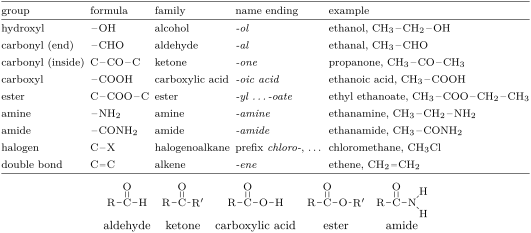
A functional group is a group of atoms, other than the carbon and hydrogen atoms of the skeleton linked only by single bonds, that gives a molecule its characteristic reactions. The compounds that share a functional group form a family.
33.2 Alcohols and their class
Definition 33.2 (Alcohol, class of an alcohol)
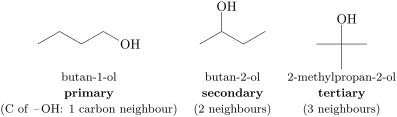
An alcohol has a hydroxyl group bonded to a carbon atom that has only single bonds. The class of an alcohol is primary, secondary or tertiary according to whether the carbon atom bearing the is bonded to one, two or three other carbon atoms. (Methanol, , whose carbon is bonded to none, is counted with the primary alcohols.)
33.3 Aldehydes, ketones, acids and esters
Definition 33.3 (Aldehyde, ketone)
A carbonyl group is a double bond. If its carbon atom is at the end of the chain (bonded to at least one hydrogen atom), the compound is an aldehyde; if it is inside the chain (bonded to two carbon atoms), the compound is a ketone.
Definition 33.4 (Carboxylic acid, ester)
A carboxylic acid has a carboxyl group , a carbonyl and a hydroxyl on the same carbon atom. An ester has the group between two carbon chains: it is related to an acid, whose has been replaced by an R coming from an alcohol.
Example 33.5 (Ethyl ethanoate)
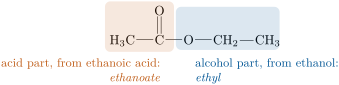
The solvent ethyl ethanoate, , smells of pear drops and nail-varnish remover. Its “acid part”, , comes from ethanoic acid and gives the second word of the name, ethanoate; its “alcohol part”, , comes from ethanol and gives the first word, ethyl. A later chapter shows how an ester is made from its acid and its alcohol.
33.4 Amines, amides, halogenoalkanes and alkenes
Definition 33.6 (Amine, amide)
An amine has a nitrogen atom bonded to a carbon chain by a single bond, as in . An amide has a nitrogen atom bonded to the carbon of a carbonyl group, as in .
Definition 33.7 (Halogenoalkane, alkene)
A halogenoalkane is an alkane in which one or more hydrogen atoms are replaced by halogen atoms (F, Cl, Br, I). An alkene has a carbon–carbon double bond, .
Remark 33.8 (Smells and groups)
Many small amines smell of rotten fish, and the smell of fish that is no longer fresh is largely due to them. Many small esters smell of fruit. Small carboxylic acids smell sharp, like vinegar; propanone, a ketone, is the familiar solvent smell of nail-varnish remover.
33.5 Naming
Method 33.9 (Naming an organic compound with one functional group)
- Find the longest carbon chain that contains the carbon of the functional group (or, for an alcohol or an amine, the carbon that bears it): it gives the root.
- Number the chain from the end that gives the functional group the lowest number.
- Replace the -e of the alkane by the ending of the family, preceded by the position of the group if needed: propan-2-ol, butan-2-one. (Aldehydes, acids and amides have their group at carbon 1: no number.)
- Add the alkyl substituents as prefixes, with their positions, as for alkanes; a halogen is always a prefix (2-chloropropane).
Example 33.10 (Four names)
 is propan-2-ol (a secondary alcohol);
  is butan-2-one;
  is butanoic acid;
  is 3-methylbutanal.
Safety


Propanone is highly flammable and irritating to the eyes; its vapour makes one drowsy. Pure ethanoic acid is flammable and causes severe burns of the skin and the eyes; vinegar is a dilute solution of it. Smells are never tested by sniffing a flask: the vapour is wafted gently towards the nose with the hand, and only when the teacher says so.
33.6 Exercises
Exercise 33.1 ★
Name the functional group and the family of each compound: ; ; ; ; .
Exercise 33.2 ★
Name: ; ; ; ; .
Solution
Solution of Exercise 33.2.
Methanol; propan-1-ol; methanoic acid; propanal; propanone.
Exercise 33.3 ★
To which family does each compound belong: butan-2-ol, pentanal, methyl propanoate, propanamide, 2-bromopropane, but-1-ene?
Exercise 33.4 ★
Write the semi-structural formulas of propanal and of propanone. Which is the aldehyde? How do you tell?
Exercise 33.5 ★
Give the class of propan-1-ol, propan-2-ol and 2-methylpropan-2-ol.
Solution
Solution of Exercise 33.5.
Primary (the carbon bearing has one carbon neighbour); secondary (two); tertiary (three).
Exercise 33.6 ★★
Draw the skeletal formulas of pentan-3-ol, 2-methylbutanoic acid, hexan-2-one and propyl ethanoate.
Solution
Solution of Exercise 33.6.
Pentan-3-ol  ; 2-methylbutanoic acid
  ; hexan-2-one
  ; propyl ethanoate
  .
.
Exercise 33.7 ★★
Propanal and propanone have the same molecular formula. Give it. Are they isomers? Do they have the same functional group?
Exercise 33.8 ★★
Write the semi-structural formula and the name of the ester whose acid part comes from methanoic acid and whose alcohol part comes from ethanol; then of the ester from ethanoic acid and propan-1-ol.
Solution
Solution of Exercise 33.8.
, ethyl methanoate; , propyl ethanoate.
Exercise 33.9 ★★
Name the esters , and , and give the acid and the alcohol each is related to.
Solution
Solution of Exercise 33.9.
Methyl ethanoate (ethanoic acid, methanol); ethyl propanoate (propanoic acid, ethanol); methyl methanoate (methanoic acid, methanol).
Exercise 33.10 ★★
Draw and name the four alcohols of formula , and give the class of each.
Solution
Solution of Exercise 33.10.
 |  |  |  |
| butan-1-ol | butan-2-ol | 2-methylpropan-1-ol | 2-methylpropan-2-ol |
| primary | secondary | primary | tertiary |
Exercise 33.11 ★★
Using the table of groups: what is the family of ? What ending does the name of an alkene take? Which families have a carbonyl group with an oxygen or nitrogen atom on the same carbon?
Solution
Solution of Exercise 33.11.
An amide (ethanamide). -ene. Carboxylic acids ( and on the same carbon), esters ( and ) and amides ( and ): three families.
Exercise 33.12 ★★★
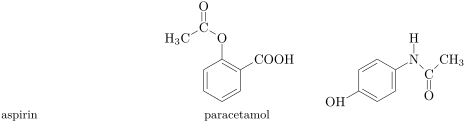
Circle and name the functional groups of aspirin and of paracetamol. (An bonded directly to a ring like that of paracetamol is called a phenol group; it behaves differently from an alcohol.)
Solution
Solution of Exercise 33.12.
Aspirin: a carboxyl group (carboxylic acid) and an ester group. Paracetamol: a phenol on the ring and an amide group .
Exercise 33.13 ★★★
Ethanol and methoxymethane have the same molecular formula. Give it. Methoxymethane belongs to a family not in the table, the ethers. Which of the two can form hydrogen bonds between its own molecules? Which boils higher (one boils at , the other at )?
Solution
Solution of Exercise 33.13.
. Only ethanol, with its , forms hydrogen bonds between its molecules (methoxymethane has no hydrogen on its oxygen). Ethanol boils higher, at ; methoxymethane at .
Exercise 33.14 ★★★
Lactic acid, made by tired muscles, is 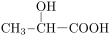 . Name its two functional groups. When a molecule has an acid group and another group, the acid gives the ending and the other group becomes a prefix (hydroxy- for , amino- for ). Name lactic acid, then glycine, .
Solution
Solution of Exercise 33.14.
A hydroxyl group and a carboxyl group. The chain has three carbons, the acid carbon being carbon 1 and the on carbon 2: 2-hydroxypropanoic acid. Glycine: 2-aminoethanoic acid (often written aminoethanoic acid).
Exercise 33.15 ★★★
Wine left open to the air turns into vinegar: ethanol becomes ethanoic acid, through ethanal. Write the semi-structural and molecular formulas of the three compounds and their families. What changes in the formula at each step?
Solution
Solution of Exercise 33.15.
Ethanol , , alcohol; ethanal , , aldehyde; ethanoic acid , , carboxylic acid. From ethanol to ethanal two hydrogen atoms are lost; from ethanal to ethanoic acid one oxygen atom is gained.
33.7 Problem: Fruit Flavours
Problem 33.1
Weekend problem — a flavour chemist builds the smell of banana: what is the molar mass of the key molecule?
A flavour chemist has five compounds on her bench:
| A |  |
| B | 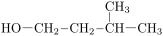 |
| C | |
| D | |
| E |
A smells of banana and pear drops, B of malt, C of vinegar, D of cut grass, E of pineapple.
Part I — Groups and families.
- Name the functional group of each compound.
- Give the family of each.
- Which compounds are esters? Which smells do they have?
- What is the class of the alcohol B?
- Give the molecular formula of D, and draw an isomer of D that is a ketone.
Part II — Names.
- Name B (find the longest chain that holds the carbon bearing ).
- Name C and D.
- Name E, and give the acid and the alcohol it is related to.
- Explain the name of A, 3-methylbutyl ethanoate: which part comes from the acid, which from the alcohol?
Part III — From an acid and an alcohol.
- To which two compounds of the bench is A related?
- Give the molecular formulas of A, B and C.
- An ester is made from its acid and its alcohol with loss of one small molecule. Using the formulas, find which.
- Write the equation of the formation of A, in molecular formulas, and check that it is balanced.
Part IV — Molar masses.
- Compute the molar masses of B and C.
- Deduce the molar mass of A from the equation of question 13.
- Compute the molar mass of A directly from its formula, and compare.
- An unknown fruity sample is found to have a molar mass close to . Is it A or E?
- Heptanoic acid, , smells rancid. Show that it is an isomer of A. Can a molar mass alone identify a compound?
- Why do chemists say the smell belongs to the functional group as much as to the skeleton? Use A and heptanoic acid.
- State the final answer: what is the molar mass of the banana ester, 3-methylbutyl ethanoate?
Solution
Solution of Problem 33.1.
1. A: ester group; B: hydroxyl; C: carboxyl; D: carbonyl at the end of the chain; E: ester group.
2. A ester, B alcohol, C carboxylic acid, D aldehyde, E ester.
3. A (banana) and E (pineapple): fruity smells.
4. Primary: the carbon bearing is bonded to one carbon.
5. ; for example hexan-2-one, .
6. The chain holding the has four carbons, numbered from the , with a methyl on carbon 3: 3-methylbutan-1-ol.
7. C: ethanoic acid; D: hexanal.
8. Ethyl butanoate, related to butanoic acid and ethanol.
9. Ethanoate: the acid part , from ethanoic acid; 3-methylbutyl: the alcohol part, from 3-methylbutan-1-ol.
10. C (ethanoic acid) and B (3-methylbutan-1-ol).
11. A ; B ; C .
12. contains , one more than : water.
13. : C 7 = 7, H 16 = 16, O 3 = 3.
14. ; .
15. .
16. : the same.
17. E, : .
18. : same formula as A, so an isomer, with the same molar mass. A molar mass alone cannot tell isomers apart.
19. A and heptanoic acid have the same atoms but different groups, an ester and a carboxylic acid: one smells of banana, the other rancid. The group, and where it sits, decides.
20. .