School Chemistry — Grades 1 to 12 · Grades 1–12
12Chemical Reactions: Reactants and Products
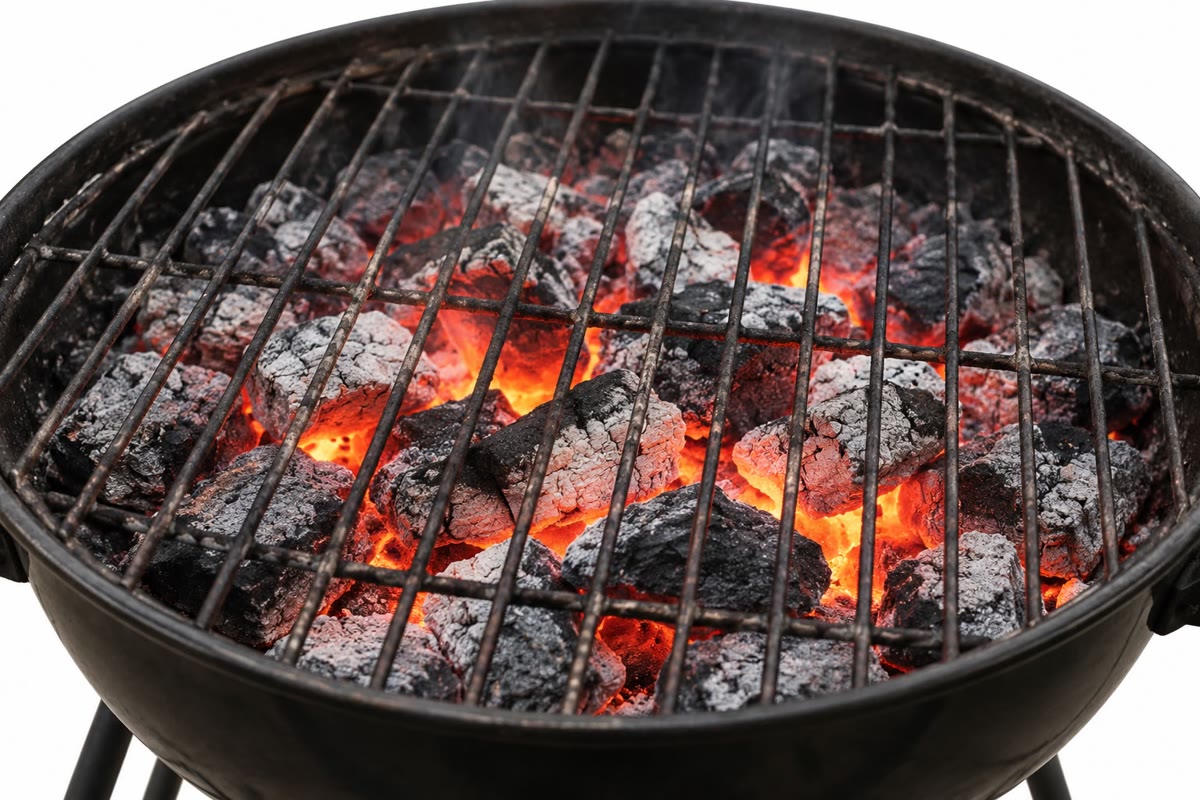
Charcoal glows in a barbecue. An hour later almost nothing is left of the black lumps — a little grey ash, and the heat that cooked the meal. Where has the black carbon gone? It has not vanished: it has met the oxygen of the air and become a new, invisible gas. With atoms and molecules in hand, we can now say exactly what happens in such a change.
You already know
In a chemical change new substances appear and there is no simple way back (Chapter 6). Limewater turns milky with carbon dioxide, anhydrous copper sulfate turns blue with water (Chapter 10). All matter is made of atoms, which group into molecules; a formula such as lists the atoms of a molecule (Chapter 11).
12.1 Physical and chemical transformations
Definition 12.1 (Physical transformation)
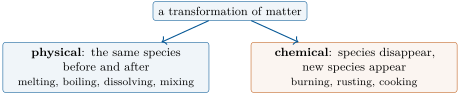
A physical transformation changes the state or the arrangement of matter without changing the chemical species: melting, freezing, boiling, dissolving, mixing. The same species are present before and after; only their form or their arrangement has changed.
Example 12.2 (Water, three ways)
Ice melting into water, water boiling into water vapour, and salt dissolving in water are physical transformations: before and after, there are water molecules (and salt). Zooming in, the molecules are the same; only how they are arranged and how they move has changed.
Proposition 12.3 (Chemical transformation)
In a chemical change, also called a chemical transformation, some chemical species disappear and new ones appear. It is told apart from a physical transformation by its products: new species, which can be detected with characteristic tests.
12.2 Reactants and products
Definition 12.4 (Chemical reaction)
A chemical reaction is the model chemists use for a chemical transformation: it lists the species that are used up and the species that are formed.
Definition 12.5 (Reactants and products)
The species used up in a chemical reaction are the reactants; the species formed are the products.
Example 12.6 (Carbon burning in oxygen)
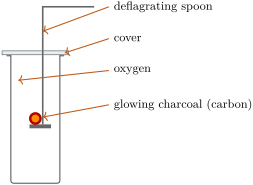
When charcoal burns, the reactants are carbon (the charcoal) and oxygen (from the air). The product is carbon dioxide: shaken with limewater, the gas left in the jar turns it milky.
In the lab — Charcoal in a jar of oxygen
The teacher heats a small piece of charcoal until it glows, on a deflagrating spoon, then lowers it into a jar of oxygen. The charcoal glows far brighter than in air and shrinks until it has gone. The jar is covered, a little limewater is poured in and shaken: it turns milky. Carbon and oxygen have been used up; carbon dioxide has been formed.
Example 12.7 (Steel wool)
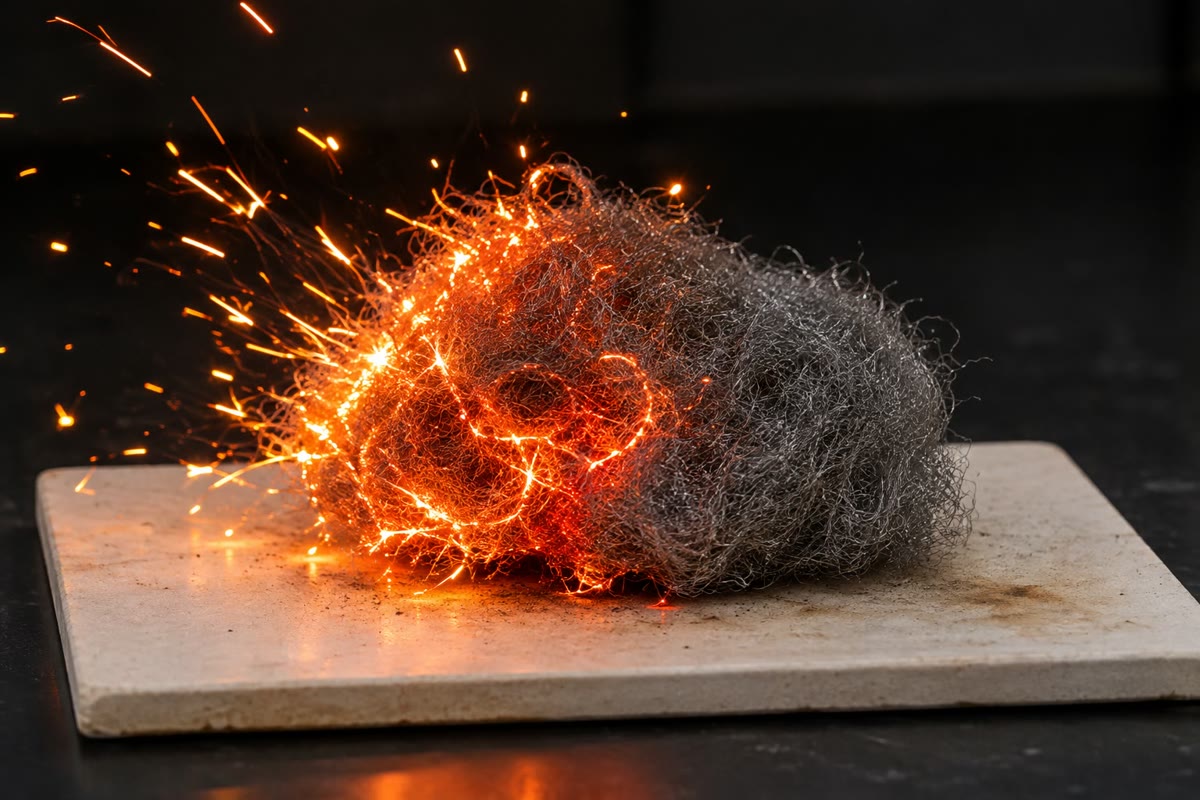
A pad of fine steel wool, which is mostly iron, can burn in air with showers of sparks. The reactants are iron and oxygen; the product is a dark, crumbly solid, an iron oxide.
12.3 The word equation
Definition 12.8 (Word equation)
A word equation writes a chemical reaction in words: the names of the reactants on the left, joined by , an arrow, and the names of the products on the right. The arrow reads “react to give”.
Example 12.9 (Three word equations)
| carbon oxygen carbon dioxide |
| methane oxygen carbon dioxide water |
| iron oxygen iron oxide |
Method 12.10 (Writing a word equation)
- Find the reactants: the species that disappear.
- Find the products: the new species, identified by tests.
- Write the reactants on the left, the products on the right, with an arrow between them; never an equals sign.
A species that is present but takes no part — the nitrogen of the air around a flame — is not written.
12.4 A reaction is a rearrangement of atoms
Proposition 12.11 (Atoms are rearranged)
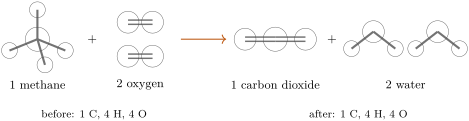
In a chemical reaction the molecules of the reactants are broken apart and their atoms join up differently to build the molecules of the products. The atoms themselves are neither created nor destroyed: the same atoms, in the same numbers, are there before and after.
Example 12.12 (Methane burning, molecule by molecule)
When the methane of a gas cooker burns, one methane molecule meets two oxygen molecules . Their atoms rearrange into one carbon dioxide molecule and two water molecules . Before: 1 carbon, 4 hydrogen and 4 oxygen atoms. After: 1 carbon, 4 hydrogen, and oxygen atoms. Nothing is lost, nothing appears from nowhere.
Remark 12.13 (Counting the molecules)
The word equation does not say how many molecules react: for that, the equation is written with formulas and numbers in front of them. Writing such equations, and finding the right numbers, is the subject of a later chapter.
12.5 Exercises
Exercise 12.1 ★
Physical or chemical transformation? Ice melting, a match burning, sugar dissolving, bread toasting, a nail rusting.
Solution
Solution of Exercise 12.1.
Physical: ice melting, sugar dissolving. Chemical: a match burning, bread toasting, a nail rusting.
Exercise 12.2 ★
What are the reactants and the products of a chemical reaction?
Exercise 12.3 ★
Write the word equation of the burning of carbon in oxygen.
Solution
Solution of Exercise 12.3.
carbon oxygen carbon dioxide.
Exercise 12.4 ★
In the word equation “iron oxygen iron oxide”, name the reactants and the product.
Exercise 12.5 ★★
When methane burns, a cold glass held above the flame mists up, and the gas collected turns limewater milky. Which products do these two tests show?
Solution
Solution of Exercise 12.5.
The mist shows water; the milky limewater shows carbon dioxide.
Exercise 12.6 ★★
Zinc reacts with hydrochloric acid: the zinc disappears, bubbles of hydrogen are given off, and zinc chloride stays in the solution. Write the word equation.
Solution
Solution of Exercise 12.6.
zinc hydrochloric acid zinc chloride hydrogen.
Exercise 12.7 ★★
Look at the model figure of methane burning. Count the hydrogen atoms before and after the reaction.
Exercise 12.8 ★★
Why is dissolving salt in water not a chemical reaction, although the salt disappears from sight?
Solution
Solution of Exercise 12.8.
No new species appears: the salt is still there, spread through the water, and it is got back by evaporating the water. It is a physical transformation.
Exercise 12.9 ★★
A log of wood burns down to a small heap of ash. Explain, using the word “products”, why the ash is so much lighter than the log.
Exercise 12.10 ★★
Hydrogen burns in oxygen to give water only. Write the word equation, and say which test would identify the product.
Solution
Solution of Exercise 12.10.
hydrogen oxygen water. The product turns anhydrous copper sulfate blue.
Exercise 12.11 ★★★
Two hydrogen molecules react with one oxygen molecule to give two water molecules . Count the atoms of each kind before and after, and show that none has been created or destroyed.
Exercise 12.12 ★★★
A student draws the burning of carbon as: one carbon atom one oxygen molecule one carbon dioxide molecule and one oxygen atom left over. What is wrong with this drawing? Draw the correct one in words.
12.6 Problem: Inside a Gas-Cooker Flame
Problem 12.1
Weekend problem — what burns in a gas-cooker flame, what it makes, and how many molecules take part
The gas of a kitchen cooker is mostly methane, . In its blue flame, methane reacts with the oxygen of the air. In a laboratory, the teacher holds a cold, dry beaker upside down above such a flame for a few seconds, then turns it over, pours in a little limewater and shakes it.
Part I — Reactants and products.
- Name the two reactants of this reaction.
- Droplets appear inside the cold beaker; a drop of them turns anhydrous copper sulfate blue. Which product does this show?
- The limewater turns milky. Which other product does this show?
- The air also contains nitrogen, which passes through the flame unchanged. Is nitrogen a reactant? Should it appear in the word equation?
Part II — The word equation.
- Write the word equation of the reaction.
- Is the burning of methane a physical or a chemical transformation? Give two reasons.
- Write the formulas of the four species of the reaction.
Part III — Counting molecules. Each methane molecule that burns reacts with two oxygen molecules, and gives one carbon dioxide molecule and two water molecules.
- Count the carbon, hydrogen and oxygen atoms in one methane molecule and two oxygen molecules, together.
- Count them in one carbon dioxide molecule and two water molecules, together. What do you notice?
- The flame burns 10 methane molecules. How many oxygen molecules does it use?
- How many carbon dioxide molecules does it make?
- How many water molecules does it make?
Solution
Solution of Problem 12.1.
1. Methane and oxygen.
2. Water.
3. Carbon dioxide.
4. No: it is not used up, and it is not written in the word equation.
5. methane oxygen carbon dioxide water.
6. Chemical: two species disappear (methane, oxygen), and two new species appear, detected by tests; and heat and light are given out.
7. , , , .
8. 1 carbon, 4 hydrogen, oxygen.
9. 1 carbon; hydrogen; oxygen. The same atoms in the same numbers: they have only been rearranged.
10. oxygen molecules.
11. 10 carbon dioxide molecules.
12. water molecules.