School Chemistry — Grades 1 to 12 · Grades 1–12
45Buffers and Predominance Diagrams
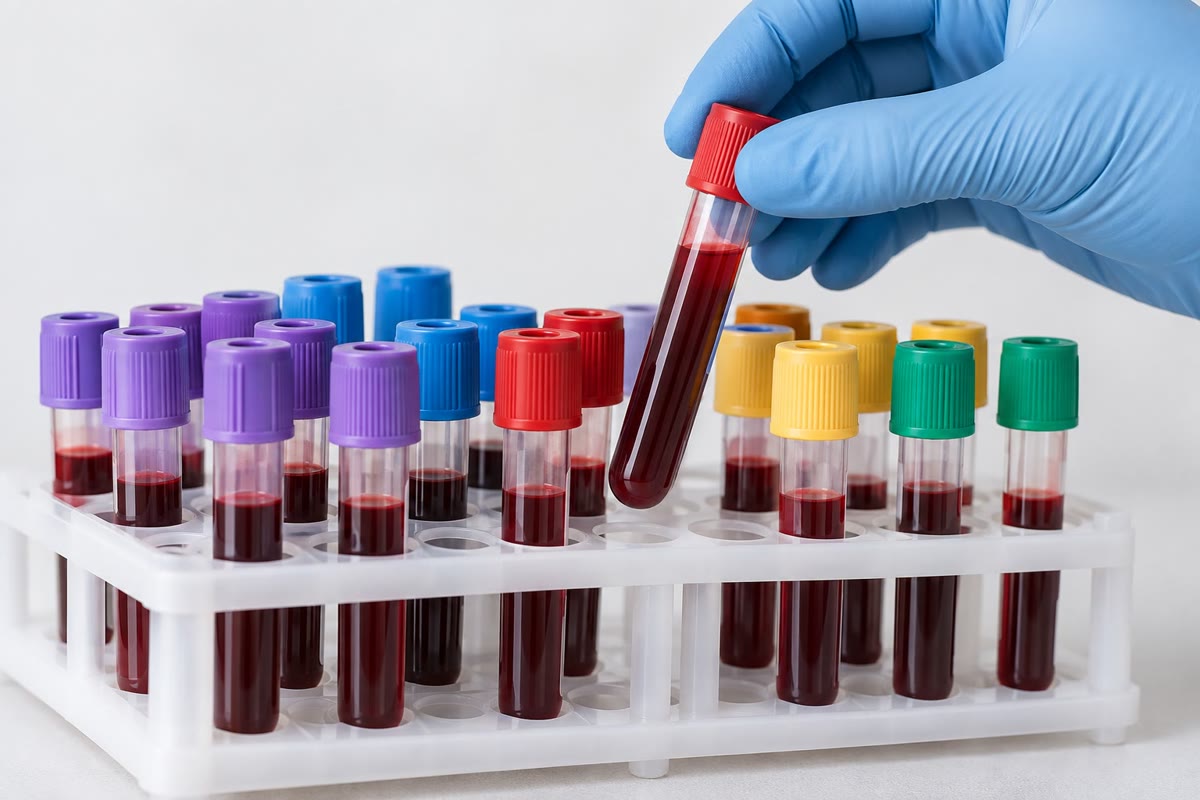
A blood test reports the pH of arterial blood: normally between 7.38 and 7.42. Muscles at work pour acids into the blood, the lungs blow carbon dioxide out of it, food brings in acids and bases; yet the pH hardly moves. A pair of species, an acid and its own base, absorbs these shocks. This chapter shows which form of a couple dominates at a given pH, how a few drops of a coloured couple reveal the pH, and how a mixture of an acid and its base holds the pH steady.
You already know
Acid–base couples, and ; the pH of a solution (Chapter 44, Chapter 18).
45.1 Predominance diagrams
Proposition 45.1 (Henderson’s relation)
In any aqueous solution containing the couple /,
Proof. From , take of both sides: . ∎
Definition 45.2 (Predominance and distribution diagrams)
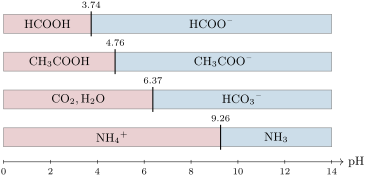
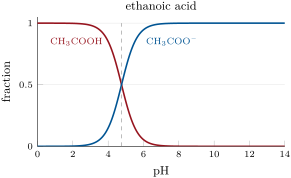
The predominance diagram of a couple is a pH axis divided at : below, the acid HA predominates (), above, the base . The distribution diagram shows the fraction of each form, and , against the pH; the two curves cross at .
Method 45.3 (Drawing a predominance diagram)
- Draw a pH axis from 0 to 14 and mark the of the couple.
- Write the acid to the left of and the base to the right.
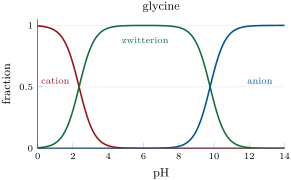
- For a species with several couples (an acid with two hydrogens to give, an amino acid), mark every : each interval belongs to one form.
- One unit from , the ratio is already 10 to 1: the minor form is under .
Example 45.4 (Glycine in the body)
At the pH of blood, about 7.4, glycine lies between its two values: it is almost entirely in the zwitterion form, carrying a positive charge on its nitrogen and a negative charge on its carboxylate, neutral overall. Every amino acid behaves the same way.
45.2 Acid–base indicators
Definition 45.5 (Acid–base indicator, colour-change range)
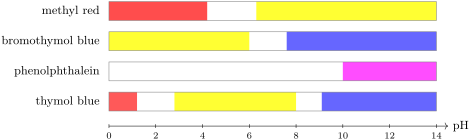
An acid–base indicator is a couple / whose two forms have different colours, used in very small amounts. Its colour-change range is the pH interval over which the colour is seen to change, roughly to : below, the colour of is seen, above, that of , and in between a mixture of the two.
Method 45.6 (Choosing an indicator)
To detect when a solution passes a given pH (the pH at the end of a titration, for example), choose an indicator whose colour-change range contains that pH: the colour then changes exactly there.
45.3 Buffer solutions
Definition 45.7 (Buffer solution)
A buffer solution is a solution whose pH changes very little when a little acid or base is added, or when it is diluted. It is usually made of a weak acid and its conjugate base in comparable amounts; its pH is then close to the of the couple.
Proposition 45.8 (Why a buffer resists)
In a buffer of and , an added strong acid is consumed by () and an added strong base by (); the ratio , and so the pH, changes only a little. Dilution does not change the ratio at all.
Proof. By Henderson’s relation the pH depends only on the ratio. Adding of acid to a buffer holding of each form changes the ratio from to , and the pH by only. ∎
Method 45.9 (Preparing a buffer)
In the lab — Preparing a buffer at pH 4.8
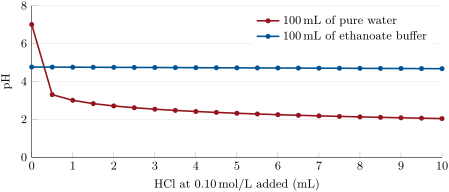
of ethanoic acid at are mixed with of sodium ethanoate at ; a pH meter reads about 4.8. A few drops of hydrochloric acid at barely move the reading, while the same drops in of distilled water bring it down to about 3.
45.4 Buffers in living things
Example 45.10 (The blood’s buffer)
The main buffer of blood is the couple of dissolved carbon dioxide and the hydrogencarbonate ion, /. In blood, the physiologists use for it the relation . The lungs remove carbon dioxide, the kidneys adjust the hydrogencarbonate: together they hold the ratio, and so the pH.
45.5 Exercises
Exercise 45.1 ★
Which form of the couple / () predominates at pH 2, at pH 4.76 and at pH 7?
Exercise 45.2 ★
On the distribution diagram of ethanoic acid, read the fraction of at pH 4 and at pH 6.
Exercise 45.3 ★
What colour does bromothymol blue show at pH 5? At pH 7? At pH 9?
Solution
Solution of Exercise 45.3.
Yellow; green (inside its range); blue.
Exercise 45.4 ★
Which form of the couple / predominates in a solution at pH 7.4? At pH 11?
Exercise 45.5 ★
Why are indicators used in very small amounts?
Solution
Solution of Exercise 45.5.
An indicator is itself an acid–base couple: in large amounts it would change the pH it is meant to show.
Exercise 45.6 ★★
Compute the ratio at pH 3.76, 4.76 and 5.76.
Solution
Solution of Exercise 45.6.
: 0.1; 1; 10.
Exercise 45.7 ★★
A titration ends at pH 8.7. Which of the four indicators of the figure would you choose? Why not methyl red?
Solution
Solution of Exercise 45.7.
Phenolphthalein (8.0–10.0) or thymol blue (8.0–9.1): their ranges contain 8.7. Methyl red changes between 4.2 and 6.3, far from 8.7: it would have changed long before.
Exercise 45.8 ★★
A buffer contains of ethanoic acid and of sodium ethanoate. Compute its pH.
Solution
Solution of Exercise 45.8.
.
Exercise 45.9 ★★
Using the glycine diagram, give the predominant form at pH 1, 6 and 12, with its charge.
Exercise 45.10 ★★
Read the response curves: by how much does the pH of water fall after of acid? And that of the buffer?
Solution
Solution of Exercise 45.10.
Water: from 7.0 to , a fall of 4 units. Buffer: from 4.76 to , a fall of 0.01.
Exercise 45.11 ★★
Which couple of the predominance figure would you choose to make a buffer at pH 9.5? In what ratio would you mix its two forms?
Solution
Solution of Exercise 45.11.
/ (). Ratio .
Exercise 45.12 ★★★
The ethanoate buffer of the figure ( of each form) receives hydrochloric acid. How much acid can it take before its pH has fallen by one unit? Why is a more concentrated buffer said to have a larger capacity?
Solution
Solution of Exercise 45.12.
The pH falls by one unit when the ratio reaches : , so . A buffer holding more of each form can absorb more acid or base for the same change of the ratio: it has a larger capacity.
Exercise 45.13 ★★★
What volume of sodium ethanoate solution at must be added to of ethanoic acid at to obtain a buffer at pH 5.0?
Solution
Solution of Exercise 45.13.
Ratio ; the acid amounts to , so of ethanoate, that is of the solution.
Exercise 45.14 ★★★
Thymol blue has two colour-change ranges. Explain why, and give its colour at pH 1, 5 and 10.
Solution
Solution of Exercise 45.14.
It has two acid–base couples, with two , hence two changes of colour: red at pH 1, yellow at pH 5, blue at pH 10.
Exercise 45.15 ★★★
A buffer at pH 4.76 is diluted ten times with distilled water. What is its new pH, according to Henderson’s relation? What happens if a strong acid of the same pH is diluted ten times?
Solution
Solution of Exercise 45.15.
Dilution divides both concentrations by 10: the ratio, and so the pH (4.76), do not change. A strong acid diluted ten times rises by one pH unit.
45.6 Problem: Blood’s Buffer
Problem 45.1
Weekend problem — what ratio of hydrogencarbonate to carbon dioxide keeps blood at pH 7.4?
The pH of arterial blood is normally between 7.38 and 7.42. Its main buffer is the couple /, for which physiologists use . The normal hydrogencarbonate concentration of blood is 22 to .
Part I — The couple.
- Write the reaction of dissolved carbon dioxide with water that gives hydrogencarbonate ions.
- Which species is the acid, which the base?
- The value 6.1 differs from the 6.37 of the table of . Give a reason (think of the temperature of the body and of the other ions present).
- What amount of hydrogencarbonate do of blood hold at ?
Part II — Predominance.
- Draw the predominance diagram of the couple with .
- Which form predominates in blood?
- Is blood slightly acidic or slightly basic?
Part III — The ratio.
- Using the relation, compute the ratio at pH 7.4.
- With , compute .
- Compute the ratio at the two ends of the normal range, 7.38 and 7.42.
- What fraction of the couple is in the hydrogencarbonate form at pH 7.4?
- Blood that is too basic may reach pH 7.6. What is the ratio then?
Part IV — When the balance is lost.
- During intense effort, acids enter the blood. Which form of the couple consumes them? Write the reaction.
- If the pH fell to 7.1, what would the ratio become?
- With unchanged hydrogencarbonate, how much would the carbon dioxide have to increase? What do the lungs do to fight back?
- Why is a weak acid with its base, rather than a strong acid, the right tool to hold a pH?
- By how much does the pH change if both concentrations are divided by two? Why?
- State the final answer: what is the hydrogencarbonate to carbon dioxide ratio of blood at pH 7.4?
Solution
Solution of Problem 45.1.
1. .
2. Dissolved carbon dioxide (with water) is the acid, hydrogencarbonate the base.
3. The table value is for in pure water; blood is at and full of other ions, which change the constant (and physiologists count all the dissolved carbon dioxide).
4. At , .
5. A pH axis cut at 6.1: below, above.
6. At 7.4, above 6.1: hydrogencarbonate.
7. Slightly basic: its pH is above 7.
8. .
9. .
10. and .
11. .
12. .
13. The hydrogencarbonate ion: .
14. .
15. From to : doubled. The lungs breathe faster and deeper, to blow the extra carbon dioxide out.
16. A weak acid and its base can each absorb what is added, and the pH depends only on their ratio; a strong acid would only push the pH one way.
17. Not at all: the ratio, and so the pH, stay the same.
18. About 20.