School Chemistry — Grades 1 to 12 · Grades 1–12
21Elements in the Universe and on Earth
The calcium in your bones, the iron in your blood and the oxygen you breathe were not made on Earth. They were made inside stars that lived and died before the Sun was born, and they have been passed from rock to sea, from sea to plant, from plant to animal, for billions of years. Some elements are everywhere, others rare. Which elements make up the stars, the Earth, the oceans — and us?
You already know
A chemical element is the set of atoms with the same atomic number ; the mass of an atom is close to , where is its mass number (Chapter 16). The periodic table lists the 118 elements by atomic number (Chapter 20). Air is about four fifths nitrogen and one fifth oxygen (Chapter 4).
21.1 Elements of the stars
Definition 21.1 (Abundance)
The abundance of an element in a body of matter — a star, the Earth’s crust, the ocean, a living being — is its share of the total mass, usually given in percent.
Proposition 21.2 (The Sun is hydrogen and helium)
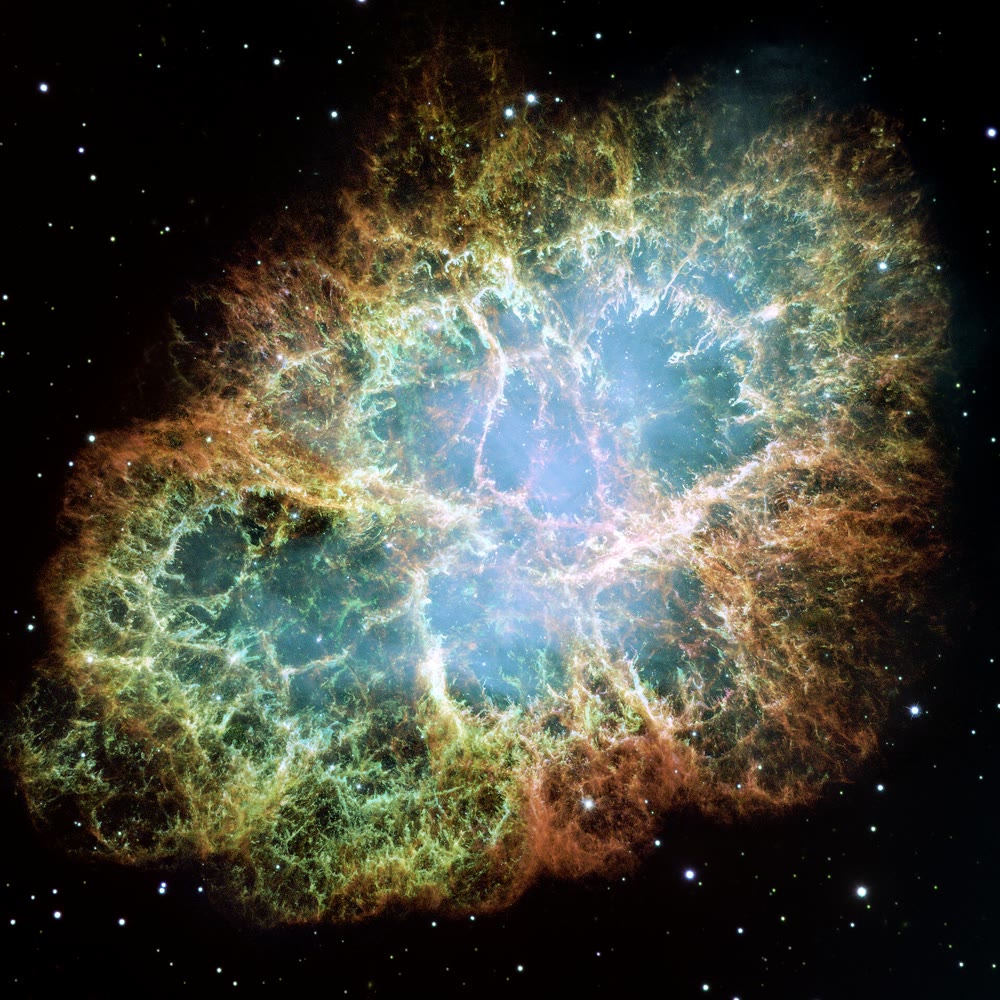
The surface of the Sun is, by mass, about hydrogen and helium; all the other elements together make up only about . Most of the visible matter of the Universe has a similar composition: hydrogen and helium, with a pinch of everything else.
Proposition 21.3 (Elements made in stars)
Hydrogen and most of the helium were formed in the first minutes of the Universe. Nearly all the heavier elements — carbon, oxygen, iron, gold — were made later, inside stars, and scattered into space when stars exploded. New stars and planets formed from that enriched dust. How the stars do it is told in the physics book.
21.2 The Earth
Proposition 21.4 (The Earth’s crust)
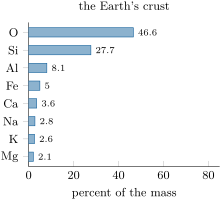
The thin rocky skin of the Earth, the crust, is almost half oxygen and more than a quarter silicon by mass: rocks and sand are mostly oxides of silicon and of a few metals. Eight elements — oxygen, silicon, aluminium, iron, calcium, sodium, potassium, magnesium — make up about of it. Hydrogen and helium, so common in the stars, are rare: the light gases escaped from the young Earth.
Remark 21.5 (Inside the Earth)
The crust is not the whole Earth. Iron, heavy, sank towards the centre when the young Earth was molten: the core of the Earth is mostly iron, with some nickel.
Proposition 21.6 (The oceans and the air)
Sea water is mostly water — hydrogen and oxygen — with about of dissolved salts by mass. Among the dissolved ions, chloride and sodium make up about , magnesium and sulfate another . The air is mostly nitrogen and oxygen.
21.3 The human body
Proposition 21.7 (What we are made of)
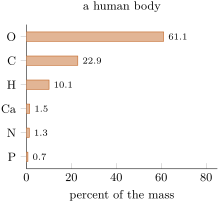
By mass, a lean adult body is about oxygen, carbon and hydrogen — mostly in water and in the molecules of life — followed by nitrogen, calcium (in bones and teeth) and phosphorus. Counted in atoms rather than in mass, the order changes: there are more hydrogen atoms in a body than all other atoms together, because hydrogen atoms are so light. A body of holds about atoms.
Method 21.8 (Reading an abundance chart)
- Check what is measured: mass (most charts) or number of atoms.
- Read the share of each element; add those of the main ones to see how much they cover.
- To compare two bodies, look for the elements common to both and for those found in one only.
Oxygen tops both charts of this chapter: it is the commonest element of the crust and of the human body by mass.
21.4 The same atoms, recycled
Example 21.9 (The journey of a carbon atom)
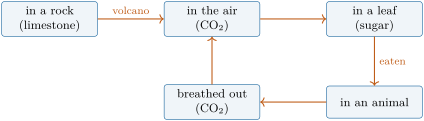
A carbon atom made in a star long ago can sit for millions of years in limestone, be released as carbon dioxide by a volcano, be taken up by a leaf, become part of a sugar in a fruit, pass into an animal that eats the fruit, and be breathed out again as carbon dioxide. Atoms are not destroyed by chemical changes: they are passed on.

21.5 Exercises
Exercise 21.1 ★
Which two elements make up almost all of the Sun?
Solution
Solution of Exercise 21.1.
Hydrogen (about ) and helium (about ).
Exercise 21.2 ★
Which element is the most abundant in the Earth’s crust? In the human body (by mass)?
Solution
Solution of Exercise 21.2.
Oxygen in both.
Exercise 21.3 ★
Where were most of the elements heavier than helium made?
Solution
Solution of Exercise 21.3.
Inside stars, and in their explosions.
Exercise 21.4 ★
What percentage of the mass of sea water is dissolved salt?
Solution
Solution of Exercise 21.4.
About .
Exercise 21.5 ★★
Using the crust chart, add the shares of oxygen and silicon. What fraction of the crust is that, roughly?
Solution
Solution of Exercise 21.5.
: about three quarters.
Exercise 21.6 ★★
Why is there so little hydrogen and helium in the Earth’s crust, when the Sun is made almost entirely of them?
Solution
Solution of Exercise 21.6.
They are very light gases: they escaped from the young Earth into space (and helium forms no compounds that could have kept it in the rocks).
Exercise 21.7 ★★
What mass of carbon is there in a body that is carbon?
Solution
Solution of Exercise 21.7.
.
Exercise 21.8 ★★
Why is oxygen the commonest element of the body by mass, while hydrogen is the commonest by number of atoms?
Exercise 21.9 ★★
A block of granite is a typical piece of the crust. Using the chart, what mass of aluminium does it hold, about?
Solution
Solution of Exercise 21.9.
About of aluminium.
Exercise 21.10 ★★
Which elements appear among the main elements of both the crust and the human body?
Solution
Solution of Exercise 21.10.
Oxygen and calcium (and, beyond the eight main elements of the crust, hydrogen, carbon and phosphorus are present in the crust in small amounts).
Exercise 21.11 ★★★
A body holds about of calcium. Compute the mass of one calcium atom (), then the number of calcium atoms. Write it in scientific notation.
Exercise 21.12 ★★★
The atoms of your body have all been part of other things before. Use the journey of a carbon atom to explain why the total number of carbon atoms on Earth hardly changes.
Solution
Solution of Exercise 21.12.
Atoms are neither created nor destroyed by chemical changes: they only pass from one compound to another (rock, gas, sugar, living body). The carbon atoms of the Earth are used again and again.
21.6 Problem: How Many Atoms Am I?
Problem 21.1
Weekend problem — from an abundance chart to the number of oxygen atoms in a human body
A lean adult of is, by mass, about oxygen, carbon and hydrogen. Take the mass of a nucleon as ; an oxygen atom has 16 nucleons, a carbon atom 12, a hydrogen atom 1. Electrons are neglected.
Part I — The masses.
- Compute the mass of oxygen in the body.
- Compute the mass of carbon and of hydrogen.
- What percentage of the mass do these three elements make up together?
- Most of this oxygen and hydrogen is in one compound. Which?
Part II — One atom.
- Compute the mass of one oxygen atom.
- Compute the mass of one carbon atom and of one hydrogen atom.
- How many hydrogen atoms weigh as much as one oxygen atom?
- Why can electrons be neglected?
Part III — The count.
- Compute the number of hydrogen atoms in the body.
- Compute the number of carbon atoms.
- Compute the number of oxygen atoms in the body.
- A careful estimate gives oxygen atoms in such a body. Compare with your count, and state the number of oxygen atoms in a body to two significant figures.
Solution
Solution of Problem 21.1.
1. .
2. Carbon ; hydrogen .
3. .
4. Water, .
5. .
6. Carbon: ; hydrogen: .
7. 16.
8. An electron is about 1836 times lighter than a nucleon: the electrons are less than a thousandth of the mass.
9. hydrogen atoms.
10. carbon atoms.
11. oxygen atoms.
12. Our count, , agrees with the estimate : a body holds about oxygen atoms.