Many ants defend themselves with methanoic acid, and on the skin it burns. Methanoic acid is a small carboxylic acid. Hydrochloric acid at the same concentration would burn far more. Both are acids; both give a solution of pH below 7; yet they are not acidic in the same way. To describe an acid fully, two numbers are needed: how much of it there is, its concentration, and how readily it gives away its hydrogen ion, its acidity constant.
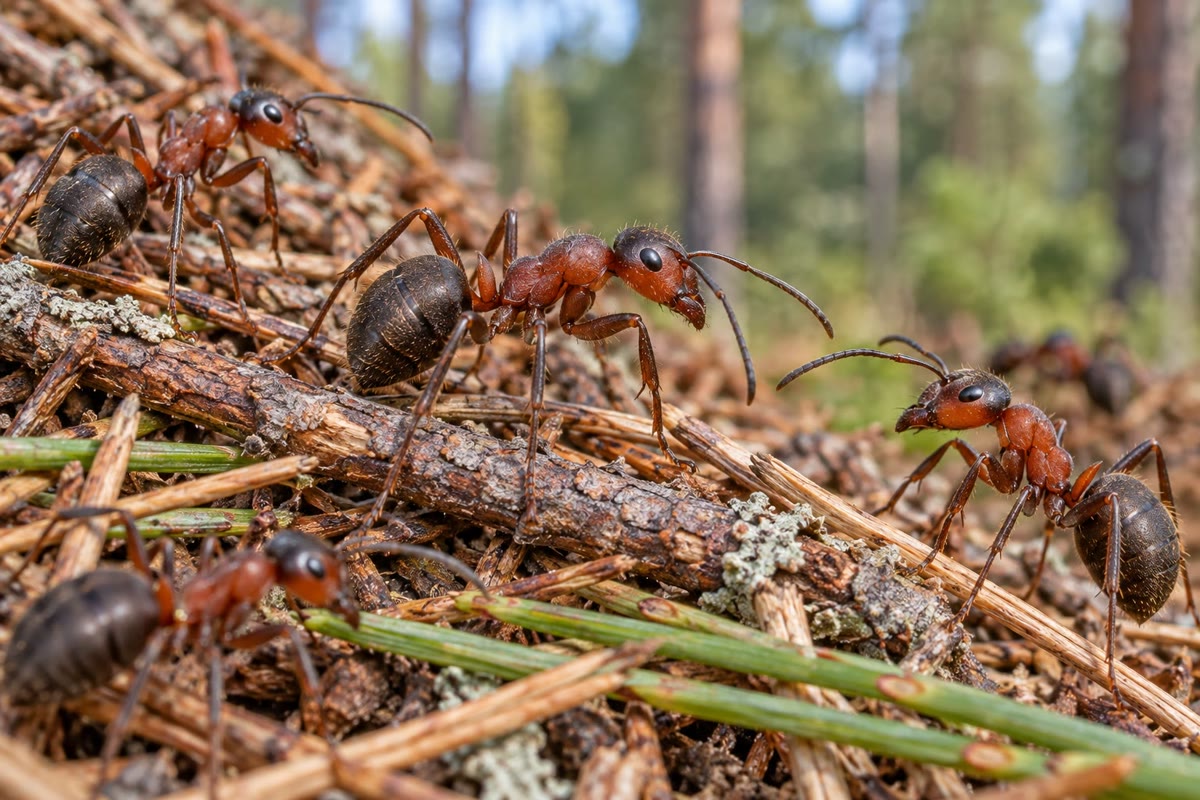
Wood ants: like many ants, they defend themselves with methanoic acid.
44.1 Brønsted acids and bases
Definition 44.1(Brønsted acid and base, acid–base couple)
A Brønsted acid is a species able to give a hydrogen ionHX+; a Brønsted base is a species able to take one. An acid HA and the base AX− it becomes by losing HX+ form an acid–base couple, written HA/AX−: HA⇌AX−+HX+.
Definition 44.2(Oxonium ion, ampholyte)
In water a hydrogen ion never stays alone: it is taken by a water molecule, giving the oxonium ionHX3OX+. A species that is the acid of one couple and the base of another is an ampholyte; water is one, acid of the couple HX2O/OHX− and base of the couple HX3OX+/HX2O.
Example 44.3(An acid in water)
When ethanoic acid dissolves, a lone pair of a water molecule takes the hydrogen of its O−H, and the O−H pair stays on the acid’s oxygen:
CHX3COOH+HX2OCHX3COOX−+HX3OX+.
Two couples exchange a hydrogen ion: CHX3COOH/CHX3COOX− gives it, HX3OX+/HX2O takes it. From now on, the hydrogen ions of earlier chapters are written HX3OX+ whenever water is the solvent.
A hydrogen ion passes from the acid to water: a lone pair of water forms the new O−H bond (orange), and the old O−H pair stays on the oxygen of the ethanoate ion (blue).
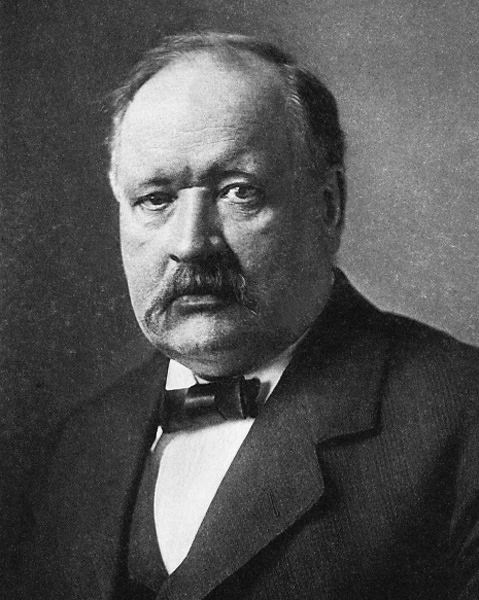
History— From Arrhenius to Brønsted, 1887–1923
In 1887 Svante Arrhenius proposed that acids give hydrogen ions in water and bases hydroxide ions. In 1923 Johannes Brønsted, and independently Thomas Lowry, broadened the idea: an acid is any species that gives a hydrogen ion, a base any species that takes one, in water or not. The ammonia molecule, which contains no hydroxide, became a base like any other.
A strong acid reacts totally with water: none of the acid remains as such in the solution. A weak acid reacts partially: its reaction with water reaches an equilibrium. Likewise a strong base reacts totally with water, a weak base partially.
Proposition 44.7(pH of a strong acid)
A solution of a strong acid of concentration c (not too dilute) has [HX3OX+]=c and pH=−log(c/c∘).
Proof. The reaction HA+HX2OAX−+HX3OX+ is total: each molecule of acid gives one oxonium ion. The ions coming from water itself are negligible as long as c is much larger than 10−7mol/L. ∎
Example 44.8(Hydrochloric acid)
Hydrochloric acid at 0.010mol/L: [HX3OX+]=0.010mol/L and pH=−log0.010=2.0. Diluted ten times, pH 3.0.
44.3 Water and the ionic product
Definition 44.9(Ionic product of water)
Water reacts very slightly with itself, 2HX2OHX3OX++OHX−. The equilibrium constant of this reaction is the ionic product of water:
Ke=(c∘)2[HX3OX+][OHX−],pKe=−logKe.
Proposition 44.10(Neutral water and strong bases)
At 25∘C, Ke=1.0×10⁻¹⁴ and pKe=14.0. In pure water [HX3OX+]=[OHX−]=1.0×10⁻⁷mol/L: pH 7.0. A strong base of concentration c gives [OHX−]=c, so [HX3OX+]=Ke(c∘)2/c and pH=14.0+log(c/c∘).
Proof. In pure water the two ions come in pairs, so they are equal, and their product is 1.0×10⁻¹⁴: each is 1.0×10⁻⁷mol/L. For the base, Ke still holds in the solution: −log([HX3OX+]/c∘)=−logKe+log(c/c∘). ∎
Example 44.11(Sodium hydroxide)
Sodium hydroxide at 0.010mol/L: [OHX−]=0.010, so [HX3OX+]=1.0×10⁻¹⁴/0.010=1.0×10−12mol/L and pH 12.0.
44.4 The acidity constant
Definition 44.12(Acidity constant, pKa)
The acidity constantKa of a couple HA/AX− is the equilibrium constant of the reaction of the acid with water, HA+HX2OAX−+HX3OX+:
Ka=[HA]c∘[AX−][HX3OX+].
The pKa of the couple is pKa=−logKa.
Proposition 44.13(The smaller the pKa, the stronger the acid)
Of two weak acids at the same concentration, the one with the larger Ka, that is the smaller pKa, reacts more with water and gives the lower pH; its conjugate base is the weaker.
Proof. A larger Ka means more AX− and HX3OX+ at equilibrium for the same HA. The base AX− of a couple that gives up its hydrogen ion easily takes it back reluctantly. ∎
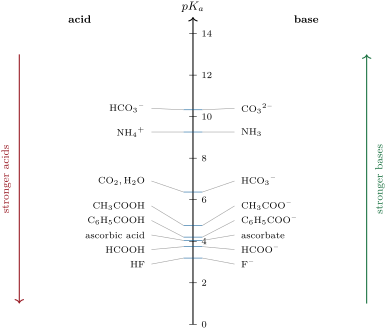
Some couples placed by their pKa at 25∘C, acids on the left, their bases on the right. The lower a couple on the scale, the stronger its acid; the higher, the stronger its base.
Method 44.14(pH of a weak acid)
For a weak acid of concentration c and constant Ka:
Write the progress table of HA+HX2OAX−+HX3OX+ per litre, with x=[HX3OX+]: [HA]=c−x, [AX−]=x (water’s own ions neglected).
Solve (c−x)c∘x2=Ka, the quadratic x2+Kac∘x−Kac∘c=0, keeping the positive root.
pH=−log(x/c∘); check that x is much larger than 10−7mol/L.
Example 44.15(Ethanoic acid at 0.010mol/L)
pKa=4.76, so Ka=10−4.76=1.74×10⁻⁵. Then x2+1.74×10⁻⁵x−1.74×10−7=0 gives x=4.1×10⁻⁴mol/L and pH 3.39. Only 4.1×10⁻⁴/0.010=4.1% of the acid has reacted with water; hydrochloric acid at the same concentration, pH 2.0, has reacted entirely.
What becomes of a strong and a weak acid at the same concentration: the strong acid is entirely turned into ions, the weak acid hardly at all. Hence the pH difference, 2.0 against 3.4.
Safety
Concentrated methanoic acid is flammable, causes severe burns of the skin and the eyes, and its vapour is toxic. It is handled only by the teacher, under a fume hood; the dilute solutions of the exercises still need goggles.
44.5 Exercises
Exercise 44.1★
Give the conjugate base of: HCOOH, NHX4X+, HX2O, HCOX3X−; and the conjugate acid of: NHX3, OHX−, HX2O, HCOX3X−. Which species are ampholytes?
Compute the pH of a sodium hydroxide solution at 2.0×10⁻³mol/L.
Solution
Solution of Exercise 44.8.
pH=14.0+log(2.0×10⁻³)=14.0−2.70=11.3.
Exercise 44.9★★
Using the pKa scale, list the acids of the couples shown from the strongest to the weakest. Where would a strong acid such as HCl lie?
Solution
Solution of Exercise 44.9.
HF, HCOOH, ascorbic acid, CX6HX5COOH, CHX3COOH, COX2,HX2O, NHX4X+, HCOX3X−. A strong acid lies far below, beyond the end of the scale: it reacts totally with water.
Exercise 44.10★★
Carbon dioxide dissolved in water makes it slightly acidic (couple COX2,HX2O/HCOX3X−, pKa=6.37). A sample of rain water in contact with the air is found to have pH 5.6. Compute [HX3OX+], and compare with pure water.
Solution
Solution of Exercise 44.10.
[HX3OX+]=10−5.6=2.5×10⁻⁶mol/L, 25 times more than in pure water (1.0×10⁻⁷mol/L).
Exercise 44.11★★
Show that for the couple NHX4X+/NHX3, pKa=pKe−pKb, where Kb=1.8×10⁻⁵ is the constant of NHX3+HX2ONHX4X++OHX−. Compute the pKa.
Solution
Solution of Exercise 44.11.
KaKb=[NHX4X+]c∘[NHX3][HX3OX+]×[NHX3]c∘[NHX4X+][OHX−]=Ke, so pKa=pKe−pKb=14.0−4.74=9.26.
Exercise 44.12★★★
Ethanoic acid at 0.010mol/L has pH 3.39. Compute the pH after a tenfold dilution. Does it rise by one unit, as for a strong acid? Explain.
Solution
Solution of Exercise 44.12.
At 0.0010mol/L: x2+1.74×10⁻⁵x−1.74×10−8=0, x=1.24×10⁻⁴mol/L, pH 3.91: a rise of 0.52, not 1. Diluted, a weak acid reacts in a larger proportion with water (here 12% against 4%), which partly makes up for the dilution.
Exercise 44.13★★★
The hydrogencarbonate ion is an ampholyte. Write its two reactions with water and their constants, using the pKa scale. Which is larger? What does that suggest for the pH of a sodium hydrogencarbonate solution?
Solution
Solution of Exercise 44.13.
As an acid: HCOX3X−+HX2OCOX3X2−+HX3OX+, K=10−10.33. As a base: HCOX3X−+HX2OHX2COX3+OHX− (HX2COX3 standing for COX2,HX2O), K=Ke/Ka=10−14.0+6.37=10−7.63. The base reaction has the larger constant: the solution is slightly basic.
Exercise 44.14★★★
Hydrochloric acid at 1.0×10⁻³mol/L is diluted a thousand times, then a thousand times again. A careless rule gives pH 6, then pH 9. Why is pH 9 impossible for a diluted acid? What pH does the very dilute solution approach?
Solution
Solution of Exercise 44.14.
An acid, however dilute, cannot make a solution basic. When the acid’s own oxonium ions become fewer than the 1×10⁻⁷mol/L that water provides, the water’s ions dominate: the pH approaches 7 from below and never passes it.
Exercise 44.15★★★
Ascorbic acid (vitamin C, pKa=4.04, M=176.0g/mol): a tablet of 500mg is dissolved in 200mL of water. Compute the pH (consider only the first acidity).
Weekend problem — what pH does the methanoic acid of an ant’s venom give at 0.010 mol/L, and how does baking soda soothe its burn?
Methanoic acid, HCOOH, is found in the venom of ants. Its pKa at 25∘C is 3.74. We study a solution at 0.010mol/L and compare it with hydrochloric acid.
Part I — The acid.
Draw the Lewis structure of methanoic acid and circle the hydrogen it gives.
Write its couple and its reaction with water.
Write Ka and compute its value.
Place the couple on the pKa scale: is methanoic acid stronger or weaker than ethanoic acid?
Compute the mass of methanoic acid in 1.0L of the solution.
Check that the ions coming from water can be neglected.
Part III — Comparison.
What is the pH of hydrochloric acid at 0.010mol/L?
How many times more oxonium ions does it contain than the methanoic acid solution?
Explain the difference, using the words strong and weak.
Part IV — Baking soda.
Baking soda is sodium hydrogencarbonate. Write the reaction between methanoic acid and the hydrogencarbonate ion (it gives methanoate and COX2,HX2O).
Show that its constant is K=Ka(HCOOH)/Ka(COX2,HX2O), and compute it.
Is the reaction favourable? What gas is seen?
Why is a base much weaker than hydroxide, such as hydrogencarbonate, preferred on the skin?
State the final answer: what is the pH of a 0.010mol/L methanoic acid solution?
14. Hydrochloric acid is a strong acid, entirely turned into ions; methanoic acid is weak: its reaction with water stops at an equilibrium where most of it remains as HCOOH.
15.HCOOH+HCOX3X−HCOOX−+COX2+HX2O.
16. Multiplying top and bottom of
K=[HCOOH][HCOX3X−][HCOOX−][COX2]
by [HX3OX+] gives K=Ka(HCOOH)/Ka(COX2,HX2O)=1.82×10−4/4.3×10−7≈420.
17. Yes, K≫1; carbon dioxide bubbles out.
18. Hydroxide is a strong base and would itself attack the skin; hydrogencarbonate is a weak base that neutralises the acid and is mild in any excess.