School Chemistry — Grades 1 to 12 · Grades 1–12
32Organic Molecules: Skeletons and Names
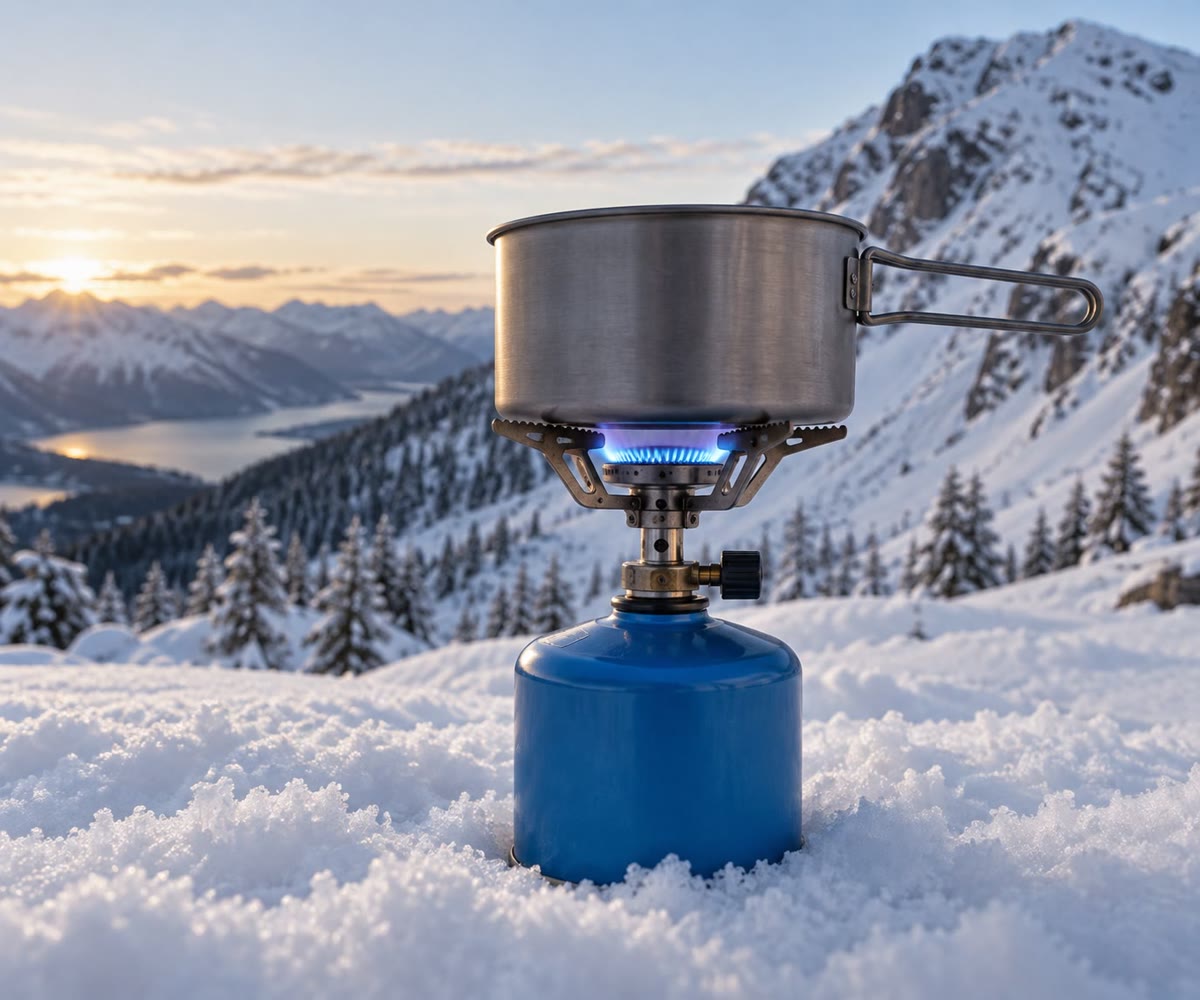
A disposable lighter holds butane, liquid under pressure; the cartridge of a camping stove taken up a snowy mountain holds propane, or a blend richer in it. Both are made of nothing but carbon and hydrogen atoms, and both belong to a huge family: the molecules built on a skeleton of carbon atoms. Millions of them are known. To talk about them, chemists need ways of drawing them quickly and of naming them without ambiguity.
You already know
Carbon forms four covalent bonds and hydrogen one; around a carbon atom with four single bonds, the bonds point to the corners of a tetrahedron, at about (Chapter 24).
32.1 Formulas of organic molecules
Definition 32.1 (Organic compound)
An organic compound is a compound whose molecules are built on a skeleton of carbon atoms bonded to one another and to hydrogen atoms, possibly with other atoms such as oxygen and nitrogen. (Carbon dioxide, carbon monoxide and the carbonates are traditionally left out.)
Definition 32.2 (Four kinds of formula)
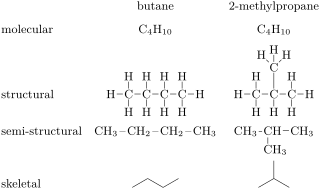
A molecule can be written in four ways:
- its molecular formula gives only the number of atoms of each element, such as ;
- its structural formula shows every atom and every bond;
- its semi-structural formula shows the bonds between carbon atoms and groups the hydrogen atoms with their carbon, such as ;
- its skeletal formula draws only the bonds of the carbon skeleton as a zigzag: each end and each corner is a carbon atom, the hydrogen atoms on carbon are not drawn, and every other atom (with its hydrogen atoms) is written.
Example 32.3 (Reading a skeletal formula)
In the skeletal formula of butane, the zigzag has two ends and two corners: four carbon atoms. Each end carbon has one bond drawn, so it carries three hydrogen atoms (); each corner has two bonds drawn, so it carries two (). Every carbon has four bonds in all, which gives back .
32.2 Carbon chains
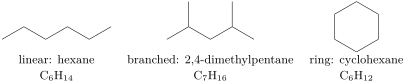
The carbon skeleton of a molecule can be a linear chain, each carbon bonded to at most two others, as in butane; a branched chain, with at least one carbon bonded to three or four others, as in 2-methylpropane; or a ring, as in cyclohexane, , whose skeletal formula is a hexagon. A zigzag is used for chains because the real bonds around each carbon make angles of about , not : a “linear” chain is in fact a zigzag in space.
32.3 Alkanes and their names
Definition 32.4 (Alkane, alkyl group)
An alkane is a compound of carbon and hydrogen whose skeleton is a chain (linear or branched, not a ring) with only single bonds; its molecular formula is . An alkyl group is what remains of an alkane when one hydrogen atom is removed, so that it can be attached to a chain: methyl , ethyl .
| name | formula | name | formula | ||
|---|---|---|---|---|---|
| 1 | methane | 6 | hexane | ||
| 2 | ethane | 7 | heptane | ||
| 3 | propane | 8 | octane | ||
| 4 | butane | 9 | nonane | ||
| 5 | pentane | 10 | decane |
Method 32.5 (Naming an alkane)
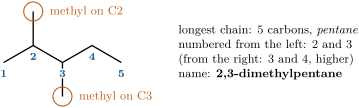
- Find the longest chain of carbon atoms: it gives the root name (pentane, hexane…).
- The atoms not in it form alkyl groups attached to it, the substituents.
- Number the main chain from the end that gives the substituents the lowest numbers.
- Write each substituent with its number (its position on the chain), in alphabetical order, before the root; repeated groups take the prefixes di-, tri-, tetra-, with one number each. Numbers are separated by commas, numbers and words by hyphens.
Method 32.6 (From a name to a skeletal formula)
- Draw the main chain given by the root, as a zigzag, and number its carbons.
- Attach each substituent at the position given by its number.
- Check: count the carbons, and that no carbon has more than four bonds.
32.4 Isomers
Definition 32.7 (Isomers, constitutional isomers)
Isomers are different compounds with the same molecular formula. Constitutional isomers are isomers whose atoms are bonded in a different order, for example with a different carbon skeleton.
Proposition 32.8 (Isomers have different properties)
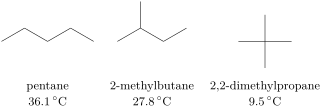
Constitutional isomers are different substances, with different properties. Among the alkane isomers of a given formula, the more branched ones boil lower: butane boils near and 2-methylpropane at ; pentane at , 2-methylbutane at and 2,2-dimethylpropane at .
Proof. The values are measured. Branched molecules are more compact, with less surface in contact with their neighbours: their van der Waals interactions are weaker (Chapter 30). ∎
32.5 Alkanes from crude oil
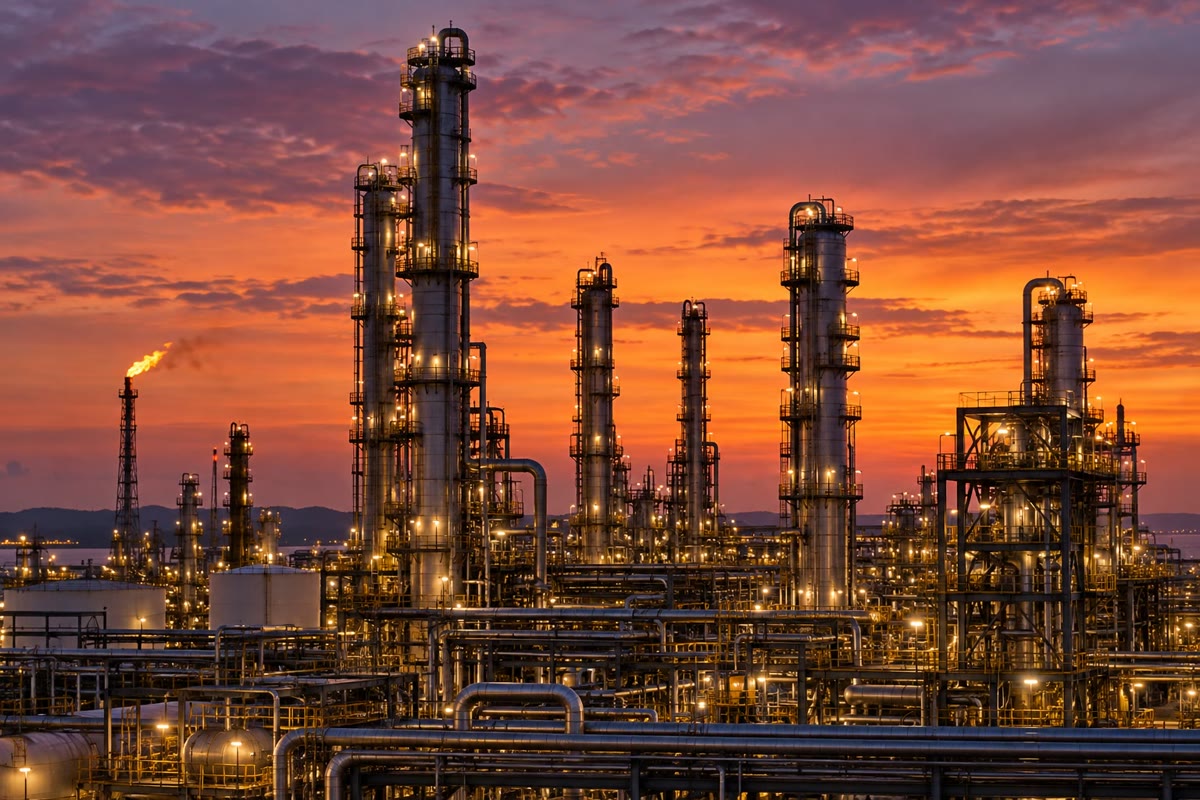
Crude oil is a mixture of thousands of compounds, most of them alkanes with 1 to more than 40 carbon atoms. In a refinery it is heated and its vapours rise through a tall column, cooler and cooler towards the top: each fraction condenses at the height where the temperature matches its boiling range. Gases (methane to butane) leave at the top, then petrol, kerosene, diesel; heavy oils and bitumen stay at the bottom. This fractional distillation separates by boiling temperature, which for alkanes grows with the length of the chain.
Safety


Butane is an extremely flammable gas, stored under pressure. Pentane is a highly flammable liquid; its vapour causes drowsiness, it can damage the lungs if swallowed and it is toxic to aquatic life. No flame near light alkanes; work under a fume hood.
32.6 Exercises
Exercise 32.1 ★
Give the molecular formulas of the molecules drawn here, and say whether they are isomers:  and
and  .
.
Exercise 32.2 ★
Name: ; ; 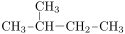 .
.
Solution
Solution of Exercise 32.2.
Propane; hexane; 2-methylbutane.
Exercise 32.3 ★
Write the semi-structural formulas of propane and of 2-methylpropane, and the structural formula of ethane.
Solution
Solution of Exercise 32.3.
; 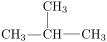 ;
;  .
.
Exercise 32.4 ★
 and
and  .
.Exercise 32.5 ★
Give the molecular formula of the alkane with 8 carbon atoms, and the number of carbon atoms of the alkane with 20 hydrogen atoms.
Solution
Solution of Exercise 32.5.
. gives : nonane, .
Exercise 32.6 ★★
Draw the skeletal formulas of 3-methylhexane, 2,2-dimethylbutane and 3-ethylpentane, and give their molecular formulas.
Solution
Solution of Exercise 32.6.
3-methylhexane 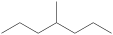 , ; 2,2-dimethylbutane
  , ; 3-ethylpentane
  , .
, .
Exercise 32.7 ★★
Draw and name the three isomers of .
Solution
Solution of Exercise 32.7.
Pentane, 2-methylbutane and 2,2-dimethylpropane, drawn in the figure of the chapter.
Exercise 32.8 ★★
These names are wrong. Draw each molecule and give its correct name: 2-ethylbutane; 4-methylpentane; 1-methylbutane.
Solution
Solution of Exercise 32.8.
“2-ethylbutane” has a longest chain of five carbons through the ethyl group: 3-methylpentane. “4-methylpentane” is numbered from the wrong end: 2-methylpentane. “1-methylbutane” is simply a chain of five carbons: pentane.
Exercise 32.9 ★★
Using the figure of the isomers of , rank them by boiling temperature and explain the order.
Solution
Solution of Exercise 32.9.
2,2-dimethylpropane () < 2-methylbutane () < pentane (). The same atoms are arranged more and more compactly: less contact between molecules, weaker van der Waals interactions, lower boiling temperature.
Exercise 32.10 ★★
Cyclohexane is and hexane . Explain the two missing hydrogen atoms. Are the two compounds isomers? Is cyclohexane an alkane?
Solution
Solution of Exercise 32.10.
Closing the chain into a ring makes one more bond, which takes the place of two bonds (one at each end). Different molecular formulas: not isomers. Cyclohexane is not an alkane (its skeleton is a ring; its formula is not ).
Exercise 32.11 ★★
Among propane, butane, 2-methylpropane and cyclobutane (, a ring of four carbon atoms), which are isomers of one another?
Solution
Solution of Exercise 32.11.
Butane and 2-methylpropane (). Propane is and cyclobutane .
Exercise 32.12 ★★★
Draw and name the five isomers of .
Solution
Solution of Exercise 32.12.
 |  |  |
| hexane | 2-methylpentane | 3-methylpentane |
 |  | |
| 2,2-dimethylbutane | 2,3-dimethylbutane |
Exercise 32.13 ★★★
Picture a linear alkane as a long zigzag and a very branched one as a ball. Using this picture, explain why branching lowers the boiling temperature of isomers.
Solution
Solution of Exercise 32.13.
Two long zigzags can lie side by side along their whole length, with many atoms in contact; two balls touch at only a small area. Van der Waals interactions act between atoms in contact: they are larger between linear molecules, which need a higher temperature to separate.
Exercise 32.14 ★★★
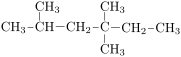
Name the alkane
Solution
Solution of Exercise 32.14.
The longest chain has six carbons; numbered from the left the substituents are at 2, 4, 4, from the right at 3, 3, 5; the first difference (2 against 3) decides: 2,4,4-trimethylhexane.
Exercise 32.15 ★★★
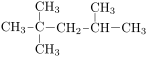
The reference compound for petrol, “isooctane”, is 2,2,4-trimethylpentane. Draw its skeletal formula, check that it is an isomer of octane, and write its semi-structural formula.
Solution
Solution of Exercise 32.15.
 : a chain of five carbons with two methyl groups on carbon 2 and one on carbon 4, eight carbon atoms in all; hydrogen atoms, , the formula of octane: they are isomers. Semi-structural formula:
  .
.
32.7 Problem: Lighter Gas
Problem 32.1
Weekend problem — how many different alkanes have the formula ?
A lighter holds butane; a winter camping cartridge holds a blend richer in propane or in 2-methylpropane. Butane boils at about , 2-methylpropane at and propane at .
Part I — Two gases with one formula.
- Give the molecular formula of butane, and check that it fits the general formula of the alkanes.
- Draw its structural formula.
- Write its semi-structural and skeletal formulas.
- Draw 2-methylpropane in the same three ways. Why does it have the same molecular formula?
- Are butane and 2-methylpropane isomers? Of which kind?
Part II — In the cold.
- Which of the three gases are gases at and normal pressure?
- An open lighter is used outdoors at . Why does it give a poor flame?
- Why are winter cartridges rich in propane or in 2-methylpropane?
- Explain why 2-methylpropane boils lower than butane.
- Why does propane have no isomer?
Part III — Naming and counting.
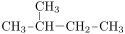
- Name
 .
. - Why is the name “3-methylbutane” wrong for the same molecule?
- How many alkane isomers have the formulas , and ?
Part IV — The isomers of .
- Draw the linear isomer and name it.
- Draw and name the isomers whose longest chain has six carbon atoms. Why is there no “4-methylhexane”?
- Draw and name the isomers whose longest chain has five carbon atoms and two methyl groups.
- Is there an isomer with a five-carbon chain and an ethyl group? Why can the ethyl group only sit on carbon 3?
- Draw and name the isomer whose longest chain has four carbon atoms.
- Count all the isomers found.
- State the final answer: how many constitutional isomers does heptane have, itself included?
Solution
Solution of Problem 32.1.
1. : with , .
2. 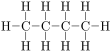 .
.
3. ;  .
.
4.  ;
;  ;
;  . It has the same atoms, four carbons and ten hydrogens, bonded in a different order.
5. Yes: constitutional isomers (different skeletons).
6. All three: their boiling temperatures are below .
7. At , below its boiling temperature, butane stays liquid at normal pressure and gives off little gas.
8. Propane () and 2-methylpropane () boil below winter temperatures: they still give plenty of gas in the cold.
9. 2-methylpropane is branched, more compact: weaker van der Waals interactions.
10. With three carbon atoms the only possible skeleton is the chain : any carbon moved elsewhere gives the same chain.
11. 2-methylbutane.
12. The chain must be numbered from the end nearer the substituent: 2, not 3.
13. 2, 3 and 5.
14. Heptane,  .
.
15. 2-methylhexane  and 3-methylhexane
  . “4-methylhexane” is 3-methylhexane numbered from the wrong end.
16. 2,2-dimethylpentane, 2,3-dimethylpentane, 2,4-dimethylpentane and 3,3-dimethylpentane.
17. Yes, 3-ethylpentane. On carbon 2 the ethyl group would make a six-carbon chain through it: the molecule would be 3-methylhexane.
18. 2,2,3-trimethylbutane,  .
.
19. .
20. Heptane has 9 constitutional isomers, itself included.