School Chemistry — Grades 1 to 12 · Grades 1–12
20The Periodic Table: A First Look
On the wall of almost every chemistry classroom hangs the same chart: 118 boxes, each with a symbol and a number, arranged in rows and columns with a strange shape — tall towers at the sides, a dip in the middle, two loose rows below. When it was first drawn, in 1869, it had about sixty boxes and several empty ones. Its author was bold enough to describe the elements that would one day fill the gaps — and he was right.
You already know
A chemical element is the set of atoms with the same atomic number , the number of protons in the nucleus (Chapter 16). Each element has a symbol, one capital letter sometimes followed by a small one (Chapter 11). Metals such as iron, zinc and aluminium give positive ions (Chapter 17).
20.1 A table of the elements
Definition 20.1 (Periodic table)
The periodic table lists all the chemical elements in order of increasing atomic number, to , arranged in rows so that elements with similar properties fall in the same column.
Definition 20.2 (Period and group)
A row of the periodic table is a period; there are seven. A column is a group; there are eighteen, numbered 1 to 18 from left to right. The two rows printed below the table belong in periods 6 and 7; they are set apart only to keep the table narrow.
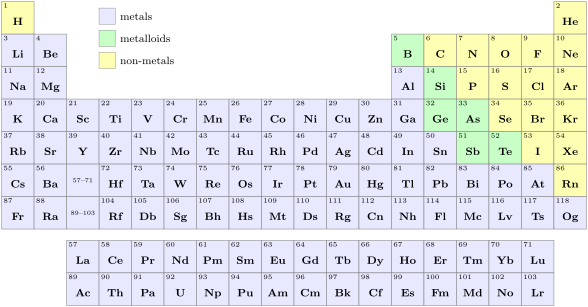
Method 20.3 (Reading the periodic table)
To place an element:
- find its box from its symbol or its atomic number;
- its row gives its period, its column its group;
- its colour says whether it is a metal or a non-metal.
Sodium, , : period 3, group 1, a metal. Chlorine, , : period 3, group 17, a non-metal.
20.2 Metals and non-metals
Definition 20.4 (Metal and non-metal)
A metal is an element that, as a pure substance, is shiny when freshly cut, conducts electricity and heat well, can be bent or hammered into shape, and forms positive ions. A non-metal lacks these properties: many are gases (oxygen, nitrogen, chlorine), the solid ones are dull and brittle (sulfur, carbon as coal), and they tend to form negative ions or to share electrons in molecules.
Proposition 20.5 (Where they sit)
About four elements in five are metals; they fill the left and the centre of the table. The non-metals sit at the top right, with hydrogen alone at the top left. Along the border between them, a few elements — boron, silicon, germanium, arsenic, antimony, tellurium — have properties in between: the metalloids.
20.3 Columns that behave alike
Proposition 20.6 (Elements of a group behave alike)
The elements of one group react in similar ways and form similar compounds. Lithium, sodium and potassium, at the top of group 1, are soft metals that react with water, giving off hydrogen; the reaction is more violent down the group. Fluorine, chlorine, bromine and iodine, in group 17, are coloured non-metals that react with metals to form salts. Helium, neon, argon and the other elements of group 18 hardly react with anything.
In the lab — Lithium, sodium and potassium in water
Behind a safety screen, the teacher drops a piece of lithium the size of a grain of rice into a large bowl of water: it fizzes gently. A piece of sodium the same size whizzes around the surface, melting into a silvery ball. Potassium bursts into a lilac flame at once. All three give off hydrogen and leave a basic solution.
Safety


Sodium: in contact with water it releases flammable gases which may ignite (GHS02); it causes severe burns (GHS05). It is kept under oil and handled only by the teacher, with tongs, in tiny pieces.
20.4 Mendeleev’s idea
History — Mendeleev’s gaps, 1869–1886
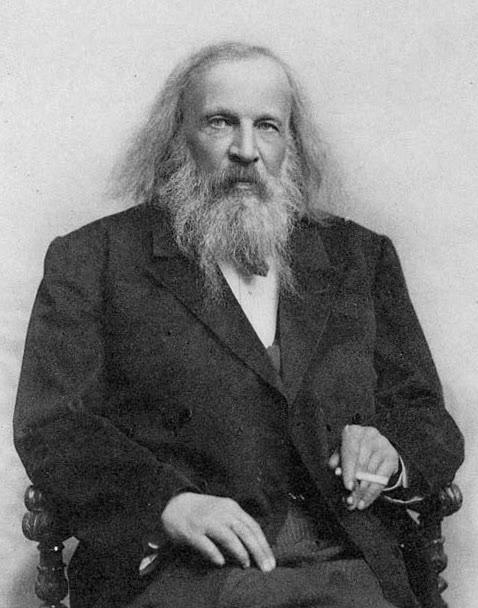
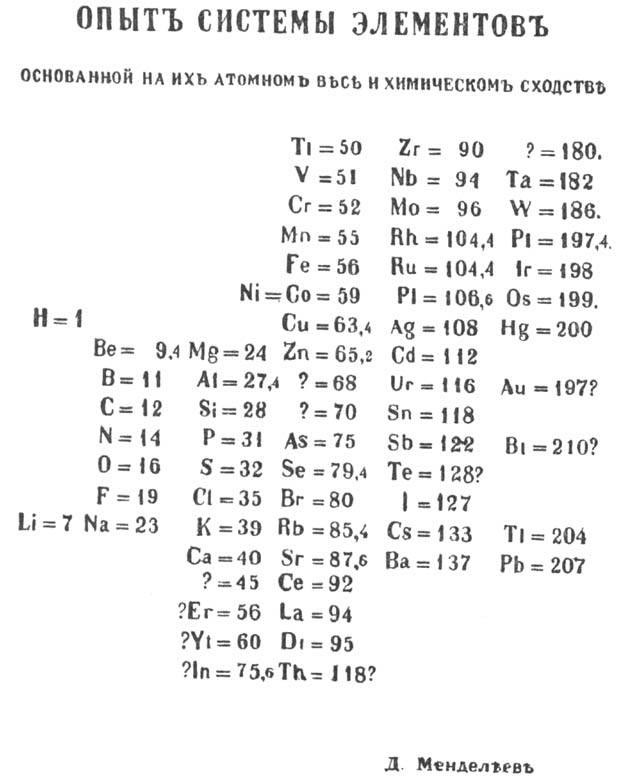
In 1869 Dmitri Mendeleev arranged the elements then known in order of increasing atomic weight — the mass of their atoms compared with that of hydrogen — and placed those with similar properties side by side. Where the pattern demanded it, he left gaps for elements nobody had yet found, and in 1871 he described their properties: below silicon, an “eka-silicon” whose atomic weight would be about 72. In 1886 the chemist Clemens Winkler discovered germanium in a silver ore, measured its atomic weight as 72.3 and found it to be the missing element. Gallium (1875) and scandium (1879) also filled gaps Mendeleev had left.
Remark 20.7 (Order by atomic number)
Mendeleev ordered the elements by atomic weight, and had to swap a few pairs, such as tellurium and iodine, to keep the families together. Today the table is ordered by atomic number, discovered later, and the swaps are no longer needed.
20.5 Exercises
Exercise 20.1 ★
In what order are the elements placed in the periodic table?
Exercise 20.2 ★
Give the period and the group of: carbon (), magnesium (), argon ().
Exercise 20.3 ★
Metal or non-metal: iron, sulfur, copper, oxygen, aluminium, chlorine?
Solution
Solution of Exercise 20.3.
Metals: iron, copper, aluminium. Non-metals: sulfur, oxygen, chlorine.
Exercise 20.4 ★
Which element is just below sodium in the table? Just below chlorine?
Solution
Solution of Exercise 20.4.
Potassium () below sodium; bromine () below chlorine.
Exercise 20.5 ★★
Using the table, name the element of period 4 and group 2, and the element of period 2 and group 15.
Solution
Solution of Exercise 20.5.
Calcium (, ) and nitrogen (, ).
Exercise 20.6 ★★
Why can one expect potassium to react with water, as sodium does?
Solution
Solution of Exercise 20.6.
It is in the same group as sodium, group 1, and elements of a group behave alike.
Exercise 20.7 ★★
A shiny element conducts electricity and forms the ion . Is it a metal or a non-metal? Explain.
Exercise 20.8 ★★
Why did Mendeleev leave gaps in his table? Why was this a strength of his table rather than a weakness?
Solution
Solution of Exercise 20.8.
To keep elements with similar properties in the same column, even if it meant leaving a box empty. The gaps were predictions: the missing elements were later found with the properties he had described.
Exercise 20.9 ★★
Look at Mendeleev’s table of 1869. Which atomic weights did he give for carbon and for oxygen? Which two gaps, marked with a question mark, appear next to aluminium and silicon?
Solution
Solution of Exercise 20.9.
Carbon: ; oxygen: . The gaps “? ” (next to Al ) and “? ” (next to Si ).
Exercise 20.10 ★★
Exercise 20.11 ★★★
Helium, neon and argon hardly react with anything. In which group are they? What could they be used for, given this property?
Solution
Solution of Exercise 20.11.
Group 18. Where nothing must react: the argon inside light bulbs and welding gas, helium in balloons (it does not burn).
Exercise 20.12 ★★★
Gallium, under aluminium, was discovered in 1875. Mendeleev had predicted for it an atomic weight close to the average of its neighbours aluminium (27.0) and indium (114.8). Compute that average. (Gallium: 69.7.)
Solution
Solution of Exercise 20.12.
, close to 69.7.
20.6 Problem: Mendeleev’s Gap
Problem 20.1
Weekend problem — predicting the atomic weight of a missing element from its four neighbours
In 1871 Mendeleev predicted the properties of eka-silicon, the element missing below silicon. One of his ideas was that an element’s properties lie between those of its neighbours above and below, to the left and to the right. Today’s atomic weights of the four neighbours of the gap are: silicon 28.1 (above), tin 118.7 (below), gallium 69.7 (left), arsenic 74.9 (right).
Part I — The gap.
- Using the periodic table of this chapter, find the atomic number, the period and the group of germanium, the element that fills the gap.
- Which element is above it, which below, which on its left, which on its right?
- Is germanium a metal, a non-metal or a metalloid?
- Why did Mendeleev expect the missing element to resemble silicon?
Part II — Averages.
- Compute the average of the atomic weights of the elements above and below the gap.
- Compute the average of the atomic weights of the elements on the left and on the right.
- Which of the two averages is closer to the true atomic weight of germanium, 72.6? Why might that be?
- In his 1869 table, Mendeleev had written “? ” for this gap. By how much was he off?
Part III — The prediction.
- Compute the average of all four neighbours, to one decimal place.
- In 1871 Mendeleev predicted 72; in 1886 Winkler measured 72.3. Compare with your average.
- Why did the discovery of germanium convince many chemists that Mendeleev’s table was right?
- State your prediction: the atomic weight of eka-silicon from the average of its four neighbours.
Solution
Solution of Problem 20.1.
2. Above: silicon. Below: tin. Left: gallium. Right: arsenic.
3. A metalloid.
4. It is in the same group as silicon, and elements of a group behave alike.
5. .
6. .
7. The left–right average (72.3): along a period the atomic weight grows steadily, element by element, while down a group it jumps by large steps.
8. .
9. , that is 72.9.
10. The average, 72.9, is close to both Mendeleev’s 72 and Winkler’s 72.3 (and today’s 72.6).
11. An element predicted before anyone had seen it was found with the properties foretold: the table was not just a list, it could make predictions.
12. About 72.9.