School Chemistry — Grades 1 to 12 · Grades 1–12
36Titration
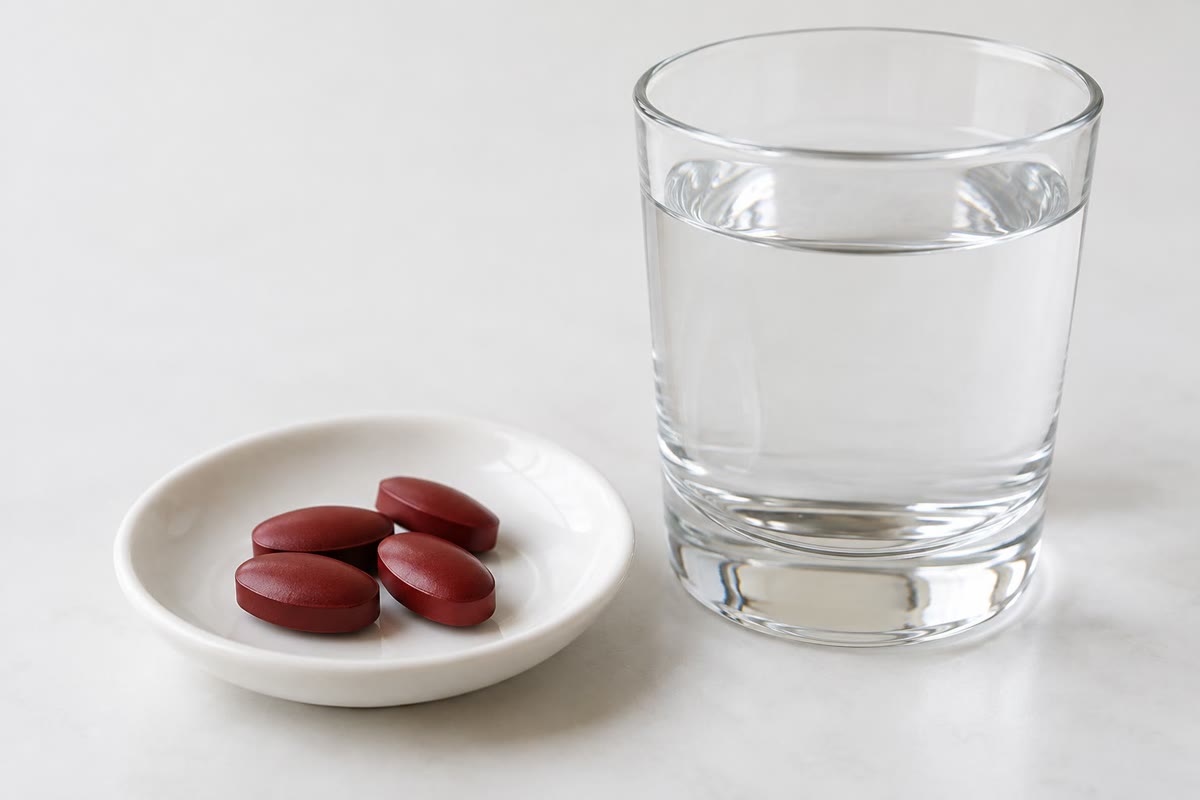
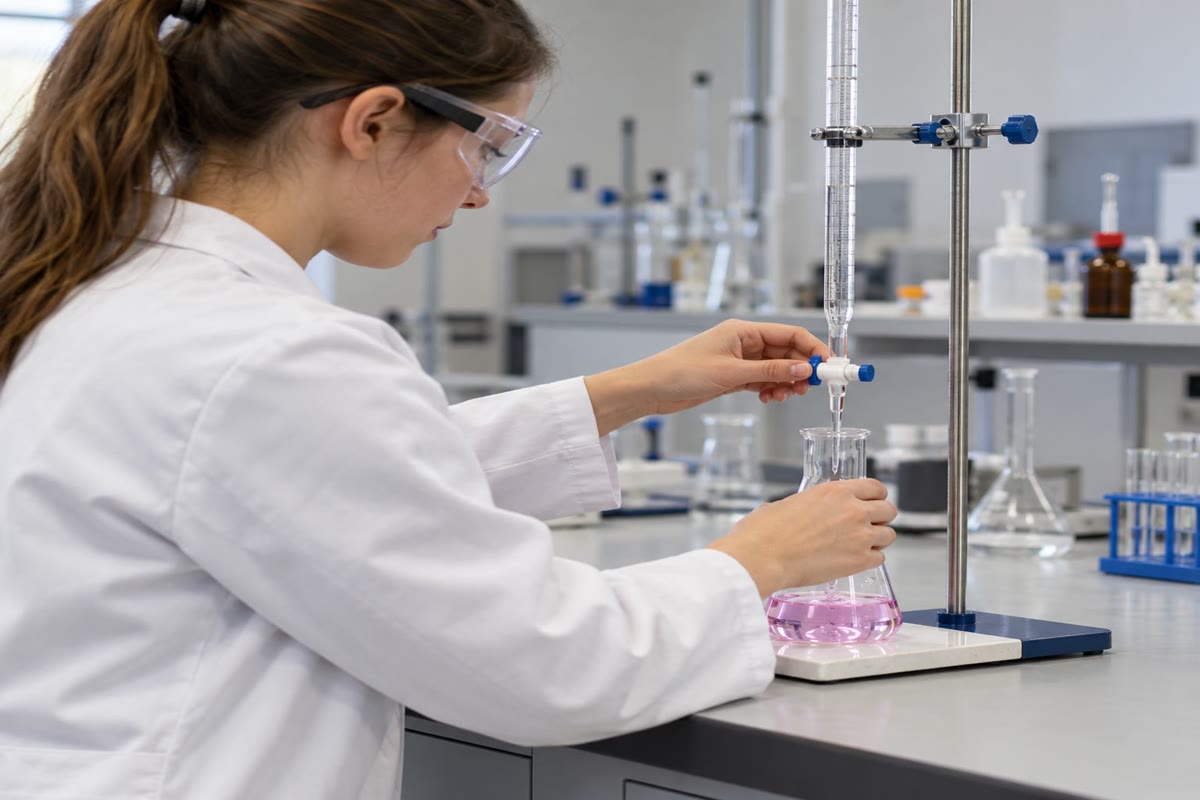
The box of an iron supplement promises of iron in every tablet, as iron(II) ions. Is it true? A chemist crushes a tablet, dissolves it in acid, and adds a purple solution of potassium permanganate drop by drop from a long graduated tube. Each drop loses its colour at once, as the permanganate ions are used up by the iron(II) ions, until one drop, the last, leaves a faint pink that does not fade. The volume poured at that moment gives the amount of iron. This chapter turns a reaction into a measurement.
You already know
An oxidant gains electrons, a reductant gives them; the permanganate ion oxidises iron(II) ions according to (Chapter 35). Molar concentration and dilution (Chapter 26); the progress table and the limiting reactant (Chapter 27).
36.1 Titrating
Definition 36.1 (Titration, titrant, titrated solution)
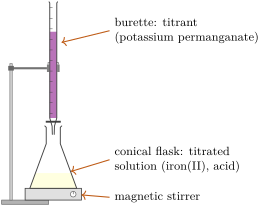
A titration measures the amount of a dissolved species by making it react with another species whose concentration is accurately known. The solution of known concentration, added from a burette, is the titrant; the solution containing the species to be measured, placed in the flask, is the titrated solution.
Proposition 36.2 (What a titration reaction must be)
A reaction can be used for a titration if it is total (so that one reactant is entirely used up), fast (so that each drop reacts at once), and unique (the titrant reacts with nothing else in the flask).
Proof. If the reaction stopped before completion, or lagged behind the drops, or consumed titrant elsewhere, the volume poured would no longer measure the amount of the titrated species. ∎
36.2 Equivalence
Definition 36.3 (Equivalence, equivalent volume)
Equivalence is the moment of a titration when the titrant added and the titrated species are in the proportions of the equation: both are used up. The volume of titrant poured at that moment is the equivalent volume, .
Proposition 36.4 (The relation at equivalence)
For a titration reaction products, with A titrated (amount ) by a titrant B of concentration , at equivalence
Proof. At equivalence the mixture is stoichiometric (Chapter 27): A and B, of initial amounts and , run out together, so . ∎
36.3 Locating equivalence by a colour change
Proposition 36.5 (Seeing equivalence)
When one of the species of the titration is coloured, equivalence is seen as a colour change of the flask: the colour of the titrant appears and persists as soon as the titrant is in excess, or the colour of the titrated species disappears when it runs out.
Proof. Before equivalence, every ion of titrant that falls into the flask is used up at once; after equivalence, it remains. A coloured species is therefore present in the flask on one side of equivalence only. ∎
Example 36.6 (Permanganate, its own indicator)
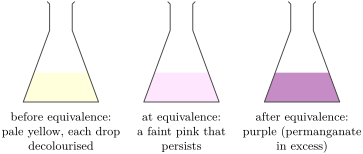
The permanganate ion is deep purple, and the manganese ions it gives are almost colourless; the iron ions give the solution only a pale yellow tint. Before equivalence, each purple drop is decolourised as it falls; the first drop that is not marks equivalence: the flask turns pale pink and stays so.
Example 36.7 (Vitamin C and iodine)
Vitamin C, ascorbic acid (), is a reductant; iodine oxidises it:
of orange juice, with a little starch, are titrated by an iodine solution at . Before equivalence the iodine is used up; the first drop in excess turns the starch dark blue. If , the juice held of vitamin C, that is in : .
36.4 Computing an unknown concentration
Method 36.8 (Computing a concentration from a titration)
- Write the balanced equation of the titration reaction and read the coefficients (titrated species) and (titrant).
- Read on the burette, and compute the amount of titrant poured, .
- At equivalence, .
- Divide by the volume titrated: . If the sample was diluted before titration, multiply by the dilution factor.
Example 36.9 (An iron(II) solution)
of an iron(II) solution, acidified, need of permanganate at . Here () and (): , so , and .
36.5 The titration as a measurement
In the lab — Reading a burette
The burette is rinsed with the titrant, filled, and its tip freed of air bubbles. The level is read at the bottom of the meniscus, with the eye at the same height, before and after the titration: the volume poured is the difference. Graduations are every , and a reading can be estimated to . Near equivalence the titrant is added drop by drop, while the flask is swirled or stirred.
Remark 36.10 (How precise is a titration?)
Each burette reading may be off by about , and the volume poured is the difference of two readings: off by up to . For , that is . A larger makes this relative error smaller, which is why titrant concentrations are chosen to give equivalent volumes of 10 to with a burette. The titration is repeated until two results agree within about . A finer treatment of the uncertainty of a measurement is given in the Year 1 volume.
Safety


Solid potassium permanganate is an oxidant that can feed a fire, corrosive and harmful; its dilute solutions stain the skin and clothes brown. Iodine solutions are harmful. Goggles and gloves; the waste is collected, never poured down the sink.
36.6 Exercises
Exercise 36.1 ★
In a titration, what is the titrant? The titrated solution? What happens at equivalence?
Solution
Solution of Exercise 36.1.
The titrant is the solution of accurately known concentration, in the burette; the titrated solution contains the species to be measured, in the flask. At equivalence the titrant added and the titrated species are in the proportions of the equation: both are used up.
Exercise 36.2 ★
What amount of permanganate ions is contained in of a solution at ?
Solution
Solution of Exercise 36.2.
.
Exercise 36.3 ★
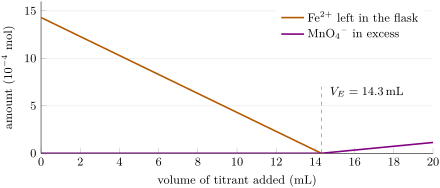
On the figure of the amounts against the volume poured, read the equivalent volume. What amount of iron(II) was in the flask at the start?
Solution
Solution of Exercise 36.3.
; the iron(II) line starts at , that is .
Exercise 36.4 ★
Why is no indicator needed for a titration by permanganate?
Solution
Solution of Exercise 36.4.
The titrant is itself coloured (purple) and its product almost colourless: the colour appears in the flask as soon as the permanganate is in excess.
Exercise 36.5 ★
At the equivalence of the titration of iron(II) by permanganate, what is the ratio of the amount of iron(II) to the amount of permanganate poured? Why?
Solution
Solution of Exercise 36.5.
5: the equation consumes 5 iron(II) ions per permanganate ion, and at equivalence the reactants have been brought together in these proportions.
Exercise 36.6 ★★
of an acidified iron(II) solution need of permanganate at . Compute the molar concentration of iron(II), then its mass concentration.
Solution
Solution of Exercise 36.6.
; ; ; .
Exercise 36.7 ★★
A vitamin C tablet is dissolved to make of solution. of it, with starch, need of iodine at . What mass of vitamin C does the tablet contain?
Solution
Solution of Exercise 36.7.
Ratio 1:1: in , so in the , that is : about .
Exercise 36.8 ★★
A reaction is total but takes several minutes. Why can it not be used as it is for a titration with a colour change?
Solution
Solution of Exercise 36.8.
Each drop would not react at once: the colour of the titrant would linger before equivalence, and the end would be seen too early (or one would have to wait minutes after each drop).
Exercise 36.9 ★★
Look at the three flasks. A student stops at a flask as purple as the third one. Is her equivalent volume too large or too small? What should she have done near equivalence?
Solution
Solution of Exercise 36.9.
Too large: she has gone past equivalence, adding permanganate in excess. Near equivalence she should have added the titrant drop by drop, swirling, and stopped at the first lasting faint pink.
Exercise 36.10 ★★
A concentrated iron(II) solution is first diluted ten times. Then of the diluted solution need of permanganate at . Find the concentration of the concentrated solution.
Solution
Solution of Exercise 36.10.
in : for the diluted solution, and for the concentrated one.
Exercise 36.11 ★★
The iron(II) solution of the chapter’s worked example has . What mass of iron does of it contain?
Solution
Solution of Exercise 36.11.
.
Exercise 36.12 ★★★
A titration gives . Estimate the relative error due to the burette readings, and compare with . Suggest two ways of obtaining a larger equivalent volume.
Solution
Solution of Exercise 36.12.
, against for . Titrate a larger volume (or a more concentrated sample) of the solution, or use a more dilute titrant.
Exercise 36.13 ★★★
Hydrogen peroxide is titrated by permanganate in acid:
A disinfectant is diluted ten times; of the diluted solution need of permanganate at . Find the molar concentration of hydrogen peroxide in the disinfectant, then its mass concentration (: ).
Solution
Solution of Exercise 36.13.
; in : in the diluted solution, in the disinfectant, that is (about a 3 % solution).
Exercise 36.14 ★★★
An iron tablet should contain about of iron(II). What concentration of permanganate gives an equivalent volume near with a burette? What would go wrong with a solution ten times more concentrated?
Solution
Solution of Exercise 36.14.
, to be delivered in about : , so a solution. Ten times more concentrated, would be about : the burette error would reach some .
Exercise 36.15 ★★★
The equation of the titration shows for each . For an equivalent volume of at , what amount of hydrogen ions is used up? Is of an acid containing of hydrogen ions enough? Why must the flask be acidified?
36.7 Problem: Is the Iron Tablet Honest?
Problem 36.1
Weekend problem — an iron supplement claims 80 mg of iron per tablet: does a titration agree?
The box of an iron supplement claims of iron, as iron(II), per tablet. A tablet is crushed and dissolved in about of dilute sulfuric acid, then titrated by potassium permanganate at . The faint pink persists at .
Part I — The reaction.
- Name the two redox couples involved. Which species is the oxidant, which the reductant?
- Write the two half-equations.
- Combine them into the equation of the titration, and check that it is balanced in charge.
- Why is the tablet dissolved in acid?
- Show that the reaction meets the conditions of a titration, and explain how equivalence is seen.
Part II — The titration.
- In which piece of glassware is the permanganate solution? How is its volume read?
- What colour is the flask before equivalence, and why does each drop lose its colour?
- Compute the amount of permanganate poured at equivalence.
Part III — The iron.
- Deduce the amount of iron(II) in the tablet.
- Compute its mass in milligrams.
- Compare with the label: relative difference?
- The volume poured may be off by . By how many milligrams may the mass of iron be off? Is the label confirmed?
Part IV — Several tablets.
- Two more tablets give and . Compute their masses of iron.
- Compute the mean of the three tablets.
- The three results differ by more than the burette error. What does this say about the tablets?
- Would permanganate at have been a better choice? Explain.
- Many supplements also contain vitamin C, a reductant. What would it do to the titration, and to the mass of iron found?
- The iron is present as iron(II) sulfate, . What mass of it does one tablet contain?
- How many iron(II) ions is that?
- State the final answer: what mass of iron does one tablet contain?
Solution
Solution of Problem 36.1.
1. / and /. The oxidant is the permanganate ion, the reductant the iron(II) ion.
2. ; .
3. The second is multiplied by 5: . Charge on the left ; on the right .
4. Hydrogen ions are a reactant: the reaction needs an acidic solution.
5. It is total, fast and the only reaction of the permanganate in the flask; the permanganate, purple, is used up before equivalence and colours the flask pink after it.
6. In the burette; read at the bottom of the meniscus, eye level, before and after, to .
7. Pale yellow (iron ions); each purple drop is used up at once by the iron(II) ions still present.
8. .
9. .
10. .
11. .
12. out of is , about : the result, mg, agrees with the label.
13. : ; : .
14. .
15. The tablets themselves differ slightly in their iron content, by about .
16. No: would be about , and the burette error , five times worse.
17. Vitamin C would also be oxidised by the permanganate: the reaction would no longer be unique, would be too large, and the iron would be overestimated.
18. , about .
19. ions.
20. About of iron per tablet: the label is honest.