School Chemistry — Grades 1 to 12 · Grades 1–12
29Colour and Absorbance
A bottle of sports drink glows bright blue on the bench of a gym. Its colour comes from a dye dissolved in it, a few milligrams in a whole litre: far too little to weigh, and far too little to see as a solid. Yet a food laboratory must check that amount, because a dye may be added only within limits. The colour itself is the key. The more dye a solution holds, the more light it absorbs; an instrument that measures how much light a solution absorbs measures, in fact, a concentration.
You already know
The mass and molar concentrations of a solution; diluting a stock solution; a calibration scale of standard solutions compared with an unknown (Chapter 26).
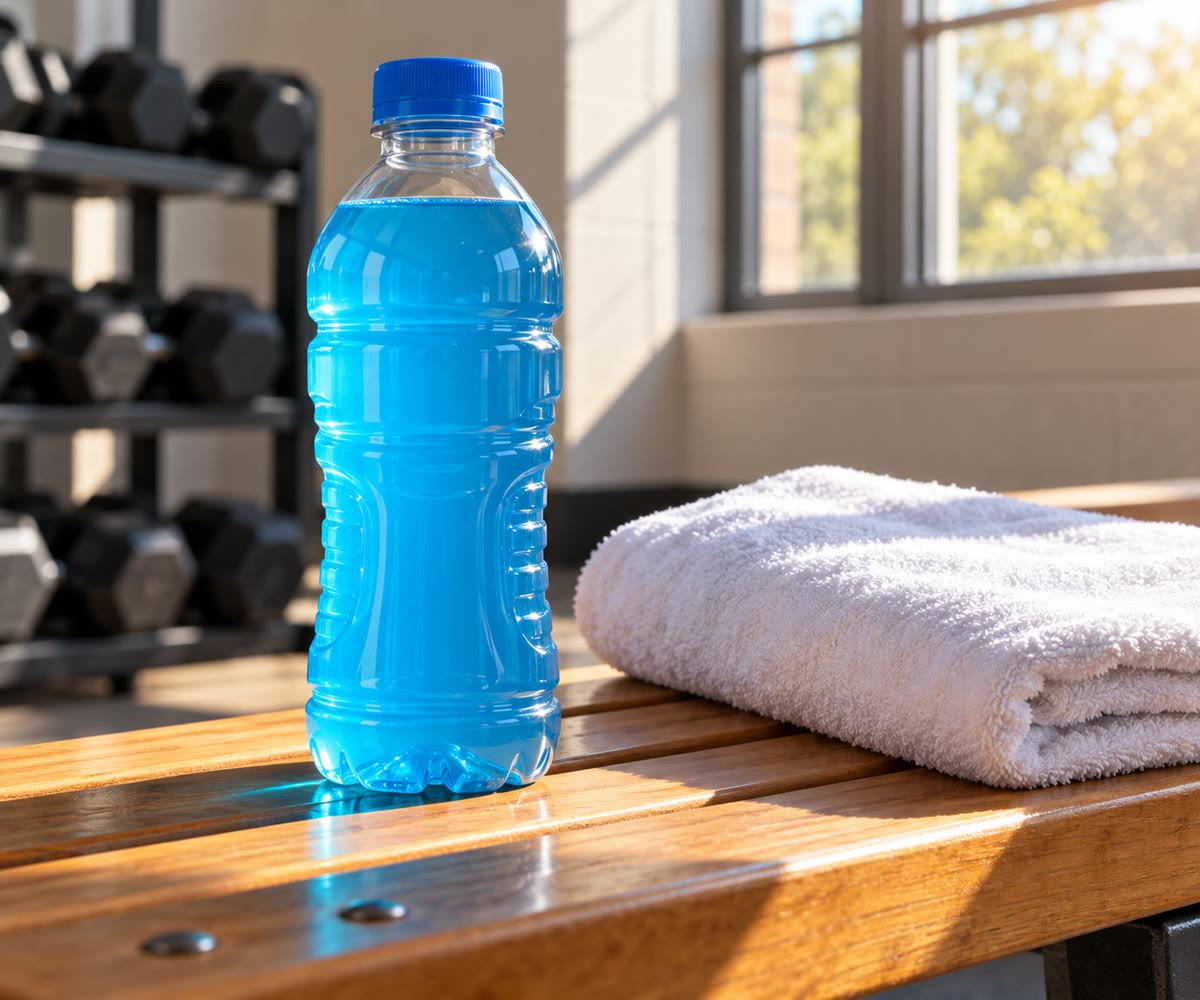
29.1 The colour of a solution
White light, such as daylight, is a mixture of all the colours of the rainbow. Each colour corresponds to a wavelength, from about for violet to about for red; the physics book explains what a wavelength is, and here it is only a label for a colour. A coloured solution absorbs part of the light that crosses it, some colours much more than others; the eye sees the colours that pass through.
Definition 29.1 (Complementary colours)
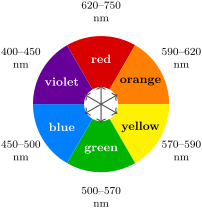
Two colours are complementary colours if mixing them gives white light. On a colour wheel, complementary colours face each other.
Proposition 29.2 (The colour seen)
A solution that absorbs mainly one colour of white light looks the colour complementary to it.
Proof. Admitted: the light that passes is white light minus the absorbed colour, and the eye sees that remainder as the complementary colour. ∎
Example 29.3 (Two food dyes)
The blue dye of the sports drink, known as Brilliant Blue (E133), absorbs mostly orange-red light, around : it looks blue. The yellow dye tartrazine (E102) absorbs mostly violet-blue light, around : it looks yellow. A green drink usually holds both.
29.2 The absorption spectrum
Definition 29.4 (Absorption spectrum)
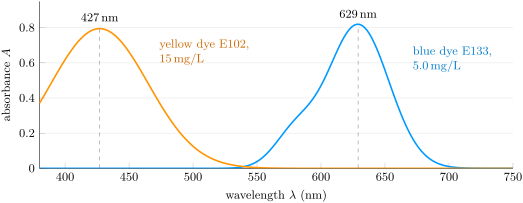
The absorption spectrum of a solution is the graph of the light it absorbs (its absorbance, defined in the next section) against the wavelength. The wavelength at which the absorption is largest is written .
Remark 29.5 (Reading a spectrum)
The blue dye absorbs almost nothing below : blue and violet light pass, and the solution looks blue. The yellow dye absorbs almost nothing above : green, yellow, orange and red light pass, and the eye sees yellow. At , only the blue dye absorbs; at , almost only the yellow one.
29.3 Absorbance and the spectrophotometer
Definition 29.6 (Absorbance)
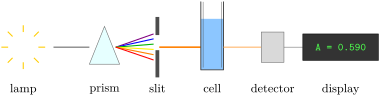
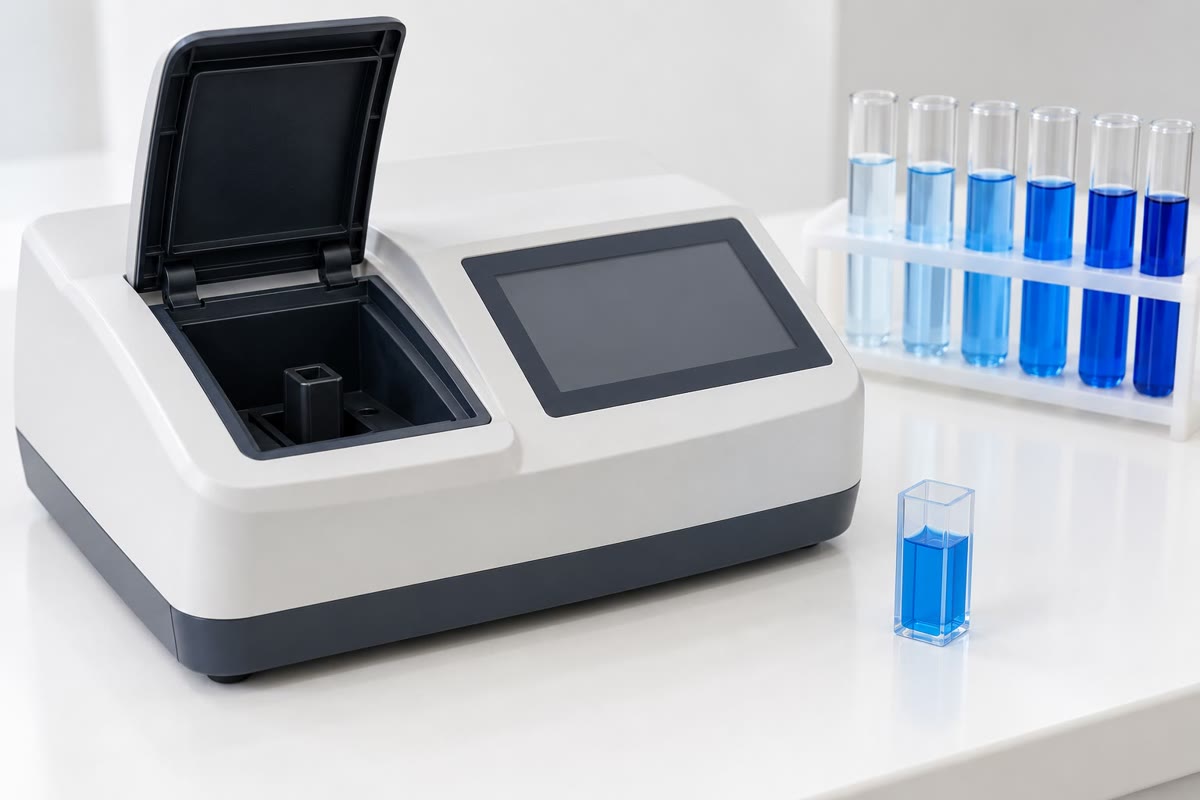
The absorbance of a solution, at a chosen wavelength, is the number displayed by a spectrophotometer that measures how much of the light of that wavelength the solution absorbs. It has no unit; it is zero for the pure solvent, and the larger the more light the solution absorbs.
Remark 29.7 (Where the number comes from)
The absorbance is calculated by the instrument from the intensities of the light entering and leaving the solution, with a mathematical function met in the last year of school, the logarithm. A university volume gives the formula; here, the absorbance is simply what the instrument reads.
In the lab — Zeroing the spectrophotometer
The cell, the solvent and the instrument itself absorb a little light. Before any measurement, a cell filled with the pure solvent, the blank, is placed in the instrument, which is set to read at the chosen wavelength. Every reading that follows is the absorbance of the solute alone. The cells are always handled by their frosted sides, and wiped: a fingerprint on a clear face absorbs light too.
29.4 The Beer–Lambert law
Definition 29.8 (Molar absorption coefficient)
The molar absorption coefficient of a dissolved species, at a given wavelength, measures how strongly one mole of it absorbs light; it depends on the species, the solvent and the wavelength, and is expressed in .
Proposition 29.9 (Beer–Lambert law)
For a dilute solution of a single absorbing species, of molar concentration , in a cell of thickness , the absorbance at a given wavelength is
The absorbance is proportional to the concentration.
Proof. Admitted here; it is derived in a university volume. ∎
Remark 29.10 (With a mass concentration)
Since , the law can also be written , with in . The specifications of food dyes give : for the blue dye E133 at , , and with its molar mass of , . A solution of only of it, in a cell, already reads .
Remark 29.11 (Dilute solutions only)
The proportionality holds only for dilute solutions, in practice for absorbances below about 1 to 1.5 on an ordinary instrument. A solution that is too concentrated is diluted by a known factor before it is measured.
29.5 Measuring a concentration
Definition 29.12 (Calibration line)
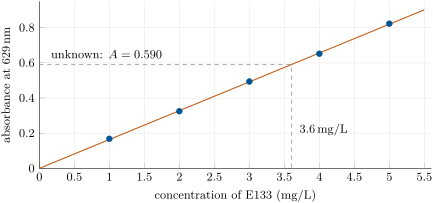
A calibration line is the graph of the absorbance of a series of standard solutions of one species, measured at the same wavelength in the same cell, against their concentration. When the Beer–Lambert law holds, it is a straight line through the origin.
Method 29.13 (Measuring a concentration with a calibration line)
- Record the absorption spectrum of the species and choose the wavelength , where the absorbance is largest and varies least with a small error on the wavelength.
- Zero the instrument with the blank.
- Prepare standard solutions by dilution of a stock solution and measure their absorbances.
- Plot against the concentration and draw the straight line through the origin closest to the points.
- Measure the unknown, diluted if needed so that its absorbance falls among those of the standards, and read its concentration on the line (or divide by the slope); multiply by the dilution factor.
Example 29.14 (The five standards)
A stock solution of the blue dye at is diluted to give of each standard: for , the dilution factor is 50, so of stock are made up to . The five standards, from 1 to , read 0.168, 0.325, 0.494, 0.652 and 0.823: within a few thousandths of , the line of the figure.
29.6 Exercises
Exercise 29.1 ★
A solution absorbs mainly orange light. What colour does it look? And a solution that absorbs mainly violet light?
Solution
Solution of Exercise 29.1.
Absorbing orange, it looks blue, the colour facing orange on the wheel. Absorbing violet, it looks yellow.
Exercise 29.2 ★
Using the colour wheel, give the colour mainly absorbed by a green solution, and the range of wavelengths that colour covers.
Solution
Solution of Exercise 29.2.
A green solution absorbs mainly red light, the colour facing green on the wheel: from about to .
Exercise 29.3 ★
Read on the absorption spectra the wavelength of each dye and its absorbance there.
Solution
Solution of Exercise 29.3.
Blue dye: , . Yellow dye: , , about 0.80.
Exercise 29.4 ★
A dye solution at reads . What does a solution of the same dye at read in the same cell, at the same wavelength? And at ?
Solution
Solution of Exercise 29.4.
is proportional to the concentration: three times more gives ; half as much gives .
Exercise 29.5 ★
What is the blank of a spectrophotometer, and why is the instrument set to zero with it?
Exercise 29.6 ★★
Using the calibration line of the blue dye, find the concentration of a solution that reads .
Solution
Solution of Exercise 29.6.
.
Exercise 29.7 ★★
To measure the blue dye, why set the spectrophotometer to rather than to ? Give two reasons.
Solution
Solution of Exercise 29.7.
At the absorbance is largest, so the measurement is most sensitive (small concentrations still give readable absorbances); and at the top of the band the curve is flat, so a small error on the wavelength hardly changes the reading. At the absorbance is small and changes fast with the wavelength.
Exercise 29.8 ★★
An undiluted drink reads at , too high to be trusted. It is diluted five times and then reads . Find the concentration of blue dye in the drink.
Solution
Solution of Exercise 29.8.
Diluted: ; the drink: (more precisely ).
Exercise 29.9 ★★
A solution of tartrazine at reads at in a cell. Compute its absorptivity in , then its molar absorption coefficient (molar mass ).
Solution
Solution of Exercise 29.9.
; .
Exercise 29.10 ★★
Look at the spectra of the two dyes. Above which wavelength does the yellow dye absorb almost nothing? Why can the blue dye be measured at even in a green drink that also contains the yellow dye?
Solution
Solution of Exercise 29.10.
Above about . At the yellow dye does not absorb at all, so the whole absorbance there comes from the blue dye.
Exercise 29.11 ★★
The same solution is measured in a cell thick instead of . How does its absorbance change? Why?
Solution
Solution of Exercise 29.11.
It doubles: is proportional to ; the light crosses twice as much solution, hence twice as many absorbing molecules.
Exercise 29.12 ★★★
Standards of the blue dye at 5, 10, 20 and read 0.82, 1.62, 2.30 and 2.70. Compute for each. What do you notice? Which standards may be used for a calibration line, and what should be done with an unknown that reads ?
Solution
Solution of Exercise 29.12.
: , , , . The ratio is constant only for the first two: beyond about (absorbances above about 1.6) the law no longer holds. Only the standards at 5 and (and lower ones) may be used; an unknown reading 2.5 must be diluted, for example five times, and measured again.
Exercise 29.13 ★★★
A green drink contains the blue dye and the yellow dye. In a cell it reads at and at . At the blue dye absorbs almost nothing, and at the yellow dye absorbs nothing. Find the mass concentrations of both dyes (use and ).
Solution
Solution of Exercise 29.13.
Blue dye, from alone: . Yellow dye, from : .
Exercise 29.14 ★★★
A student forgets the blank and sets the instrument to zero with an empty cell. Every reading is then too high. The unknown reads , and she divides by the slope of the true calibration line. What concentration does she find? What is the true one? By what percentage is she wrong?
Solution
Solution of Exercise 29.14.
She finds . The true absorbance is , so the true concentration is . She is too high.
Exercise 29.15 ★★★
The acceptable daily intake of tartrazine is per kilogram of body mass. A drink contains of it. What volume of the drink would bring a adult to this intake in one day? Is that a realistic risk?
Solution
Solution of Exercise 29.15.
per day, in of drink. No one drinks thirty litres a day: the drink alone is no realistic risk, although the dye may also come from other foods.
29.7 Problem: The Blue of a Sports Drink
Problem 29.1
Weekend problem — how many bottles of a blue sports drink would a child have to drink to reach the safe daily limit of its dye?
A food laboratory checks the blue dye E133 of a sports drink sold in bottles. The specifications of the dye give its molar mass, , and its acceptable daily intake: per kilogram of body mass and per day, an amount that can be eaten every day for a lifetime without appreciable risk.
Part I — Colour and spectrum.
- The drink looks blue. Using the colour wheel, which colour of light does it absorb most?
- Read the wavelength of the dye on its spectrum.
- Why is the absorbance of the dye almost zero at ? Is that consistent with its colour?
- At which wavelength should the measurements be made?
Part II — The calibration line.
- of pure dye are dissolved to make of stock solution. Compute its mass concentration in .
- Standards of 1.0, 2.0, 3.0, 4.0 and are made, each. What volume of stock is needed for the standard? With which glassware?
- The standards read 0.168, 0.325, 0.494, 0.652 and 0.823. Compute for each, and show that the points lie close to a line through the origin of slope about .
- Why must the line pass through the origin?
- Deduce the absorptivity of the dye in (cell of ), then its molar absorption coefficient.
Part III — The drink.
- of drink are made up to with water. What is the dilution factor?
- The diluted drink reads . Find its concentration of dye.
- Deduce the concentration of dye in the drink itself.
- What would the undiluted drink read? Why was it diluted?
- Compute the mass of dye in one bottle.
- Compute the amount of dye, in moles, in one bottle.
Part IV — The acceptable daily intake.
- What mass of the dye may a child of take in each day?
- How many bottles would the child have to drink in one day to reach it?
- What volume of drink is that? Comment.
- Same question for an adult of .
- State the final answer: how many bottles would a child have to drink in a day to reach the acceptable daily intake of the dye?
Solution
Solution of Problem 29.1.
1. Orange-red, the colour facing blue on the wheel.
2. .
3. At the light is blue: the dye lets it through, which is exactly why the drink looks blue.
4. At .
5. .
6. Dilution factor , so : a graduated pipette (or a burette) and a volumetric flask.
7. = 0.168, 0.163, 0.165, 0.163, 0.165: all close to 0.164, so , a line through the origin.
8. A solution without dye () is the blank, set to .
9. per centimetre, that is ; .
10. .
11. .
12. .
13. About , above the highest standard (0.823): the reading would lie outside the calibrated range, where the law may fail. Diluting brings it among the standards.
14. .
15. .
16. per day.
17. bottles.
18. in a day: impossible to drink. The dye of this drink alone cannot bring a child near the limit, though dyes from several foods add up.
19. , that is bottles.
20. About 50 bottles of , of drink, in a single day.