School Chemistry — Grades 1 to 12 · Grades 1–12
4Air, a Mixture of Gases
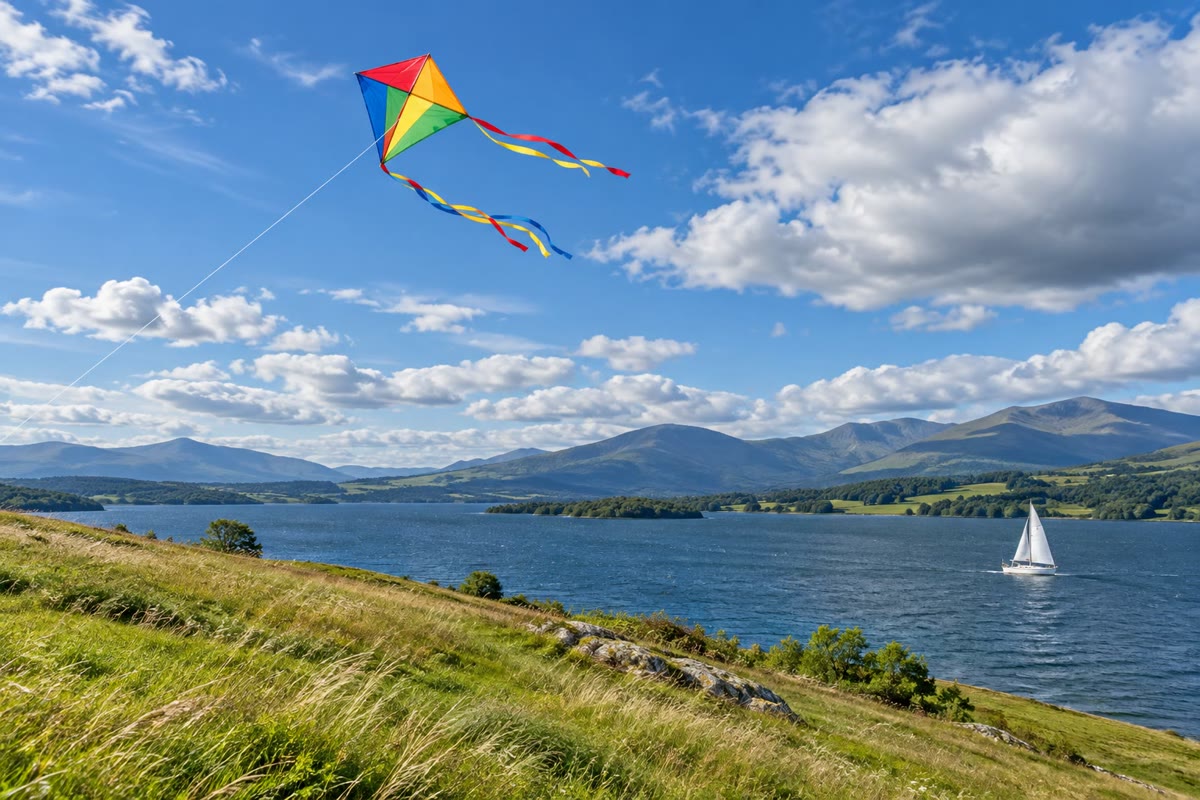
On a windy day a kite tugs at its string, and on the lake a sail fills and pushes a boat along. Something is pushing them, yet there is nothing to see. That something is air. We cannot see it, but it is all around us, it fills every empty bottle and every room, and we take it in with every breath. What is air made of?
You already know
To mix is to put different things together; what we get is a mix of those things, and nothing is lost when we mix them (Chapter 2).
4.1 Air is all around us
Example 4.1 (An upturned glass)
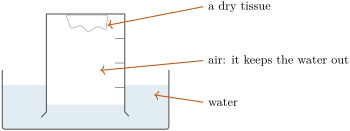
A dry paper tissue is pushed to the bottom of an empty glass. The glass is turned upside down and pushed straight down into a bowl of water. When it is lifted out again, the tissue is still dry. The glass was not empty: it was full of air, and the air kept the water out.
Remark 4.2 (Air is a gas)
Air is a gas: it has no shape of its own and spreads out to fill any container. It is matter all the same, and a balloon full of air weighs a little more than the same balloon empty. What gases are, and why they behave like this, is told in the physics book.
4.2 Air is a mixture
Definition 4.3 (Air)
Air is the mixture of gases that surrounds the Earth. It is not one single gas: several gases are mixed in it, and they can be separated from one another.
Proposition 4.4 (What air is made of)
Leaving out its water vapour, air is made of:
- nitrogen, about four fifths of the air;
- oxygen, about one fifth of the air;
- a little argon, about 1 part in 100;
- a very little carbon dioxide, about 4 parts in 10 000, and tiny amounts of other gases.
Air also holds water vapour, invisible: very little on a dry cold day, up to about 4 parts in 100 on a hot damp day.
Example 4.5 (One hundred bottles of air)
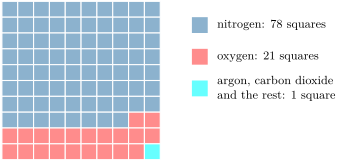
Imagine 100 bottles of dry air, and the gases of the air sorted into separate bottles. About 78 bottles would hold nitrogen, 21 bottles oxygen, and the last bottle argon, with a few drops’ worth of carbon dioxide and other gases.
Remark 4.6 (Names of gases)
Nitrogen, oxygen, argon and carbon dioxide are the names of gases. They are all colourless and have no smell. A later chapter shows what each of them is made of, down to the tiny pieces that make up all matter.
4.3 What we breathe in and out
Proposition 4.7 (Breathed-out air)
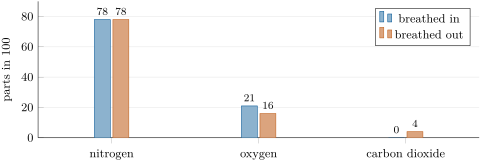
The air we breathe out is not the air we breathed in. Our body takes some of the oxygen and gives out carbon dioxide and water vapour:
Example 4.8 (A crowded room)
In a small classroom with the windows shut, thirty people breathe out carbon dioxide all morning. Little by little the air of the room holds less oxygen and more carbon dioxide, and people feel tired. Opening the windows brings fresh air back in.
Remark 4.9 (Why divers breathe air)
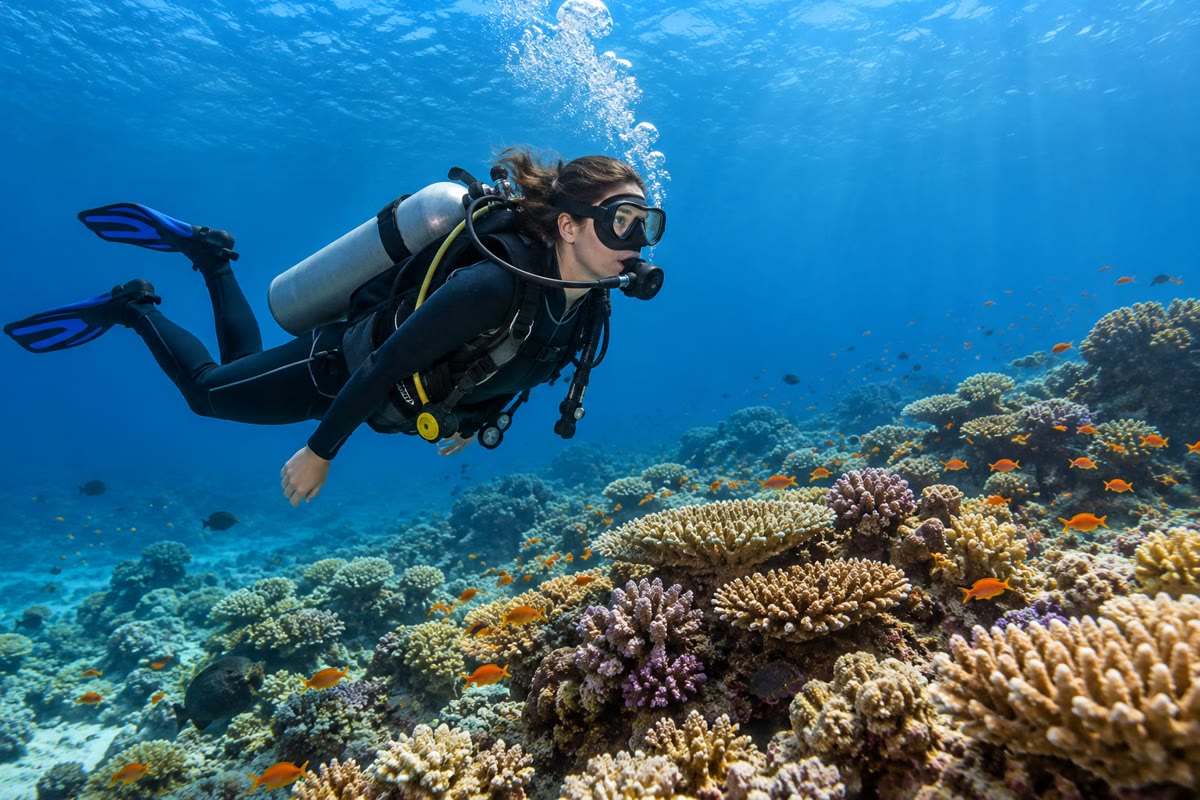
A diver’s tank is filled with air squeezed into a small space, not with pure oxygen: breathing pure oxygen deep under water is dangerous. The nitrogen of the air is there to dilute the oxygen.
4.4 Oxygen for life and for fire
Proposition 4.10 (Oxygen is used up by living things and by flames)
Of all the gases of the air, oxygen is the one living things and flames need. Animals and people take it in when they breathe; a flame takes it from the air around it. Green plants, in daylight, give oxygen back to the air.
In the lab — A candle under a jar
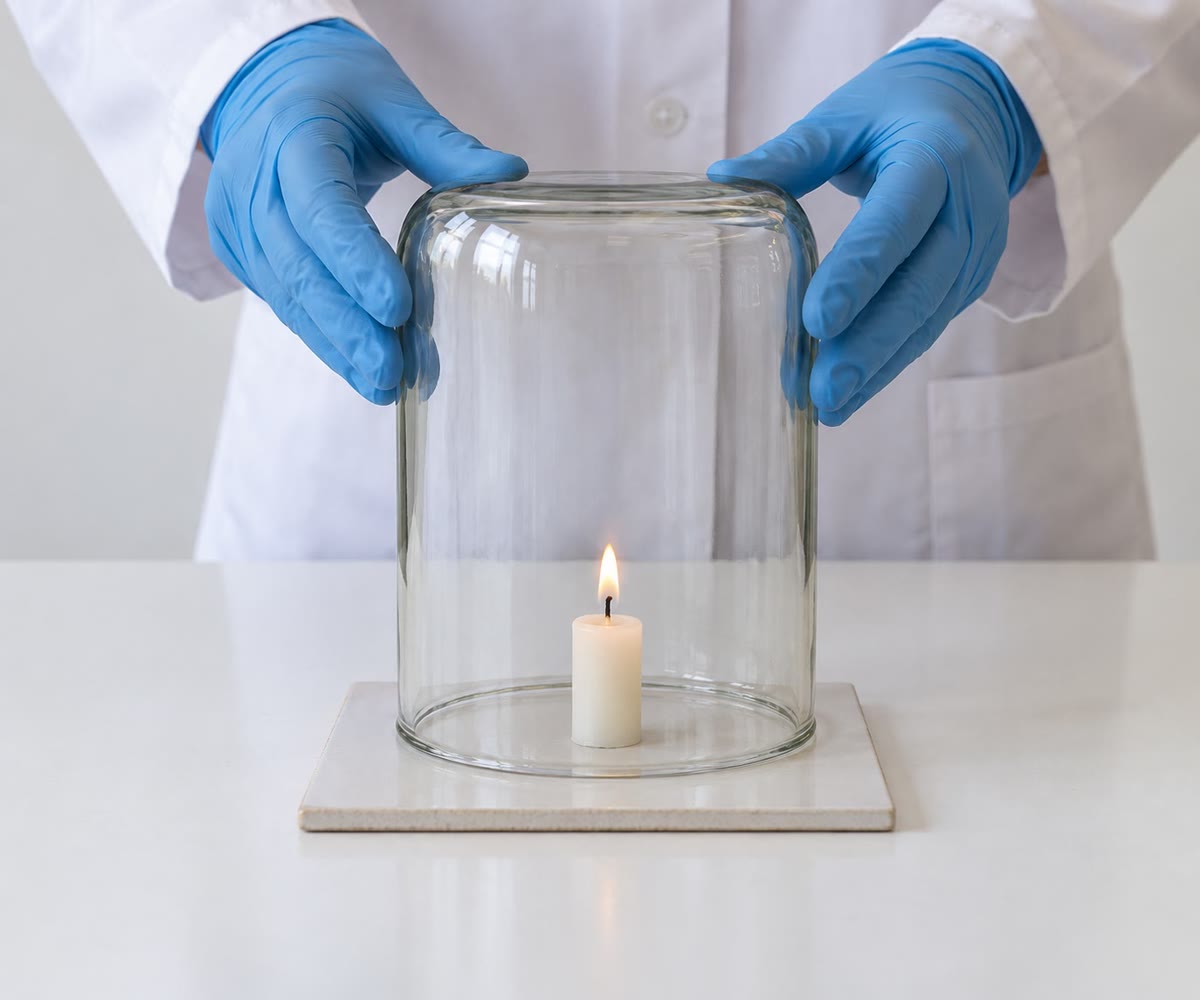
The teacher lights a candle on a tile and slowly lowers a large glass jar over it. The flame shrinks, flickers and goes out after a few seconds: around the flame, the air holds too little oxygen to keep it burning. Under a jar twice as large, the candle burns about twice as long, because there is about twice as much air, and so twice as much oxygen, to use.
Remark 4.11 (Nitrogen does not burn)
Nitrogen is the largest part of the air, yet it does not keep a flame burning and it is not used by our body. If air were all nitrogen, we could not breathe and nothing could burn.
4.5 Exercises
Exercise 4.1 ★
Is air one single gas or a mixture? Name the two main gases of the air.
Solution
Solution of Exercise 4.1.
A mixture. Its two main gases are nitrogen and oxygen.
Exercise 4.2 ★
About what fraction of the air is nitrogen? About what fraction is oxygen?
Solution
Solution of Exercise 4.2.
About four fifths of the air is nitrogen, about one fifth is oxygen.
Exercise 4.3 ★
In 100 litres of dry air, about how many litres are nitrogen? About how many litres are oxygen?
Solution
Solution of Exercise 4.3.
About 78 litres of nitrogen and about 21 litres of oxygen.
Exercise 4.4 ★
An empty bottle is put upside down into a basin of water. Why does the water not fill the bottle?
Exercise 4.5 ★
Look at the bar chart. Which gas is there less of in the air breathed out? Which gas is there more of?
Solution
Solution of Exercise 4.5.
There is less oxygen (16 parts in 100 instead of 21) and more carbon dioxide (4 parts in 100 instead of almost none).
Exercise 4.6 ★
Which gas of the air does a flame need? Which gas of the air do we need when we breathe?
Solution
Solution of Exercise 4.6.
Oxygen in both cases: a flame and our body both use the oxygen of the air.
Exercise 4.7 ★
Look at the figure with 100 squares. How many squares are nitrogen? How many are not nitrogen?
Solution
Solution of Exercise 4.7.
78 squares are nitrogen; squares are not.
Exercise 4.8 ★
Why does a candle under a jar go out after a while?
Solution
Solution of Exercise 4.8.
The flame uses the oxygen of the air in the jar. When too little oxygen is left around the flame, it goes out.
Exercise 4.9 ★
In 500 litres of air, about how many litres are oxygen? (One fifth of the air is oxygen.)
Solution
Solution of Exercise 4.9.
One fifth of 500 litres: litres of oxygen.
Exercise 4.10 ★★
Why is it a good idea to open the windows of a classroom between lessons?
Solution
Solution of Exercise 4.10.
The people in the room breathe in oxygen and breathe out carbon dioxide. Opening the windows brings back fresh air, with more oxygen and less carbon dioxide.
Exercise 4.11 ★★
A candle burns for 10 seconds under a small jar. About how long would it burn under a jar holding three times as much air?
Solution
Solution of Exercise 4.11.
Three times as much air holds three times as much oxygen: about seconds.