School Chemistry — Grades 1 to 12 · Grades 1–12
13Conservation of Mass and Balanced Equations
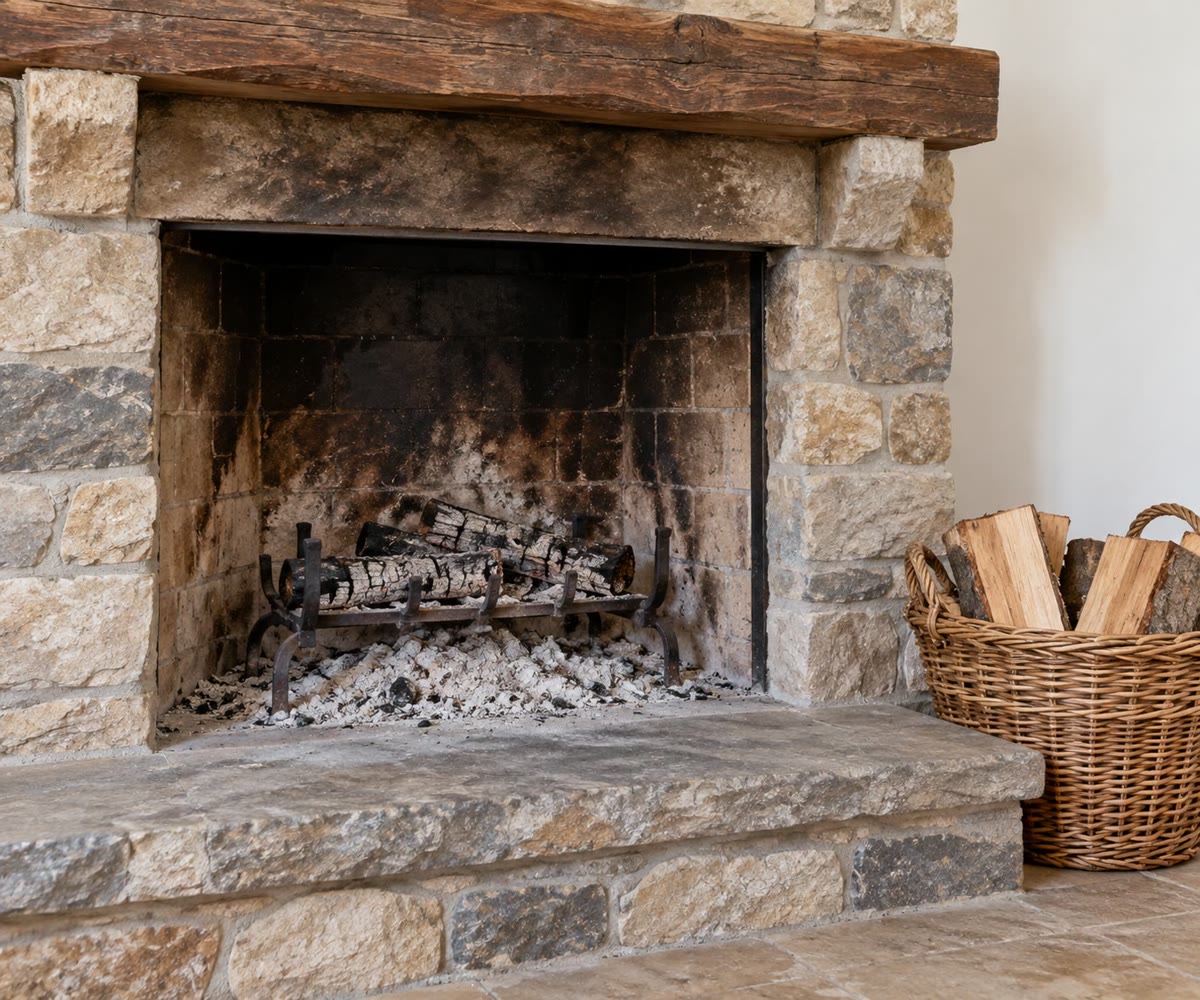
A log weighing two kilograms burns in a fireplace. In the morning, a few tens of grams of grey ash are left. Did almost two kilograms of matter vanish in the night? For centuries nobody could say. The answer came from a chemist who decided to weigh everything — including the gases that nobody had thought of weighing.
You already know
In a chemical reaction the reactants are used up and the products are formed; the atoms of the reactants are rearranged into the products, neither created nor destroyed (Chapter 12). A chemical formula such as lists the atoms of a molecule; a number in front, as in , counts molecules (Chapter 11).
13.1 Mass is conserved
In the lab — Weighing a reaction in a closed flask
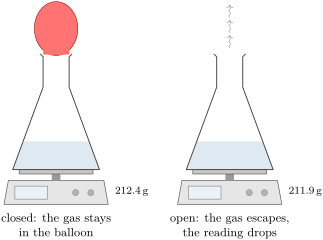
The teacher puts some vinegar in a flask, and baking soda in a balloon fitted over its neck, then sets the whole on a balance: . The balloon is lifted so that the soda falls into the vinegar: the mixture fizzes and the balloon swells with the gas formed. The balance still reads . The same reaction in an open flask, without the balloon, “loses” mass: the gas escapes into the room.
Definition 13.1 (Conservation of mass)
Conservation of mass is the law that in a chemical reaction, the total mass of the products formed is equal to the total mass of the reactants used up. Nothing is lost and nothing is created; matter only changes form.
Example 13.2 (The log, weighed properly)
If the burning log and the oxygen it took from the air could be weighed before, and the ash, carbon dioxide and water vapour after, the two totals would be equal. The ash is light because most of the products are gases that go up the chimney.
History — Lavoisier weighs everything, 1770s–1789
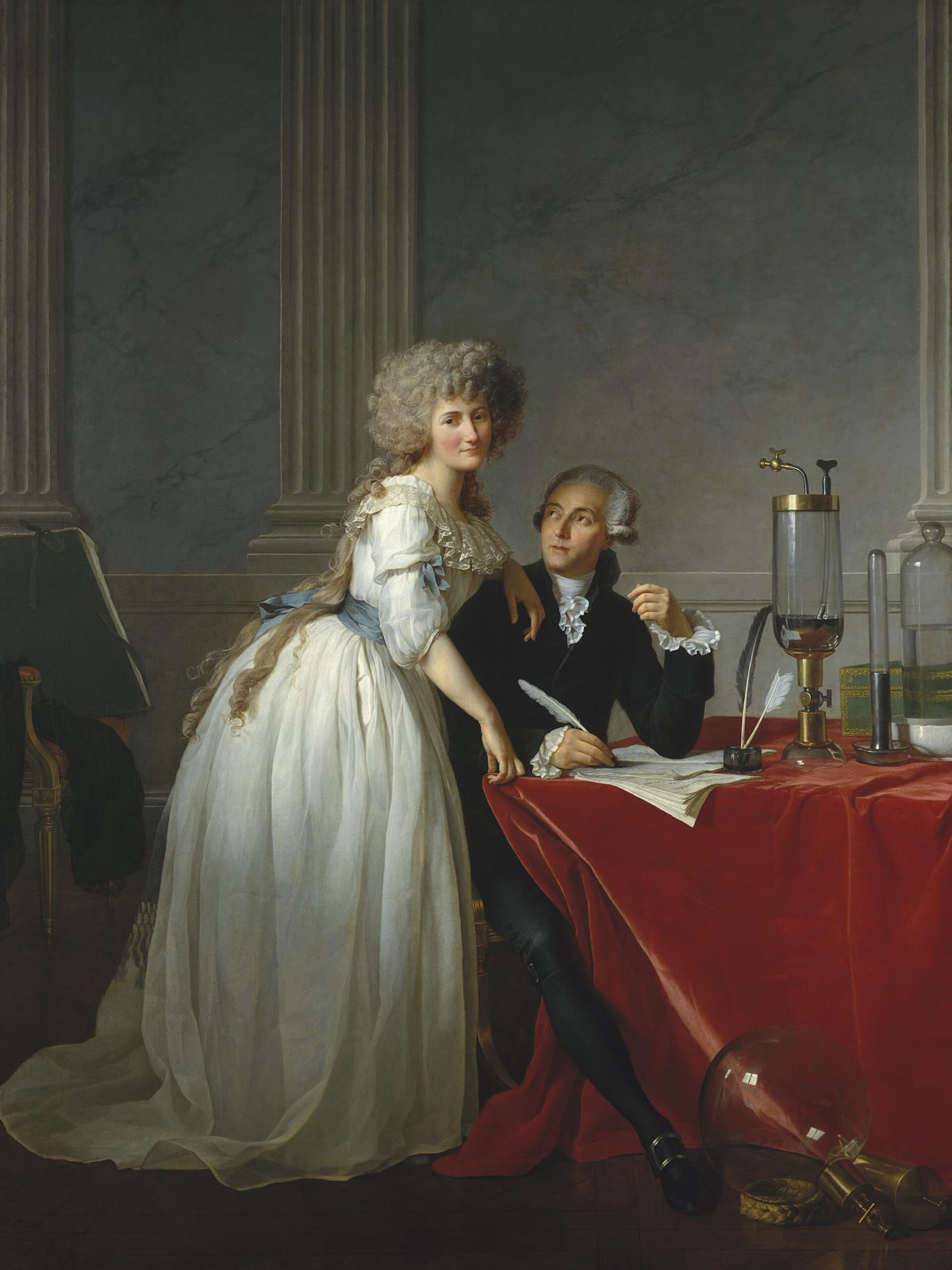
Antoine-Laurent Lavoisier made a rule of weighing every substance before and after each reaction, in sealed vessels so that no gas could escape or enter. He showed that metals gain mass when they rust or burn, by taking something from the air — oxygen, which he named — and stated in 1789 that nothing is created and nothing is lost in a reaction. His wife, Marie-Anne Paulze Lavoisier, worked beside him, recorded the experiments and drew the apparatus for his book.
13.2 Why mass is conserved
Proposition 13.3 (Atoms are conserved, so mass is conserved)
In a reaction the atoms are only rearranged: every atom of the reactants is found again in the products. Each atom keeps its own mass. The total mass therefore cannot change.
Example 13.4 (Iron that gains mass)
Steel wool burnt on a balance in an open dish gets heavier: the iron atoms have joined oxygen atoms taken from the air, and the iron oxide formed weighs the iron plus that oxygen. Burnt in a sealed jar of air on the balance, the whole does not change mass: the oxygen was already inside the jar.
13.3 The chemical equation
Definition 13.5 (Chemical equation)
A chemical equation writes a reaction with formulas: the formulas of the reactants on the left, joined by , an arrow, and the formulas of the products on the right. Each formula may carry a number in front of it. The equation is a balanced equation when each kind of atom appears the same number of times on both sides.
Definition 13.6 (Stoichiometric coefficient)
The number written in front of a formula in an equation is its stoichiometric coefficient: it counts the molecules (or other particles) of that species taking part. A coefficient 1 is not written.
Notation 13.7 (State symbols)
A letter in brackets after a formula may give its physical state: (s) solid, (l) liquid, (g) gas. Thus is liquid water and water vapour.
Example 13.8 (Reading an equation)
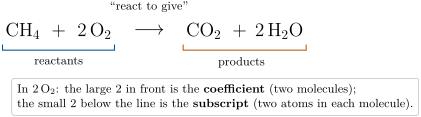
reads: one methane molecule and two oxygen molecules react to give one carbon dioxide molecule and two water molecules. Left: 1 C, 4 H, 4 O. Right: 1 C, 4 H, O. The equation is balanced.
13.4 Balancing an equation
Method 13.9 (Balancing an equation)
- Write the correct formulas of the reactants and products. Never change a formula afterwards: changing into would describe another substance.
- Count the atoms of each kind on each side.
- Balance one kind of atom at a time with coefficients, starting with the atoms that appear in only one formula on each side; leave hydrogen and oxygen for last.
- Count again; repeat until every kind of atom balances.
- Use the smallest whole numbers.
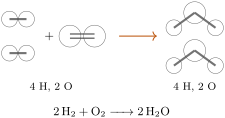
Example 13.10 (Hydrogen and oxygen)
Unbalanced: has 2 O on the left, 1 on the right. Put 2 in front of : now 4 H on the right, so 2 in front of :
Check: 4 H and 2 O on each side.
Example 13.11 (Iron burning in oxygen)
Iron and oxygen give the iron oxide . Oxygen: 2 on the left, 3 on the right; the smallest common number is 6, so 3 and 2 . Then 4 Fe on the right, so 4 Fe on the left:
13.5 Reading an equation in molecules
Proposition 13.12 (What a balanced equation says)
The coefficients of a balanced equation give the proportions in which the particles react and are formed. If the equation reads , then 200 hydrogen molecules react with 100 oxygen molecules to give 200 water molecules; a million oxygen molecules need two million hydrogen molecules.
Example 13.13 (Propane in a camping stove)
Propane, , burns in oxygen to give carbon dioxide and water. Carbon first: 3 C, so 3 . Hydrogen: 8 H, so 4 . Oxygen on the right: O, so 5 :
13.6 Exercises
Exercise 13.1 ★
State the law of conservation of mass.
Solution
Solution of Exercise 13.1.
In a chemical reaction, the total mass of the products formed equals the total mass of the reactants used up.
Exercise 13.2 ★
In , what is the stoichiometric coefficient? How many carbon atoms and how many oxygen atoms does it represent?
Exercise 13.3 ★
Is balanced? Count the atoms to check.
Solution
Solution of Exercise 13.3.
Yes: 1 C and 2 O on each side.
Exercise 13.4 ★
Balance .
Solution
Solution of Exercise 13.4.
: 2 Mg and 2 O on each side.
Exercise 13.5 ★★
Balance , the reaction that makes ammonia.
Solution
Solution of Exercise 13.5.
Nitrogen: 2 N on the left, so 2 ; then 6 H on the right, so 3 : .
Exercise 13.6 ★★
of carbon burn completely and form of carbon dioxide. What mass of oxygen was used?
Exercise 13.7 ★★
Look at the figure of the two flasks on balances. Why does the reading of the open flask drop? Has mass been destroyed?
Solution
Solution of Exercise 13.7.
The gas formed escapes into the room, so the balance no longer weighs it. No mass is destroyed: the missing mass is in the air of the room.
Exercise 13.8 ★★
Balance step by step, saying which atom you balance at each step.
Solution
Solution of Exercise 13.8.
Carbon: 1 on each side. Hydrogen: 4 on the left, so 2 . Oxygen: on the right, so 2 : .
Exercise 13.9 ★★
A student balances by writing . Why is this wrong?
Solution
Solution of Exercise 13.9.
Changing into changes the substance: is hydrogen peroxide, not water. Only coefficients may be changed: .
Exercise 13.10 ★★
Using , how many oxygen molecules are needed to burn 20 propane molecules? How many water molecules are formed?
Exercise 13.11 ★★★
Balance , the burning of ethane. (Hint: try doubling the ethane.)
Solution
Solution of Exercise 13.11.
With 2 : 4 C, so 4 ; 12 H, so 6 ; oxygen on the right , so 7 : .
Exercise 13.12 ★★★
A candle of burns in a sealed glass box full of air, which sits on a balance reading in all. When the flame goes out, the candle weighs . What does the balance read? Explain.
Solution
Solution of Exercise 13.12.
Still . The box is sealed: the of wax that burnt has become carbon dioxide and water vapour, which are still inside the box with the oxygen they took. Nothing has entered or left.
13.7 Problem: Steel Wool in a Sealed Jar
Problem 13.1
Weekend problem — iron that burns, a balance that does not move, and the oxygen taken from the air
In a laboratory, a teacher burns steel wool, which is almost pure iron, in two ways. First, a pad is burnt in an open dish on a balance: the reading goes up. Then a pad of is burnt, ignited by an electric spark, inside a closed jar of air standing on the balance: the reading does not change. The jar holds about of oxygen. Iron burning in oxygen forms the iron oxide ; with less oxygen it can also form .
Part I — Two weighings.
- In the open dish, the mass goes up. Where does the extra mass come from?
- In the closed jar, the mass does not change. Explain.
- State the law illustrated by these two weighings.
Part II — Two equations.
- Balance the equation .
- Balance the equation .
- Check the first equation by counting the atoms of each kind on each side.
- According to the first equation, how many oxygen molecules react with 400 iron atoms?
Part III — Masses. In , every of iron are combined with of oxygen. The pad burns completely to .
- What mass of oxygen combines with of iron?
- What is the mass of iron oxide formed?
- Was there enough oxygen in the jar? Explain.
- The jar is opened after cooling, and air rushes in. Explain why, and say how the reading of the balance then changes.
- Compute the mass of oxygen taken from the air of the jar by the burning steel wool.
Solution
Solution of Problem 13.1.
1. From the oxygen of the air, which combines with the iron: the iron oxide weighs the iron plus that oxygen.
2. Everything stays inside the jar: the oxygen used was already in the jar, and the oxide formed stays there. The total mass does not change.
3. Conservation of mass: in a reaction the total mass of the products equals the total mass of the reactants.
4. .
5. .
6. Left: 4 Fe, O. Right: Fe, O. Balanced.
7. 4 iron atoms for 3 oxygen molecules, so oxygen molecules.
8. of oxygen.
9. of iron oxide.
10. Yes: are needed and the jar held about .
11. The oxygen used has left the air of the jar (it is now inside the solid oxide), so the jar holds less gas than before and air from the room flows in. The balance reading then goes up, by the mass of the air that enters.
12. of oxygen were taken from the air of the jar.