School Chemistry — Grades 1 to 12 · Grades 1–12
38Proton NMR
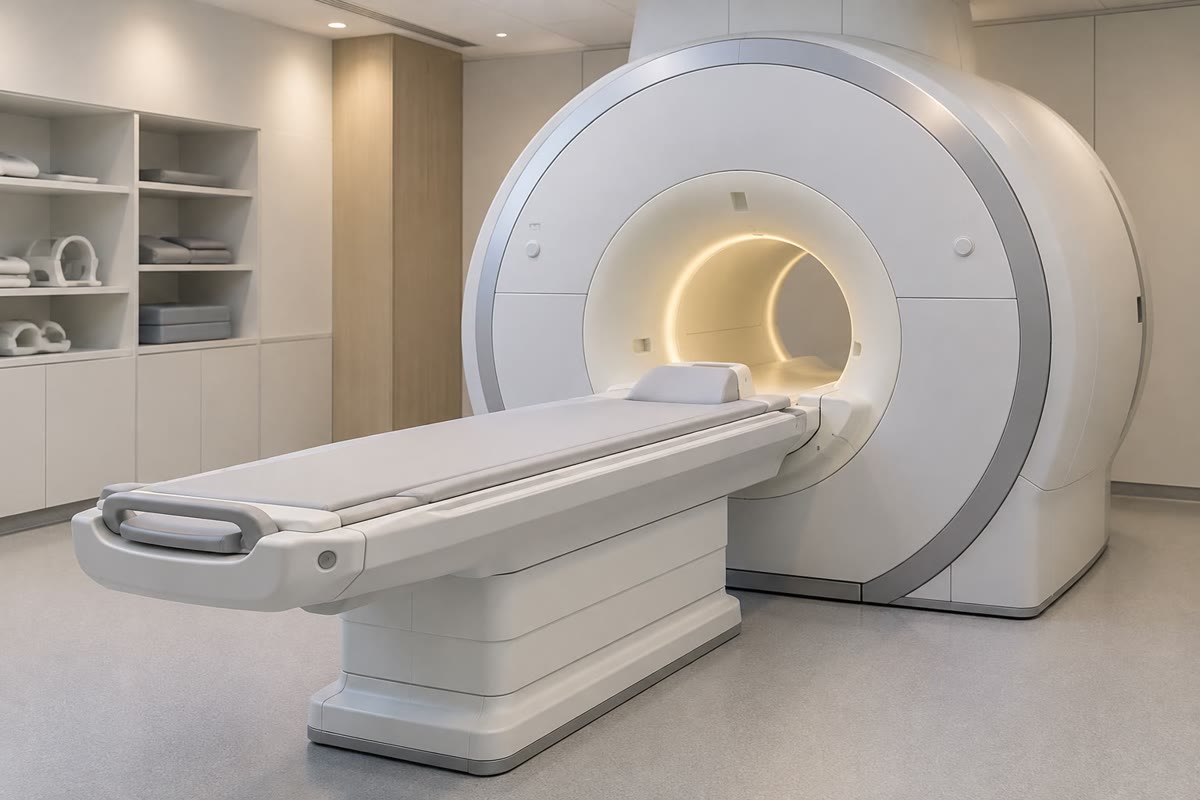
In a hospital, a patient lies inside the ring of an MRI scanner, and an image of the soft tissues of the body appears on the screen, built from the answers of the hydrogen nuclei of its water and fats. In a chemistry laboratory, a small glass tube holding a few milligrams of a compound is lowered into the bore of a powerful magnet, and a spectrum appears built the same way: a strong magnet, a radio signal, and hydrogen nuclei answering it. In the chemist’s spectrometer each hydrogen nucleus answers a little differently according to its neighbours, and the spectrum is a map of the hydrogen atoms of the molecule.
You already know
An infrared spectrum shows which bonds a molecule contains (Chapter 34). Functional groups, families and isomers (Chapter 33, Chapter 32).
38.1 Protons in a magnetic field
The nucleus of a hydrogen atom is a single proton. Placed in a strong magnetic field, it absorbs radio waves of a precise frequency; how and why belongs to physics, and is not needed here. What matters to the chemist is that the electrons around a proton shield it slightly from the field, and that this shielding depends on the atoms nearby: a proton next to an electronegative oxygen atom, which pulls electrons away, absorbs at a slightly different frequency from a proton in a hydrocarbon chain. The differences are tiny, a few millionths of the frequency, and are given in parts per million.
Definition 38.1 (NMR spectrum, chemical shift)
A proton NMR spectrum (nuclear magnetic resonance) shows the signals absorbed by the hydrogen nuclei of a compound. The position of a signal is its chemical shift , in parts per million (), measured from the signal of a reference compound, tetramethylsilane (TMS), set at . The axis is drawn increasing from right to left.
Proposition 38.2 (The shift depends on the neighbours)
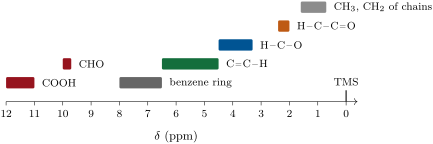
The chemical shift of a proton depends on the atoms close to it: the nearer it is to an electronegative atom or a double bond, the larger its shift. Typical ranges, in :
Proof. Measured on many compounds. An electronegative neighbour draws electrons away from the proton, which is less shielded and absorbs at a larger shift. ∎
In the lab — Preparing an NMR tube
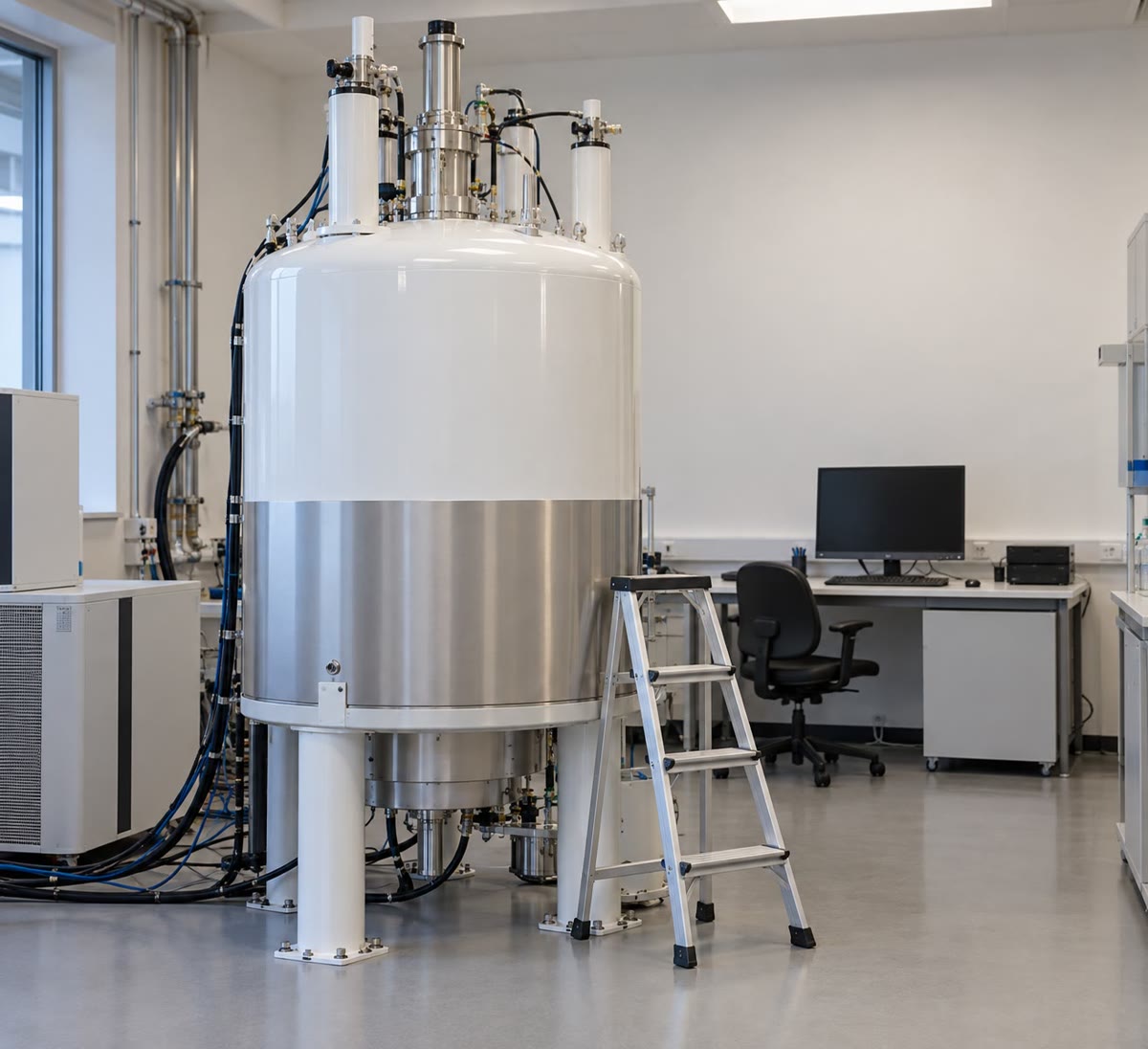
A few milligrams of the compound are dissolved in about of a solvent whose hydrogen atoms have been replaced by deuterium (, deuterated chloroform), which gives no signal; a trace of TMS is added as the reference. The solution is filtered into a thin glass tube, which is capped, labelled and lowered into the magnet.
38.2 Equivalent protons
Definition 38.3 (Equivalent protons)
Protons are equivalent protons if they have the same environment in the molecule, so that they absorb at the same shift. Each group of equivalent protons gives one signal. The three protons of a group are always equivalent.
Example 38.4 (Counting groups)
Propanone, , has six protons but one group: the two are alike, one on each side of the . Ethanol, , has three groups (, , ), and ethyl ethanoate, , three as well: the next to , the next to , and the at the end.
38.3 Integration
Definition 38.5 (Integration curve)
The integration curve of an NMR spectrum is a curve, drawn above the signals, that rises by a step at each signal: the height of each step is proportional to the number of protons that give that signal.
Example 38.6 (Reading the steps)
In the spectrum of ethanol, the steps above the three signals measure 2, 1 and 3 units, from left to right: , and . Only the ratios count: steps of 12, 6 and 18 mm say the same thing.
38.4 Multiplicity and the rule
Definition 38.7 (Multiplet, rule)
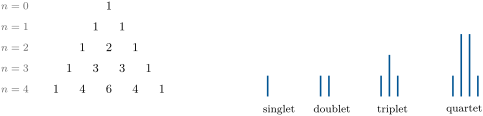
A signal is often split into several close lines: a multiplet (singlet, doublet, triplet, quartet, … for 1, 2, 3, 4 lines). By the rule, a group of equivalent protons whose neighbouring carbon atoms carry protons in all, not equivalent to it, gives a signal of lines, with intensities in the ratios of Pascal’s triangle.
Proposition 38.8 (Splitting by neighbours)
In a molecule (X without hydrogen), the signal is a triplet (2 neighbouring protons) and the signal a quartet (3 neighbouring protons). Protons bonded to an oxygen or a nitrogen atom usually give a singlet and do not split their neighbours.
Proof. Admitted: each neighbouring proton slightly shifts the signal up or down according to its own state, and the combinations give lines; the physics is explained in the Year 1 volume. Protons on O or N are exchanged quickly between molecules, which averages out their effect. ∎
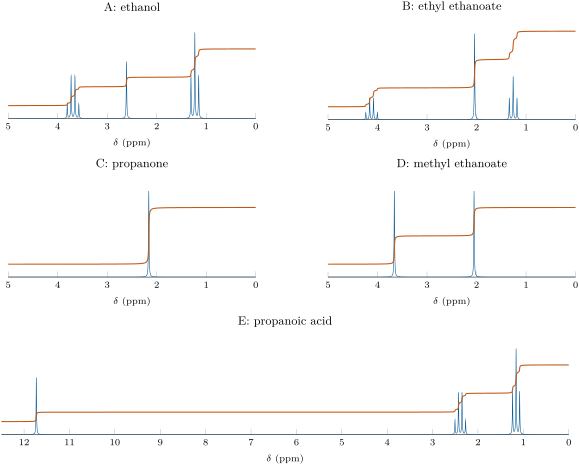
Example 38.9 (Reading the spectra)
Ethyl ethanoate (B) gives a quartet of 2 protons at (, next to oxygen and to a ), a singlet of 3 protons at (, no neighbouring proton) and a triplet of 3 protons at (, next to a ). Propanone (C) gives a single singlet of 6 protons at . Propanoic acid (E) has a quartet at , a triplet at , and a singlet far to the left, at , its acid proton.
38.5 Using infrared and NMR together
Method 38.10 (Identifying a molecule from its IR and NMR spectra)
- From the molecular formula, list the possible isomers and their functional groups.
- Infrared: look for a band near and for or bands; strike out the isomers that do not fit.
- NMR: count the signals (groups of equivalent protons), read the integration (protons per group), the multiplicities (neighbours) and the shifts (environments).
- Assemble the pieces into one structure, and check it against every observation.
Example 38.11 (Two isomers )
Propanoic acid and methyl ethanoate are isomers. In infrared, only the acid shows the very broad band. In NMR (spectra E and D), the acid gives a triplet, a quartet and a singlet near ; the ester gives two singlets of 3 protons each, at 3.66 () and (), since no carbon of the ester carries protons next to another protonated carbon.
38.6 Exercises
Exercise 38.1 ★
How many groups of equivalent protons, and so how many signals, do these molecules give: methane; ethane ; propane; methanol ; methoxymethane ?
Solution
Solution of Exercise 38.1.
Methane: 1. Ethane: 1 (the two are alike). Propane: 2 (two alike, one ). Methanol: 2 ( and ). Methoxymethane: 1.
Exercise 38.2 ★
A group of protons has 2 neighbouring protons on the next carbon. How many lines has its signal, and in which ratios? Same question for 3 and for 0 neighbours.
Solution
Solution of Exercise 38.2.
2 neighbours: a triplet, 1:2:1. 3 neighbours: a quartet, 1:3:3:1. 0 neighbours: a singlet.
Exercise 38.3 ★
A spectrum has three signals with integration steps of 15, 10 and 15 mm. The molecule has 8 protons. How many protons does each signal represent?
Exercise 38.4 ★
Using the table of shifts, where would you expect the signal of a proton of an aldehyde group? Of a group in a chain?
Exercise 38.5 ★
Why is the reference TMS chosen so that its protons are all equivalent? Why is the solvent deuterated?
Solution
Solution of Exercise 38.5.
Its twelve equivalent protons give a single, sharp, intense line, easy to place at zero. The deuterated solvent gives no proton signal of its own, which would otherwise swamp those of the few milligrams of sample.
Exercise 38.6 ★★
Predict the spectrum of chloroethane : number of signals, integration, multiplicities, approximate shifts.
Exercise 38.7 ★★
Predict the spectrum of propan-2-ol, : in particular, the multiplicity of the signal and of the signal (assume the gives a singlet and does not split).
Solution
Solution of Exercise 38.7.
Three signals: the two , 6 equivalent protons, a doublet (1 neighbour, the ); the , 1 proton, split by 6 neighbours into 7 lines, in the range (3.3–); the , 1 proton, a singlet.
Exercise 38.8 ★★
Three spectra: (a) one singlet; (b) a quartet, a singlet and a triplet, integrations 2:3:3; (c) a quartet, a triplet and a singlet far left, integrations 2:3:1. Match them with ethyl ethanoate, propanone and propanoic acid.
Solution
Solution of Exercise 38.8.
(a) propanone; (b) ethyl ethanoate; (c) propanoic acid.
Exercise 38.9 ★★
Using the shift chart, explain why the of ethyl ethanoate () is far to the left of the of the same ethyl group ().
Exercise 38.10 ★★
A compound shows a strong infrared band at and a single NMR singlet. Identify it. Why is propanal excluded?
Solution
Solution of Exercise 38.10.
Propanone: a (ketone, ) and six equivalent protons, one singlet. Propanal would give three signals, one of them, the aldehyde proton of , near 9.7–.
Exercise 38.11 ★★
In the spectrum of ethanol, why is the signal a singlet, and why does the appear as a quartet rather than as a more complex signal?
Exercise 38.12 ★★★
Give the structures of four isomers that are esters or acids (butanoic acid, ethyl ethanoate, methyl propanoate, propyl methanoate, …) and predict, for each, the number of NMR signals and their multiplicities.
Solution
Solution of Exercise 38.12.
Butanoic acid : 4 signals, a triplet (), a 6-line signal (central , 5 neighbours), a triplet (), a singlet near 11–. Ethyl ethanoate: a singlet, a quartet, a triplet. Methyl propanoate : a triplet, a quartet (, 2.0–), a singlet (). Propyl methanoate : 4 signals, a singlet far to the left (the H on the carbon), a triplet (), a 6-line signal, a triplet ().
Exercise 38.13 ★★★
A drop of heavy water is shaken with a solution of ethanol, and the spectrum is recorded again: one signal disappears. Which, and why? How does this help to recognise protons?
Exercise 38.14 ★★★
A sample of ethyl ethanoate contains some ethanol. Which extra signals appear in the spectrum? If the integration of the singlet at is 30 mm and that of a small extra triplet at is 3 mm, estimate the ratio of the amounts of ethanol and ester.
Solution
Solution of Exercise 38.14.
Ethanol adds a quartet near , a triplet near and an singlet. The ester singlet: for 3 protons, per proton of ester. The ethanol triplet: for 3 protons, per proton of ethanol. Since each molecule contributes one to these signals, the amounts are in the ratio : about one molecule of ethanol for ten of ester.
Exercise 38.15 ★★★
2-Methylpropan-1-ol is . Predict its spectrum: the signals, their integrations, and the multiplicity of the and signals. Which signal has the most lines?
38.7 Problem: The Unknown Solvent
Problem 38.1
Weekend problem — a bottle of solvent labelled only : what is it, and how tall is each step of its integration curve?
A bottle of solvent in a storeroom is labelled only “”. Its infrared spectrum shows a strong band at and no band above . Its NMR spectrum shows three signals: a quartet at , a singlet at and a triplet at . The integration curve rises by a total of .
Part I — The candidates.
- Check that fits an ester or a carboxylic acid with single bonds only in its chain.
- Give the semi-structural formulas and names of butanoic acid and of the three esters ethyl ethanoate, methyl propanoate and propyl methanoate.
- Which functional group do they share in pairs?
Part II — Infrared.
- What does the band at reveal?
- What would butanoic acid show that is missing here? Strike it out.
- Can infrared alone choose between the three esters?
Part III — NMR.
- How many groups of equivalent protons has the unknown?
- What do the quartet and the triplet suggest together?
- What does the singlet say about the neighbours of its protons?
- Why is the quartet at a large shift?
- Predict the spectrum of methyl propanoate (signals, multiplicities, approximate shifts). Is it the unknown?
- Predict the spectrum of propyl methanoate. Is it the unknown?
Part IV — Identification and integration.
- Identify the unknown and draw its structure, labelling each signal.
- How many protons does each signal represent?
- The total integration is for 8 protons. How many millimetres per proton?
- Compute the height of the step of the singlet and of the triplet.
- Check that the three steps add up to .
- Ethyl ethanoate smells of pear drops: is that consistent with the family found?
- State the final answer: how tall is the integration step of the quartet?
Solution
Solution of Problem 38.1.
1. An alkane with four carbons is ; one removes two hydrogens and the two oxygens add none: , the formula of acids and esters with four carbons.
2. Butanoic acid ; ethyl ethanoate ; methyl propanoate ; propyl methanoate .
3. The three esters share the ester group; all four have a .
4. A , in the ester range (near ).
5. The very broad band from 2500 to : absent, so not butanoic acid.
6. No: the three esters have the same groups.
7. Three.
8. An ethyl group : the split by 3 protons (quartet), the by 2 (triplet).
9. Its protons have no protons on the neighbouring atoms: a bonded to the carbon or to the ester oxygen.
10. The is bonded to oxygen ( range).
11. A triplet (), a quartet near 2.0– ( next to ) and a singlet in the range (). The quartet would be far below and the singlet far above : not the unknown.
12. Four signals (a singlet far left, a triplet, a 6-line signal, a triplet): not the unknown, which has three.
13. Ethyl ethanoate, : singlet = ; quartet = ; triplet = the end .
14. Singlet 3, quartet 2, triplet 3.
15. per proton.
16. Singlet ; triplet .
17. .
18. Yes: small esters are known for their fruity smells.
19. The quartet’s step is out of .