School Chemistry — Grades 1 to 12 · Grades 1–12
14Combustion: Fuels, Products and Greenhouse Gases
A family sleeps in a flat whose gas boiler has a blocked flue. The flame, starved of air, burns badly, and an invisible gas with no smell slowly fills the rooms. At two in the morning a small box on the wall starts to shriek: the carbon monoxide alarm. Everyone gets out in time. The same fuel, burning well, gives only carbon dioxide and water — and that carbon dioxide has its own story, written in the air of the whole planet.
You already know
A burning, or combustion, needs a fuel, oxygen and heat, and makes new substances (Chapter 5). Air is about one fifth oxygen (Chapter 4). An equation is balanced when each kind of atom appears the same number of times on both sides (Chapter 13).
14.1 Burning carbon and methane
Example 14.1 (Two combustions)
Carbon (charcoal, coal) burns to give carbon dioxide:
Methane, the main part of natural gas, burns to give carbon dioxide and water:
In both cases limewater turns milky with the gas formed; with methane a cold glass mists up as well.
Method 14.2 (Writing the combustion of a fuel made of carbon and hydrogen)
For a fuel whose molecules hold only carbon and hydrogen:
- the products are carbon dioxide and water;
- balance carbon with , then hydrogen with ;
- count the oxygen atoms on the right and balance them with ; double everything if a half appears.
For butane: .
14.2 Complete and incomplete combustion
Definition 14.3 (Complete and incomplete combustion)
A complete combustion takes place with enough oxygen: all the carbon of the fuel becomes carbon dioxide. An incomplete combustion takes place with too little oxygen: part of the carbon becomes carbon monoxide, , or soot, which is carbon, .
Example 14.4 (Methane short of oxygen)
With too little air, methane can burn to carbon monoxide or to soot:
Proposition 14.5 (Reading a flame)
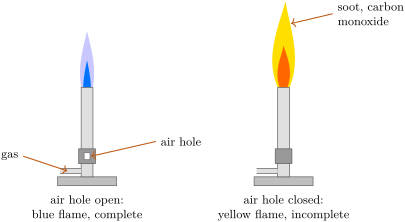
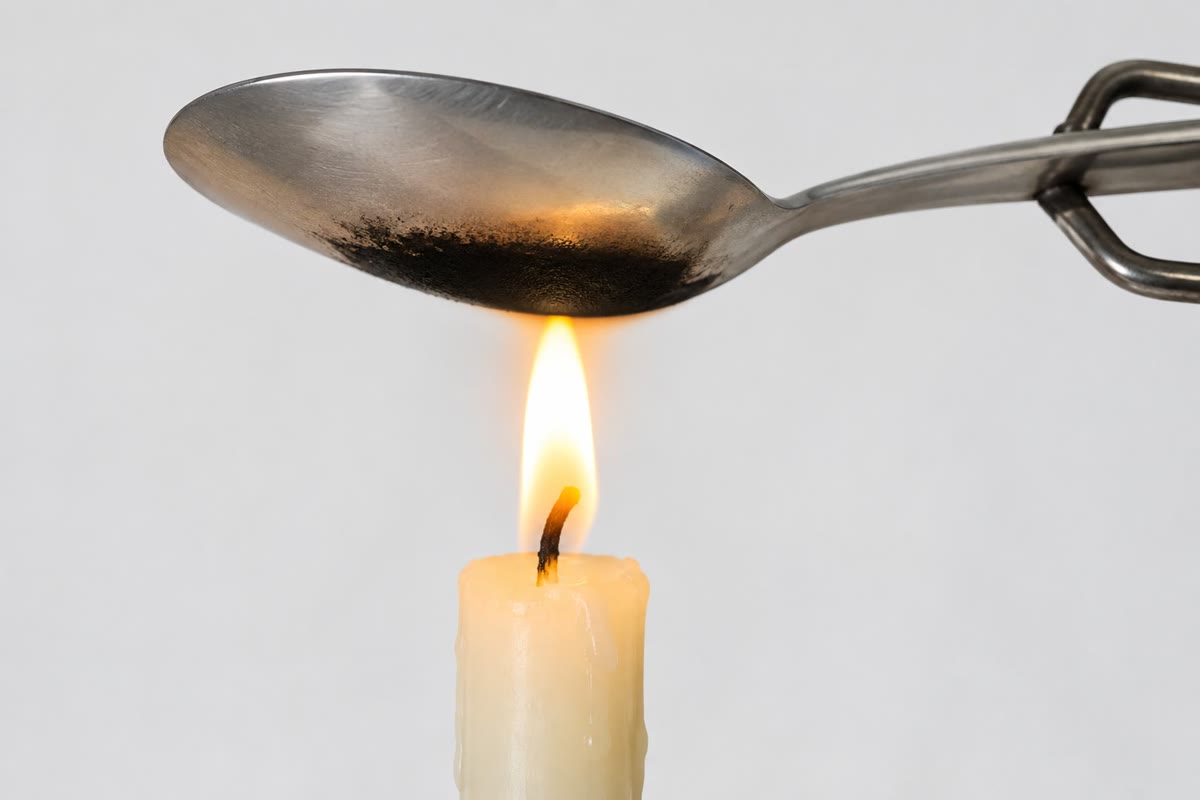
A Bunsen burner with its air hole open mixes air into the gas before it burns: the flame is blue and hardly visible, the combustion complete. With the air hole closed, the gas finds too little oxygen: the flame is yellow, smoky, and blackens a cold object held in it with soot — the combustion is incomplete.
14.3 Carbon monoxide, a silent danger
Proposition 14.6 (Why carbon monoxide kills)
Carbon monoxide has no colour, no smell and no taste. Breathed in, it takes the place of oxygen in the blood (the biology book explains how), causing headaches, sleepiness, and in a closed room unconsciousness and death. It is made by any fuel burning short of air: a gas boiler or water heater badly serviced or with a blocked flue, a stove in a closed tent, a barbecue or a generator used indoors.
Safety


Carbon monoxide: extremely flammable gas (GHS02), supplied under pressure (GHS04); toxic if inhaled (GHS06); damages organs by repeated exposure and may harm the unborn child (GHS08).
Remark 14.7 (Preventing poisoning)
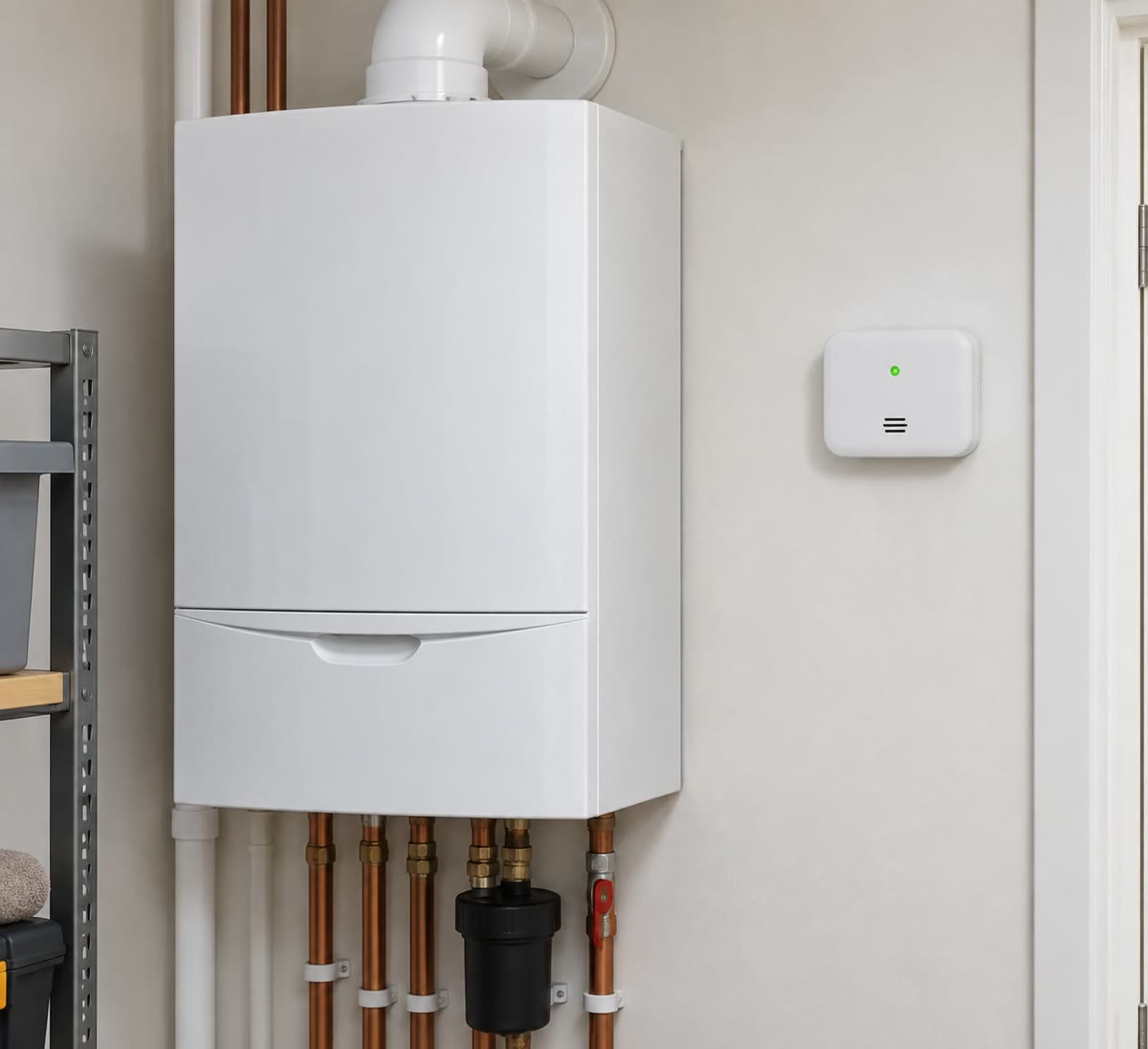
Gas appliances are serviced regularly by a professional, flues and air vents are never blocked, barbecues and generators are used only outdoors, and a carbon monoxide alarm is fitted near any burner.
14.4 Carbon dioxide and the greenhouse effect
Definition 14.8 (Greenhouse gas)
A greenhouse gas is a gas of the air that lets the sunlight through but holds back part of the heat that the Earth’s surface sends back towards space, and so warms the lower atmosphere. Water vapour, carbon dioxide and methane are greenhouse gases; nitrogen and oxygen are not. (How this happens is explained in the physics book.)
Proposition 14.9 (Carbon dioxide in the air is rising)
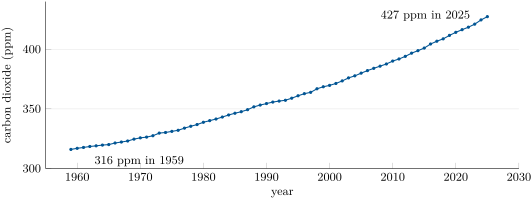
The amount of carbon dioxide in the air has been measured without a break since 1959 at an observatory on a mountain in the middle of the Pacific Ocean. It was 316 parts per million (ppm) of air in 1959 and 427 ppm in 2025: a rise of about in a human lifetime, mostly from the burning of coal, oil and natural gas. The extra carbon dioxide strengthens the greenhouse effect and warms the climate.
14.5 Fossil and renewable fuels
Definition 14.10 (Fossil and renewable fuels)
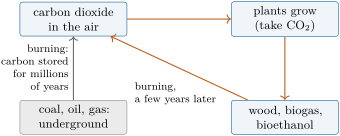
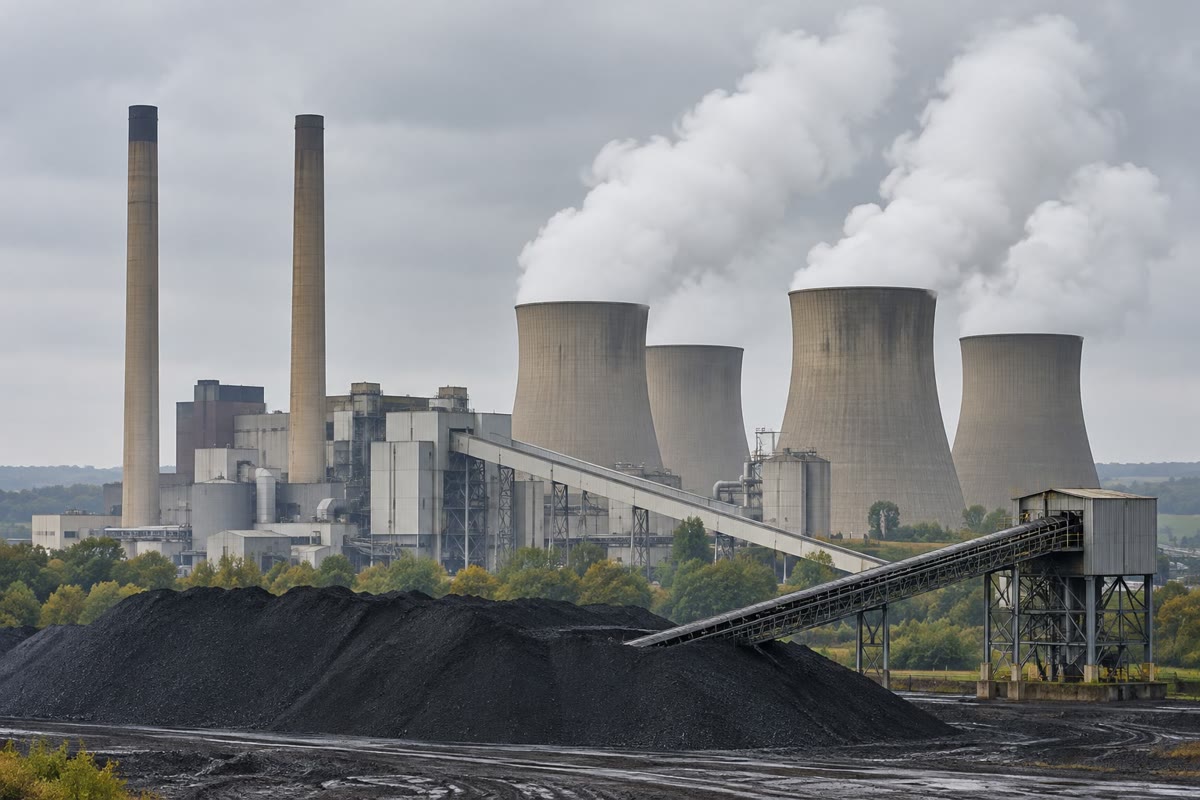
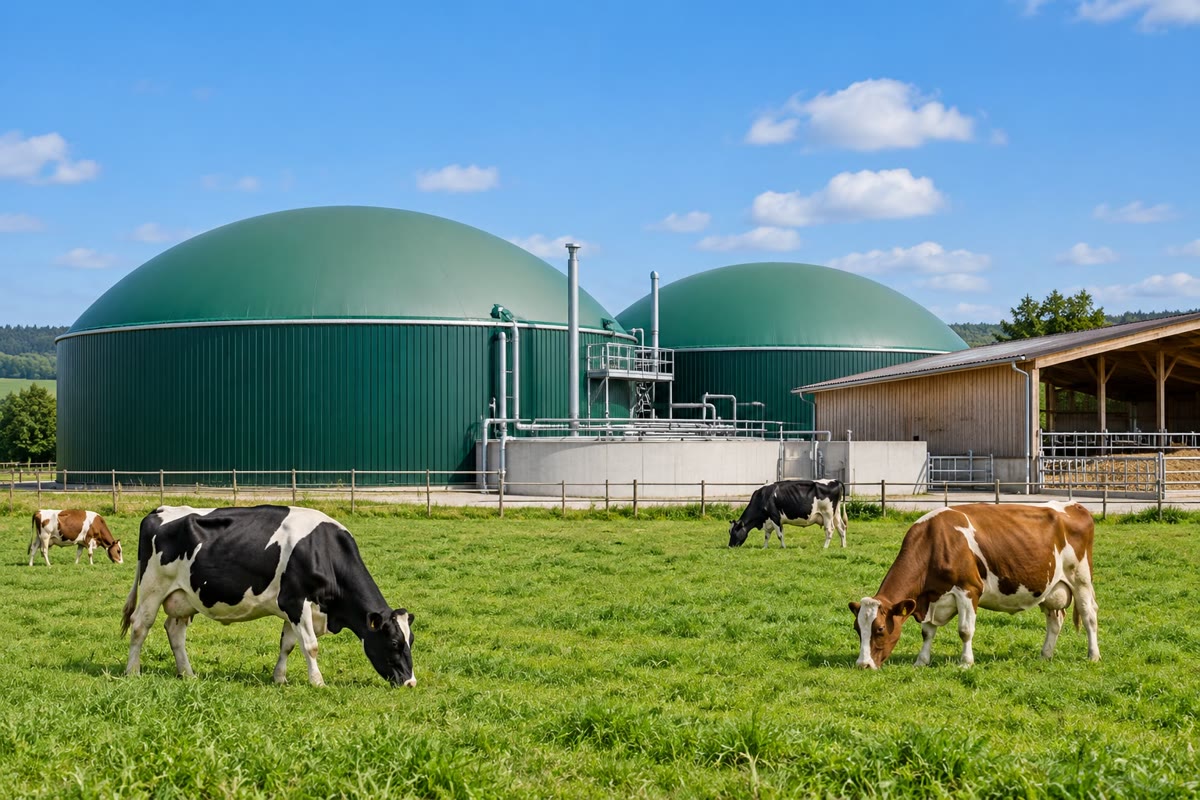
A fossil fuel — coal, oil, natural gas — formed underground over millions of years from the remains of ancient plants and sea creatures. A renewable fuel is made from plants grown today, or from waste: wood, biogas from manure and food waste, ethanol made from sugar beet or cane.
Proposition 14.11 (Where the carbon comes from)
Plants take carbon dioxide from the air to grow. Burning a renewable fuel gives back carbon dioxide that its plants took from the air a few years ago. Burning a fossil fuel releases carbon that was locked away underground for millions of years: it adds carbon dioxide to the air.
14.6 Exercises
Exercise 14.1 ★
Write the balanced equation of the complete combustion of carbon.
Solution
Solution of Exercise 14.1.
.
Exercise 14.2 ★
What is the difference between a complete and an incomplete combustion?
Solution
Solution of Exercise 14.2.
With enough oxygen, all the carbon becomes carbon dioxide (complete). With too little, part becomes carbon monoxide or soot (incomplete).
Exercise 14.3 ★
Why is carbon monoxide called a silent danger?
Solution
Solution of Exercise 14.3.
It has no colour, no smell and no taste: nobody notices it, yet it is toxic.
Exercise 14.4 ★
Fossil or renewable: coal, wood, natural gas, biogas, petrol, ethanol from sugar beet?
Solution
Solution of Exercise 14.4.
Fossil: coal, natural gas, petrol. Renewable: wood, biogas, ethanol from sugar beet.
Exercise 14.5 ★★
Write the balanced equation of the complete combustion of propane, .
Solution
Solution of Exercise 14.5.
.
Exercise 14.6 ★★
Ethanol, , burns completely in oxygen. Balance .
Solution
Solution of Exercise 14.6.
Carbon: 2 ; hydrogen: 3 ; oxygen on the right , of which 1 comes from ethanol, so 3 : .
Exercise 14.7 ★★
A pan held over a yellow flame turns black underneath. What is the black substance? What does it tell us about the combustion?
Solution
Solution of Exercise 14.7.
Soot, that is carbon. The combustion is incomplete: the flame lacks oxygen.
Exercise 14.8 ★★
Read the carbon dioxide curve: about how much carbon dioxide did the air hold in 1980 and in 2000? By how many ppm did it rise in those twenty years?
Solution
Solution of Exercise 14.8.
About 339 ppm in 1980 and about 370 ppm in 2000: a rise of about 30 ppm.
Exercise 14.9 ★★
Why does burning wood add less carbon dioxide to the air, over the years, than burning coal, although both give carbon dioxide?
Exercise 14.10 ★★
Balance the incomplete combustion of carbon to carbon monoxide, .
Solution
Solution of Exercise 14.10.
.
Exercise 14.11 ★★★
From 1959 (316 ppm) to 2025 (427 ppm), by what percentage did the carbon dioxide of the air increase? Round to the nearest whole number.
Solution
Solution of Exercise 14.11.
: about .
Exercise 14.12 ★★★
A gas heater is used in a small room with the window closed. Explain, using two equations of this chapter, how the combustion can change from complete to incomplete as time passes, and why this is dangerous.
Solution
Solution of Exercise 14.12.
At first there is enough oxygen: . As the oxygen of the closed room is used up, the flame burns short of air: . Carbon monoxide, odourless and toxic, builds up in the room.
14.7 Problem: The Stove in the Tent
Problem 14.1
Weekend problem — a camping stove, the gas it burns, what it makes, and why it never goes inside a tent
A camping stove burns propane, , from a cartridge holding of it. In the open air the flame is blue. Take these mass proportions, worked out from the balanced equation: of propane burning completely give of carbon dioxide.
Part I — The equations.
- Write the balanced equation of the complete combustion of propane.
- Check it by counting the atoms of each kind on each side.
- Balance the incomplete combustion .
- Which of the two needs more oxygen per propane molecule?
Part II — Inside a tent.
- A stove lit inside a closed tent soon burns with a yellow flame. Explain why.
- Which dangerous gas is then formed? Give two of its properties that make it hard to notice.
- The propane cartridge carries two pictograms. Name them and say what each means.
- Give two rules for using a camping stove safely.
Part III — The carbon dioxide of one cartridge.
- How many times heavier is the carbon dioxide formed than the propane burnt?
- Where do the extra grams come from?
- Is propane a fossil fuel or a renewable fuel? Does burning it add carbon dioxide to the air?
- Compute the mass of carbon dioxide released when a whole cartridge burns completely.
Solution
Solution of Problem 14.1.
1. .
2. Left: 3 C, 8 H, 10 O. Right: 3 C, H, O. Balanced.
3. .
4. The complete combustion: 5 oxygen molecules per propane molecule, against for the incomplete one.
5. The air of the closed tent is soon short of oxygen; the flame no longer gets enough of it and burns incompletely, yellow.
6. Carbon monoxide: no colour, no smell (and no taste).
7. GHS02, the flame: extremely flammable. GHS04, the gas bottle: a gas kept under pressure.
8. For instance: use it only in the open air, never in a tent or a closed room; keep it away from anything that can burn; change the cartridge away from any flame.
9. times heavier.
10. From the oxygen of the air, which ends up in the carbon dioxide (and the water).
11. A fossil fuel (it comes from natural gas or oil): burning it adds carbon dioxide to the air.
12. of carbon dioxide.