School Chemistry — Grades 1 to 12 · Grades 1–12
49Polymers
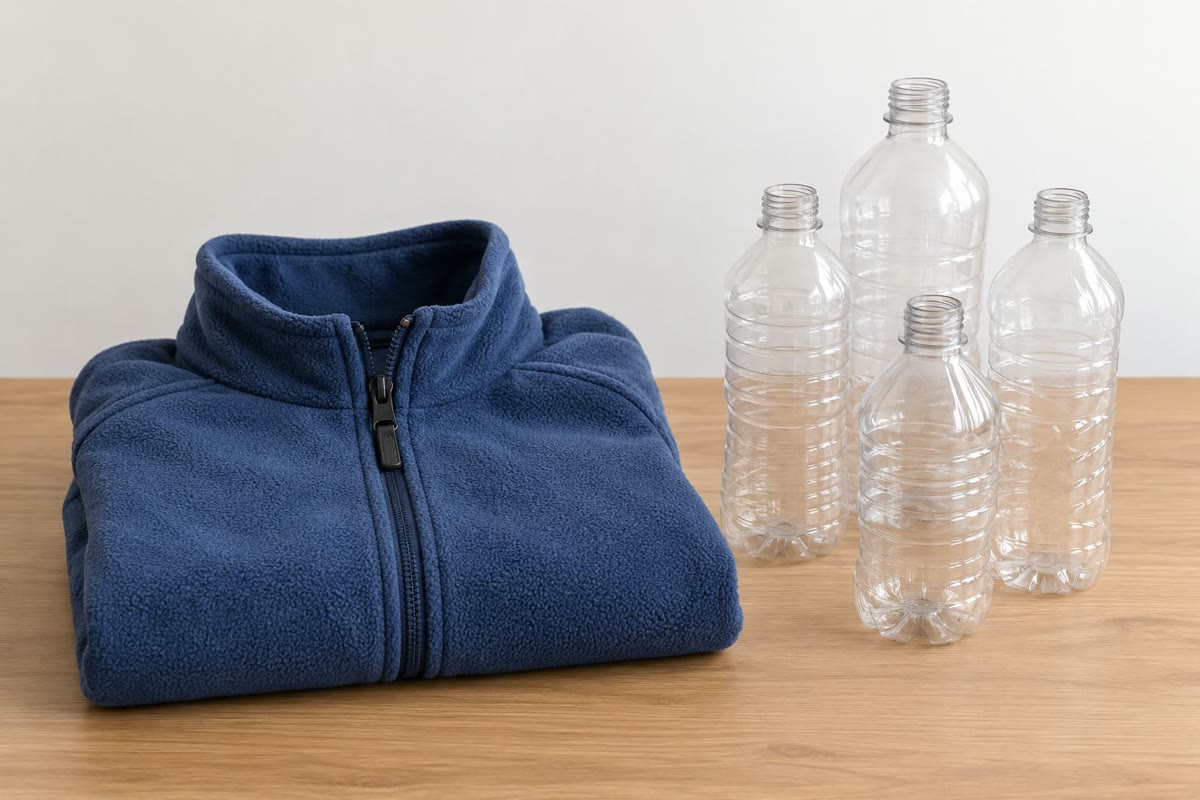
A fleece jacket can be spun from melted drink bottles; a climbing rope is made of nylon; this page is cellulose, made by trees. All three are polymers: molecules thousands of atoms long, built by repeating one small unit again and again. Their properties — soft or rigid, elastic or brittle, meltable or not — come less from the atoms they contain than from the way their long chains are arranged.
You already know
Plastics are made of very long molecules; thermoplastics soften on heating, thermosets do not (Chapter 15). Alcohol, acid, ester, amine and amide groups (Chapter 33). An addition joins two molecules into one without losing any atom (Chapter 40).
49.1 Monomers, polymers, repeat units
Definition 49.1 (Polymer, monomer, polymerisation)
A polymer is a substance made of very large molecules, the macromolecules, each built from many small units bonded one after the other. The small molecules from which it is made are its monomers; the reaction that joins them is a polymerisation.
Definition 49.2 (Repeat unit, degree of polymerisation)
The repeat unit of a polymer is the smallest group of atoms whose repetition gives the chain; it is written between brackets with an index . The number of repeat units in a chain is its degree of polymerisation.

Proposition 49.3 (Molar mass of a polymer)
A chain of degree of polymerisation has a molar mass
the two ends of the chain being negligible for large .
Proof. The chain is repeat units plus two end groups of a few atoms each; for in the thousands, the end groups weigh less than a thousandth of the whole. ∎
Example 49.4 (A polyethene chain)
A chain of polyethene of molar mass has repeat units, so twenty thousand carbon atoms in a row. In a real sample the chains do not all have the same length: is an average.
49.2 Addition polymers
Definition 49.5 (Addition polymer, condensation polymer)
An addition polymer forms by additions of monomers carrying a double bond, with no other product: its repeat unit has the same atoms as the monomer. A condensation polymer forms by reactions between two functional groups that join two monomers and release a small molecule, usually water, at each link.
| monomer | polymer | repeat unit | uses |
|---|---|---|---|
| ethene | polyethene (PE) | bags, bottles | |
| chloroethene | poly(vinyl chloride) (PVC) | pipes, frames | |
| phenylethene | polystyrene (PS) | cups, foam | |
| tetrafluoroethene | PTFE | non-stick pans |
Method 49.6 (Finding the monomer from a polymer)
- Find the repeat unit: the smallest group whose repetition gives the chain.
- If the main chain holds only carbon atoms, it is an addition polymer: put back a double bond between the two carbons of the repeat unit’s main chain. That is the monomer.
- If the main chain holds ester or amide links, it is a condensation polymer: cut each link, and give back to each side the atoms of the small molecule released ( to the , to the or ). Those are the monomers.
Example 49.7 (The monomer of PVC)
The chain repeats ; it holds only carbons in its main chain, so the monomer is , chloroethene.
49.3 Condensation polymers
A monomer with one reactive group can bond only once: it ends a chain. To build a chain by condensation, each monomer needs two groups, one at each end.
Example 49.8 (PET, a polyester)
Ethane-1,2-diol, , carries two alcohol groups; benzene-1,4-dicarboxylic acid, , two acid groups. Each acid group forms an ester with an alcohol group and releases water: the chain grows from both ends. The polymer is poly(ethylene terephthalate), PET, the material of drink bottles and of polyester fibres. Its repeat unit, , has a molar mass of , that is the two monomers () minus two molecules of water ().

Example 49.9 (Nylon-6,6, a polyamide)
Hexane-1,6-diamine, , and hexanedioic acid, , join by amide links, each releasing one molecule of water:
The two sixes in the name count the carbon atoms of each monomer. The amide links of neighbouring chains attract each other by hydrogen bonds, which makes nylon fibres strong.
History — Carothers and nylon
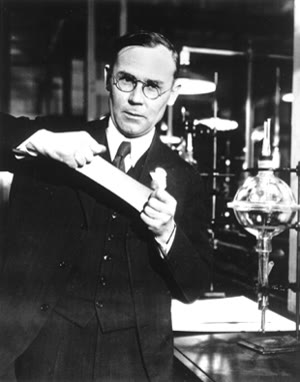
The chemist Wallace Carothers, who led a research laboratory of a chemical company, set out to prove that polymers were genuine giant molecules and to make them on purpose. His team first made polyesters, which melted too easily to be useful; in 1934 they turned to amines and made polyamides, among them the fibre later named nylon. Nylon went into production in 1939, first as stockings that caused a sensation at a World’s Fair, then as parachutes, ropes and toothbrush bristles.
49.4 Structure and properties
Two samples of the same polymer can behave very differently: what counts is the length of the chains, their shape, and how they are packed.
Proposition 49.10 (Chains and properties)
- Longer chains tangle more: the material is stronger and melts at a higher temperature.
- Linear chains can line up side by side in ordered, crystalline regions; branched chains cannot, and stay disordered, amorphous. Crystalline regions make a polymer denser, stiffer and less transparent.
- Chains held side by side only by intermolecular forces slide past each other when heated: the polymer is a thermoplastic. Chains joined by covalent cross-links cannot: the polymer is a thermoset, or, with few cross-links, a rubber-like elastic solid.
Proof. Heating gives the chains enough energy to overcome the intermolecular forces between them (Chapter 30), which are weaker than covalent bonds; the more contact between chains, the more energy this takes. Cross-links are covalent: breaking them destroys the material instead of melting it. ∎

Example 49.11 (Two polyethenes)
Polyethene made under very high pressure has many short branches: its chains pack badly, and it gives soft, transparent films for bags. Made with a catalyst at low pressure, its chains are nearly linear and pack into crystalline regions: it is denser and stiffer, and gives milk bottles and crates. Same monomer, same repeat unit, different architecture.
49.5 Natural polymers
Living things made polymers long before chemists did.
- Cellulose and starch are both chains of glucose units, per unit, joined differently: cellulose forms straight, strong fibres (wood, cotton, paper); starch forms coils that the body digests.
- Proteins are chains of amino acids joined by amide links, the peptide bonds of the dipeptide of Chapter 48.
- DNA is a chain of nucleotides; the order of its four kinds of unit stores genetic information.
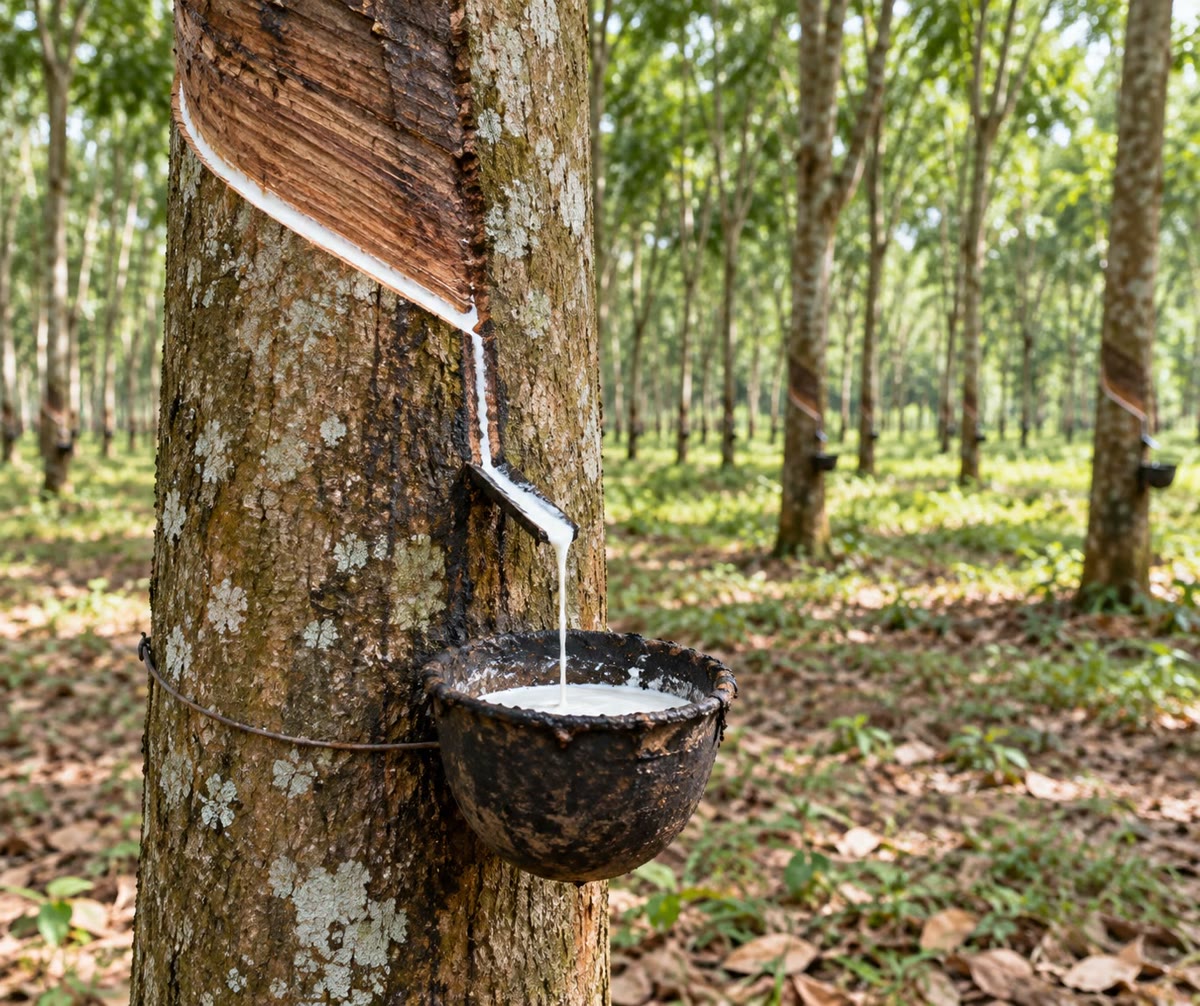
- Natural rubber is an addition polymer of isoprene, , collected as a milky liquid, latex, from the bark of the rubber tree. Heated with sulfur, its chains are linked by sulfur bridges: the rubber becomes tougher and keeps its shape, as in a tyre.
Remark 49.12 (Making and unmaking)
A thermoplastic can be melted and shaped again: mechanical recycling. A condensation polymer can also be broken down to its monomers by the reverse reaction, a hydrolysis, and the monomers made into new polymer: chemical recycling. A thermoset can do neither easily.
49.6 Exercises
Exercise 49.1 ★
Give the monomer of polypropene, whose repeat unit is .
Solution
Solution of Exercise 49.1.
Propene, .
Exercise 49.2 ★
Write the repeat unit of the polymer made from tetrafluoroethene, . Is it an addition or a condensation polymer?
Solution
Solution of Exercise 49.2.
; an addition polymer: the monomer has a bond and no other product forms.
Exercise 49.3 ★
Classify as addition or condensation polymers: polyethene, PET, nylon, PVC, polystyrene.
Solution
Solution of Exercise 49.3.
Addition: polyethene, PVC, polystyrene. Condensation: PET (a polyester), nylon (a polyamide).
Exercise 49.4 ★
Which of these polymers are natural: cellulose, nylon, starch, PVC, rubber from latex, proteins?
Solution
Solution of Exercise 49.4.
Cellulose, starch, rubber from latex, proteins. Nylon and PVC are synthetic.
Exercise 49.5 ★
Why must each monomer of a condensation polymer carry two reactive groups?
Exercise 49.6 ★★
A sample of PVC has an average molar mass of . Compute its degree of polymerisation.
Solution
Solution of Exercise 49.6.
; .
Exercise 49.7 ★★
A chain of polystyrene has a degree of polymerisation of 2500. Compute its molar mass.
Solution
Solution of Exercise 49.7.
; .
Exercise 49.8 ★★
Lactic acid, , carries an alcohol group and an acid group. Show that it can form a polyester on its own, write its repeat unit, and name the small molecule released.
Solution
Solution of Exercise 49.8.
The acid group of one molecule forms an ester with the alcohol group of the next, which still has a free acid group: the chain grows. Repeat unit ; water is released at each link.
Exercise 49.9 ★★
Explain, with the figure of chain arrangements, why bag films are soft and transparent while milk bottles are stiff and opaque.
Solution
Solution of Exercise 49.9.
Bag films are made of branched chains, which cannot pack: the material is amorphous, soft and transparent. Milk bottles are made of nearly linear chains, which pack into crystalline regions: denser, stiffer, and the crystalline regions scatter light.
Exercise 49.10 ★★
The handle of a pan is a thermoset, its plastic lid knob too. Describe their chains. Why can they not be melted and recycled?
Solution
Solution of Exercise 49.10.
Their chains are joined by many covalent cross-links. Heating cannot make the chains slide; it breaks bonds and destroys the material instead of melting it.
Exercise 49.11 ★★
A chain of nylon-6,6 has a molar mass of . Compute the molar mass of its repeat unit , then its degree of polymerisation.
Solution
Solution of Exercise 49.11.
; .
Exercise 49.12 ★★★
Write the reaction between one molecule of hexane-1,6-diamine and one of hexanedioic acid, giving the first amide link. Why can the product go on reacting at both ends?
Exercise 49.13 ★★★
What mass of water is released when of nylon-6,6 is made?
Solution
Solution of Exercise 49.13.
Two molecules of water per repeat unit. of repeat units, so of water: .
Exercise 49.14 ★★★
Natural rubber is soft and sticky when warm; heated with sulfur, it becomes the elastic, tough rubber of tyres. Explain with the chains. Why is a tyre so hard to recycle?
Solution
Solution of Exercise 49.14.
Warm natural rubber is made of chains that slide past one another. Sulfur bridges link the chains: they stretch but spring back, and no longer flow. Being cross-linked, a tyre cannot be melted and reshaped.
Exercise 49.15 ★★★
Starch and cellulose have the same formula per unit, . A cellulose chain has a molar mass of . How many glucose units does it hold? How long is it, if each unit adds to its length?
Solution
Solution of Exercise 49.15.
; units; length , about .
49.7 Problem: From Bottle to Fleece
Problem 49.1
Weekend problem — how many 25 g bottles go into one fleece jacket?
A fleece jacket is made of of PET fibre. Used bottles of each are collected, sorted, washed, shredded, melted and spun; in this process of the mass of the bottles ends up as fibre in the jacket.
Part I — The polymer.
- Name the two monomers of PET and the functional groups they carry.
- Which link forms between them? What small molecule is released?
- Is PET an addition or a condensation polymer?
- Compute the molar masses of the two monomers.
- Deduce the molar mass of the repeat unit , and check it with its formula.
Part II — The chains.
- The PET of a bottle has chains of average molar mass . Compute the degree of polymerisation.
- How many ester links does one chain contain, about?
- PET of bottles is partly crystalline. What does that say about its chains?
- Why can PET be melted and spun into a fibre?
Part III — Recycling.
- What mass of bottles is needed for one jacket?
- How many bottles is that?
- What happens to the rest of the mass?
- Which principle of green chemistry does this recycling apply?
Part IV — Back to the monomers.
- Write, for one repeat unit, the hydrolysis of PET into its monomers.
- What amount of repeat units is there in of PET?
- What masses of each monomer does the full hydrolysis of of PET give?
- What mass of water does it consume? Check the conservation of mass.
- Give one advantage of this chemical recycling over melting.
- State the final answer: how many bottles go into one fleece jacket?
Solution
Solution of Problem 49.1.
1. Ethane-1,2-diol (two alcohol groups) and benzene-1,4-dicarboxylic acid (two carboxylic acid groups).
2. An ester link; water is released.
3. A condensation polymer.
4. ; .
5. ; and .
6. .
7. Two ester links per repeat unit: about 400.
8. Its chains are mostly linear, and parts of them line up in ordered regions.
9. It is a thermoplastic: its chains are not cross-linked and slide past each other when hot.
10. .
11. bottles.
12. Caps, labels, dirt and scraps are removed or lost during sorting, washing and spinning.
13. Prevent waste (principle 1): a used object becomes raw material.
14. .
15. .
16. Diol: ; acid: .
17. of water; : mass is conserved.
18. The monomers can be purified and give new PET as good as new, while melting shortens the chains a little each time.
19. One fleece jacket takes 15 bottles of .