School Chemistry — Grades 1 to 12 · Grades 1–12
39Stereochemistry: Chirality and Isomers
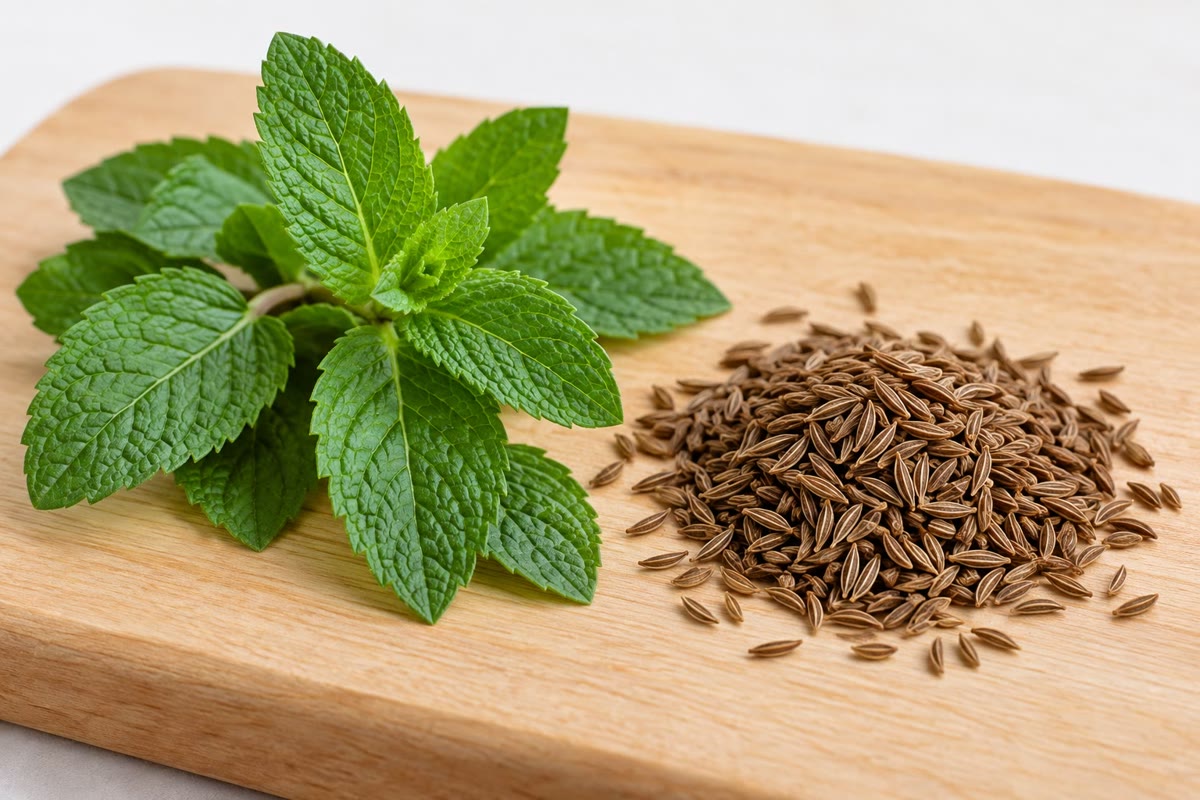
Spearmint leaves and caraway seeds smell nothing alike: one is the fresh smell of chewing gum, the other the warm smell of rye bread. Yet the molecule responsible for each smell is the same carvone, made of the same atoms bonded in the same order. The two carvones differ only as a left hand differs from a right hand: each is the mirror image of the other. Our nose, built of molecules that are themselves “handed”, tells them apart. This chapter learns to see molecules in three dimensions.
You already know
The shape of molecules, and the wedges and dashes that draw them in space (Chapter 24). Constitutional isomers (Chapter 32). Functional groups (Chapter 33).
39.1 Molecules in space
Definition 39.1 (Stereoisomers)
Stereoisomers are molecules with the same formula and the same sequence of bonded atoms, which differ only by the arrangement of their atoms in space.
Definition 39.2 (Cram representation)
In the Cram representation of a carbon atom with four single bonds, two bonds are drawn in the plane of the paper as plain lines, at an angle, the bond pointing towards the reader as a solid wedge and the bond pointing away as a dashed wedge.
39.2 Chirality
Definition 39.3 (Chiral, asymmetric carbon)
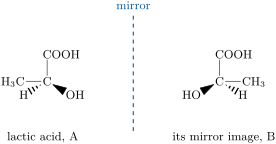
An object or a molecule is chiral if it cannot be superimposed on its mirror image, like a hand. A carbon atom bonded to four different atoms or groups is an asymmetric carbon; it is often marked with a star.
Proposition 39.4 (One asymmetric carbon makes a molecule chiral)
A molecule with exactly one asymmetric carbon is chiral.
Proof. Admitted: exchanging two of the four different groups around the asymmetric carbon gives the mirror image, and no rotation of the whole molecule can bring it back, since the four groups are all different. ∎
Definition 39.5 (Enantiomers, racemic mixture)
Two stereoisomers that are mirror images of each other and not superimposable are enantiomers. A mixture of equal amounts of two enantiomers is a racemic mixture.
Method 39.6 (Is a molecule chiral?)
- Look for asymmetric carbons: a carbon with four different groups. None: the molecule is (in this book) not chiral.
- Exactly one: the molecule is chiral.
- Two or more: look for a plane that cuts the molecule into two mirror halves, in one of its shapes; if there is one, the molecule is not chiral, otherwise it is.
Remark 39.7 (Same properties, different smells)
Two enantiomers have the same melting and boiling temperatures, the same solubility, the same spectra: every measurement made with something that is not itself chiral gives the same result for both. They differ only when they meet something chiral, such as polarised light, which they turn in opposite directions, or the receptors of the nose: one carvone smells of spearmint, its enantiomer of caraway.
39.3 Diastereomers
Definition 39.8 (Diastereomers)
Stereoisomers that are not mirror images of each other are diastereomers. Unlike enantiomers, diastereomers have different physical properties.
Proposition 39.9 (Counting stereoisomers)
A molecule with asymmetric carbons has at most stereoisomers. There are fewer when the molecule has two alike halves: then one of the combinations has a mirror plane and is not chiral (a meso form).
Proof. Each asymmetric carbon can take two arrangements, independently of the others: combinations. When two combinations are the same molecule, the count drops. ∎
History — Pasteur sorts crystals by hand, 1848
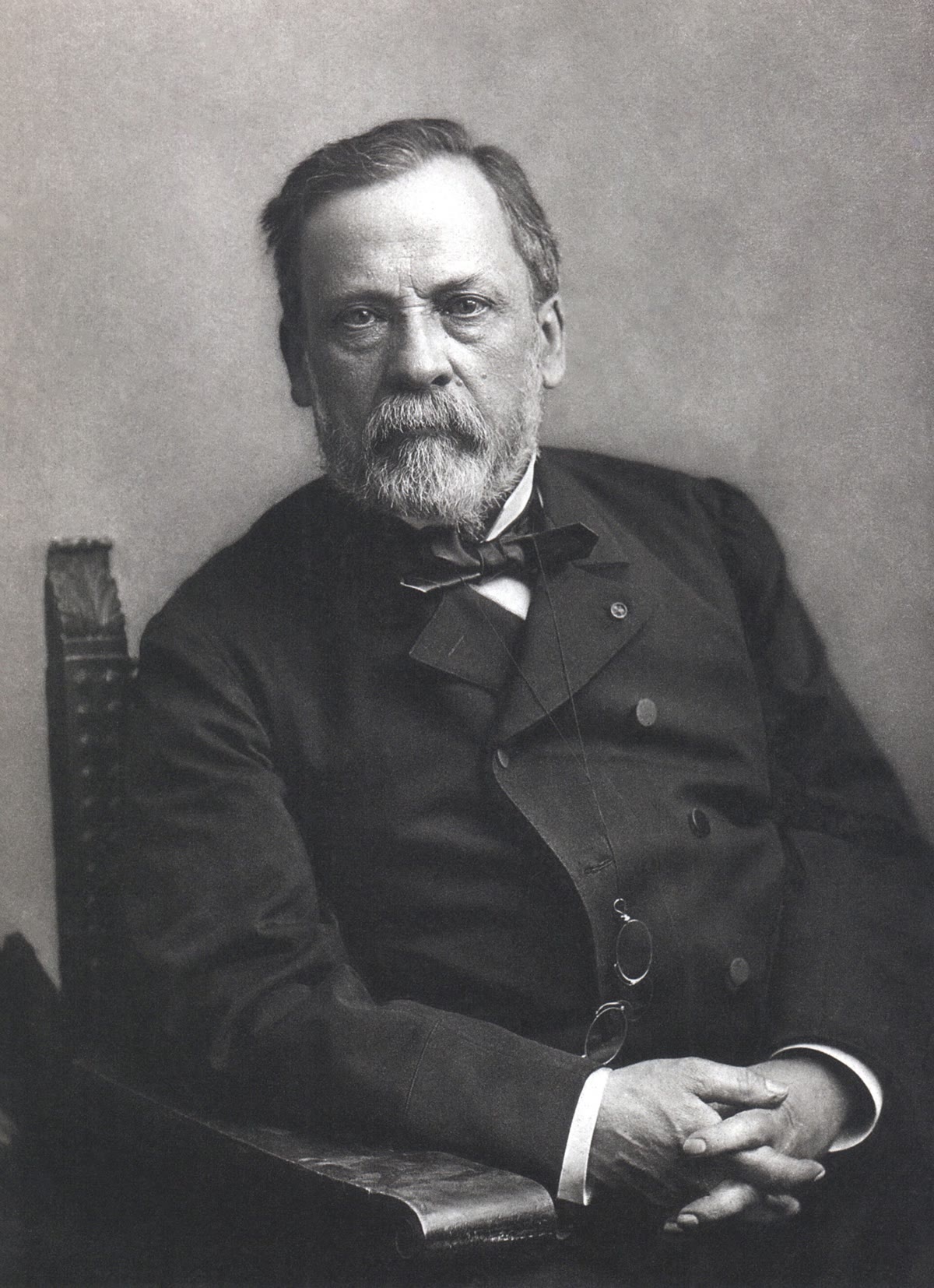
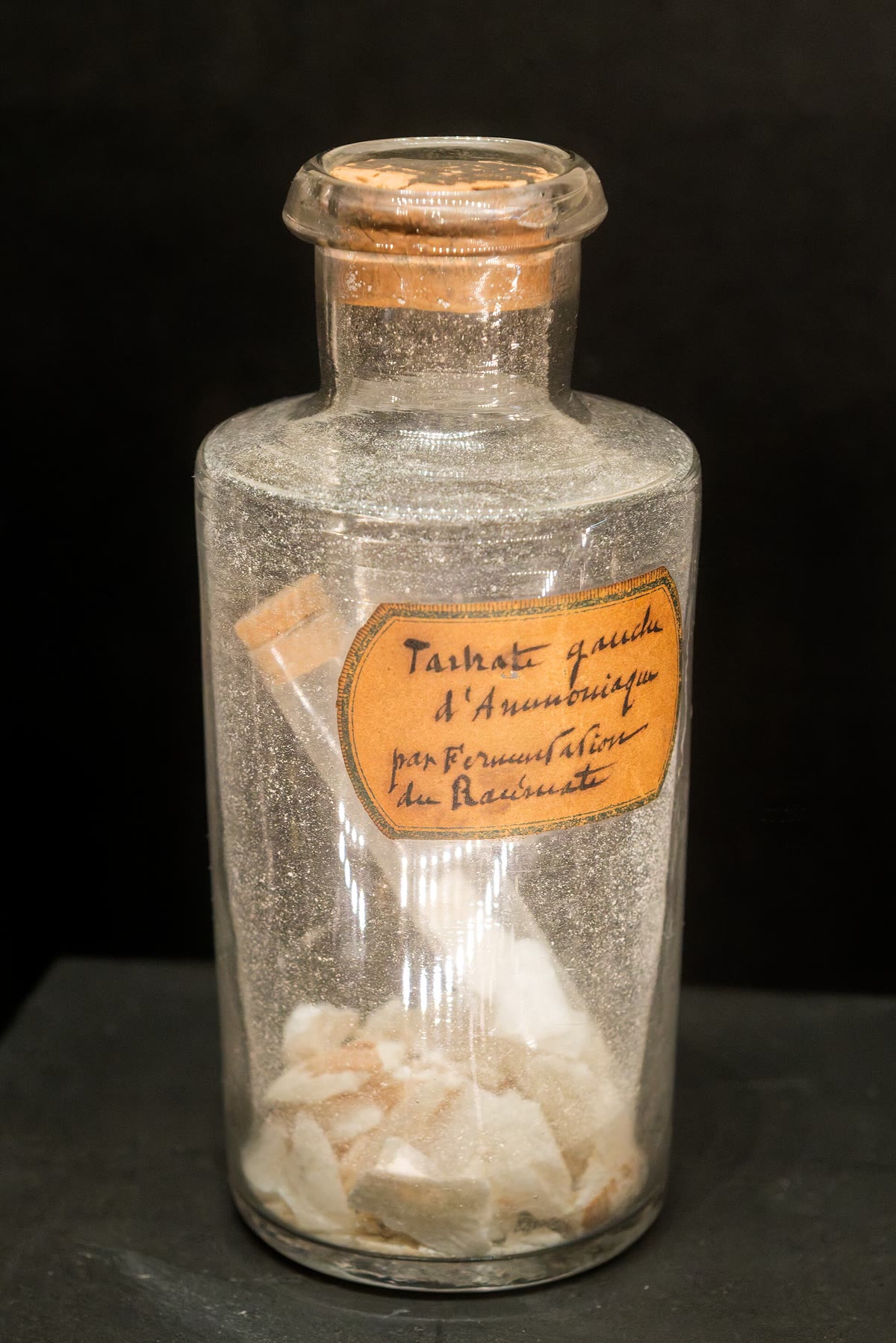
In 1848 the young chemist Louis Pasteur looked with a magnifying glass at crystals of a salt of “racemic acid”, a form of tartaric acid that turned polarised light neither way. He noticed that the crystals came in two shapes, mirror images of each other, and sorted them one by one with tweezers. Dissolved, one pile turned polarised light to the right, the other, by the same amount, to the left: racemic acid was a mixture of two mirror-image molecules. Molecules, he concluded, can be handed.
39.4 Z and E isomers
Definition 39.10 (Z and E isomers)
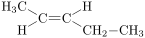
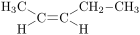
When each carbon of a double bond carries two different atoms or groups, two stereoisomers exist, because the double bond does not rotate. On each carbon, the group whose atom bonded to it has the larger atomic number has priority. If the two priority groups are on the same side of the double bond, the isomer is Z; if they are on opposite sides, it is E.
Method 39.11 (Z or E?)
- Check that each carbon of the double bond carries two different groups; otherwise there is no Z/E isomerism.
- On each carbon, give priority to the group whose first atom has the larger atomic number (the full rules for ties are given in the Year 1 volume).
- Same side: Z. Opposite sides: E.

39.5 Conformations
Definition 39.12 (Conformation)
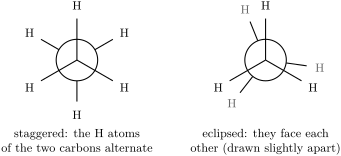
The atoms of a molecule can rotate about a single bond. Each arrangement reached by such rotations is a conformation of the molecule. Conformations of one molecule are not isomers: they turn into one another all the time at room temperature.
Remark 39.13 (Why it matters)
Living things are built of chiral molecules (proteins, sugars), and the receptors and enzymes made of them distinguish enantiomers: two enantiomers can smell, taste or act as medicines very differently. That is why chemists who make a drug with an asymmetric carbon must know which enantiomer they make, and test each one.
39.6 Exercises
Exercise 39.1 ★
Which of these molecules have an asymmetric carbon? Mark it with a star. Butan-2-ol ; propan-2-ol ; 2-chlorobutane; lactic acid .
Solution
Solution of Exercise 39.1.
Butan-2-ol: carbon 2 (, , , ). Propan-2-ol: none (carbon 2 carries two identical ). 2-Chlorobutane: carbon 2. Lactic acid: carbon 2 (, , , ).
Exercise 39.2 ★

Exercise 39.3 ★
Which are chiral: a glove, a spoon, a screw, a cube? Which of the molecules and is chiral?
Exercise 39.4 ★
What is a racemic mixture? Does it smell of spearmint, of caraway, or of both, in the case of carvone?
Solution
Solution of Exercise 39.4.
A mixture of equal amounts of two enantiomers. Racemic carvone contains both enantiomers, so the nose receives both smells at once.
Exercise 39.5 ★
Exercise 39.6 ★★
Draw the two enantiomers of butan-2-ol in Cram representation, with a mirror between them.
Solution
Solution of Exercise 39.6.
 mirror
Exercise 39.7 ★★
How many stereoisomers do these have: 2-chlorobutane; 2,3-dichlorobutane ; pent-2-ene ?
Solution
Solution of Exercise 39.7.
2-Chlorobutane: 2 (one asymmetric carbon). 2,3-Dichlorobutane: 3 (two asymmetric carbons with alike halves: a pair of enantiomers and a meso form). Pent-2-ene: 2 (Z and E).
Exercise 39.8 ★★
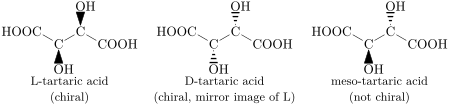
Say whether these pairs are enantiomers, diastereomers or the same molecule: L- and D-tartaric acid; L- and meso-tartaric acid; (Z)- and (E)-but-2-ene; meso-tartaric acid and its own mirror image.
Solution
Solution of Exercise 39.8.
Enantiomers; diastereomers; diastereomers; the same molecule (meso tartaric acid is superimposable on its mirror image).
Exercise 39.9 ★★
Butane, , seen along its central bond. Draw the staggered conformation where the two groups are opposite, and an eclipsed one where they face each other. Which is the more stable? Why?
Solution
Solution of Exercise 39.9.
In the staggered conformation with opposite groups, the large groups are as far apart as possible: it is the most stable. In the eclipsed one, the two face each other and crowd one another.
Exercise 39.10 ★★
meso-Tartaric acid has two asymmetric carbons but is not chiral. Explain, using its mirror plane.
Exercise 39.11 ★★
 and (
and (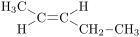 .
.Exercise 39.12 ★★★
2,3-Dibromobutane has two asymmetric carbons. Draw its stereoisomers in the zigzag representation used for tartaric acid, and show that one of them is a meso form.
Solution
Solution of Exercise 39.12.
As for tartaric acid, with instead of and instead of : both solid, both dashed (a pair of enantiomers), and one solid one dashed, which has a mirror plane: the meso form. Three stereoisomers.
Exercise 39.13 ★★★
A drug molecule has one asymmetric carbon. Its synthesis gives a racemic mixture, but only one enantiomer fits the chiral receptor it must act on. What fraction of the racemic medicine is active? Give two ways a chemist could do better.
Solution
Solution of Exercise 39.13.
Half. The chemist can separate the two enantiomers (as Pasteur did, by other means), or make only the useful enantiomer, with a reaction that is itself chiral (a chiral catalyst, an enzyme, a chiral starting material).
Exercise 39.14 ★★★
Hexa-2,4-diene, , has two double bonds, each able to be Z or E. How many stereoisomers does it have? (Beware of the symmetry of the molecule.)
Solution
Solution of Exercise 39.14.
Three: (2E,4E), (2Z,4Z) and (2E,4Z), the last being the same molecule as (2Z,4E) read from the other end.
Exercise 39.15 ★★★
A sugar molecule has three asymmetric carbons and no symmetry. How many stereoisomers can it have at most? How many pairs of enantiomers is that? How many diastereomers does each stereoisomer have?
Solution
Solution of Exercise 39.15.
stereoisomers, that is 4 pairs of enantiomers. Each stereoisomer has one enantiomer and diastereomers.
39.7 Problem: Pasteur’s Crystals
Problem 39.1
Weekend problem — tartaric acid has two asymmetric carbons: how many stereoisomers does it really have?
The forms of tartaric acid, , played a decisive part in the discovery that molecules can be handed. L-Tartaric acid melts at about .
Part I — The molecule.
- Give the molecular formula of tartaric acid and its molar mass.
- Name its functional groups, and say how many of each.
- Which carbon atoms are asymmetric? List the four groups of each.
- According to the rule of this chapter, how many stereoisomers could it have at most?
Part II — The stereoisomers.
- In the zigzag drawing of L-tartaric acid, are the groups drawn with solid or dashed wedges?
- Draw its mirror image. Can the two be superimposed? Name the mirror image.
- Draw the form with one solid and one dashed wedge. Rotate it in your mind about the central bond, and find a mirror plane.
- Is this form chiral? What is it called?
- Explain why tartaric acid has only three stereoisomers.
- Say whether L and D, then L and meso, are enantiomers or diastereomers.
Part III — Properties.
- At what temperature does D-tartaric acid melt? Why?
- Must meso-tartaric acid melt at the same temperature? Why?
- Carvone shows that two enantiomers can smell different. Why can a nose tell them apart while a thermometer cannot?
- A racemic mixture of L and D tartaric acid: is it a pure substance? Is it optically active as a whole?
Part IV — Pasteur.
- Pasteur’s racemic salt gave crystals of two mirror-image shapes. What did each crystal contain?
- From of racemic salt, what mass of each kind of crystal could he expect?
- Why does the meso form never appear among these crystals?
- How could he check, after sorting, that the two piles were enantiomers?
- 3-Chlorobutan-2-ol, , also has two asymmetric carbons. How many stereoisomers does it have? Why does it not lose one like tartaric acid?
- State the final answer: how many stereoisomers does tartaric acid have?
Solution
Solution of Problem 39.1.
1. ; .
2. Two carboxyl groups (acid) and two hydroxyl groups (alcohol).
3. The two central carbons, each bonded to , , and .
4. .
5. Both with solid wedges.
6. Both with dashed wedges; it cannot be superimposed on L: it is D-tartaric acid, its enantiomer.
7. Turned about the central bond so that the two face the same way, the molecule has a plane between its two central carbons that reflects one half onto the other.
8. No: it is meso-tartaric acid.
9. Of the four combinations (solid, solid), (dashed, dashed), (solid, dashed), (dashed, solid), the last two are the same molecule, the meso form, because the two halves of the molecule are alike.
10. L and D: enantiomers. L and meso: diastereomers.
11. At too: enantiomers have the same physical properties.
12. No: it is a diastereomer of L, a different compound with its own properties.
13. The receptors of the nose are chiral and distinguish mirror images; a thermometer, not chiral, cannot.
14. No, a mixture of two compounds; as a whole it is not optically active, the two enantiomers cancelling each other.
15. Only one enantiomer: each crystal was built of L or of D alone.
16. of each.
17. The meso form is a different compound, not part of the racemic mixture of L and D.
18. By dissolving each pile: the solutions turn polarised light by the same amount in opposite directions (and the crystals are mirror images).
19. Four: its two asymmetric carbons carry different groups ( on one, on the other), so no combination has a mirror plane, and no two combinations are the same molecule.
20. Three: L, D and meso.