School Chemistry — Grades 1 to 12 · Grades 1–12
43Chemical Equilibrium: Quotient and Constant
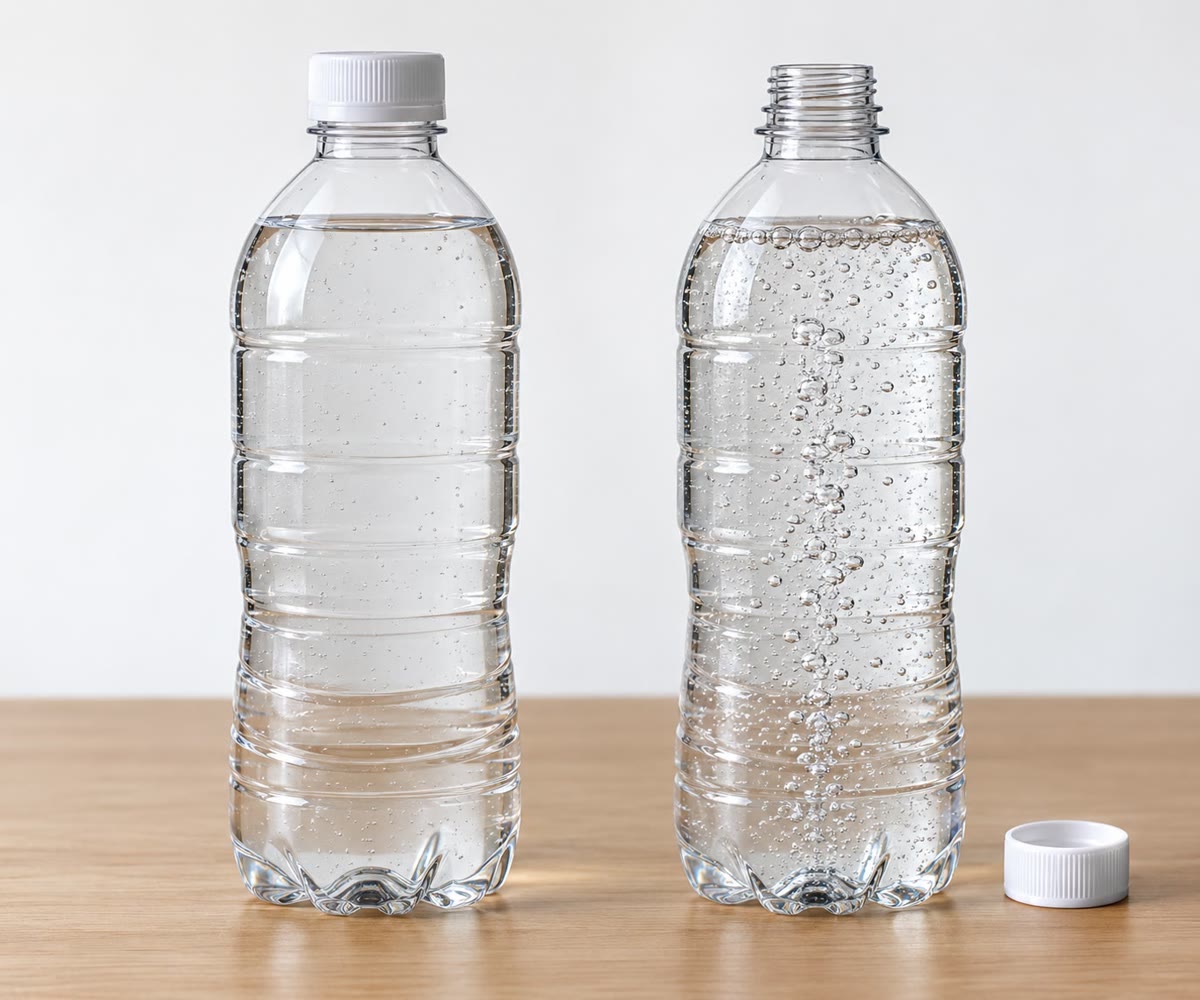
A sealed bottle of sparkling water keeps its fizz for months; opened, it goes flat in an afternoon. Nothing has gone wrong in either case. In the closed bottle, carbon dioxide leaves the water and returns to it at the same rate, and the composition stays put; open the cap, and the gas that leaves no longer comes back. Many reactions behave like this: they stop before any reactant is used up, at a balance between two opposite reactions. This chapter describes that balance with one number.
You already know
The extent of a reaction, its maximum , and the total reactions that reach it (Chapter 27). Rates and kinetic factors (Chapter 41); a catalyst does not change the final state (Chapter 42).
43.1 Reactions that are not total
Definition 43.1 (Non-total reaction, final extent ratio)
A reaction is a non-total reaction if it stops at a final extent smaller than its maximum extent , with all the reactants still present. Its final extent ratio is
( for a total reaction).
Example 43.2 (An ester that stops halfway)
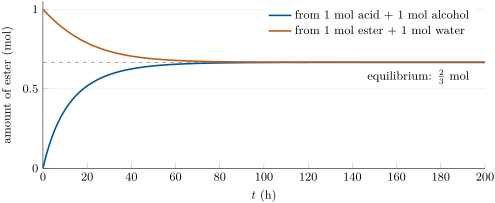
Heated with of ethanol, of ethanoic acid forms ethyl ethanoate and water, . The reaction stops when about two thirds of the acid have reacted: for , so . Starting from of ester and of water, the reverse reaction also stops, with about one third of the ester hydrolysed: the same final mixture.
History — Berthelot and Péan de Saint-Gilles, 1862
The chemists Marcellin Berthelot and Léon Péan de Saint-Gilles heated mixtures of ethanoic acid and ethanol, and of ethyl ethanoate and water, for long periods, and analysed them. From equal amounts of acid and alcohol, the reaction always stopped at about two thirds; from ester and water, at one third of hydrolysis; and they noticed that the amount of ester formed at each moment depended on the product of the amounts of the reactants. Their work was one of the first quantitative studies of a chemical equilibrium.
43.2 The equilibrium state
Definition 43.3 (Equilibrium state)
A system is in an equilibrium state when its composition no longer changes although both the forward and the reverse reactions are still going on, at the same rate. A reaction that can reach such a state is written with the double arrow .
43.3 The reaction quotient
Notation 43.4 (Standard concentration)
is the standard concentration. Dividing a concentration by gives a number without unit with the same value: .
Definition 43.5 (Reaction quotient)
For a reaction in solution , the reaction quotient in a given state of the system is
Solids, and the solvent (water in an aqueous solution), do not appear in .
Example 43.6 (Writing quotients)
For in water (the ion is introduced in the next chapter), water is the solvent: . For the dissolving of a solid, , the solid is left out: . For the esterification, where all four species are in the same liquid mixture of volume , the volumes cancel and .
43.4 The equilibrium constant
Definition 43.7 (Equilibrium constant)
The value of the reaction quotient in the equilibrium state is the equilibrium constant of the reaction. It has no unit.
Proposition 43.8 ( depends only on the temperature)
For a given reaction, in every equilibrium state at a given temperature, whatever the initial amounts.
Proof. Admitted; it is derived in the Year 2 volume. It is checked on the esterification: both runs of the figure, started from opposite sides, give the same . ∎
Example 43.9 ( of the esterification)
From of acid and of alcohol, the equilibrium holds mol of ester and of water and mol of acid and of alcohol:
Method 43.10 (Final state of a non-total reaction)
- Fill the progress table with the unknown final extent .
- Write as a function of and set it equal to .
- Solve for (often a quadratic equation), keeping the root between 0 and .
- Deduce the final amounts and .
Example 43.11 (An excess of alcohol)
From of acid and of alcohol: , that is , whose root between 0 and 1 is . Doubling the alcohol raises the yield, counted on the acid, from to .
43.5 Predicting and shifting the evolution
Proposition 43.12 (Direction of evolution)
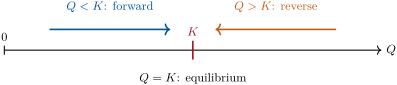
If , the system evolves in the forward direction (the products increase) until ; if , it evolves in the reverse direction; if , it is in equilibrium and does not change.
Proof. Admitted: increases when the forward reaction proceeds (products in the numerator grow, reactants in the denominator shrink), and the system moves towards the state where . ∎
Remark 43.13 (Shifting an equilibrium)
To obtain more product from a non-total reaction, one can add an excess of one reactant (the cheaper one), or remove a product as it forms: each makes again, and the system moves forward. Removing the water of an esterification (with a drying agent, or by distilling it off) can drive the reaction almost to completion. The open bottle of sparkling water does the same with the carbon dioxide that escapes.
43.6 Exercises
Exercise 43.1 ★
Write the reaction quotient of: (a) (gases, use concentrations); (b) in water; (c) ; (d) .
Solution
Solution of Exercise 43.1.
(a) ; (b) (water, the solvent, is left out); (c) (the solid is left out); (d) .
Exercise 43.2 ★
A reaction has and reaches . Compute . Is the reaction total?
Solution
Solution of Exercise 43.2.
: not total.
Exercise 43.3 ★
For a reaction with , in which direction does a mixture evolve if ? If ? If ?
Solution
Solution of Exercise 43.3.
: forward. : reverse. : no change.
Exercise 43.4 ★
Explain why an equilibrium is said to be “dynamic”.
Solution
Solution of Exercise 43.4.
The composition is constant, but the forward and reverse reactions go on at the same rate: molecules keep reacting both ways.
Exercise 43.5 ★
Does a catalyst change ? The time needed to reach equilibrium? Explain.
Solution
Solution of Exercise 43.5.
No, is unchanged (the final state is the same); the time to reach equilibrium is shorter.
Exercise 43.6 ★★
of ethanoic acid and of ethanol are mixed (). Compute the final amounts of the four species.
Exercise 43.7 ★★
A mixture contains each of ethanoic acid, ethanol, ethyl ethanoate and water. Compute . In which direction does it evolve?
Exercise 43.8 ★★
Using the figure of the two runs, read the amount of ester after in each run. When can the system be considered at equilibrium?
Solution
Solution of Exercise 43.8.
About from the acid side and from the ester side. After about both curves are on the dashed line: equilibrium.
Exercise 43.9 ★★
Starting from of ester and of water ( for the esterification, so for the hydrolysis), compute the final amounts by the method of the chapter, and compare with the esterification run.
Exercise 43.10 ★★
Why does the solid not appear in the quotient of ? Does adding more solid shift the equilibrium?
Solution
Solution of Exercise 43.10.
A solid is a pure phase, whose “concentration” does not change: it is left out of . Adding more solid does not change , so it does not shift the equilibrium (as long as some solid is present).
Exercise 43.11 ★★
In a closed bottle of sparkling water, carbon dioxide leaves and enters the water at the same rate. Write the equilibrium and explain, with and , why the water goes flat when the bottle is opened.
Solution
Solution of Exercise 43.11.
fixes the ratio of carbon dioxide in the gas to that in the water. Opened, the gas above the water escapes into the air: the carbon dioxide in the gas falls, , and more gas leaves the water, until almost none is left.
Exercise 43.12 ★★★
An esterification of of acid and of alcohol reaches equilibrium. Half of the water present is then removed. Compute the new , say in which direction the system evolves, and find the new final amount of ester.
Exercise 43.13 ★★★
Show that the constant of the reverse reaction is . What is the constant of the hydrolysis of ethyl ethanoate?
Solution
Solution of Exercise 43.13.
The quotient of the reverse reaction has numerator and denominator exchanged: , so at equilibrium . Hydrolysis: .
Exercise 43.14 ★★★
A chemist mixes of acid, of alcohol, of ester and of water. Will anything happen? Explain.
Solution
Solution of Exercise 43.14.
: the mixture is already in equilibrium; its composition does not change.
Exercise 43.15 ★★★
What excess of alcohol (amount per mole of acid) is needed to esterify of the acid? Solve .
43.7 Problem: Berthelot’s Ester
Problem 43.1
Weekend problem — how much ester when the alcohol is put in threefold excess?
Ethyl ethanoate, a solvent and a flavouring, is made from ethanoic acid and ethanol. In 1862 Berthelot and Péan de Saint-Gilles found that from equal amounts of acid and alcohol the reaction stops when about two thirds of the acid have reacted.
Part I — The reaction.
- Write the equation of the esterification, with semi-structural formulas.
- Why is it written with a double arrow?
- Write its reaction quotient in amounts.
- From of acid and of alcohol, what is ? What is , from Berthelot’s result?
- Compute .
Part II — The constant.
- Give the final amounts of the four species.
- Compute .
- Starting from of ester and of water, Berthelot found one third hydrolysed. Show that this agrees with the same .
- Why must be the same in both cases?
Part III — A threefold excess of alcohol.
- From of acid and of alcohol, fill the progress table.
- Write the equation and show that it becomes .
- Solve it, and keep the meaningful root.
- What fraction of the acid is esterified?
- Compute the mass of ester obtained.
Part IV — Removing water.
- From the equimolar equilibrium, the water is removed as it forms. Explain with why the reaction goes on.
- If all the water could be removed, what would the yield become?
- Why is the alcohol, not the acid, usually put in excess? (Think of the cost and of separating the products.)
- Does heating the mixture change the final state, or only the time to reach it? (The esterification gives out almost no heat.)
- State the final answer: what fraction of the acid is esterified with a threefold excess of alcohol?
Solution
Solution of Problem 43.1.
1. .
2. It is not total: it stops in an equilibrium where both directions go on.
3. .
4. ; mol.
5. .
6. Acid and alcohol mol each, ester and water mol each.
7. .
8. One third hydrolysed: ester and water , acid and alcohol : the same mixture, .
9. It is the same reaction at the same temperature, and depends only on the temperature.
10. Acid ; alcohol ; ester ; water .
11. , so .
12. : 0.903 or 4.43; only lies between 0 and 1.
13. .
14. : .
15. Each removal of water lowers the numerator of , which falls below : the system moves forward again.
16. The reaction would go on until the acid is used up: .
17. Ethanol is cheaper, and its excess is easily separated from the ester (and recycled).
18. Only the time: a reaction that gives out almost no heat has a constant that hardly changes with temperature, and heating only makes it reach equilibrium sooner.
19. About of the acid.