School Chemistry — Grades 1 to 12 · Grades 1–12
34Infrared Spectroscopy
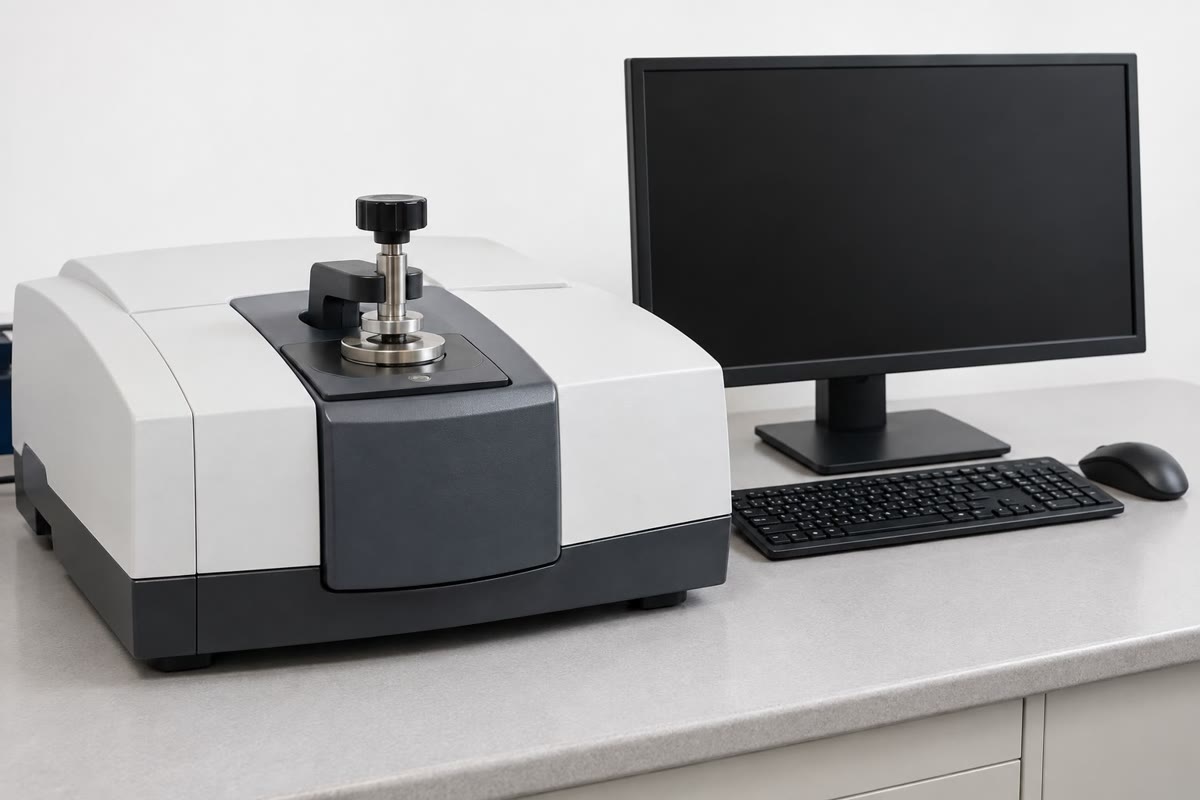
On a laboratory shelf stands a bottle of colourless liquid whose label has been torn off. It might be an alcohol, a ketone or an acid: three families that look exactly alike in a bottle. A drop placed on the crystal of an infrared spectrometer, two minutes of waiting, and a graph appears on the screen that answers the question. The bonds of a molecule vibrate, and each kind of bond absorbs infrared light of its own frequencies: an infrared spectrum is a list of the bonds present.
You already know
Functional groups and families (Chapter 33). An absorption spectrum shows how much light a substance absorbs at each wavelength (Chapter 29). Hydrogen bonds link groups to neighbouring molecules (Chapter 30).
34.1 Bonds vibrate
A covalent bond is not rigid: the two atoms vibrate, moving closer and apart many millions of millions of times per second, like two balls joined by a spring. A stiffer spring (a double bond rather than a single one) or lighter balls (a hydrogen atom rather than a carbon atom) vibrate faster. A bond can absorb infrared light whose frequency matches its own vibration: infrared light, invisible to the eye, has wavelengths of a few micrometres to a few tens of micrometres.

Definition 34.1 (Wavenumber)
The wavenumber of a light is the inverse of its wavelength, . In infrared spectroscopy it is expressed in : the number of wavelengths in one centimetre. A larger wavenumber means a shorter wavelength and a faster vibration.
Example 34.2 (From a wavenumber to a wavelength)
A band at corresponds to . Infrared spectra usually run from () to ().
34.2 Reading an infrared spectrum
Definition 34.3 (Infrared spectrum, transmittance)
The transmittance of a sample at a given wavenumber is the percentage of the infrared light that passes through it: if nothing is absorbed. The infrared spectrum of a compound is the graph of against the wavenumber, drawn by convention with the wavenumbers decreasing from left to right.
Definition 34.4 (Absorption band, fingerprint region)
An absorption band is a dip of the transmittance: the light of those wavenumbers is absorbed by a bond. Its position tells which bond, its width and its depth complete the picture. Below about , the spectrum is crowded with bands that depend on the whole molecule: this fingerprint region identifies a compound by comparison with a known spectrum, but is hard to read bond by bond.
In the lab — Recording a spectrum
Most school and university spectrometers now use a small diamond crystal: a drop of liquid, or a few grains of solid pressed by a clamp, is placed on the crystal, and the infrared beam that grazes its surface probes the sample. The crystal is first recorded clean (the “background”), which plays the part of the blank. The crystal is cleaned with a tissue and a little solvent between two samples.
34.3 Characteristic bands
Proposition 34.5 (Each bond type has its band)
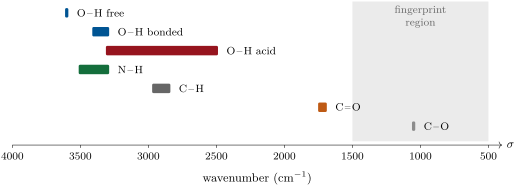
Each type of bond absorbs in a characteristic range of wavenumbers, nearly the same from one molecule to the next:
| bond | wavenumber () | appearance |
|---|---|---|
| , not hydrogen-bonded (gas, dilute) | near 3600 | sharp |
| , hydrogen-bonded (liquid alcohol) | 3300–3400 | broad, strong |
| of a carboxylic acid | 2500–3300 | very broad |
| of an amine | 3300–3500 | medium (two bands for ) |
| of a chain | 2850–2960 | strong |
| of an ester | near 1735 | very strong, sharp |
| of an aldehyde | near 1730 | very strong, sharp |
| of a ketone | near 1715 | very strong, sharp |
| of a carboxylic acid | near 1710 | very strong, broader |
| near 1650 | medium | |
| of an alcohol | near 1050 | strong |
Proof. These ranges are measured on many compounds. They group by bond because the vibration of a bond depends mostly on the bond itself and its two atoms, little on the rest of the molecule. ∎
Proposition 34.6 (Hydrogen bonds broaden the O–H band)
When groups are linked by hydrogen bonds, as in a liquid alcohol, their band is broad and lies at lower wavenumbers (about 3300–); without hydrogen bonds, as in the gas, it is sharp and near .
Proof. Admitted: a hydrogen bond pulls on the hydrogen atom and loosens the bond, which vibrates more slowly; and since every molecule is bonded a little differently, the band spreads over a range. ∎
34.4 Identifying functional groups
Method 34.7 (Reading an infrared spectrum)
- Look above first; leave the fingerprint region for a comparison with known spectra.
- Near : a very strong band means a group (aldehyde, ketone, acid, ester, amide).
- Between 2500 and : a broad band near means an alcohol ; a very broad band from 2500 to with a means a carboxylic acid; medium bands at 3300– mean .
- Combine with the molecular formula to choose the family, then check with the position of the band if there is one.
Example 34.8 (Reading the six spectra)
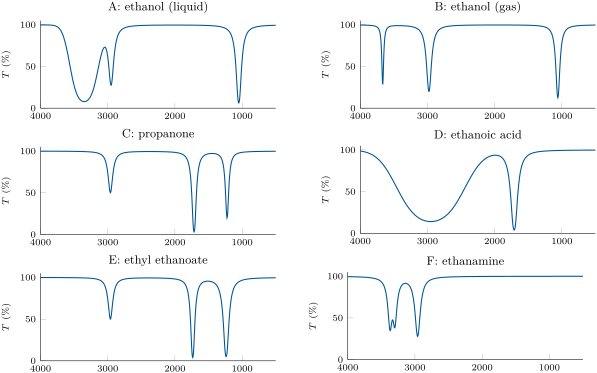
Ethanol (A) shows a broad band near , the bands just below and a strong band near , but nothing near . In the gas (B), its band becomes a sharp line at . Propanone (C) has no band but a very strong at . Ethanoic acid (D) shows both: an enormous band from 2500 to and a at . Ethyl ethanoate (E) has its at and a strong near , and no . Ethanamine (F) shows two medium bands above .
34.5 Exercises
Exercise 34.1 ★
Convert into a wavelength in micrometres: and . Which corresponds to the faster vibration?
Solution
Solution of Exercise 34.1.
; . The band at , of larger wavenumber, belongs to the faster vibration.
Exercise 34.2 ★
A wavelength of is absorbed. Give the wavenumber in .
Solution
Solution of Exercise 34.2.
, so .
Exercise 34.3 ★
Which bond absorbs: near ; near (broad); between 2850 and ?
Exercise 34.4 ★
On spectrum C (propanone), find the strongest band. Which bond does it belong to?
Solution
Solution of Exercise 34.4.
The band at : the bond.
Exercise 34.5 ★
Why is an infrared spectrum drawn with a transmittance axis, the bands pointing down? What does mean?
Solution
Solution of Exercise 34.5.
The instrument measures the light that passes through the sample; where a bond absorbs, less light passes and the curve dips. means that none of the light of that wavenumber is absorbed.
Exercise 34.6 ★★
A compound shows a very strong band at and no band above . Another, , shows a broad band near and none near . To which families do they belong? Propose a name for each.
Exercise 34.7 ★★
Explain why the band of ethanoic acid is so broad, broader even than that of liquid ethanol.
Exercise 34.8 ★★
Compare spectra A and B of ethanol. What changes, and why?
Solution
Solution of Exercise 34.8.
In the liquid (A) the band is broad, near ; in the gas (B), where the molecules are far apart and form no hydrogen bonds, it is a sharp band near .
Exercise 34.9 ★★
Propanal and propanone are both . Both show a strong band. Can infrared tell them apart from that band alone? What else could help?
Solution
Solution of Exercise 34.9.
Hardly: near for the aldehyde and for the ketone, close values. Comparison of the whole spectrum, fingerprint region included, with reference spectra would decide, or another technique.
Exercise 34.10 ★★
A compound shows a strong band at , a strong band near and nothing above . Its formula is . Which family? Is ethanoic acid a possibility? Butanoic acid?
Solution
Solution of Exercise 34.10.
An ester ( near , strong , no ), for example ethyl ethanoate. Ethanoic acid is , not . Butanoic acid has the right formula but would show the very broad band of acids: excluded.
Exercise 34.11 ★★
Which of the six spectra would a molecule of propan-1-ol most resemble? Of propanoic acid? Explain.
Solution
Solution of Exercise 34.11.
Propan-1-ol is an alcohol: like A. Propanoic acid is a carboxylic acid: like D.
Exercise 34.12 ★★★
Propan-2-ol can be oxidised into propanone. A student follows the reaction by recording spectra of samples taken every ten minutes. Describe how the spectra change. How does she know the reaction is complete?
Solution
Solution of Exercise 34.12.
The broad band near shrinks while a strong band near grows. The reaction is complete when the band has disappeared and the band no longer grows.
Exercise 34.13 ★★★
Butanoic acid and ethyl ethanoate are isomers, . Describe two differences between their infrared spectra, and explain them.
Exercise 34.14 ★★★
A sample of ethyl ethanoate shows, besides the expected bands, a weak broad band near . Suggest two impurities that could cause it (think of how esters are made, and of the air). How could the sample be checked?
Exercise 34.15 ★★★
The band of ketones lies near , that of a near , and the band near . Using the picture of two balls on a spring, explain why a double bond vibrates faster than a single bond . Why are , and bands all at high wavenumbers?
Solution
Solution of Exercise 34.15.
A double bond is a stiffer spring than a single bond between the same atoms: it vibrates faster, at a higher wavenumber (1715 against ). The , and bonds all involve a hydrogen atom, the lightest of all: light balls on a spring vibrate fast, hence wavenumbers near 2900–.
34.6 Problem: Three Unlabelled Bottles
Problem 34.1
Weekend problem — three bottles have lost their labels: which is which, and what wavelength does the ketone absorb most?
Three bottles of colourless liquid have lost their labels. The stock list says they contain ethanol, propanone and ethanoic acid. Their spectra are recorded: bottle 1 gives a spectrum like A, bottle 2 like D, bottle 3 like C.
Part I — The candidates.
- Write the semi-structural formulas of ethanol, propanone and ethanoic acid.
- Give their molecular formulas.
- Name the functional group of each.
- Which bonds of each should give a band above ?
Part II — The spectra.
- Bottle 1: is there a band? An band? Which compound is it?
- Bottle 2: describe its two strongest features. Which compound?
- Bottle 3: which compound? Which band decides?
- Could the smell have told them apart? Why is it better not to try?
- Why is the band of bottle 2 wider than that of bottle 1?
Part III — Isomers.
- Methoxymethane is an isomer of ethanol. Write its formula. Which band of ethanol would its spectrum lack?
- Propanal is an isomer of propanone. Which band do they share? Where does it lie for each?
- Methyl methanoate, , is an isomer of ethanoic acid. Which band of the acid would be missing? Where would its band lie?
- Why can a molecular formula alone not identify a compound, while formula and spectrum together usually can?
Part IV — The wavelength.
- What is the wavenumber of the strongest band of propanone?
- Express it in .
- Compute the wavelength absorbed, in metres, then in micrometres.
- Is that light visible? To which kind of radiation does it belong?
- Do the same for the band of ethanol near .
- Which of the two bonds vibrates faster?
- State the final answer: what wavelength does the bond of propanone absorb most strongly?
Solution
Solution of Problem 34.1.
1. ; ; .
2. ; ; .
3. Hydroxyl; carbonyl (ketone); carboxyl.
4. Ethanol: and . Propanone: and . Ethanoic acid: , and .
5. No band, a broad band: ethanol.
6. A very broad band from 2500 to and a strong near : ethanoic acid.
7. Propanone: the very strong band at , with no .
8. Probably (vinegar, solvent, alcohol), but sniffing unknown liquids is dangerous; the spectrum is safe and certain.
9. The acid’s groups are more strongly hydrogen-bonded (paired molecules), so the band is lower and much wider.
10. , ; it has no , so no band.
11. The band: near for propanal, near for propanone.
12. The band: an ester has no . Its would lie near .
13. Isomers share a formula; their functional groups differ, and the spectrum shows the groups.
14. .
15. .
16. .
17. No: visible light runs from about 0.4 to . It is infrared radiation.
18. , so .
19. The bond (higher wavenumber, shorter wavelength).
20. About .