Primary & Middle School Mathematics · Grades 1–9
11Shapes and Solids
Flat shapes live on paper; solids fill your hands. This chapter sorts flat shapes by counting sides and corners, tests the right angle with a folded paper corner, and meets the first solids — whose faces are the flat shapes we already know.
11.1 Sorting flat shapes
Definition 11.1 (Straight-sided and round)
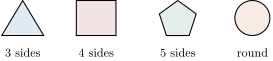
A shape whose border is made only of straight sides is a polygon: triangle ( sides), quadrilateral ( sides: squares and rectangles are quadrilaterals), pentagon (), hexagon (). A shape with a curved border, like the circle, is not a polygon.
Method 11.2 (Testing a right angle)
Fold a sheet of paper twice to make a sharp corner — that corner is a right angle. Lay it into the corner of a shape:
- if the two sides of the shape run exactly along the folded corner, the angle is right;
- if the corner is wider or narrower, it is not right.
A square and a rectangle have four right angles.
11.2 Reproducing on a grid
Method 11.3 (Copying a figure)
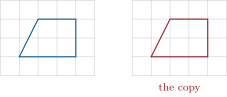
On grid paper, copy a figure vertex by vertex:
- pick a corner and mark it on the empty grid;
- count the squares to the next corner (“ right, up”) and mark it;
- join the corners in order; compare with the model.
11.3 Solids
Definition 11.4 (First solids)
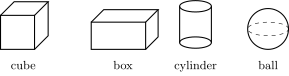
Solids take up space. Their flat sides are faces:
- the cube: square faces (a die);
- the box (rectangular prism): rectangle faces (a cereal packet);
- the cylinder: two round faces and a rolled side (a can);
- the ball: perfectly round, no flat face.
Solids and their faces return in Chapter 35.
11.4 Exercises
Exercise 11.1 ★
For each, count sides and corners and name it: a shape with sides; a shape with corners; a round shape.
Solution
Solution of Exercise 11.1.
sides, corners: a pentagon. corners (and sides): a triangle. Round: a circle.
Exercise 11.2 ★
Sort into “polygon” or “not a polygon”: a square; a circle; a triangle; a hexagon.
Exercise 11.3 ★
Make a right-angle tester by folding paper. Find three right angles in the room, and one angle that is not right.
Solution
Solution of Exercise 11.3.
Right angles at, for instance, the corners of the board, a book, a window; a not-right angle at the open lid of a box or the hands of a clock at o’clock.
Exercise 11.4 ★
How many right angles has a square? A rectangle? A triangle can have at most how many? (Try to draw one with two.)
Solution
Solution of Exercise 11.4.
Square: right angles. Rectangle: . A triangle can have at most right angle — two would make the other two sides never meet.
Exercise 11.5 ★
On grid paper, copy a rectangle that is squares wide and tall, then a triangle with a -square base.
Solution
Solution of Exercise 11.5.
Grid copies made by counting squares between corners; comparing with the model checks the work.
Exercise 11.6 ★
Name the solid: a die; a can of soup; a football; a shoebox.
Exercise 11.7 ★
How many faces has a cube? What shape is each face? How many faces has a box?
Exercise 11.8 ★
Which solids can roll: the cube, the box, the ball, the cylinder? Why?
Exercise 11.9 ★
A shape has sides. What is it called? How many corners has it?
Solution
Solution of Exercise 11.9.
sides: a hexagon, with corners.
Exercise 11.10 ★★
On grid paper, draw a house: a square for the wall () with a triangle roof on top. How many sides and corners has the whole outline of the house?
Solution
Solution of Exercise 11.10.
The house outline (square wall with a triangle roof, the roof base sitting on the square’s top side) has sides and corners — it is a pentagon (bottom, two walls, two roof slopes; the top of the wall is hidden under the roof).