Primary & Middle School Mathematics · Grades 1–9
54Multiplying Negative Numbers
Grade 7 added and subtracted relative numbers (Chapter 46); it remains to multiply and divide them. One question dominates the chapter: why should “minus times minus” be plus? We give a reason, not just a rule.
54.1 The sign rules
Theorem 54.1 (Sign of a product)
The product of two relative numbers has distance to zero equal to the product of the distances, and its sign is given by:
Same signs: positive product. Opposite signs: negative product. The same table governs quotients.
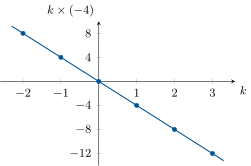
Why . First, means : a positive times a negative is negative. Now watch the pattern:
Each step, the first factor drops by and the result rises by . Continuing the pattern one more step:
Any other choice would break the regularity of arithmetic (distributivity). So minus times minus must be plus. ∎
Example 54.2
54.2 Products of several factors
Proposition 54.3 (Sign of a long product)
The sign of a product of several nonzero factors depends only on the number of negative factors:
Proof. Negative factors pair up, and each pair contributes a positive sign (Theorem 54.1); an odd count leaves one unpaired negative factor, which makes the whole product negative. ∎
Example 54.4
: three negative factors (odd), so the product is negative; distances: . Result: . Decide the sign first, then multiply the distances — two easy tasks instead of one error-prone one.
Example 54.5 (Powers of negatives)
, and : even exponents give positive values, odd exponents keep the sign. Careful with notation: but .
54.3 Computing with all four operations
Method 54.6 (Safe computation with relative numbers)
- Respect the priorities of Chapter 45: brackets, then and , then and ;
- at each multiplication or division, find the sign first, then the distance;
- rewrite one step per line.
Example 54.7
Example 54.8 (Substituting negative values)
Evaluate for , brackets around the value:
The brackets in are essential: without them the square would apply to only.
54.4 Exercises
Exercise 54.1 ★
Compute:
Exercise 54.2 ★
Compute:
Solution
Solution of Exercise 54.2.
; ; ; .
Exercise 54.3 ★
Give only the sign of each product, without computing it:
Exercise 54.4 ★
Compute:
Exercise 54.5 ★
Compute step by step, respecting priorities:
Solution
Solution of Exercise 54.5.
.
.
.
Exercise 54.6 ★
Compute:
Solution
Solution of Exercise 54.6.
.
.
Exercise 54.7 ★
Evaluate for :
Solution
Solution of Exercise 54.7.
For : ; ; ; ; .
Exercise 54.8 ★★
Complete each equality:
Solution
Solution of Exercise 54.8.
; ; , so the missing number is .
Exercise 54.9 ★★
True or false? Justify or give a counterexample.
- The product of two relative numbers is always at least as large as their sum.
- The square of a relative number is never negative.
- If a product of three factors is positive, all three factors are positive.
Exercise 54.10 ★★
Each wrong answer at a quiz counts points, each right answer . Zoe answered questions and scored points. How many answers were right? (Try values, or set up the computation .)
Solution
Solution of Exercise 54.10.
Let be the number of right answers; then are wrong, and
Twelve right answers (and eight wrong: check, ).
Exercise 54.11 ★★★
Using distributivity (as in the proof of Theorem 54.1), expand and justify each step of
and conclude that must equal .
54.5 Problem: Why minus times minus is plus
Problem 54.1
Weekend problem — the sign rules deduced from distributivity, and the alternating sum
The proof of Theorem 54.1 continued a pattern and claimed that “any other choice would break distributivity”. This problem makes the claim exact: starting from distributivity alone (Theorem 45.6), you will prove the sign rules — no picture, no pattern, the way algebra does it — then put them to work on powers of and on a famous sum with alternating signs. Throughout, and are relative numbers; we take for granted the addition rules of Chapter 46, that , and that a product may be computed in any order (so distributivity applies on either side of a product).
Part I — The sign rules are theorems.
- Prove that for every relative number . (Write , expand , and ask which number, added to , gives back.)
Expand to show that , and conclude that
multiplying by gives the opposite. Compare with Exercise 54.11, which is the case .
- Deduce that : one minus sign comes out of a product unchanged.
- Deduce that : two minus signs cancel.
- Every relative number is its distance to zero with a sign in front: or . Explain how questions 3 and 4 prove all four cases of the sign table of Theorem 54.1, distances included.
Part II — Powers of .
- Compute , , , , then give, with justification from Proposition 54.3, the value of for every whole number .
Give (without computing any distance) the sign of
and write the distance of this product as a product of whole numbers, without working it out.
- Show that and that . For which exponents does the minus sign survive?
- Use the sign rules to show that the square of a relative number is never negative, and deduce that no relative number satisfies .
- Zoe claims: “, and more generally two consecutive powers of always cancel.” Is she right? Justify.
Part III — The alternating sum. With the sign rules secured, we can compute sums that mix both signs. For a whole number , let
be the sum of the whole numbers from to with alternating signs: the last term is when is odd, when is even. So and .
- Compute , , , and . What do you conjecture?
- Suppose is even. Group the terms two by two, , count the pairs, and prove that .
- Suppose is odd. Explain why , and deduce from the previous question that .
- Compute , and .
- Alma computed and was surprised to find exactly . Should she have been? Explain in one sentence, and state the value of without any further computation.
Solution
Solution of Problem 54.1.
1. Since , distributivity (Theorem 45.6) gives
So adding to itself changes nothing — and the only number one can add without changing anything is . (Directly: subtract from both sides.) Hence .
2. Expanding, then using and question 1:
So is the number which, added to , gives : that is exactly the opposite of , and . Exercise 54.11 is the special case : there, .
3. Write (question 2) and regroup the factors:
4. Apply question 3 twice (once on each factor):
since the opposite of the opposite of a number is the number itself.
5. Write or and or , where and are the distances to zero. The four cases:
the middle two by question 3, the last by question 4. In every case the distance of the result is , the product of the distances, and the sign is the one announced by the table of Theorem 54.1: same signs positive, opposite signs negative.
6. , , , . In general is a product of negative factors, each of distance : by Proposition 54.3 it is when is even and when is odd.
7. There are ten negative factors — an even number — so the product is positive (Proposition 54.3). Its distance is .
8. By question 4, . Then by question 3,
The minus sign disappears for even exponents and survives for odd ones, in line with Example 54.5.
9. If then . Otherwise and have the same sign, so is positive (Theorem 54.1). A square is therefore never negative; since is negative, no relative number satisfies .
10. Zoe is right. The exponents and have opposite parities, so and , which add to . In general, of two consecutive exponents one is even and one is odd, so the two powers are and in some order: opposite numbers, whose sum is always .
11. , then , , , . Conjecture: for even , and for odd .
12. For even the terms pair up completely:
and each pair equals . There are pairs (two terms per pair, terms in all), so .
13. For odd , the sum is the sum of the first terms, plus the last term, which is since is odd. As is even, question 12 gives
14. , , .
15. No surprise: passing from to adds exactly one term, namely , so the difference had to be . For the same reason, — without computing at all.