Primary & Middle School Mathematics · Grades 1–9
4Numbers to 100
Counting a big pile one by one takes forever. The great trick: bundle the objects in packs of ten, and count the packs. This is how the numbers up to are built — and why they are written with two digits.
4.1 Bundles of ten
Definition 4.1 (Tens and units)
A ten is a bundle of ten units. The number means tens and units:
The left digit counts the bundles, the right digit the loose units.

Example 4.2 (Reading the numbers)
is two tens (twenty), three tens (thirty) … up to (ninety) and (one hundred: ten tens!). In between: reads “forty-seven” — forty for the tens, seven for the units.
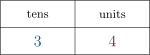
Example 4.3 (Same digits, different numbers)
and use the same digits but are very different: is tens and units; is tens and units — much bigger! The place of a digit decides what it counts.
4.2 The hundred grid
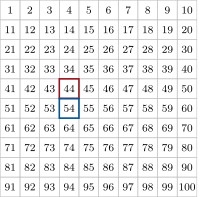
Method 4.4 (Moving on the grid)
- / : one step right / left;
- / : one step down / up — only the tens digit changes: ;
- counting by tens: — follow the last column of the grid straight down.
Example 4.5 (Counting by 2s and 5s)
By s: (the even numbers). By s: — they end in or and make a nice pattern on the grid. Skip counting prepares multiplication (Chapter 10).
4.3 Comparing bigger numbers
Method 4.6 (Comparing with tens)
More tens wins: because tens beat tens — even though is more than ! Only when the tens are equal do the units decide: .
Example 4.7
Order , , : tens first (, , ):
4.4 Exercises
Exercise 4.1 ★
How many tens and units in: ; ; ; ?
Solution
Solution of Exercise 4.1.
: tens, units. : tens, units. : tens, units. : tens, units.
Exercise 4.2 ★
Write the number: tens and units; tens; ten and units; tens.
Solution
Solution of Exercise 4.2.
; ; ; .
Exercise 4.3 ★
Write in digits: sixty-three; forty; eighty-five; one hundred.
Solution
Solution of Exercise 4.3.
; ; ; .
Exercise 4.4 ★
Compute by moving on the hundred grid: ; ; ; .
Solution
Solution of Exercise 4.4.
; ; ; .
Exercise 4.5 ★
Continue: . . .
Solution
Solution of Exercise 4.5.
. . .
Exercise 4.6 ★
Copy and complete with or :
Solution
Solution of Exercise 4.6.
; ; ; .
Exercise 4.7 ★
Order from smallest to biggest: ; ; ; ; .
Solution
Solution of Exercise 4.7.
.
Exercise 4.8 ★
A gardener bundles flowers in bunches of ten. How many full bunches, and how many loose flowers?
Solution
Solution of Exercise 4.8.
is tens and units: full bunches and loose flowers.
Exercise 4.9 ★★
On the hundred grid, start at ; go two steps down and one step left. Where do you land? Which computation did you just do?
Solution
Solution of Exercise 4.9.
From , two steps down is (), one step left is (). You land on . The computation is , that is .