Mathematics · Book 1 · Grades 1–9

Primary & Middle School Mathematics

Primary & Middle School Mathematics · Grades 1–9

55Fractions: All Four Operations

This chapter completes the arithmetic of fractions: addition and subtraction with any denominators, multiplication, and — the newcomer — division, which turns out to be a multiplication in disguise. Signs from Chapter 54 come along for the ride.

55.1 Adding with any denominators

Method 55.1 (Common denominator)

To add or subtract ab\frac ab and cd\frac cd:

  1. find a common multiple of bb and dd (the product b×db \times d always works; a smaller one saves effort);
  2. rewrite both fractions with that denominator;
  3. add or subtract the numerators; simplify.

Example 55.2

Compute 56+34\dfrac{5}{6} + \dfrac{3}{4}. A common multiple of 66 and 44 is 1212:

56=1012,34=912,56+34=10+912=1912.\frac{5}{6} = \frac{10}{12}, \qquad \frac{3}{4} = \frac{9}{12}, \qquad \frac{5}{6} + \frac{3}{4} = \frac{10 + 9}{12} = \frac{19}{12}.

With signs: 2375=10152115=1115\dfrac{2}{3} - \dfrac{7}{5} = \dfrac{10}{15} - \dfrac{21}{15} = -\dfrac{11}{15}.

55.2 Multiplying fractions

Theorem 55.3 (Product of fractions)

ab×cd=a×cb×d.\frac{a}{b} \times \frac{c}{d} = \frac{a \times c}{b \times d} .

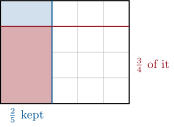
Why, on a picture. Take 34\frac34 of 25\frac25 of a square: cut the square in 55 vertical strips and keep 22; cut horizontally in 44 and keep 33 rows of what remained. The kept part is a grid of 3×23 \times 2 small cells out of 4×54 \times 5: fraction 620\frac{6}{20}.

3/4 × 2/5: the doubly-shaded region is 3 × 2 = 6 cells out of 4 × 5 = 20, i.e. 6/20 = 3/10 — numerators multiplied, denominators multiplied.
34×25\frac34 \times \frac25: the doubly-shaded region is 3×2=63 \times 2 = 6 cells out of 4×5=204 \times 5 = 20, i.e. 620=310\frac{6}{20} = \frac{3}{10}numerators multiplied, denominators multiplied.

Example 55.4

Simplify before multiplying, crossing out common factors:

712×914=7×912×14=7×3×33×4×2×7=38\frac{7}{12} \times \frac{9}{14} = \frac{7 \times 9}{12 \times 14} = \frac{7 \times 3 \times 3}{3 \times 4 \times 2 \times 7} = \frac{3}{8}

(the factor 77 and one factor 33 cancel between top and bottom). With signs, the rules of Theorem 54.1 apply first: (23)×(54)=+1012=56\left(-\frac23\right) \times \left(-\frac{5}{4}\right) = +\frac{10}{12} = \frac56.

55.3 Dividing fractions

Definition 55.5 (Inverse)

The inverse of a nonzero number xx is the number which multiplied by xx gives 11. The inverse of ab\frac ab is ba\frac ba, since ab×ba=abab=1\frac ab \times \frac ba = \frac{ab}{ab} = 1; the inverse of an integer nn is 1n\frac1n.

Theorem 55.6 (Dividing means multiplying by the inverse)

For c0c \neq 0:

ab÷cd=ab×dc.\frac{a}{b} \div \frac{c}{d} = \frac{a}{b} \times \frac{d}{c} .

Proof. By definition, the quotient qq of ab\frac ab by cd\frac cd is the number with q×cd=abq \times \frac cd = \frac ab. Check the candidate q=ab×dcq = \frac ab \times \frac dc:

(ab×dc)×cd=ab×(dc×cd)=ab×1=ab.\left(\frac ab \times \frac dc\right) \times \frac cd = \frac ab \times \left(\frac dc \times \frac cd\right) = \frac ab \times 1 = \frac ab . \qedhere

Example 55.7

35÷710=35×107=3×105×7=3035=67.\frac{3}{5} \div \frac{7}{10} = \frac{3}{5} \times \frac{10}{7} = \frac{3 \times 10}{5 \times 7} = \frac{30}{35} = \frac{6}{7}.

A sanity check: dividing by 710\frac{7}{10}, a number smaller than 11, must give a result larger than 35\frac35 — and 67>35\frac67 > \frac35 indeed (3035>2135\frac{30}{35} > \frac{21}{35}).

Example 55.8 (Fraction bars within fraction bars)

A “double-decker” is just a division written vertically:

 23  56 =23÷56=23×65=1215=45.\frac{\ \frac{2}{3}\ }{\ \frac{5}{6}\ } = \frac{2}{3} \div \frac{5}{6} = \frac{2}{3} \times \frac{6}{5} = \frac{12}{15} = \frac{4}{5}.

Locate the main bar first (the longest one), then apply Theorem 55.6.

Method 55.9 (Mixed computations)

In an expression mixing fractions and the four operations:

  1. apply the usual priorities (Chapter 45);
  2. convert every division into a multiplication by the inverse;
  3. decide signs first (Method 54.6), then multiply or find common denominators;
  4. simplify at the earliest opportunity.

Example 55.10

12+23×94=12+2×93×4(product first!)=12+1812=12+32=42=2.\begin{align*} \frac12 + \frac{2}{3} \times \frac{9}{4} &= \frac12 + \frac{2 \times 9}{3 \times 4} && \text{(product first!)} \\ &= \frac12 + \frac{18}{12} = \frac12 + \frac32 = \frac{4}{2} = 2 . \end{align*}

55.4 Exercises

Exercise 55.1

Compute and simplify:

34+25,5638,710+815.\frac{3}{4} + \frac{2}{5}, \qquad \frac{5}{6} - \frac{3}{8}, \qquad \frac{7}{10} + \frac{8}{15} .
Solution

Solution of Exercise 55.1.

34+25=1520+820=2320\dfrac34 + \dfrac25 = \dfrac{15}{20} + \dfrac{8}{20} = \dfrac{23}{20}.

5638=2024924=1124\dfrac56 - \dfrac38 = \dfrac{20}{24} - \dfrac{9}{24} = \dfrac{11}{24}.

710+815=2130+1630=3730\dfrac{7}{10} + \dfrac{8}{15} = \dfrac{21}{30} + \dfrac{16}{30} = \dfrac{37}{30}.

Exercise 55.2

Compute (signs first):

27+314,1654,3512.-\frac{2}{7} + \frac{3}{14}, \qquad \frac{1}{6} - \frac{5}{4}, \qquad -\frac{3}{5} - \frac{1}{2} .
Solution

Solution of Exercise 55.2.

27+314=414+314=114-\dfrac27 + \dfrac{3}{14} = -\dfrac{4}{14} + \dfrac{3}{14} = -\dfrac{1}{14}.

1654=2121512=1312\dfrac16 - \dfrac54 = \dfrac{2}{12} - \dfrac{15}{12} = -\dfrac{13}{12}.

3512=610510=1110-\dfrac35 - \dfrac12 = -\dfrac{6}{10} - \dfrac{5}{10} = -\dfrac{11}{10}.

Exercise 55.3

Compute, simplifying before multiplying:

58×415,914×73,(65)×109.\frac{5}{8} \times \frac{4}{15}, \qquad \frac{9}{14} \times \frac{7}{3}, \qquad \left(-\frac{6}{5}\right) \times \frac{10}{9} .
Solution

Solution of Exercise 55.3.

58×415=5×48×15=12×3=16\dfrac58 \times \dfrac{4}{15} = \dfrac{5 \times 4}{8 \times 15} = \dfrac{1}{2 \times 3} = \dfrac16 (simplify by 55 and by 44).

914×73=9×714×3=32\dfrac{9}{14} \times \dfrac73 = \dfrac{9 \times 7}{14 \times 3} = \dfrac{3}{2} (simplify by 77 and by 33).

(65)×109=6045=43\left(-\dfrac65\right) \times \dfrac{10}{9} = -\dfrac{60}{45} = -\dfrac43 (opposite signs: negative).

Exercise 55.4

Give the inverse of: 37\dfrac{3}{7}; 55; 14\dfrac{1}{4}; 29-\dfrac{2}{9}.

Solution

Solution of Exercise 55.4.

Inverses: 73\dfrac73; 15\dfrac15; 44; 92-\dfrac92 (the inverse keeps the sign).

Exercise 55.5

Compute:

49÷23,75÷14,6÷34.\frac{4}{9} \div \frac{2}{3}, \qquad \frac{7}{5} \div 14, \qquad 6 \div \frac{3}{4} .
Solution

Solution of Exercise 55.5.

49÷23=49×32=1218=23\dfrac49 \div \dfrac23 = \dfrac49 \times \dfrac32 = \dfrac{12}{18} = \dfrac23.

75÷14=75×114=770=110\dfrac75 \div 14 = \dfrac75 \times \dfrac{1}{14} = \dfrac{7}{70} = \dfrac{1}{10}.

6÷34=6×43=86 \div \dfrac34 = 6 \times \dfrac43 = 8.

Exercise 55.6

Compute the double-deckers:

 34  98 , 56  10 , 2  47 .\frac{\ \frac{3}{4}\ }{\ \frac{9}{8}\ }, \qquad \frac{\ \frac{5}{6}\ }{\ 10\ }, \qquad \frac{\ 2\ }{\ \frac{4}{7}\ } .
Solution

Solution of Exercise 55.6.

3/49/8=34×89=2436=23\dfrac{3/4}{9/8} = \dfrac34 \times \dfrac89 = \dfrac{24}{36} = \dfrac23.

5/610=56×110=560=112\dfrac{5/6}{10} = \dfrac56 \times \dfrac{1}{10} = \dfrac{5}{60} = \dfrac{1}{12}.

24/7=2×74=72\dfrac{2}{4/7} = 2 \times \dfrac74 = \dfrac72.

Exercise 55.7

Compute, respecting priorities:

13+12×45,(13+12)×45.\frac{1}{3} + \frac{1}{2} \times \frac{4}{5}, \qquad \left(\frac{1}{3} + \frac{1}{2}\right) \times \frac{4}{5} .
Solution

Solution of Exercise 55.7.

Product first: 13+12×45=13+410=1030+1230=2230=1115\dfrac13 + \dfrac12 \times \dfrac45 = \dfrac13 + \dfrac{4}{10} = \dfrac{10}{30} + \dfrac{12}{30} = \dfrac{22}{30} = \dfrac{11}{15}.

Brackets first: (13+12)×45=56×45=2030=23\left(\dfrac13 + \dfrac12\right) \times \dfrac45 = \dfrac56 \times \dfrac45 = \dfrac{20}{30} = \dfrac23.

Exercise 55.8 ★★

A tank is 25\frac{2}{5} full. One adds 13\frac{1}{3} of the tank’s capacity. What fraction of the tank is now full? What fraction is still empty?

Solution

Solution of Exercise 55.8.

Full: 25+13=615+515=1115\dfrac25 + \dfrac13 = \dfrac{6}{15} + \dfrac{5}{15} = \dfrac{11}{15} of the tank. Empty: 11115=4151 - \dfrac{11}{15} = \dfrac{4}{15}.

Exercise 55.9 ★★

Three quarters of the students of a class passed a test; among those, two thirds got more than 1414 out of 2020. What fraction of the class got more than 1414? If that represents 1212 students, how large is the class?

Solution

Solution of Exercise 55.9.

Fraction with more than 1414: 23×34=612=12\dfrac23 \times \dfrac34 = \dfrac{6}{12} = \dfrac12 of the class. If that is 1212 students, the class has 2424 students.

Exercise 55.10 ★★

A rope of 152\frac{15}{2} m must be cut into pieces of 34\frac{3}{4} m each. How many pieces does one get? (A division of fractions — check that the answer is a whole number.)

Solution

Solution of Exercise 55.10.

152÷34=152×43=606=10\dfrac{15}{2} \div \dfrac34 = \dfrac{15}{2} \times \dfrac43 = \dfrac{60}{6} = 10 pieces — a whole number, no rope wasted.

Exercise 55.11 ★★

Compute

E=2356÷109,F=(12)2×83.E = \frac{2}{3} - \frac{5}{6} \div \frac{10}{9}, \qquad F = \left(-\frac{1}{2}\right)^2 \times \frac{8}{3} .
Solution

Solution of Exercise 55.11.

EE: division first: 56÷109=56×910=4560=34\dfrac56 \div \dfrac{10}{9} = \dfrac56 \times \dfrac{9}{10} = \dfrac{45}{60} = \dfrac34; then E=2334=812912=112E = \dfrac23 - \dfrac34 = \dfrac{8}{12} - \dfrac{9}{12} = -\dfrac{1}{12}.

F=(12)2×83=14×83=812=23F = \left(-\dfrac12\right)^2 \times \dfrac83 = \dfrac14 \times \dfrac83 = \dfrac{8}{12} = \dfrac23 (the square is positive).

Exercise 55.12 ★★★

Simplify the expression

1+11+11+11 + \cfrac{1}{1 + \cfrac{1}{1 + 1}}

(start from the innermost fraction and work outward, one bar at a time).

Solution

Solution of Exercise 55.12.

From the inside out: 1+1=21 + 1 = 2; then 1+12=321 + \dfrac12 = \dfrac32; then

1+13/2=1+23=53.1 + \frac{1}{3/2} = 1 + \frac23 = \frac53 .

55.5 Problem: Egyptian fractions

Problem 55.1

Weekend problem — every fraction is a sum of distinct unit fractions

A unit fraction is a fraction with numerator 11. The scribes of ancient Egypt — the Rhind papyrus was copied around 15501550 BC — wrote every fraction as a sum of distinct unit fractions: never 27=17+17\frac27 = \frac17 + \frac17, but 27=14+128\frac27 = \frac14 + \frac{1}{28}. Such a sum is called an Egyptian writing of the fraction. This problem develops the addition and comparison techniques of this chapter (Method 55.1) into a method — published by Fibonacci in 12021202 — that produces an Egyptian writing of any fraction between 00 and 11, and ends with a celebrated inheritance puzzle.

Part I — Unit fractions and the splitting identity.

  1. Compute 12+13\frac12 + \frac13 and 12+14\frac12 + \frac14, and deduce Egyptian writings of 56\frac56 and 34\frac34.
  2. Verify the scribes’ entry for 27\frac27: show that 14+128=27\frac14 + \frac{1}{28} = \frac27.
  3. Check that 13+16=12\frac13 + \frac16 = \frac12 and that 14+112=13\frac14 + \frac{1}{12} = \frac13. Then prove the splitting identity: for every whole number n1n \geq 1,

    1n=1n+1+1n(n+1).\frac{1}{n} = \frac{1}{n+1} + \frac{1}{n(n+1)} .
  4. Deduce an Egyptian writing of 11 itself, as a sum of three distinct unit fractions.
  5. Split the last term of 56=12+13\frac56 = \frac12 + \frac13 to obtain a second Egyptian writing of 56\frac56, with three unit fractions. Explain why no fraction has a unique Egyptian writing.

Part II — Fibonacci’s greedy method. The method is: subtract the largest unit fraction that fits, and repeat with what remains.

  1. Using common denominators, show that 14<27<13\frac14 < \frac27 < \frac13. Why does this prove that 14\frac14 is the largest unit fraction smaller than 27\frac27?
  2. Compute 2714\frac27 - \frac14. Which writing of 27\frac27 does the greedy method produce?
  3. Now take 57\frac57. Show that the largest unit fraction smaller than 57\frac57 is 12\frac12, and compute 5712\frac57 - \frac12.
  4. Show that the largest unit fraction smaller than 314\frac{3}{14} is 15\frac15 (compare 314\frac{3}{14} with 14\frac14 and with 15\frac15), compute 31415\frac{3}{14} - \frac15, and conclude:

    57=12+15+170.\frac57 = \frac12 + \frac15 + \frac{1}{70} .

    Verify this writing directly with the common denominator 7070.

  5. Run the greedy method on 45\frac45, checking at each step that your unit fraction is the largest one that fits, and verify the final writing.

Part III — Why the method always stops, and the eighteenth camel.

  1. In questions 7–10 the method was applied to 27\frac27, 57\frac57 and 45\frac45. For each, list the numerators of the successive remainders (before any simplification). What do you observe?
  2. For a fraction ab\frac ab and a whole number nn, show that

    ab1n=a×nbb×n.\frac{a}{b} - \frac{1}{n} = \frac{a \times n - b}{b \times n} .
  3. Suppose the greedy method subtracts 1n\frac1n from ab\frac ab: then 1n\frac1n fits but 1n1\frac{1}{n-1} is already too big, 1n1>ab\frac{1}{n-1} > \frac ab. Putting both over the common denominator b×(n1)b \times (n - 1), deduce that b>a×nab > a \times n - a, hence that the new numerator satisfies

    a×nb<a.a \times n - b < a .

    Explain why this proves that the method always stops.

  4. An old tale: a father dies leaving 1717 camels, willing 12\frac12 of the herd to his eldest child, 13\frac13 to the second, 19\frac19 to the third — and none of the shares is a whole number of camels. A neighbour lends the family an eighteenth camel; the children take 99, 66 and 22 camels, and the borrowed camel is returned. Compute 12+13+19\frac12 + \frac13 + \frac19 and explain the trick: why could the herd be shared in whole camels, and why did no child receive less than the will promised?
  5. Repair the will: propose three distinct unit fractions that add up to exactly 11, and give the smallest herd size for which all three shares are whole numbers of camels.
Solution

Solution of Problem 55.1.

1. 12+13=36+26=56\frac12 + \frac13 = \frac36 + \frac26 = \frac56 and 12+14=24+14=34\frac12 + \frac14 = \frac24 + \frac14 = \frac34. So 56=12+13\frac56 = \frac12 + \frac13 and 34=12+14\frac34 = \frac12 + \frac14 are Egyptian writings (distinct unit fractions in each).

2. With the common denominator 2828:

14+128=728+128=828=27.\frac14 + \frac{1}{28} = \frac{7}{28} + \frac{1}{28} = \frac{8}{28} = \frac{2}{7} .

3. 13+16=26+16=36=12\frac13 + \frac16 = \frac26 + \frac16 = \frac36 = \frac12, and 14+112=312+112=412=13\frac14 + \frac{1}{12} = \frac{3}{12} + \frac{1}{12} = \frac{4}{12} = \frac13. In general, the common denominator of 1n+1\frac{1}{n+1} and 1n(n+1)\frac{1}{n(n+1)} is n(n+1)n(n+1):

1n+1+1n(n+1)=nn(n+1)+1n(n+1)=n+1n(n+1)=1n.\frac{1}{n+1} + \frac{1}{n(n+1)} = \frac{n}{n(n+1)} + \frac{1}{n(n+1)} = \frac{n+1}{n(n+1)} = \frac{1}{n} .

4. Start from 1=12+121 = \frac12 + \frac12 and split the second half by question 3:

1=12+13+16,1 = \frac12 + \frac13 + \frac16 ,

three distinct unit fractions.

5. Splitting the 13\frac13 in 56=12+13\frac56 = \frac12 + \frac13 gives

56=12+14+112.\frac56 = \frac12 + \frac14 + \frac{1}{12} .

No Egyptian writing is ever unique: the splitting identity can always replace the unit fraction with the largest denominator by two new, even smaller unit fractions — so from any writing one manufactures another.

6. With denominator 2121: 27=621<721=13\frac27 = \frac{6}{21} < \frac{7}{21} = \frac13. With denominator 2828: 14=728<828=27\frac14 = \frac{7}{28} < \frac{8}{28} = \frac27. Unit fractions shrink as their denominators grow, 1>12>13>14>1 > \frac12 > \frac13 > \frac14 > \dots; since 13\frac13 (and everything above it) is too big and 14\frac14 fits, 14\frac14 is the largest unit fraction smaller than 27\frac27.

7. 2714=828728=128\frac27 - \frac14 = \frac{8}{28} - \frac{7}{28} = \frac{1}{28}: the greedy method produces 27=14+128\frac27 = \frac14 + \frac{1}{28}, exactly the scribes’ entry of question 2.

8. With denominator 1414: 12=714<1014=57\frac12 = \frac{7}{14} < \frac{10}{14} = \frac57, while the only larger unit fraction, 11, exceeds 57\frac57. So 12\frac12 is the largest that fits, and

5712=1014714=314.\frac57 - \frac12 = \frac{10}{14} - \frac{7}{14} = \frac{3}{14} .

9. With denominator 2828: 314=628<728=14\frac{3}{14} = \frac{6}{28} < \frac{7}{28} = \frac14, so 14\frac14 is too big. With denominator 7070: 15=1470<1570=314\frac15 = \frac{14}{70} < \frac{15}{70} = \frac{3}{14}, so 15\frac15 fits: it is the largest unit fraction smaller than 314\frac{3}{14}. Then

31415=15701470=170,hence57=12+15+170.\frac{3}{14} - \frac15 = \frac{15}{70} - \frac{14}{70} = \frac{1}{70}, \qquad\text{hence}\qquad \frac57 = \frac12 + \frac15 + \frac{1}{70} .

Check: 3570+1470+170=5070=57\frac{35}{70} + \frac{14}{70} + \frac{1}{70} = \frac{50}{70} = \frac57.

10. First step: 12=510<810=45\frac12 = \frac{5}{10} < \frac{8}{10} = \frac45 and 1>451 > \frac45, so subtract 12\frac12: 4512=810510=310\frac45 - \frac12 = \frac{8}{10} - \frac{5}{10} = \frac{3}{10}. Second step: 13=1030>930=310\frac13 = \frac{10}{30} > \frac{9}{30} = \frac{3}{10} is too big, and 14=520<620=310\frac14 = \frac{5}{20} < \frac{6}{20} = \frac{3}{10} fits, so subtract 14\frac14: 31014=620520=120\frac{3}{10} - \frac14 = \frac{6}{20} - \frac{5}{20} = \frac{1}{20}. Conclusion:

45=12+14+120,1020+520+120=1620=45.\frac45 = \frac12 + \frac14 + \frac{1}{20}, \qquad \frac{10}{20} + \frac{5}{20} + \frac{1}{20} = \frac{16}{20} = \frac45 . \checkmark

11. The numerators of the successive remainders are: for 27\frac27: 22, then 11; for 57\frac57: 55, then 33, then 11; for 45\frac45: 44, then 33, then 11. Each list is strictly decreasing.

12. The common denominator of ab\frac ab and 1n\frac1n is b×nb \times n:

ab1n=a×nb×nbb×n=a×nbb×n.\frac{a}{b} - \frac{1}{n} = \frac{a \times n}{b \times n} - \frac{b}{b \times n} = \frac{a \times n - b}{b \times n} .

13. Over the common denominator b×(n1)b \times (n-1), the inequality 1n1>ab\frac{1}{n-1} > \frac ab compares the numerators bb and a×(n1)a \times (n - 1):

b>a×(n1)=a×na,b > a \times (n - 1) = a \times n - a ,

and adding aba - b to both sides gives a>a×nba > a \times n - b. So after each greedy step the numerator of the remainder (question 12) is a whole number strictly smaller than the one before. Whole numbers cannot decrease strictly forever: after at most aa steps the remainder has numerator 11 — a unit fraction — or is 00, and the method stops.

14. With the common denominator 1818:

12+13+19=918+618+218=1718,\frac12 + \frac13 + \frac19 = \frac{9}{18} + \frac{6}{18} + \frac{2}{18} = \frac{17}{18} ,

which is less than 11: the will forgot 118\frac{1}{18} of the herd. That gap is the whole trick. Out of 1818 camels the shares 12\frac12, 13\frac13, 19\frac19 are the whole numbers 99, 66 and 22, which add up to 9+6+2=179 + 6 + 2 = 17: exactly the herd, and the eighteenth camel goes home. And nobody can complain: the will promised, out of 1717 camels, 172=8.5\frac{17}{2} = 8.5, then 1735.67\frac{17}{3} \approx 5.67, then 1791.89\frac{17}{9} \approx 1.89 camels, and each child received strictly more (99, 66 and 22). The forgotten 118\frac{1}{18} is what the neighbour’s camel temporarily filled.

15. Question 4 provides the repaired will:

12+13+16=1.\frac12 + \frac13 + \frac16 = 1 .

The shares are whole numbers when the herd size is divisible by 22, by 33 and by 66 — that is, divisible by 66. The smallest such herd is 66 camels: shares 33, 22 and 11, and nothing is left over.