Primary & Middle School Mathematics · Grades 1–9
6Measuring and Time
Which pencil is longer? What day is it? How much does a sweet cost? This chapter compares lengths and measures them in centimeters, puts the days of the week in order, reads whole hours on the clock, and counts small coins.
6.1 Longer and shorter
Method 6.1 (Comparing lengths)
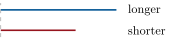
To compare two lengths, line them up with one end matched:
- put both objects side by side, starting from the same line;
- the one that reaches further is longer, the other is shorter;
- if both reach the same place, they are the same length.
Matching the start is the whole secret — comparing from crooked starts fools the eye.
Definition 6.2 (The centimeter)
To say how long, we measure with a ruler in centimeters (cm). Put the of the ruler at the start of the object, and read the number at its end.

6.2 The days of the week
Example 6.3 (The seven days)
The week has days, always in the same order:
After Sunday, Monday starts again. Yesterday is the day before, tomorrow the day after: if today is Wednesday, yesterday was Tuesday and tomorrow is Thursday.
6.3 Whole hours on the clock
Method 6.4 (Reading a whole hour)
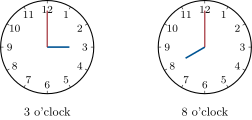
When the long hand points straight up to the , it is a whole hour: read the number the short hand points to. Short hand on the , long hand on the : it is o’clock.
6.4 Small coins
Example 6.5 (Making an amount)
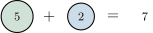
With coins of , and , many amounts can be made in several ways. To make :
The biggest coins first is usually the quickest way, using the fewest coins.
6.5 Exercises
Exercise 6.1 ★
Line up three pencils matched at one end. Which is the longest? Which is the shortest?
Solution
Solution of Exercise 6.1.
Answers depend on the pencils; the longest reaches furthest when they are matched at one end, the shortest reaches least far.
Exercise 6.2 ★
Measure with your ruler: the long side of this book; your little finger; a spoon. Answer in whole centimeters.
Solution
Solution of Exercise 6.2.
Answers vary; each is read by putting the ruler’s at the start of the object and reading the whole centimeter at its end.
Exercise 6.3 ★
Name the day: after Monday; before Sunday; two days after Friday.
Solution
Solution of Exercise 6.3.
After Monday: Tuesday. Before Sunday: Saturday. Two days after Friday: Sunday.
Exercise 6.4 ★
Today is Thursday. What day was yesterday? What day is tomorrow? What day is in three days?
Solution
Solution of Exercise 6.4.
Yesterday: Wednesday. Tomorrow: Friday. In three days: Sunday.
Exercise 6.5 ★
Draw a clock showing o’clock. Where is the short hand? Where is the long hand?
Solution
Solution of Exercise 6.5.
At o’clock the short hand points to the and the long hand points up to the .
Exercise 6.6 ★
Read the whole hour: short hand on , long hand on ; short hand on , long hand on .
Solution
Solution of Exercise 6.6.
Short hand on : o’clock. Short hand on : o’clock.
Exercise 6.7 ★
Make with coins of , and , in two different ways.
Solution
Solution of Exercise 6.7.
For , for instance or (other correct answers exist).
Exercise 6.8 ★
Leo has a coin and three coins. How much money has he altogether?
Solution
Solution of Exercise 6.8.
. Leo has .
Exercise 6.9 ★★
A sweet costs . Zoe pays with a coin. How much change does she get back? (Count up from to .)
Solution
Solution of Exercise 6.9.
From up to is : Zoe gets back.